
Best Plants for Raised Garden Beds: What to Grow and Where

Bloomcabin · Raised-bed guides
Best Plants for Raised Garden Beds: What to Grow and Where
Leaf lettuce, radishes, and parsley are good first candidates for a small salad bed. For a sunny bed with room for mature plants, consider bush beans, a compact pepper, or a compact tomato. The best plants for raised garden beds fit the site's light and rooting depth, leave room to work, and give you something you want to pick.
Start with a salad bed
Leaf lettuce, radishes, and parsley make a useful shortlist if their planting windows and growing needs match.
Measure soil, not just walls
For the best plants for raised garden beds with low walls, count the ground below only if roots can grow into it.
Draw plants at full size
Set aside space for cages and mature leaves before counting how many plants fit.
Price the whole setup
Measure the inside of the assembled bed and the intended fill depth before ordering soil.
A sunny square bed and a narrow strip along a fence don't need the same planting list. Start with what you want to eat or enjoy, then compare the site with the needs of particular varieties. That will tell you more than the size of a seedling at the store.
This guide matches the best plants for raised garden beds to the space they'll use at maturity. It also shows how to compare three open-bottom frames, estimate fill from inside measurements, and turn a crop shortlist into a planting plan.
01
Build a shortlist around what you want to harvest
The best plants for raised garden beds are ones you can picture harvesting or enjoying. If you make salads several times a week, a strip you can reach from the path may do more for you than a mixed bed of vegetables you rarely cook. If tomatoes are the reason you're starting a garden, give the tomato enough space first and decide what else fits afterward.
Use the shortlist below to compare varieties rather than treating each crop name as a guarantee. One tomato label may describe a plant you can fit beside a path; another may call for support and more room than you have. The best plants for raised garden beds are often decided at that level: compare mature size, light, and planting season before you buy.
- Salad and herbs: Shortlist leaf lettuce, radishes, and parsley. Check that their local planting windows overlap, then put the crop you pick most often along an easy-to-reach edge.
- Warm-season meals: Compare bush beans, a compact pepper, and a compact tomato for your sunniest suitable spot. Pick one as the main crop in a small bed; draw its mature spread and any support before adding neighbors.
- Roots or flowers: Try a short-rooted carrot variety where you can confirm enough usable soil depth. If flowers are the priority, look for a compact marigold whose light and spacing instructions fit the site.

02
Check actual sunlight and where roots can go
Watch where direct sun falls at different times on a clear day. Note shadows from fences, buildings, and trees, and check how easily you can bring water to each spot. If you're choosing the best plants for raised garden beds along two different edges, make a separate light note for each one. Compare that observation with the packet or plant tag instead of treating the whole yard as one growing site.
Next, separate wall height from fill depth and total rooting depth. Fill depth is the soil you actually put inside the frame. With an open base, roots may also have access to suitable ground below. Don't count that extra depth if you haven't checked what's underneath. Pavement, difficult drainage, or suspected contamination calls for a different site assessment, not just a taller frame.
Screen the best plants for raised garden beds with limited rooting depth by variety. For carrots, check the expected root length and growing guidance before buying seed. For lettuce or parsley, check the recommended soil depth rather than assuming either will work in a few inches of fill. If your site can't provide the soil a crop needs, change the crop or the setup before buying either.

03
Compare three frames against the same crop plan
Compare frames after you've narrowed down the best plants for raised garden beds at your site. These three Bloomcabin options arrive unassembled and have open bottoms. Their nominal measurements are for planning the space they occupy; verify clear inside dimensions and intended fill depth before drawing the final layout or buying soil.
Use the same cost checklist for all three: current frame price, growing medium, site and path preparation, watering equipment, plants, and any supports. For the best plants for raised garden beds that share a narrow footprint, the useful comparison is whether paying for more fill solves a real depth or access problem. A higher rim doesn't give a spreading crop more room across the bed.
- Narrow Aluminum Raised Garden Bed 39.37×19.69×3.94 in: The nominal footprint is 39.37 by 19.69 inches, with 3.94-inch walls, aluminum panels and corner posts, and one planting bay. It suits a reachable strip for greens or herbs when suitable ground below provides the needed rooting depth. Work from the long side; check that you can still reach the back after planting. Plan to monitor moisture along the strip and price the fill plus any preparation the underlying soil needs.
- Square Aluminum Raised Garden Bed 39.37×39.37×15.75 in: The nominal footprint is 39.37 inches square, with 15.75-inch walls, aluminum panels and corner posts, and one bay. It suits a gardener who can leave access on at least two opposite sides and wants a main crop with a separate picking edge. Check that mature plants and supports won't block access for watering and harvest. Price the measured fill and any cage or other crop support you need.
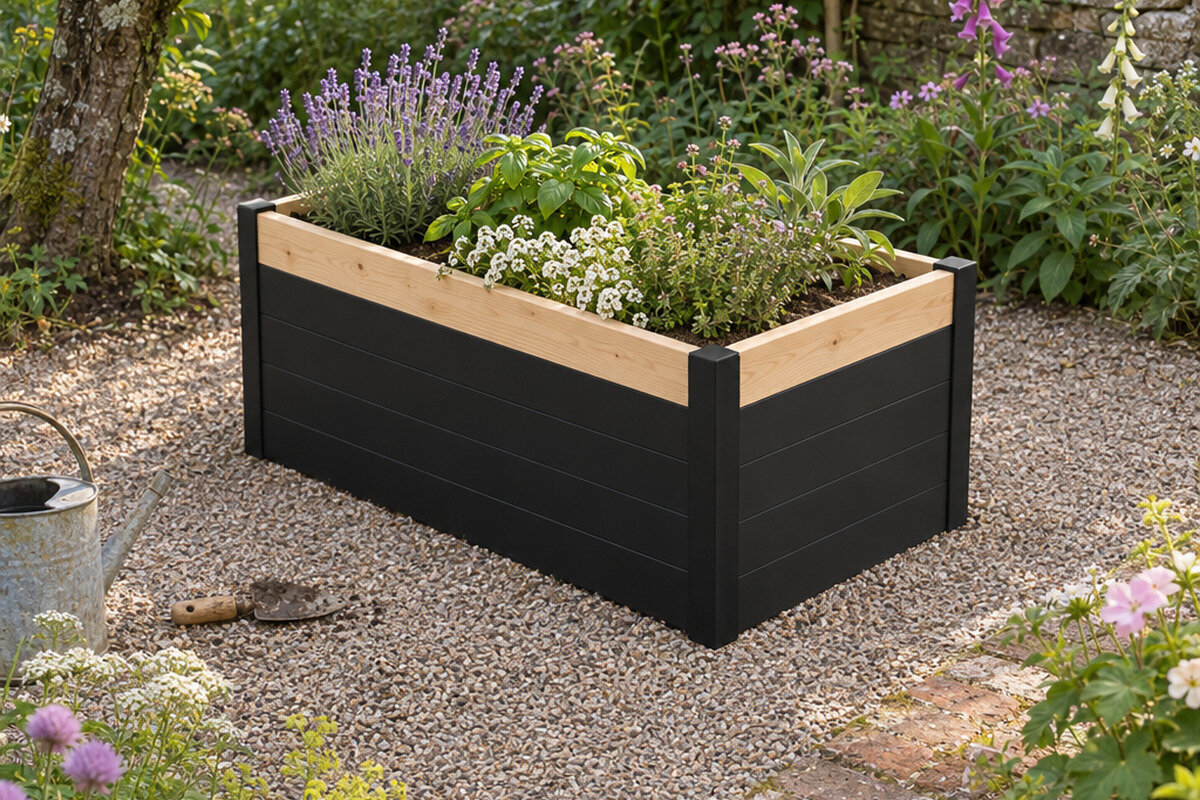
- Narrow Accoya Raised Garden Bed 39.37×19.69×23.62 in: The nominal footprint is 39.37 by 19.69 inches, with 23.62-inch walls and one bay. The top 3.94 inches of each wall are Accoya boards; the panels below and the corner posts are aluminum. It suits an edge planting where width is limited and a higher rim or more above-ground soil is wanted. Test your reach from the long side, check the care instructions for both materials, and price the intended fill before choosing the taller frame.

04
Test your reach and measure before filling
Mark the outside footprint on the ground before assembly. Stand where you would sow, thin seedlings, and pull a crop at harvest. Try the same reach with a bucket or watering can in hand. The best plants for raised garden beds along a fence should leave you able to reach the back from the open side. If you can't, move the frame away from the fence or change the planting plan.
Check what's under the footprint before committing to the location. If you suspect contamination, resolve the concern before using that site for food crops; don't assume that a layer of purchased soil makes it suitable. Assemble the frame using the model's instructions. Then measure the clear inside length and width and decide how deep the fill should be, allowing for any space you plan to leave below the rim.
Choose a growing medium intended for the setup, with local guidance if you're unsure about your soil or the site. For a simple rectangular bay, multiply its inside length, inside width, and planned fill depth in feet to estimate cubic feet. For a divided or irregular layout, estimate the fill for each separately measured bay and add the results; do not count paths or access notches. The best plants for raised garden beds should drive the depth decision before you place the soil order.

05
Work through a square-bed planting plan
Hypothetical example: A gardener wants leaf lettuce, radishes, and parsley for meals and can reach a square bed from two opposite sides. Assume the clear interior measures 36 by 36 inches and the gardener plans 12 inches of fill. These are example measurements, not a product specification. The estimated fill is 3 feet × 3 feet × 1 foot, or 9 cubic feet. The gardener verifies the crop guidance and the ground below before settling on that depth.
On paper, the gardener divides the square into three strips, each 12 by 36 inches. Lettuce goes along one working side for easy picking, radishes occupy the middle, and parsley goes by the other working side. The middle of the bed is 18 inches from either working edge. The strips are space allocations, not planting instructions: packet spacing determines how many plants fit. If the parsley needs more room, the gardener widens its strip or plants less rather than crowding the other crops.
The best plants for raised garden beds in this example change if the gardener would rather have a tomato than salad greens. Draw the tomato and its support first, then keep only the companion crops that still have the light and space they need. That's a more useful test of the best plants for raised garden beds than counting how many seedlings fit on planting day.

06
Plant by local timing, not by the shopping date
Once the layout is drawn, mark each crop as direct-sown or transplanted according to its instructions. Check your local extension planting guidance for the outdoor window and follow the packet or tag for planting depth and spacing. Some of the best plants for raised garden beds in one season won't be the right choices in another. If you raised tender seedlings indoors, acclimate them before leaving them outside.
Place any planned supports so you can still reach neighboring plants and so taller growth is less likely to shade crops that need more light. Label sown strips or patches; that makes it easier to see what came up and where to thin. If a crop can be sown in batches and its local window allows, leave part of its allocation empty for a later sowing rather than filling the whole strip at once.
Even the best plants for raised garden beds can be a poor buy at the wrong time. If the local planting window is still ahead, finish preparing the bed or choose a crop suited to current conditions instead of buying transplants just because they're available.

07
Use watering and harvest to improve the next round
Make your first watering checks in more than one spot. The edge near the path may not need water at the same time as the middle. Pay particular attention where seeds are germinating or transplants are settling in. Water where roots are growing, consider mulch where appropriate, and use soil-test results and crop guidance to decide whether to feed. If plants decline, identify the problem before treating it.
At harvest, notice which plants you reach for and which you reach around. A crop can grow well and still be a poor fit if it spills into the path or blocks access to another plant. The best plants for raised garden beds you visit daily may be the greens and herbs you pick in small amounts; give those the most convenient edge if that's how you actually cook.
Before replanting, record one crop worth repeating and one layout change worth making. Check the local planting window before filling a vacated strip. If last season's best plants for raised garden beds took up more room than planned, start by giving them that space on paper rather than adding another frame.

Questions readers ask
What are the best plants for raised garden beds if I only have room for one?
If you like salads, start with leaf lettuce, radishes, and a small patch of parsley, provided local guidance puts them in the same planting window. If you would rather harvest tomatoes, start with one compact variety that fits and give it the space and support its label specifies. Don't assume both plans will fit at once.
What are the best plants for raised garden beds that get afternoon shade?
Put leaf lettuce and parsley on your shortlist, then compare the site's actual hours of direct sun with variety instructions and local guidance. Afternoon shade alone doesn't tell you how much light a plant will get. If you're deciding between two spots, reserve the sunnier one for crops whose labels call for more direct sun.
Can I use an open-bottom frame on a patio?
The frames compared here are open to prepared ground and have no floor panel. Don't assume they are suitable for a patio. For a hard surface, verify that your chosen planter is intended for that use and that you have accounted for drainage, the filled weight, and what the surface can support.
Start with the crop you most want to grow
Choose one main crop, verify its local planting window and space needs, and measure before buying the frame or soil. The best plants for raised garden beds are the ones you can reach, care for, and look forward to harvesting.
Find a raised bed for your plan
Compare layouts and check the dimensions on the product page.
