
Best Raised Bed Kits: How to Choose, Set Up, and Plant One

Bloomcabin · Raised-bed guides
Best Raised Bed Kits: How to Choose, Set Up, and Plant One
The best raised bed kits are a narrow strip for one-sided access, a square bay for a small plot you can reach from two sides, or a divided kit when you need separate planting areas. Choose the layout first, then check growing depth and price the full setup before ordering.
Measure the working space
The best raised bed kits leave enough room to work from the path, not just enough room for the frame.
Check the growing depth
Compare wall height, planned fill depth, and usable soil beneath the frame as three separate things.
Budget for the full setup
Price the frame, soil, site preparation, and supplies together before ordering.
Make a crop plan
Choose crops and planting times using seed instructions and local growing guidance.
Start with the place you plan to garden, not the product photo. A low aluminum strip and a tall Accoya-topped frame can occupy the same patch of ground, yet call for different amounts of soil and put the working edge at very different heights.
This guide compares the best raised bed kits for different yard layouts using Bloomcabin's listed US specifications, not hands-on testing. Use the comparisons to narrow your choices, then confirm the exact model's instructions, interior measurements, and current costs before buying.
01
Rule out beds that don't fit your site
The best raised bed kits for your yard are the ones that pass three checks: they fit the space you can work from, they suit the ground beneath them, and they give your chosen crops enough usable soil. Start with a short crop list. Check the light and water access at the actual site before deciding between a narrow strip beside a fence and a square bed in the open.
Mark the nominal footprint with string, then mark the paths you expect to use. Walk the route with your watering can, cart, or other equipment. Try reaching where you would sow, weed, and harvest without stepping into the bed. If the only good approach is from one side, the best raised bed kits to shortlist are the narrow ones, even when a wider frame technically fits.
All eight frames compared here are supplied unassembled and have no floor panel. They sit open to prepared ground. If the site drains poorly or you suspect contamination, get local guidance before using it. Even the best raised bed kits cannot make questionable ground suitable simply by covering it with more soil.
- Reject a layout if you cannot comfortably reach the middle or far edge from the planned paths.
- Reject an open-bottom frame for a site where you need a self-contained planter.

02
Compare four single-bay kits by reach and height
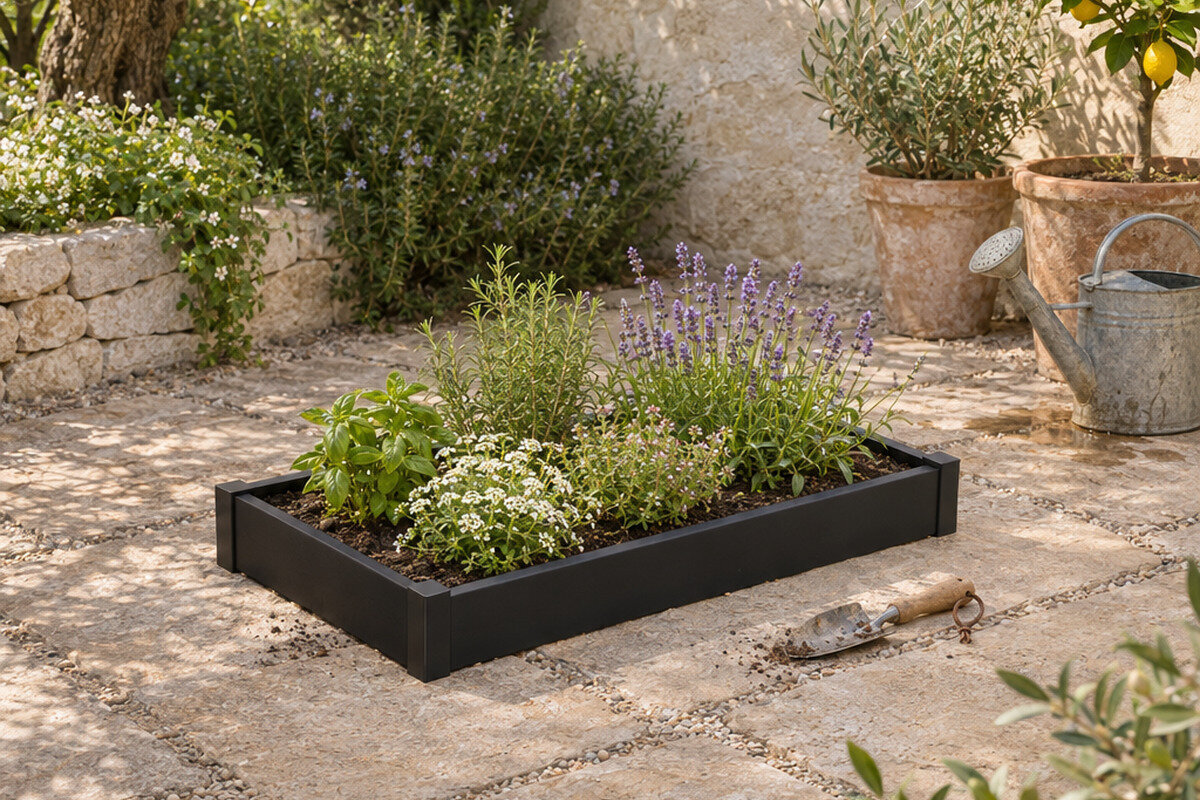
For a short garden edge, the best raised bed kits to compare first share a nominal 39.37 × 19.69-inch footprint and 5.38 square feet of nominal planting area. The Narrow Aluminum Raised Garden Bed has aluminum walls and corner posts and a 3.94-inch wall. Choose it when you mainly want to define an herb or salad strip and can rely on suitable soil below. The Narrow Accoya Raised Garden Bed has 23.62-inch walls: aluminum below, Accoya wood in the top 3.94 inches, and aluminum corner posts. Choose it if you want the taller working edge or room for more fill, and budget for the wood-top care specified for that model.
Where you can work from two opposite sides, the Square Aluminum Raised Garden Bed is a better starting point. It measures 39.37 × 39.37 inches nominally, gives 10.76 square feet of nominal planting area, and has 15.75-inch aluminum walls and aluminum corner posts. It's one of the best raised bed kits to consider for a single, undivided planting area: you can work toward the center from either side instead of reaching all the way across.
For a longer one-sided site, the Narrow Aluminum Raised Garden Bed measuring 78.74 × 19.69 × 23.62 inches gives the same 10.76 square feet of nominal planting area as the square, but in a shallower reach. Its aluminum long walls use two sections joined by T connectors. Between these two, the best raised bed kits aren't decided by planting area: compare the path layout, the additional wall joints, and the cost of filling to the depth you actually intend. A higher wall gives you room for more fill; it doesn't tell you how deep roots can grow.

03
Decide whether separate bays earn their space
If you want two distinct planting plans in one frame, the best raised bed kits to compare are the double and split double. Each is nominally 78.74 × 39.37 inches with two 39.37-inch-square bays, 21.53 square feet of nominal planting area, and aluminum panels, posts, and T connectors. The Double Aluminum Raised Garden Bed has 11.81-inch walls in both bays. The Split Double Aluminum Raised Garden Bed has one 11.81-inch bay and one 31.5-inch bay. Plan to approach from both long sides. Choose the split only if a taller working edge or more room for fill on one side is worth the potential soil cost and the need to plan two fill depths.
For five separate bays, the best raised bed kits on this shortlist are the two U-shaped configurations. Each has a nominal footprint of 118.11 × 78.74 inches, 53.82 square feet of nominal planting area, and a nominal 39.37 × 39.37-inch access notch. Both use aluminum walls, posts, T connectors, and cross connectors. The standard U has 11.81-inch walls throughout. The Framed U raises both rear corners to 23.62 inches and keeps the other three bays at 11.81 inches. Pick the standard version if you don't need the extra wall height at the corners; price the Framed U using separate fill estimates for its tall and low bays.
Don't count the notch as planting area or assume it gives you access to every corner. Mark outside paths too, and try turning in the notch with the tools you use. Even the best raised bed kits become awkward if you can't reach all five bays once the crops mature.

04
Compare the cost of getting each bed ready to plant
Compare the best raised bed kits using a ready-to-plant total. Start with the current kit price and any applicable shipping or pickup cost. Add growing medium, any site preparation you need, and tools you don't already own. List optional crop supports or irrigation separately so you can see whether the difference comes from the kit or from your planting plan.
Soil is the line item you can calculate before choosing, provided you have actual interior measurements. Multiply the inside length by the inside width and the planned fill depth for each rectangular bay. Use feet for all three measurements to get cubic feet, or divide a result in cubic inches by 1,728. For bulk quantities, divide cubic feet by 27 to get cubic yards. The best raised bed kits for a tight budget are easier to spot once you price the intended fill rather than treating the outer dimensions and full wall height as the soil order.
Give each finalist the same maintenance check. Can you reach its corners and joints to inspect them? How many bays will you need to check and water? What care does the manufacturer specify for the aluminum parts or the Accoya top? The best raised bed kits for your schedule are the ones you can keep up with; a material label alone doesn't establish a service life or a care schedule.
- Use the same cost categories for each finalist, and mark unknown charges as unknown rather than zero.
- Confirm current US product details, included parts, tools, and any applicable shipping charges before you buy.

05
Worked example: same planting area, different fit
Hypothetical worked example: A gardener has a 9 × 5-foot strip of suitable garden ground beside a fence. The crops are salad greens and herbs suited to the site's light and season. The best raised bed kits on this gardener's initial shortlist are the long narrow aluminum bed and the square aluminum bed. Both list 10.76 square feet of nominal planting area, so the gardener tests the paths rather than using area as the tiebreaker.
The gardener sets aside a 2.5-foot working path along the open side and 1 foot at each end for this particular layout. The long narrow frame is about 6.56 × 1.64 feet nominally. With the reserved space, the plan uses about 8.56 feet of length and 4.14 feet of width. The square frame is about 3.28 feet wide; even one 2.5-foot path would bring it to 5.78 feet. Of the two best raised bed kits on this shortlist, only the long narrow model fits the planned route. These clearances are the gardener's assumptions, not universal recommendations.
For a sample soil budget, suppose the assembled long narrow bed measures 78 × 19 inches inside and the gardener plans 20 inches of fill after checking the model instructions and crop needs. These are hypothetical measurements, not product specifications. The calculation is 78 × 19 × 20 = 29,640 cubic inches, or about 17.2 cubic feet. Use the actual interior measurements and fill plan before ordering.

06
Assemble and check the frame before filling
Even the best raised bed kits go together more predictably when you leave room to work. Read the instructions for your exact model before preparing the ground or opening the soil bags. Match panels, posts, dividers, and connectors against the parts list as applicable. Set out the pieces by bay if you have a divided or stepped layout. Use the specified tools and assembly sequence rather than copying the gallery photo.
Before filling, check the footprint again, confirm that the site is prepared as directed, and verify the frame and any dividers are assembled correctly. Walk both the permanent paths and the access notch if there is one. Move the empty frame if the location needs adjusting, following the manufacturer's directions. Measure the actual interior of each bay at this point if you couldn't confirm it before purchase.
The best raised bed kits for an in-ground site still depend on what's below them. Wall height is the height of the frame; fill depth is how much medium you plan to add; total rooting depth also depends on whether roots can use the soil below. Select the growing medium with the site and crops in mind, and consult local guidance if you are unsure about the underlying soil.

07
Plant for the season and make care easy
The best raised bed kits make it easy to look after crops you actually want to grow. On paper, assign each crop a space based on its mature size, and put taller plants where they won't shade shorter neighbors that need the light. In a divided bed, give each bay a job you can manage, such as sowing greens in one and setting out herb transplants in the other. Check seed packets and local extension guidance for timing and whether to sow or transplant.
The best raised bed kits for your routine let you check the soil without leaning on the frame or stepping into a bay. Raised beds can dry faster than surrounding ground, so judge watering by soil moisture and crop stage. Water near the roots and consider mulch to limit moisture loss and weeds. If growth looks poor, investigate before treating or feeding; use soil-test and crop guidance to decide whether fertilizer is needed.

Questions readers ask
What are the best raised bed kits if I garden from one side?
Start with a 19.69-inch-wide narrow model. Choose its length and height by marking out the footprint and trying to reach the far edge from your working position. A low strip over good garden soil and a taller strip you plan to fill much deeper are different projects, even if they take up the same ground space.
Are the best raised bed kits for a patio the same as for a yard?
No. The Bloomcabin models compared here are open-bottom frames intended for prepared ground, not freestanding containers with a floor. For a patio, look for a design documented for that surface, with a way to contain the growing medium and manage drainage.
Should I order the frame and soil at the same time?
Only if you can confirm the interior dimensions and planned fill depth first. Otherwise, get the measurements once the frame is assembled. For divided or stepped models, calculate each bay separately, then add the volumes before converting to bag quantities or cubic yards.
Make the final choice at the site
Before ordering, mark out your finalists and try reaching the farthest planting spot. The best raised bed kits will pass that test, suit the ground underneath, and fit your budget once the soil and other supplies are included.
Find a raised bed for your plan
Compare layouts and check the dimensions on the product page.
