
Black Raised Beds: How to Choose a Finish That Fits Your Garden

Bloomcabin · Raised-bed guides
Black Raised Beds: How to Choose a Finish That Fits Your Garden
Black raised beds are a good fit when you can verify what the walls are made of, how the black finish is applied, and whether the soil-facing surfaces suit what you plan to grow. Treat the color as a design choice, not proof of material, coating, or durability.
Separate color from material
Black raised beds can have different substrates, finishes, and care requirements even when they look alike.
Check the inside surface
Ask what covers the soil-facing walls and whether that surface is intended for your use.
Check the actual appearance
Compare sheen and visible hardware in the light where the bed will sit.
Plan for upkeep
Get the preparation, cleaning, and touch-up instructions before buying or repainting.
If you’re comparing black raised beds to match a fence or simply prefer a dark frame, start by comparing the finish separately from the wall material. Painted wood and coated aluminum can look similar from the path, yet the questions you need to ask about cleaning, repairs, and direct contact with growing mix can be different.
Bloomcabin’s US raised garden bed range provides examples of aluminum frames and a model with Accoya upper boards. The specifications discussed here do not confirm a black finish on those models. Use their documented materials and dimensions to compare layouts, then confirm the color and coating for the exact option before buying.
01
Decide which parts need to look black
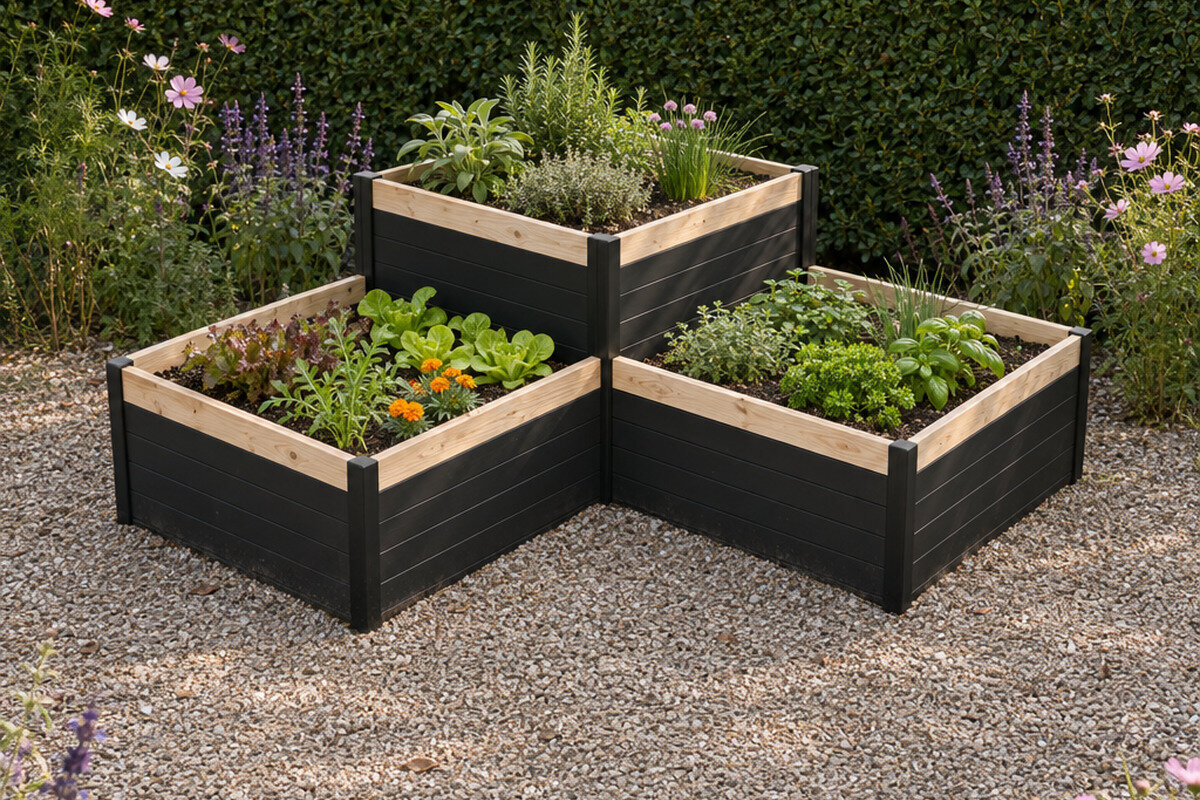
Start by deciding which parts need to be black. From across the yard, the broad wall panels may be all you see. Beside a path, the top edge, posts, connectors, and exposed fasteners may matter just as much. Some shoppers want the whole frame to read as one color; others are happy with black panels and a contrasting rim. When comparing black raised beds, ask which pieces are included in the color option rather than assuming it applies to every visible part.
Compare sheen as well as the color name. If a finish sample is available, hold it horizontally where the rim will sit and vertically where a wall will face the path. Look at it in direct light and shade, then step back to your usual viewing distance. If you want the bed to sit beside a black fence, compare the two together. You may prefer a deliberate contrast to two finishes that look almost, but not quite, alike.
Catalog photos can help you compare the shapes of black raised beds, but they do not establish an exact color match or identify a coating. If you cannot get a sample, ask whether the listing specifies a finish name or code and whether it applies to the panels, posts, and trim. A written answer is more useful than trying to match a product photo to a photo of your yard.

02
Find out what is beneath the finish
Build a short checklist for each candidate. For wood, distinguish the species from any treatment and from the visible stain or paint. For metal, distinguish the underlying material from whatever gives it its color. These are separate entries: two black raised beds can look alike while calling for different fasteners, cleaners, and touch-up products.
The Narrow Accoya Raised Garden Bed 39.37×19.69×23.62 in illustrates why it helps to read the wall specification from top to bottom. It has Accoya boards in the upper 3.94 inches of all four walls, aluminum panels below, and aluminum corner posts. The Accoya boards are 0.79 inches thick. That thickness describes the boards, not the aluminum panels. And the materials description does not establish the color or treatment of either part. When comparing this layout with black raised beds, ask separately how the wood and aluminum are finished and cared for.
- Identify the wood species or the metal type and grade where applicable. For mixed construction, note which material is used in each part.
- Verify the wall thickness, supplied or specified fasteners, and any model-specific instructions for supports and joints.
- Record the finish or treatment separately for each material. Mark anything the seller cannot verify as unknown rather than assuming it is untreated or uncoated.

03
Verify the soil-facing finish, not just the visible one
For black raised beds intended for vegetables or herbs, ask about the surfaces that will actually meet the growing mix. Is the inside finished the same way as the outside? What does the manufacturer say about sustained contact with moist soil on that face? If the instructions specify a barrier, find out where it goes and how it is meant to work with the bed’s drainage. A description of the visible exterior does not answer any of those questions.
An outdoor-use claim is not the same as documentation for the soil-facing surface of a bed used for food crops. You do not need to infer suitability from a coating name or from a different product made of the same material. Ask for the use and care instructions for the exact model and finish. If black raised beds on your shortlist have incomplete documentation, mark those choices as unverified for your intended use, not necessarily unsafe. Choose a documented alternative if the answer matters and you cannot get it.
Apply the same distinction when buying a coating separately. A product you can use on the outer face is not automatically suitable for the inner face or top edge, where you might spill growing mix. Decide which surfaces you need to finish before buying paint, primer, or sealant, and check the instructions against that plan.

04
Prepare the surface before changing its color
If you plan to make existing beds black, identify what is already on them. Bare wood, an existing painted surface, and factory-finished aluminum should not be treated as the same painting job. Use a coating system whose instructions name the substrate and cover the existing finish, if any. Check whether the bed maker allows refinishing, especially around joints or on surfaces that will contact the growing mix.
For black raised beds you are refinishing yourself, start with an inspection. Look for dirt, loose coating, damage around fasteners, and areas that stay damp. Fix a loose joint or damaged panel according to the model’s instructions before dealing with its appearance. Clean and dry the surface as directed. Sand, scuff, strip, or prime only if the applicable instructions call for it; do not assume a factory finish needs to be removed. If an older coating cannot be identified, do not sand or strip it by guesswork.
Before committing to the whole job, check the listed application conditions and cure time, including when the finish can be exposed to water or soil. If the instructions allow it, test the approved system on an offcut with the same surface or in an inconspicuous spot. Judge color and sheen after it has dried as directed. A color test can help you decide whether you like the result; it does not establish whether black raised beds made with that coating are suitable for soil contact.

05
Check that the frame fits the ground and the crop
Once you have a finish you can verify, check whether the frame belongs on your site. The Bloomcabin models shown are open to prepared ground and have no floor panel. An open-bottom frame lets roots reach suitable soil beneath it, so wall height is not necessarily total rooting depth. On paving, there is no underlying soil for roots to enter. If you are shopping for black raised beds for a patio, look for instructions that address that placement, drainage, soil containment, and support when filled.
When comparing black raised beds for a garden edge, measure the space for the frame separately from the space you need to tend it. Use the nominal footprint to screen candidates, confirm actual outside measurements if the fit is tight, and ask for internal measurements if planting space is the deciding factor. A stated planting area is not an aisle allowance. Mark the proposed outline on the ground and check whether you can reach the middle from the side that will stay open.
Before assembling an open-bottom bed, check the underlying soil and look for poor drainage or other site concerns. A frame does not resolve those problems by itself. Follow the model’s instructions for preparing the base and joining the parts. If you need a low frame to act like a deep container, do not improvise a floor or add soil above the design height to make up the difference.

06
Buy a finish you are willing to maintain
Compare the upkeep of black raised beds before you pick a finish. Ask what can be used to remove dried soil or water marks, whether touching up a small blemish is allowed, and whether a matching product is available. On a mixed-material frame, there may be separate instructions for the rim and panels. Keep the finish name and care sheet with the assembly guide so you can identify what needs attention later.
Decide how much visible wear you are willing to live with. If you set tools down on the rim or move pots beside the bed, look closely at that edge when cleaning. A mark that wipes away, a scratch in the finish, and movement at a fastener are different problems. Start with the permitted cleaning method. If the surface is damaged, find out whether touch-up is appropriate; if a joint moves, refer to the assembly instructions rather than covering it with paint.
Do not budget for annual repainting or assume black raised beds are maintenance-free. The right care depends on the actual finish and the condition you find. Inspect reachable edges and joints as part of normal garden cleanup, and address chips or loose parts using the model’s instructions. If those instructions are unavailable, ask for the approved approach before trying a harsher cleaner or a color-matched repair.

07
Worked example: a narrow salad bed beside a black gate
Hypothetical example: A gardener comparing black raised beds for salad greens has a 46-by-24-inch space on prepared ground, with a separate path along one long side. Assume the ground is suitable for rooting and the gardener wants the frame to match a matte black gate. The Narrow Aluminum Raised Garden Bed 39.37×19.69×3.94 in is a candidate for the layout. Its nominal footprint leaves 6.63 inches of total spare length and 4.31 inches of total spare width in the measured space. Those are margins around the nominal frame, not aisle widths or internal planting dimensions.
The listed wall height is 3.94 inches, so the gardener does not count on the frame alone to provide all the rooting depth. Instead, they check whether the underlying ground and usable planting area suit the greens they want to grow, using seed-packet spacing and local guidance. They also confirm the actual outside fit and test their reach from the path before deciding that the layout works.
Then comes the deciding question: does this layout come with the finish the gardener wants, and what is documented for the soil-facing surface? The listed dimensions and aluminum construction answer neither question. If the seller can verify the color but not the intended use of the inside finish, the gardener keeps looking. That is how to compare black raised beds without letting a good dimensional fit make the finish decision for you.

Questions readers ask
Does Bloomcabin list any of these models as black raised beds?
The specifications discussed here identify aluminum components and, on the fusion model, Accoya upper boards. They do not confirm a black finish. If a listing offers a color choice, verify the exact option and which parts it covers before ordering.
Can black raised beds sit directly on a patio?
Only choose a bed whose instructions support that placement. The Bloomcabin frames described here are open to prepared ground and have no floor panel. For a patio, confirm how the chosen model contains growing mix, drains, and is supported when filled. Do not assume a liner can substitute for an approved base.
Can I use leftover exterior paint on black raised beds?
Only if the paint instructions support the exact substrate, existing finish, and exposure you intend, and the bed maker permits recoating. Exterior use alone does not establish suitability on a soil-facing surface. If you cannot identify an old coating or confirm a compatible system, do not guess.
Make color a requirement, not a shortcut
Shortlist black raised beds by appearance, but buy only after you’ve verified the material, the finish on each relevant surface, and the care it calls for. If the finish or its suitability for your intended use remains unverified, choose a better-documented option rather than planning to fix it after delivery.
Find a raised bed for your plan
Compare layouts and check the dimensions on the product page.
