
Block Flower Bed: How to Choose the Right Blocks

Bloomcabin · Raised-bed guides
Block Flower Bed: How to Choose the Right Blocks
A block flower bed can work if the exact units are documented for the job: edging at ground level or holding soil above it. Verify the material, finish, and installation instructions first, then check that the bed will drain and leave enough room for your flowers.
Identify the block
Get the exact block material, dimensions, finish, and product instructions before buying.
Define the wall’s job
An edging unit may suit a border without being documented to hold raised soil.
Measure what you can use
Measure both the planting space inside the walls and the working space outside them.
Compare like for like
A block flower bed and an open-bottom aluminum frame require different assembly instructions.
When someone offers you blocks for a block flower bed, ask for the product name and instructions before you decide how to use them. “Block” describes the form, not the material grade, coating, thickness, or joining method. A unit meant to edge a lawn is not automatically a unit you can stack to raise the soil level.
Start with one job for your block flower bed: mark the edge of a planting area or enclose a raised one. Then compare the instructions with the actual site. That gives you a way to choose between new landscape units, leftover blocks, and a prefabricated frame without assuming that look-alike materials work the same way.
01
Identify the unit before you judge the material
At the store or salvage yard, start with the label, not the display. A block flower bed could use landscape edging units, a landscape-wall system, or masonry units sold for another purpose. The labels “garden block,” “concrete block,” and “cinder block” are not enough to tell you which assembly you are looking at or what it is intended to do. Ask for a spec sheet and installation guide that match the exact unit being offered.
Read the two documents together. A material description can identify a block without telling you whether the maker intends it to hold soil at your proposed height. An assembly sketch can show a joint without answering what finish is on a salvaged piece. For a block flower bed, both questions matter. If you cannot match the paperwork to the units in front of you, keep looking rather than treating an unknown as a confirmed fit.
- Identity: Record the maker, product name or code, material or grade, and whether the unit is solid, hollow, or shaped to interlock. If you are considering timber blocks, ask for the wood species and any treatment.
- Surface and condition: Ask about coatings, sealers, treatment, and intended contact with planting soil. For secondhand blocks, check their history and look for residues, chips, or cracks. Appearance does not establish what a unit contains.
- Dimensions and connections: Verify actual thickness, the height of each course, and which joints, fasteners, or other components the instructions call for. Ask whether corners or ends need different pieces.

02
Decide whether the wall is edging or holding soil
Sketch a side view before choosing the units. Mark the existing ground on both sides and draw the intended finished soil line. If the block flower bed simply separates flowers from turf at about the same level, look for units documented for edging. If the soil will sit higher on the flower side, the wall has to hold that difference in grade. Check the instructions for that use rather than assuming you can add courses to an edging product.
The shape of the unit matters as much as its label. Check how adjoining pieces meet, whether the system can turn the corners you drew, and how much a cap or projecting face would add to the footprint. For a block flower bed beside a path, measure clearance to the outermost face, not to an outline drawn through the middle of the wall. If a curved layout is important, confirm that the units are intended for the curve rather than forcing gaps between straight pieces.
Next, check whether the bed fits the way you work. Mark the outside edges and any path with string, then stand where you would weed or deadhead and reach toward the center. If one side borders a fence, do the reach check from the accessible side only. In the same visit, check light for the flowers you want and your route to a water source. Use local planting guidance and plant labels or seed packets for timing and plant requirements.

03
Check the first course and the water’s exit
Before assembling a block flower bed, read the guide through to the step when soil is added. Check how it calls for preparing and leveling the base, arranging the first course, making corners, and joining any additional courses. Dry stacking, mortar, and adhesive are not interchangeable choices. Use the stated method and compatible components. If the instructions show a level site and yours drops at one corner, ask for a detail that covers that condition or get qualified help before proceeding.
Where the instructions allow, lay out the first course before making permanent joints. Check the inside opening, path clearance, and fit at each corner. This is the time to spot a unit that would need a cut the instructions do not allow, or a bed that will be too wide to tend from the path. If the drawings call for a different end unit or cap at a corner, count it separately when making your materials list.
Resolve drainage before filling the block flower bed. Over prepared ground, check how the underlying soil handles water and where surface runoff goes after rain. The raised border does not fix a wet site or make questionable soil safe. On pavement there is no soil below the bed to receive water, so verify that the assembly is appropriate for that surface and that water has somewhere to exit without pooling on the path or running toward a building. Do not count open joints or hollow cores as drains unless the instructions identify them as part of the drainage system.

04
Calculate what the walls leave for flowers
Measure a block flower bed across its inner faces to find the space available for planting. Keep that measurement separate from the overall footprint and the working gap around the bed. Measure vertically from the intended soil surface to the bottom of the growing medium, not from the top of a cap to the ground. On an open-bottom bed, suitable soil beneath the enclosure can add rooting space; next to a paved walk, distinguish soil under the bed from pavement alongside it.
Hypothetical example: A gardener has room for a block flower bed with an outside footprint of 8 feet by 4 feet, after setting aside room to work along both long sides. Assume rectangular walls with straight inside faces and no inward-projecting caps. A 6-inch-thick wall on each side takes 1 foot off each overall dimension, leaving a 7-by-3-foot planting area, or 21 square feet. A 12-inch-thick wall takes 2 feet off each dimension, leaving 6 by 2 feet, or 12 square feet.
That is a difference of 9 square feet within the same footprint. Now assume the thinner blocks are salvaged and unidentified, while the thicker system is documented for the intended height and site. The extra planting area does not make the salvaged units a sound choice. If 12 square feet is too little for the flower plan, look for a documented thinner system or change the layout. These dimensions illustrate the trade-off; they are not specifications or recommendations for a particular block.

05
Plan for inspections and repairs before buying
Before buying blocks, ask what maintenance the supplier calls for and which replacement units or compatible repair materials you would need. If repeated freezing and thawing is a concern at your site, ask whether the manufacturer addresses that exposure for the exact unit and finish. Do not assume a coating can substitute for that information. Ask before using a cleaner, sealer, or paint, especially when the treated surface would be next to planting soil.
Once the block flower bed is filled, look along the wall after heavy rain and during routine garden care. Compare any new leaning, joint gaps, loose caps, or washed-out areas with the installation guide. Check for pooling and follow the water’s route before assuming a crack is only cosmetic or a wet spot calls for a new opening through the wall. If part of the wall has shifted, keep people from leaning or sitting on it while you determine how it should be repaired.
Keep the flowers’ watering needs separate from the wall inspection. Check moisture in the growing medium near the plants rather than judging by the color of the blocks or watering on a fixed schedule. A dry surface does not tell you what is happening farther down. If plants are struggling while water also collects beside the wall, check both the root zone and the drainage route before changing how often you water.

06
Compare a documented frame on the same terms
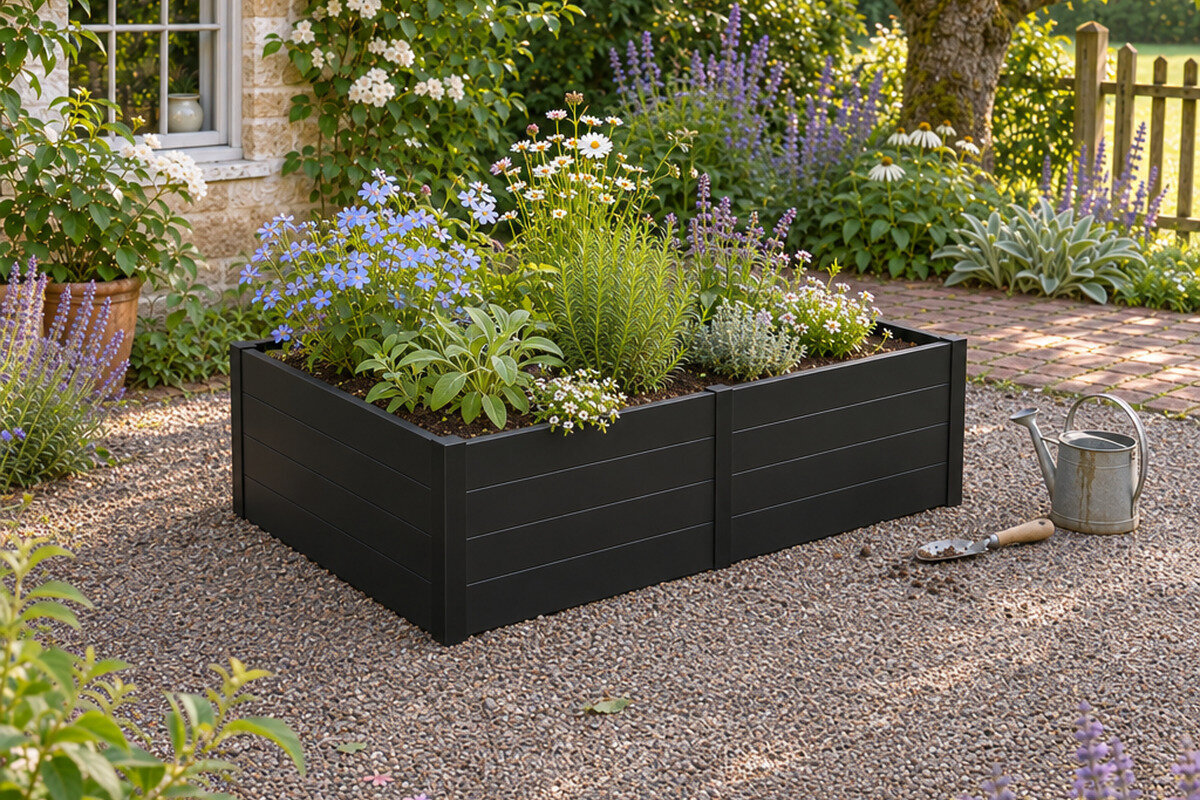
Compare a block flower bed with a framed alternative if thick walls would take too much of the planting space, or if the block supplier cannot document the proposed assembly. Bloomcabin’s listed frames use aluminum wall panels, with Accoya boards at the top of all four walls on the listed fusion model. They are not masonry-block beds. Use the same comparison criteria for both approaches: material and finish, required components, outside footprint, usable inside dimensions, site preparation, and drainage.
For example, the Square Aluminum Raised Garden Bed 39.37×39.37×15.75 in has a nominal footprint of 39.37 × 39.37 inches, 15.75-inch walls, one planting compartment, and a listed planting area of 10.76 square feet. Its wall panels and corner posts are aluminum. The bed comes unassembled and is open to prepared ground, with no floor panel. Allow access from at least two opposite sides. The nominal footprint describes the frame, not the space needed to work around it.
When comparing it with your block flower bed sketch, use the listed area to screen for size, then verify actual inside clearance if a particular spacing or fit matters. Check the assembly instructions for the frame itself; there is no reason to transfer a block base or joint detail to it. The product specifications identify the construction, but they do not establish suitability for an improvised installation on a hard surface.

07
Make the buy, redesign, or stop decision
Make three decisions before paying for a block flower bed. First, can you identify the exact units and account for their finish and condition? Second, do the instructions cover the job you drew, including the soil height, base, joints, and corners? Third, does the resulting bed leave enough room for the flowers, enough access to tend them, and a workable route for water? Write down the missing answer if any of those checks fails.
If the paperwork is missing, ask for it before ordering. If it covers edging only, either keep the bed at ground level or choose a system documented to hold raised soil. If assembly is suitable but the inside is too narrow, change the footprint or the material rather than squeezing plants closer together. If drainage is still unresolved, postpone filling. Each fix addresses a different problem; a larger bed or a better-looking block cannot make up for missing installation guidance.
Once the checks are satisfied, use the approved layout to list the units, special pieces, and joining materials. Estimate fill from the actual space you intend to fill, not the outside dimensions. Keep the instructions and product ID so you can identify matching parts or check an approved repair later.

Questions readers ask
Can I use leftover blocks for a block flower bed?
Consider them only if you can verify what they are, what finishes or residues are present, and whether their condition and documented use fit the job. A matching shape or color does not identify a salvaged unit. If records are missing, choose a traceable option rather than relying on a coating to make unknown material suitable.
Can I dry-stack a block flower bed instead of using mortar?
Only if the instructions for the exact units cover dry stacking for the layout and use you intend. Directions for a single row of edging do not establish that several courses can hold raised soil. Check the base, corners, joints, and permitted height together; do not substitute a joining method just because the pieces fit.
Will a taller block flower bed give my flowers deeper roots?
Not necessarily. Check the actual depth of growing medium in the bed and whether roots can continue into suitable soil below it. Over pavement, there is no underlying soil to count. Choose the bed for the flowers’ rooting needs and the site’s drainage, not wall height alone.
Choose the block you can verify
The right block flower bed starts with identifiable units and instructions that match the site. If you cannot verify the material or the wall’s intended use, choose a documented alternative before spending money on blocks, base materials, or soil.
Find a raised bed for your plan
Compare layouts and check the dimensions on the product page.
