
Buying an Outdoor Sauna: A First-Time Buyer's Guide
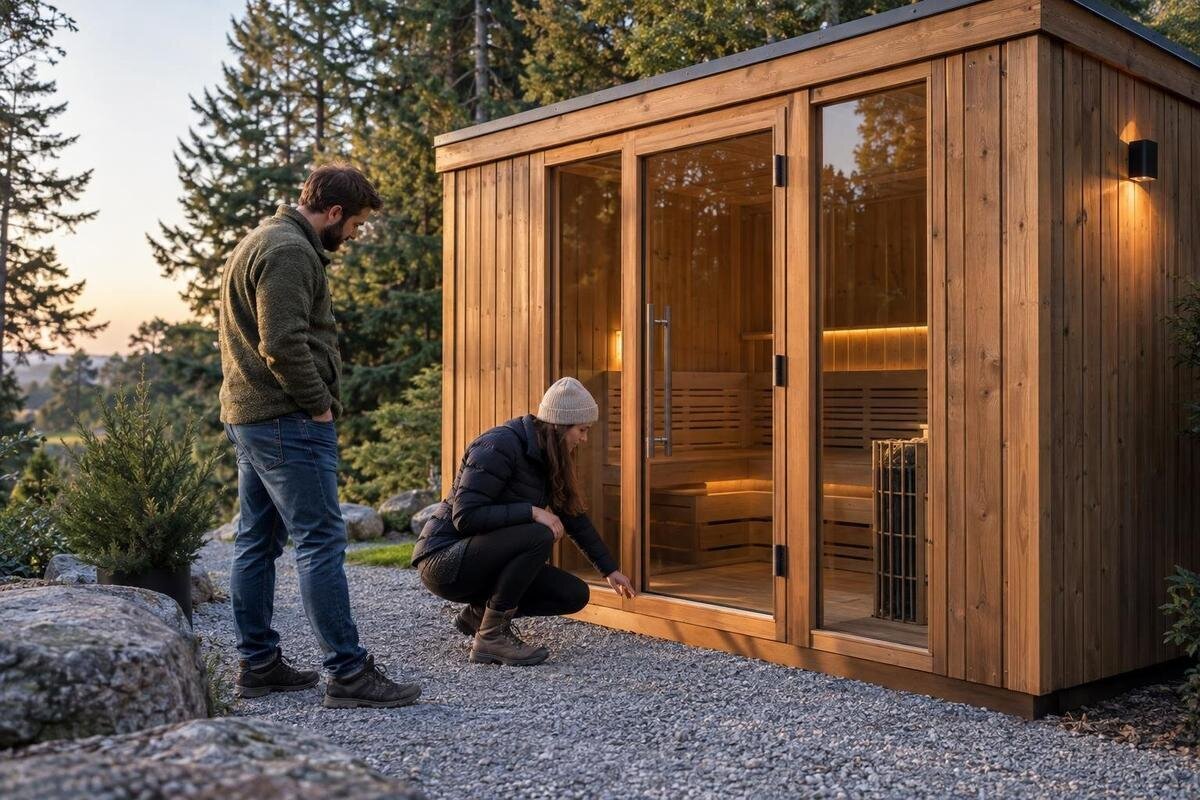
OUTDOOR SAUNA BUYING GUIDE
Buying an outdoor sauna means balancing the room you want with what your property can accommodate. Capacity, heater choice, weather exposure, installation work, and ongoing care all affect whether a cabin will suit your routine. For a first-time buyer, a photo or headline capacity alone leaves important questions unanswered. Start by deciding how you expect to use it, then check its fit against the site and the utilities available. The aim is not to choose the largest or most feature-rich option, but a sauna whose space, heating approach, and ownership needs make sense together.
Start with who will use the sauna
Begin with how the sauna will actually be used: how many people are likely to sit inside at once, whether they usually go in together, and how often they will use it. A listed capacity is a useful first filter, but it does not show how comfortably people can sit, whether there is enough bench length for everyone, or how the interior feels when full. Decide whether the usual group is one or two people, a family, or a few friends. If that number varies, size for an ordinary visit rather than a rare maximum. If people tend to take turns, a lower stated capacity may still suit your routine.
Think about the whole visit, not only the sauna room. Users may want somewhere to leave shoes, towels, and outdoor layers, plus a convenient route between the house and the sauna. Decide whether those needs belong in an attached changing space, a separate area, or nearby storage; they do not automatically call for a larger heated interior. Consider who will use the benches and whether everyone can enter, sit down, and leave comfortably. If users vary in height or mobility, review the seating plan and entry arrangement rather than assuming the stated capacity guarantees a comfortable fit. Separating storage from seating can help clarify how much interior space you actually need.
Compare the usable interior with the footprint
Compare interior and exterior dimensions separately. Outside measurements show whether a sauna fits its intended location; inside dimensions and bench layout show how much usable space remains. Wall thickness, sloped ceilings, heater placement, and room shape can affect the interior, so a quoted person capacity is not a substitute for a floor plan. Ask for a dimensioned drawing of the exact configuration and compare bench length, seat depth, headroom, and movement space with the needs of the intended users. If only an exterior size is provided, ask for interior measurements before judging comfort.
Measure the proposed site, but include the space needed to approach and use the sauna. Check the door’s swing, the route out, any step or landing, and the clearances the manufacturer requires around the unit. Marking the footprint and door arc on the ground can reveal conflicts with a fence or walkway before installation. Also measure the route from the delivery point: gates, tight turns, slopes, and overhead obstacles may matter even if the final footprint fits. Use the exact installation instructions for required clearances rather than a generic rule, and leave room for service access if the documentation calls for it.
Confirm the site and base requirements
Ask what surface and support the specific sauna requires before choosing a site. Ground conditions, the complete installed weight, and the manufacturer’s instructions all matter, so there is no single foundation type that suits every yard or model. Confirm which surfaces are acceptable, whether the package includes a floor or anchoring components, and how the installer expects the base to be prepared. Request the model-specific base instructions and share them with the installer. The area should not collect water where it can affect the structure. If you are considering an existing patio or deck, have a qualified professional confirm it is appropriate for the sauna’s complete installed load and attachment requirements.
Look beyond the base to the surroundings. Think about privacy, a clear approach in wet or cold weather, drainage, nearby vegetation, and whether installers can reach the location. Keep the specified access and clearance needs in mind rather than placing the cabin close to a fence or structure based on appearance alone. Consider how water moves across the site after rain and where service access will be needed; do not assume one terrain condition calls for a particular foundation. Before finalizing a location, ask the appropriate local authority or qualified installer about any site, permit, or fire-siting requirements that may apply. A nearby installation may not share the same conditions.
Choose a heater that fits the property
An electric sauna heater may suit a property where an appropriate power supply can be provided, but compatibility is not something to guess from a heater’s name or a sales photo. Ask for the exact heater information and manufacturer’s electrical requirements, then have a qualified electrician review them against the home’s available service before you buy. This can affect installation scope as well as cost. Confirm whether the quote includes the heater and controls, and whether a different heater option changes the cabin’s requirements. The electrician and sauna installer should work from the same model-specific documents, not assumptions borrowed from another unit.
Wood-fired heaters change the utility and operating plan. Ask about the required chimney arrangement, clearances, air supply, fuel storage, ash handling, and any applicable local restrictions on smoke or fires. Resolve those points for the exact product with its manufacturer, installer, and relevant local authority. Infrared saunas use radiant elements and should be assessed as a distinct format, not assumed to deliver the same experience as an air-heated sauna. Compare what the equipment is designed to do, its outdoor-use statement, installation requirements, and stated energy information. No heater type is automatically best: access to utilities, daily routine, site conditions, and installation work all shape the choice.
Budget for the installed sauna and ongoing use
The purchase price is only one part of the comparison. Find out whether the quote includes the cabin, heater, controls, benches, floor components, roof or exterior finish, and accessories shown in the description. Then identify work that may be outside the package: preparing the base, electrical or chimney work, professional assembly, unloading, moving the unit to its site, and arranging access. Not every purchase needs every item, so use a written, itemized estimate for your site and configuration instead of adding a guessed allowance. Ask whether taxes, delivery, and installation are listed separately so you can compare estimates on the same basis.
Plan for operating and maintenance costs, too. Electric models use energy; wood-fired models need fuel and routine handling, and any sauna may require regular cleaning or care for exposed surfaces. Ask for the heater’s published energy-use information and the assumptions behind any estimate, then compare it with your local utility rate and expected frequency of use. For a wood-fired option, include how you expect to source and store fuel. Request the maintenance schedule and information on replacement parts or consumables. A single universal running-cost figure is unlikely to reflect your use, but consistent assumptions give you a fairer basis for comparing ownership commitments.
Check materials and weather protection
Confirm that the exact unit is specified for outdoor installation; do not infer that from its appearance or from the word “sauna.” Ask what exterior construction, wood species, roof system, finish, and weather protection are included, and request care instructions suited to the exposure where the unit will stand. A material name by itself does not explain how often a finish needs attention or how the assembly should be protected. Sun, rain, freeze-thaw cycles, and damp ground can affect upkeep, so compare documented maintenance and any exposure limitations. A shelter around the sauna does not, by itself, establish that an indoor-design unit is suitable outdoors.
Ask how routine care applies to the roof, exterior joints, floor, door, seals, and hardware, and whether those details are intended for the proposed outdoor setting. Find out whether exterior treatments need periodic renewal, what cleaning methods the manufacturer specifies, and which tasks are expected of the owner. Ventilation and moisture management inside the room also belong in the care instructions. Do not rely on a broad label such as “weatherproof” without details for the exact configuration. Consider whether you can reach the areas that need regular attention, and compare clear maintenance guidance and support rather than relying on a general promise of low upkeep.
Understand installation and delivery
Installation can range from setting a prepared unit in place to assembling a kit and coordinating separate trade work. Ask which steps the quote covers, who prepares the base, who assembles the cabin, and who handles the heater connection or chimney work. Read the manufacturer’s installation documents before choosing a do-it-yourself route, and be realistic about the work, tools, and skills required. Electrical and fire-related installation should be reviewed by qualified professionals; do not improvise from generic online instructions. Clarify who coordinates the different trades and who checks that the supplied components match the chosen configuration. A written division of responsibility helps prevent gaps between the sauna supplier and installer.
Confirm delivery and moving arrangements in practical terms. The finished sauna’s dimensions are not necessarily the dimensions of the shipped packages, and the route to the site may have restrictions the seller cannot see. Request package dimensions and weights, describe gates, stairs, slopes, and overhead obstructions, and clarify whether unloading, movement to the final location, and assembly are included. Ask where responsibility transfers, such as at the driveway or another delivery point, rather than assuming placement in the yard is part of delivery. Ask what happens to the packaging and whether it must be removed by you. Special access equipment may be relevant at some properties, but obtain the provider’s assessment instead of assuming it is required.
Compare layouts and features
Layout can make a smaller sauna more useful than a larger cabin with an awkward arrangement. Compare the number and shape of benches, heater location, door position, and whether windows bring in light or compromise privacy. If you are comparing a barrel profile with a more box-shaped cabin, look at the cross-section and bench plan rather than judging by the exterior shape alone. Consider whether an entry vestibule, changing area, or covered approach supports your routine; these are design options, not features every outdoor sauna includes. Ask for a floor plan or images of the configuration you would actually purchase, since promotional pictures may show optional equipment or a different layout.
Review controls, lighting, interior fittings, and accessories as practical choices. Ask where controls are located, what comes with the heater, and which items in the listing or photographs are optional. A feature may add convenience for your household while also adding cost, installation needs, or care; weigh it against the way you will use the sauna. Check how the door, heater, and benches work together so people can enter and sit without an awkward route. If possible, see a comparable layout in person or inspect a detailed plan before purchase. Prioritize comfortable seating and usable access before paying extra for upgrades chosen mainly because they look appealing.
Read the documents and purchase terms
Use product documents to confirm details that cannot be judged from a showroom picture or brief listing. Request exact exterior and interior dimensions, weight, included components, heater requirements, an outdoor-use statement, base instructions, required clearances, and the installation manual for the configuration under consideration. Make sure the documents refer to the exact model and options, not just a general product range. If a measurement or requirement affects your site, ask the supplier to confirm it in writing and compare it with the installer’s advice. This is especially important if you are considering optional windows, an entry module, a different heater, or another change that could affect fit or installation work.
Read the purchase terms alongside the technical information. Check the stated warranty coverage and exclusions, who provides service, how damage or missing components are handled, and whether replacement parts are available; do not assume terms are identical across sellers. Ask what maintenance may be needed to preserve coverage and whether installation by a specified professional is required. Review the stated delivery and cancellation terms, especially before choosing optional or customized features, and find out how changes are handled if a site check reveals a mismatch. Keep written answers with the quote so you can compare the same commitments across finalists.
Use the same criteria to compare finalists
Set non-negotiable filters before comparing attractive extras. A candidate should meet your seating needs, fit the measured site and access route, be documented for outdoor use, and have a heater plan the property can support. Eliminate options that leave unresolved foundation, electrical, chimney, clearance, or installation questions instead of assuming those details can be solved after purchase. Set a budget for the full installed project, including site work where applicable, rather than judging by the cabin price alone. For the remaining choices, compare upkeep and the everyday routine you expect. This keeps a low headline price, higher stated capacity, or appealing finish from outweighing a practical mismatch.
Compare every finalist using the same fields: usable interior layout, overall footprint, heater and utility needs, base and installation scope, delivery access, included items, maintenance, and estimated ongoing costs. Mark each detail as confirmed, estimated, or unanswered; do not treat an unknown cost as zero. Ask for written clarification on any item that could change fit or budget. If two choices still look close, identify the trade-off you will notice most often in daily use—space, heating style, installation complexity, upkeep, or budget—and prioritize it. A first purchase is easier to judge when every option is measured against the same property and household, not a different set of selling points.
Frequently Asked Questions
What size outdoor sauna should I buy?
Start with how many people will use it at the same time, then compare the interior dimensions and bench layout—not just the advertised capacity. Check that the seating is comfortable for the intended users and that the exterior footprint, door area, and approach fit the site. If people usually take turns, you may not need to size the room for the largest possible group.
Can I put an outdoor sauna on an existing deck?
Possibly, but the deck’s suitability depends on the sauna’s complete installed weight, support and attachment requirements, and the manufacturer’s instructions. Have a qualified professional assess the specific deck and installation plan before committing. Do not assume that a deck that supports ordinary outdoor furniture is suitable for a sauna.
Should I choose an electric or wood-fired heater?
Compare the property’s utilities and the work each option involves. An electric heater requires its model-specific electrical requirements to be reviewed by a qualified electrician. A wood-fired heater raises questions about the chimney, clearances, fuel, ash handling, and any local restrictions. Choose based on the site and routine, not on a general claim that one type is best.
What does it cost to run an outdoor sauna?
There is no single figure that applies to every sauna. Energy or fuel use depends on the heater, how often the sauna is used, and the assumptions behind the estimate. Ask for the manufacturer’s energy-use information, compare it with your local utility rate and expected routine, and include fuel or routine care where relevant.
What should I confirm before placing an order?
Confirm the exact outdoor-use specification, interior and exterior dimensions, site and base requirements, heater needs, installation scope, delivery arrangements, and what the quote includes. Read the care instructions and purchase terms as well. Get written answers to any question that could change the sauna’s fit, installation work, or total cost.
An outdoor sauna is a good fit only when its interior works for its users and its exterior requirements work for the site. Compare the full installation scope—not just the cabin—and resolve questions about the heater, base, access, and care while you can still adjust your shortlist. Once those details are clear, choose the layout and heating approach that fit your ordinary routine and budget. That makes for a more considered first purchase than choosing by capacity or appearance alone.
