
Corrugated Metal Raised Garden Beds: Is the Material Right for Your Site?

Bloomcabin · Raised-bed guides
Corrugated Metal Raised Garden Beds: Is the Material Right for Your Site?
Corrugated metal raised garden beds can be a good choice when the supplier identifies the panels and finish, documents the intended use, and provides assembly instructions for a layout that fits your site. The ribbed profile alone doesn’t tell you any of those things.
Read past the name
Corrugated metal raised garden beds get their name from the ribbed sheet profile, not from a particular metal, grade, or coating.
Ask for the spec sheet
Verify the metal grade, finish, sheet thickness, edge treatment, fasteners, and intended use for the exact model.
Measure the usable space
Check actual inside width and fill depth separately from nominal footprint and wall height. Leave room to work outside the bed.
Check the site first
Confirm where water can exit before filling. An open base does not fix poor drainage underneath.
If you’re comparing corrugated metal raised garden beds for a vegetable patch, start with one concrete task: get the spec sheet and assembly guide for the exact kit you would buy. Use them to answer two separate questions: Is the finished material appropriate for the growing use, and is the assembled frame designed for the setup you have in mind?
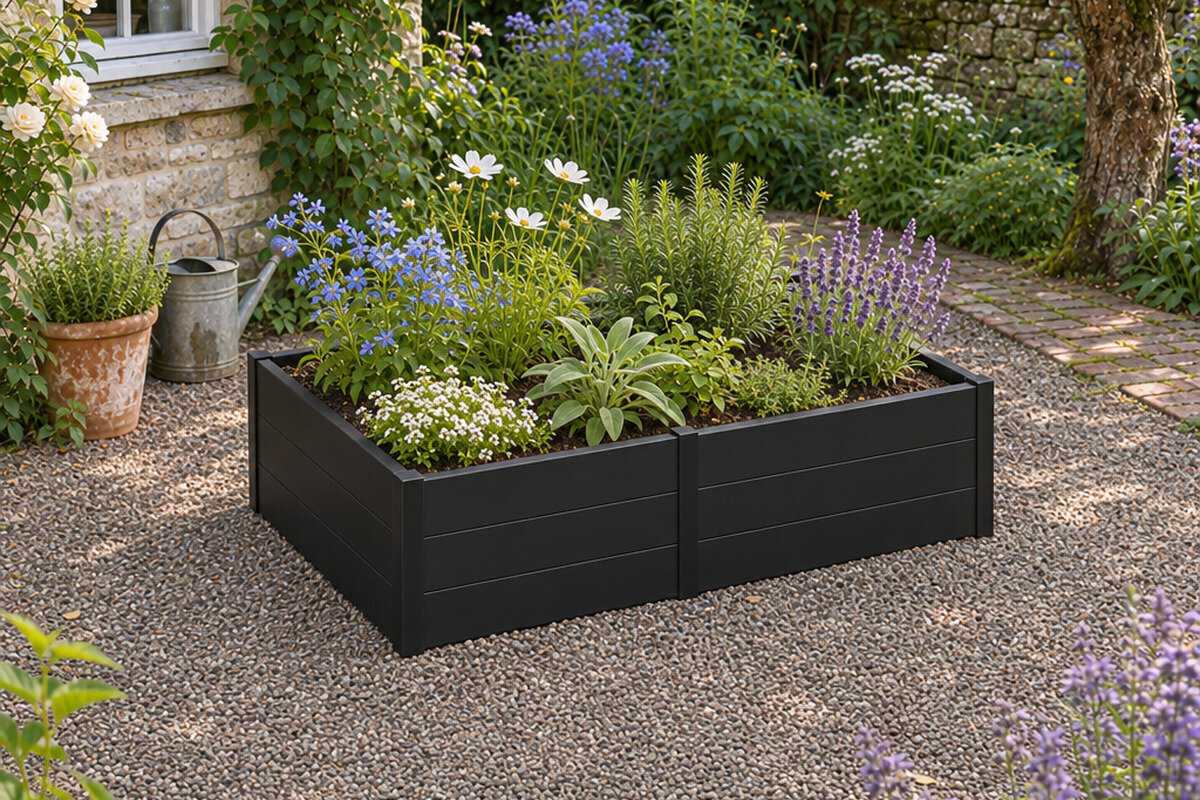
A product photo can help you picture a bed beside a fence or path, but it can’t verify a coating, sheet thickness, or required support. This guide shows what to check in the listing, what to ask the supplier, and which questions to settle at the site before you commit.
01
What the ribs tell you about the wall
The ribs in corrugated metal raised garden beds change how the sheet resists bending compared with a flat sheet. The direction and shape of those ribs matter, but so do the metal thickness and the distance between supports. You can’t tell how much soil a finished bed is designed to hold by looking at the ribs. Check the exact layout in the supplier’s manual, especially if you’re comparing a short version with a longer or taller one.
Look at the whole wall assembly. The top edge is where your arms will pass while you weed and harvest, so ask how it’s finished and whether any protective trim is included. At the corners and seams, check how the panels meet and what hardware the instructions call for. If a kit shows a center support or brace at the size you want, make sure it’s included rather than assuming you can leave it out to gain planting space.
For corrugated metal raised garden beds sold in several configurations, ask which wall lengths and heights the documentation covers. Instructions for one configuration don’t establish that the same panel can span a longer distance without support. When two corrugated metal raised garden beds look alike in photos, compare the finished edges, joints, and support layouts before treating them as equivalent.

02
Verify the metal and what touches the soil
When sellers describe corrugated metal raised garden beds as galvanized, painted, or coated, ask them to identify both the underlying metal and the finish. Request the stated grade or material specification and the metal thickness in inches; rib depth is a different measurement. If the listing gives only a gauge, ask for the corresponding thickness for that specific material rather than comparing gauge numbers across different metals.
For corrugated metal raised garden beds intended for vegetables or herbs, look for written guidance that covers the specific panels and their contact with growing soil. Ask whether that guidance applies to the finished kit or only to the sheet. Check it against the parts list: the fasteners and edge pieces may not be made of the same material as the wall, so use the hardware specified for that kit.
Treat salvaged sheets or unmarked offcuts for corrugated metal raised garden beds as unknown unless you can verify their identity, finish, and prior use. A seller’s description of a sheet as outdoor roofing or siding does not document its suitability as a garden-bed wall. If the supplier can’t answer a question that matters to your use, record it as unknown. That isn’t proof the panel is unsafe; it’s a reason not to rely on it for that use.

03
Measure the space you can plant and reach
Mark out the nominal footprint of the corrugated metal raised garden beds you’re considering, then mark the paths separately. Stand where you’ll actually work and check your reach. A bed you can tend comfortably from both sides in an open yard may be awkward against a fence. Check where the hose will run and whether you can move soil to the bed without blocking the only convenient approach.
The nominal footprint is the listed outside size; check the actual inside width and length before planning rows or ordering soil. Planting area is a surface measurement, not a volume. Wall height is not the same as fill depth, and neither is necessarily the total rooting depth. In an open-bottom bed over suitable soil, roots may extend below the frame. On a hard surface, they can’t use the ground underneath, so the depth of the growing mix matters more.
To see how those measurements differ, compare the Bloomcabin Square Aluminum Raised Garden Bed. It has a nominal footprint of 39.37 × 39.37 inches, a nominal planting area of 10.76 square feet, 15.75-inch walls, and an open base to prepared ground. Those figures don’t give the exact inside dimensions or rooting depth at your site. Use that same distinction when evaluating corrugated metal raised garden beds; pick crops and planting dates with seed-packet directions and local extension guidance.

04
Decide where water will go before filling
For open-bottom corrugated metal raised garden beds, start by checking the ground underneath. Look at the spot after rain: does water pool where the bed would go, or does runoff cross it on its way downhill? Check whether the ground can be prepared as the instructions require. A frame can hold growing soil above grade, but it doesn’t by itself solve poor drainage or make contaminated ground suitable for gardening.
If corrugated metal raised garden beds would sit on concrete or paving, ask whether the model is meant for that surface, how it retains soil, and where excess water goes. Think about the outlet as well as the bed: water should have somewhere to go that won’t create a problem on a walkway or against the house. Don’t assume an open-bottom kit intended for prepared soil can be moved onto pavement and used unchanged. If there’s no documented setup for the surface, choose a design that addresses it.
Before ordering, consider both the path water takes into the bed and the path it takes out. A convenient hose doesn’t solve a soggy base, and a well-drained spot can still be inconvenient if it’s difficult to water. Check both while it’s still easy to move the layout.

05
Use the manual to check the assembled frame
Read the assembly instructions for the exact corrugated metal raised garden beds on your shortlist before buying. Look for the required tools, whether you can reach the fasteners at the planned site, and whether the configuration needs a second person to handle the panels. If a wall will be close to a fence, use the instructions to decide whether the kit can be put together in place or needs more working room.
At setup, inventory the hardware and match the panels, corners, edge protection, and any specified supports to the parts list. Follow the manual for panel orientation, overlap, and fastening. A hole that doesn’t line up is a reason to check the panel orientation and part number, not to drill a new hole. If a piece is missing or damaged, ask the supplier which replacement is appropriate before using a substitute.
Before filling corrugated metal raised garden beds, walk around the frame and look for a twisted panel, a loose seam, an exposed sharp edge, or a missing support. Check that the frame is seated as directed and the planned drainage path is clear. Take care of those issues while the frame is empty; once it’s full, correcting a corner or changing the base may mean taking soil back out.

06
Know what you’ll inspect and maintain
Compare care instructions for corrugated metal raised garden beds before assuming that all coated panels need the same upkeep. Ask what to do about a scratch, a damaged edge cover, or a fastener that needs replacing. A supplier that identifies compatible replacement parts gives you something concrete to compare. Don’t use a general label such as “weather-resistant” to predict how long the finish will last at your site.
Once the bed is in use, check the rim, seams, and visible supports while you tend the plants. Watch for changes, such as a seam opening or a panel bowing more than it did after filling. If you notice movement, don’t add more soil or improvise a brace. Check the manual and ask the supplier how to correct it. If the finish is damaged, ask about a repair appropriate for the specific surface and its location rather than assuming any exterior paint will do.
Separate watering from wall care. Soil in corrugated metal raised garden beds can dry at different rates across the bed. Check the soil around the roots in more than one spot before changing your watering routine, especially when seedlings are getting established. Direct water toward the root zone, and consider mulch where it suits the crop. Base changes on what you find in the soil, not a schedule tied to the wall material.

07
Compare two candidates for the same job
When comparing corrugated metal raised garden beds, hold the job constant: same crops, same location, and the same reach and growing-depth needs. Compare the exact panel specification, finish, hardware, edge protection, and support layout first. Then compare the complete setup: frame, any separately required parts, soil, and site preparation. A lower frame price doesn’t tell you which option will cost less to set up.
Hypothetical example: You’re comparing two corrugated metal raised garden beds for herbs and salad greens along a fence on prepared ground. Assume one kit has a verified inside growing space 6 feet long by 2 feet wide, with a planned fill depth of 12 inches, below its rim. If that space is rectangular and you ignore small displacements from the ribs and hardware, the starting soil estimate is 6 × 2 × 1, or about 12 cubic feet. With access from only one long side, mark the 2-foot inside width and check that you can reach the back row from your working position.
Suppose the other kit shows the same nominal outside length and width, but the seller can’t confirm its inside dimensions, panel finish, or required supports. Don’t transfer the soil estimate to it or assume it’s an equivalent choice for edibles. Of those two corrugated metal raised garden beds, advance the first only if its written material guidance also covers the intended use. If neither supplier can establish that, keep looking or change the plan before ordering soil.

Questions readers ask
Can I make corrugated metal raised garden beds from leftover roofing panels?
Don’t assume roofing specifications cover soil contact or use as a retaining wall. If you can identify the original panel, ask for its metal grade, coating, thickness, and intended-use guidance. If the material or its prior use is unknown, choose a documented alternative for an edible bed.
Do corrugated metal raised garden beds need an inside liner?
Ask what the liner is meant to do and whether the supplier specifies one. A sidewall liner doesn’t establish that an unidentified panel is appropriate for food growing. A liner across the base changes the drainage setup, so don’t add one without a plan for where water will go.
Are Bloomcabin’s aluminum models examples of corrugated metal raised garden beds?
The available specifications identify aluminum wall panels on Classic models but do not establish a corrugated panel profile. Use the listed models to compare dimensions and open-bottom layouts, not as examples of verified corrugated construction.
Make the decision before you order soil
Choose corrugated metal raised garden beds when the documented material and complete wall assembly fit the job, and you know you can reach the crops and manage drainage. If the coating, intended use, or required supports are still unknown, resolve that question before buying rather than trying to compensate after filling.
Find a raised bed for your plan
Compare layouts and check the dimensions on the product page.
