
Elevated Planter Guide: How to Choose, Set Up, and Plant One

Bloomcabin · Raised-bed guides
Elevated Planter Guide: How to Choose, Set Up, and Plant One
Choose an elevated planter by checking what holds the soil. A supported container holds growing medium above the surface it stands on. An open-bottom frame raises the soil surface but relies on suitable ground underneath. Once you know which type you need, compare reach, rooting depth, and filled size before buying.
Look underneath
An elevated planter may be a supported container or an open-bottom frame. Check whether it has a floor before choosing a site.
Test your reach
Mark the footprint and try reaching the farthest planting point from where you’ll actually stand or sit.
Measure for two jobs
Use the nominal footprint to plan placement. Use verified inside dimensions and intended fill depth to estimate soil.
Choose crops before filling
Check light, water access, and the root space your crops need before settling on a size.
The right elevated planter lets you do the everyday jobs comfortably: sow at the far edge, water without crossing an awkward path, and harvest once the plants have spread. Think about where you’ll stand or sit and which crops you’ll grow before deciding how tall or wide the bed should be.
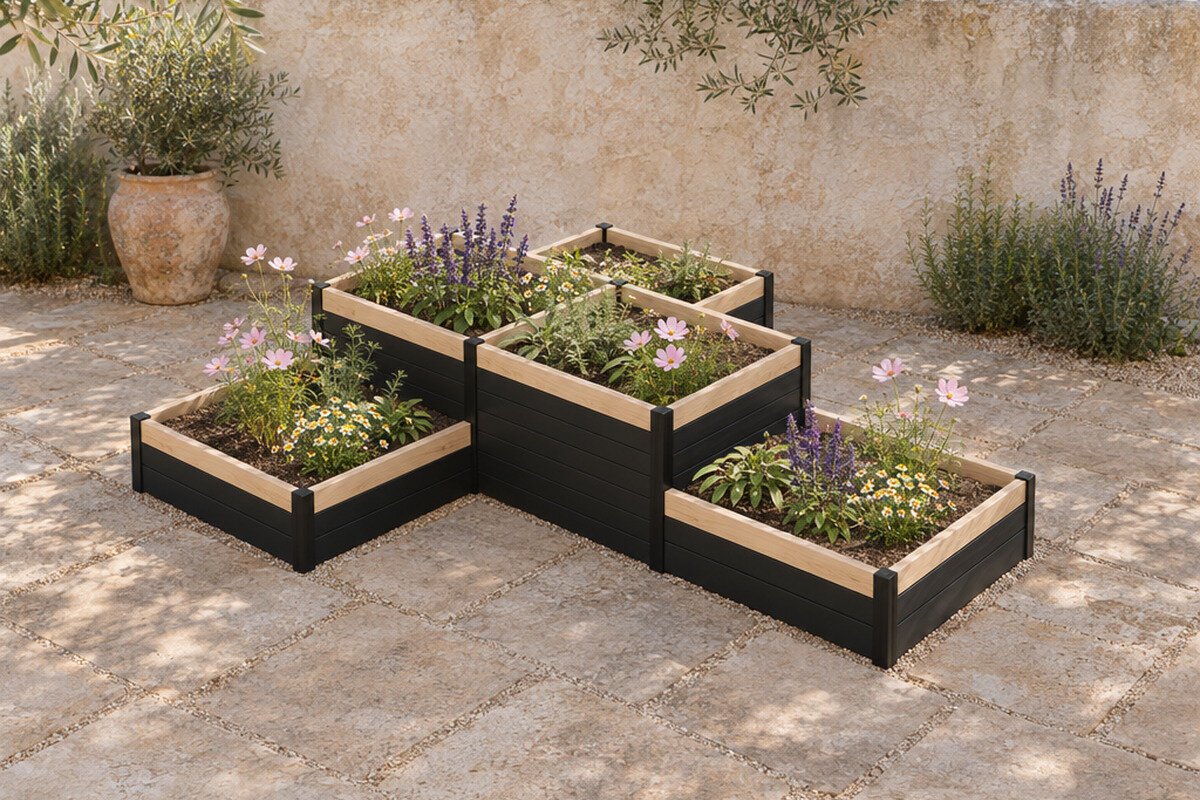
Use this guide to rule out the wrong base, test a footprint at home, and work out how much growing medium you’ll need. The Bloomcabin models shown are open-bottom raised beds for prepared ground. They’re useful comparisons for width, wall height, and layout, but they’re not substitutes for a container with its own floor.
01
Start with the base: what holds the soil?
If you want to garden on paving or need to approach a planter while seated, start by looking for a supported container designed for that use. The bottom has to retain the growing medium, and the supports have to carry the filled container. Check where the water exits, what the manufacturer says about placement, and whether there is enough clearance to get close. A high rim alone doesn’t tell you whether you can get your knees underneath or reach across the planting surface.
An open-bottom elevated planter does a different job: its walls hold added soil above grade, while the ground below remains part of the growing site. It suits gardeners who have suitable ground and want a defined growing area or a higher working edge. That is the type shown in the Bloomcabin gallery. The illustrated models arrive unassembled and sit on prepared ground without a floor panel. Tall sides do not turn them into freestanding containers.
If drainage is poor or you have reason to question what’s in the existing soil, investigate before installing an open frame for food crops. Added soil does not isolate roots from the ground below. If keeping the growing medium separate is essential, rule out the open-bottom design at this stage rather than buying it and improvising a floor.

02
Test the site at planting and harvesting height
Choose a short crop list before measuring the site. A few plants you use regularly make a better starting point than a collection that only fits on paper. Look up mature spread, light needs, and any support requirements. Notice when buildings or fences shade the proposed spot, and picture the garden with plants at full size. If one crop will be much taller than the rest, plan where it can grow without shading neighbors that need more light.
Mark the elevated planter footprint with string or tape. Then approach it with whatever you use to garden: a watering can, a kneeling pad, a stool, or a mobility aid. At the intended working height, see whether you could reach a seedling at the center or harvest from a back corner without leaning on the rim. Test the approach with gates open and the hose in place. A gap that looks generous on a drawing may be hard to use when you’re carrying something or need room to turn.
Finally, follow the water route. If you’re deciding between two spots with comparable light and access, favor the one where checking and watering will be easiest. If the elevated planter will have a floor, also trace the runoff route. Check whether the outlet would drain across your approach or onto a surface you need to keep dry, and resolve that before placing the container.

03
Read the dimensions without confusing rim height and root space
Read an elevated planter listing as a set of separate measurements. The nominal footprint helps you lay out the site. The clear inside length and width determine how much room you have for your planting pattern. A nominal planting area is useful for comparison, but it does not tell you how many plants will fit at the spacing they need. And the path is not part of the footprint: reserve it separately, including room at the end if that’s how you’ll enter.
The narrow aluminum bed with 3.94-inch walls lists a nominal footprint of 39.37 × 19.69 inches, one planting compartment, and 5.38 square feet of nominal planting area. Compare it with the square aluminum bed with 15.75-inch walls, which lists a nominal footprint of 39.37 × 39.37 inches and 10.76 square feet of nominal planting area. The square provides more planting area, but Bloomcabin calls for access from at least two opposite sides. Where you can only approach from one long side, the narrow frame is worth trying first in your reach mock-up.
For an elevated planter with a floor, the usable root zone is limited to the medium above that floor. With an open-bottom frame, suitable soil below the edge may provide more root space. The wall height is neither the planned fill depth nor a guarantee of total rooting depth. If the ground below is compacted or otherwise unsuitable for rooting, do not count on it to make up for a shallow fill. Check that the usable depth works for your crop before choosing the shorter wall.

04
Choose a layout you can tend and a finish you understand
Compare the layout by how you’ll use it. A single bay gives you one continuous planting area; a divided bed lets you assign separate areas without marking the boundary every season. The double aluminum bed with equal-height bays lists two nominal 39.37 × 39.37-inch bays, each with 11.81-inch walls. In the split-height version, the listed wall heights are 11.81 and 31.5 inches. With that elevated planter layout, check access at both heights and consider whether plants in the higher bay could shade the lower one.
A U-shaped elevated planter can give you another approach, but the notch is a passage, not planting space. The five-bay U-shaped aluminum bed lists a nominal access notch of 39.37 × 39.37 inches. Measure the route into it, then try tending an imaginary plant at the back of the notch. Check the outside approaches too: access from the notch will not necessarily put every part of every bay within your reach.
Read the material description as closely as the drawing. The classic models shown use aluminum wall panels and corner posts. On the narrow Accoya fusion bed, the upper 3.94 inches of each wall are Accoya boards, and the lower 19.69 inches are aluminum. It is not an all-wood planter. If upkeep, finish, or replacement parts matter to your choice, ask for the model’s care and parts information rather than inferring it from the material name.

05
Assemble on the intended site, then work out the fill
Prepare the site for the exact model before adding growing medium. For an open-bottom elevated planter, clear the footprint and check the ground conditions against the installation instructions. Lay out the parts against the supplied list and assemble them in the stated order. If a piece is missing, the frame doesn’t sit as the instructions show, or you can’t tell whether the site is suitable, stop before filling. It’s easier to resolve a fit or placement problem while the frame is empty.
Estimate fill only once you have the actual internal dimensions and know the intended fill depth. For a rectangular bay, multiply inside length by inside width by fill depth, with all three in feet, to get cubic feet. For a divided elevated planter, repeat the calculation for each rectangular bay and add the results. Do not use the outer rectangle of a U-shaped kit: it includes the approach notch. If a compartment is irregular or the floor is not flat, ask for its fill capacity instead of guessing from the outside.
Select a growing medium for the type of planter and the crops you’re growing. A supported container needs a medium suited to container growing; an open frame also calls for assessing the soil beneath it. Use local Extension or soil-test guidance if you need to decide what to add. Leave drain openings clear on a container, and keep the rim and access route usable once the bed is filled. If you spot a drainage problem, resolve it before planting rather than relying on the new soil to hide it.

06
Worked example: square or narrow in a 6-by-8-foot space?
Hypothetical example: A gardener has a clear patch of suitable ground measuring 6 by 8 feet for an elevated planter. The site has enough light for the crops they want, a nearby water source, and access from both ends of the longer dimension. They want to plant leaf lettuce and compact herbs, and their own mock-up shows they need at least 24 inches of working space on each of two opposite sides. That’s their measured preference, not a universal aisle width.
They compare the narrow frame with the square model. Center the square’s nominal 39.37-inch footprint along the 8-foot direction and the two working approaches are each about 28.3 inches: subtract 39.37 from 96 inches and divide by two. Along the 6-foot direction the gaps are only about 16.3 inches each. They can choose the square elevated planter if the wider approaches stay clear and they can reach the center from them. If one of those approaches will be blocked, they’ll lay out the narrow model and see whether they can work it comfortably from one long side.
To estimate a soil order, suppose the gardener confirms a rectangular interior measuring 36 by 36 inches and plans to fill it 12 inches deep. Those are hypothetical measurements, not specifications for the square model. The calculation is 3 feet × 3 feet × 1 foot, or 9 cubic feet. Before ordering, they’d use the verified measurements for the chosen bed and check that the fill and suitable ground beneath it provide the root space the plants need. They’d also check packet spacing to see whether both crops fit without crowding.

07
Plant the first round and let routine care guide the next
Lay out the first planting before you sow. Use the spacing on the packet to mark rows or individual plants, and check local Extension guidance for when to start. Mark the locations you intend to reach most often, such as a row you’ll cut regularly, and move them toward the working edge if that makes harvest easier. Leave space for mature growth rather than filling every gap you see between seedlings. If the plan is too tight, drop a crop or grow it in the next planting window.
Check moisture in the elevated planter where the plants are growing, not just by looking at the surface or at the ground beside it. A newly sown row and a neighboring patch of established plants may not need the same attention. Water near the roots as needed. In a container, pay attention to where the drained water actually goes; it may reveal a placement problem you missed while the planter was empty.
After a few rounds of watering and harvesting, revisit the layout. If the back row is hard to pick, plant a frequently harvested crop closer to you next time. If water runs across a walkway, adjust the runoff plan before it becomes part of your daily route. If plants struggle, identify the cause before applying a treatment or fertilizer. The most useful changes are often the ones that make the elevated planter easier to reach, observe, and care for.

Questions readers ask
Does an elevated planter have to be waist-high?
No. Check the finished rim height and the soil level you’ll work at. For a container on supports, check both knee clearance and forward reach if you plan to garden seated. For a ground-level frame, taller walls raise the rim but don’t provide space beneath the bed.
Can I use an elevated planter on a patio or deck?
Choose a container intended for that surface, with a supported bottom and a plan for runoff. Confirm that the site can handle the filled weight with the medium wet. The Bloomcabin frames shown here are open at the bottom and specified for prepared ground.
Can I use the wall height of an elevated planter to order soil?
Use the planned fill depth and verified inside dimensions instead. Wall height measures the frame, not how high you intend to fill it. For a divided bed, calculate the fill for each compartment before adding the volumes.
Make the purchase decision before you order soil
Buy the elevated planter whose base suits the site and whose farthest planting point you can reach. Verify the inside measurements before ordering fill, then use crop instructions and local guidance to plan your first planting.
Find a raised bed for your plan
Compare layouts and check the dimensions on the product page.
