
Flower Bed Stone: How to Choose the Right Stone for Edging or a Raised Wall

Bloomcabin · Raised-bed guides
Flower Bed Stone: How to Choose the Right Stone for Edging or a Raised Wall
Flower bed stone is a good choice for edging when the pieces suit the site and can be set securely. For a raised wall that holds soil, choose stone only when the supplier documents that use and provides instructions for your planned height and layout.
Match the job
Flower bed stone sold for a single-row border isn’t automatically suitable for a raised wall.
Read the specifications
Check stone type, thickness, finish, and the required base and joints before you order.
Check the fit
Measure how much room the stone takes up and check where water can go before you fill the bed.
Have a fallback
If you need a raised enclosure and the stone has no instructions for retaining soil, keep the two jobs separate.
Start with the problem you want to solve. If mulch keeps spilling onto a path, a low edge may be enough. If you want the planting soil to sit above the surrounding ground, the edge becomes a wall. Before you buy flower bed stone for either job, check what the pieces are made of, how they’re meant to sit together, and what will support them.
Bring a sketch to the supplier with the length of the run, the difference in soil level across the proposed edge, and the space you can give up to the stone itself. Take note of any pavement, slope, or place where water collects. Those details are more useful than a photo of the look you want: they help you rule out pieces that won’t fit or whose instructions don’t cover your site.
01
Decide what the stone needs to do
To choose flower bed stone, look at where the soil will sit on either side of it. If the lawn or path and the planting soil are at roughly the same level, you may only need a line of edging. If the soil inside will sit higher than the ground outside, note that difference. A wall that holds soil back is doing more than tracing a line around the flowers, even when its top looks like an ordinary border.
Loose flower bed stone does a different job. Gravel or decorative rock can cover exposed soil or define a strip, but a scattering of pieces doesn’t make a continuous edge. If your concern is stone spreading into a path or lawn, decide what will contain it and whether you’ll be able to clear stray pieces. If your concern is keeping raised soil in place, start with the enclosure rather than the surface covering.
When shopping for flower bed stone, describe the job plainly: ‘one row alongside an existing bed’ or ‘a wall with the planting soil higher on one side.’ Include the planned height and mention a slope, if there is one. Some pieces sold with a stone look are manufactured masonry rather than natural stone. Confirm what you’re buying and use instructions for that exact material and shape, not a similar-looking piece from another system.

02
Check the material, dimensions, and joints
A listing for flower bed stone should tell you more than the color and an approximate size. Ask for the stone type or manufactured material, the grade if one is specified, and any coating, sealer, or treatment already applied. With reclaimed pieces, ask about their previous use. Unknown composition or a finish you can’t identify isn’t proof of a problem, but it also isn’t evidence that the pieces are suitable beside planting soil.
Measure flower bed stone in the orientation in which it will be laid. Along the border, length tells you how many pieces to order. Across it, thickness tells you how much planting or path space the edge takes up. Vertical height matters for the portion that will be visible versus the portion the instructions call for setting below grade. Ask how much the sizes vary within the batch. For a straight edge, lay a few representative pieces together and see whether their faces line up without twisting or rocking.
Get the instructions for the exact flower bed stone you’re considering. Find out whether it’s meant to be dry-laid, set with a specified joint material, or assembled with connectors or fasteners. If hardware is specified, check the required type and whether it’s included. Ask about corners, ends, and cuts before buying. If the only documented installation is a straight, single row, don’t count on being able to stack it or turn a tight corner without a different detail.

03
Fit a short run before committing to the full border
Before setting flower bed stone, mark both sides of the proposed border, not just its centerline. That shows what the edge will take away from the planting strip or the path. Mark transitions at pavement and any ends or corners. A piece that looks right in the middle of a run may leave a poor fit at the end; that’s easier to correct on the ground than after base preparation.
Use the supplier’s directions to prepare the base and place the first row. When placement can be adjusted before final installation, check a short run for rocking, fit at the joints, and changes in top height. Compare what you see with the intended profile: a stepped edge on changing ground isn’t the same as an unintended high piece in a level run. Ask about piece weights and how cuts should be made if the sample layout shows you’ll need them. Don’t plan on a cut until you know the material and method.
When flower bed stone will retain soil, check that the wall instructions cover the proposed height, base, corners, backfill, and drainage as a system. Don’t improvise extra rows, substitute a bonding material, or use a border detail to solve a slope. If the site or layout falls outside the instructions, get site-specific advice or choose a system that covers the job. Resolve any differences between the instructions and the build before adding soil.

04
Trace the water path, not just the bed outline
Before installing flower bed stone, look at the site after rain if you can. Note where water enters the area, where it pools, and where it leaves. A border across a low point changes the route water has available. If a path or building is nearby, check where runoff would go from the proposed edge rather than assuming it will stay in the bed.
Over prepared ground, an open-bottom bed can connect its fill to the soil below. The wall height therefore doesn’t necessarily tell you how much rooting depth is available. Check the ground beneath it: an open base doesn’t make a poorly drained site drain well. On pavement, there’s no connection to soil underneath. If that’s where you want the bed, you need a design that addresses both usable soil depth and how water exits on that surface.
The drainage detail for flower bed stone depends on the job. For low edging, check whether the layout would block an existing runoff path. For a soil-retaining wall, follow the drainage and backfill details for that system. Don’t assume that open joints in an unrelated product can serve as a drain, or that adding a layer of gravel will fix a site with nowhere for water to go. If water routinely ponds along the proposed line, resolve the route or move the edge before installation.

05
Worked example: count the pieces and measure what’s left
Hypothetical example: You want to edge the long side of an existing flower bed beside a path. The straight run is 8 ft long, the planting strip is 36 in wide before installation, and the soil on either side is at about the same level. You’re comparing two candidates for flower bed stone, both documented for a single row along a path. The entire width of either edging option would sit inside the planting strip.
Option A covers 12 in along the run per piece when laid as directed, including any required spacing in that coverage figure. Since 8 ft is 96 in, the straight run takes eight pieces if the installed lengths match the layout and no special end pieces are needed. Check that with a test layout before ordering, especially if the supplier gives a range of lengths. Any spare or cutting allowance should reflect those checks; it isn’t part of the eight-piece calculation.
If Option A takes up 4 in across the strip, it leaves 32 in for planting. If Option B takes up 7 in, it leaves 29 in. That 3 in difference gives you something concrete to compare if you’re keeping an existing row of flowers or want room to reach around them. Option B may still be the better fit if its shape follows the path more neatly. In that case, check its coverage per piece separately rather than ordering eight by analogy. Neither calculation establishes that the flower bed stone can retain raised soil.

06
Compare stone with a frame only if you need raised soil
Compare flower bed stone by installed footprint and documented use, not by the dimensions of one piece or the look of a display. Check what the wall or border takes away from planting space and whether you can reach the center from the sides you actually have access to. For a raised enclosure, compare the true internal dimensions and intended fill depth when estimating soil needs. The outside rectangle is useful for marking the site, but it isn’t a fill measurement.
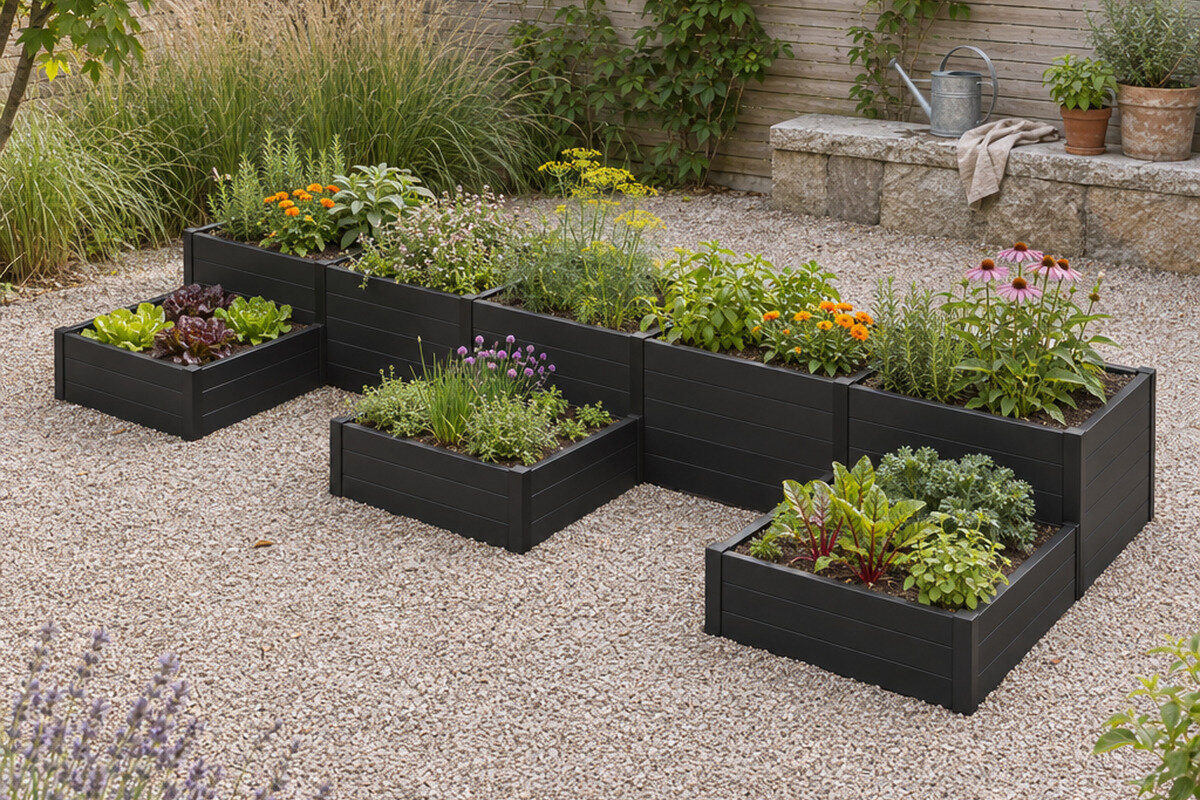
If the stone works as edging but you need a separate raised enclosure, compare it with a frame made for that purpose. Bloomcabin’s Square Aluminum Raised Garden Bed has a nominal footprint of 39.37 × 39.37 in, 15.75 in walls, and a nominal planting area of 10.76 sq ft. The aluminum panels and corner posts are supplied unassembled, and the bed is open to prepared ground. Mark out the footprint and check access from at least two opposite sides. Verify actual inside measurements separately if an exact fit or soil quantity matters.
The aluminum frame isn’t flower bed stone, and its stated height tells you nothing about how high you can stack a stone border. The useful comparison is what each option lets you verify before purchase: the space it occupies, how it goes together, what base it needs, and whether its instructions cover the job. If you only need to mark the edge of an existing bed, you don’t need to buy a raised enclosure to do it.

07
Watch for movement, runoff, and changes at the joints
Keep the instructions and take a photo of the line and joints once the flower bed stone is in place. After a heavy rain or when you first notice soil on the path, compare the edge with that starting point. Look for rocking pieces, new gaps, soil escaping at a joint, or water collecting in a new spot. Loose decorative rock may simply need to be gathered back into its strip; movement in a wall holding soil deserves closer attention.
If one edging piece moves, check what changed around it before resetting it according to the installation instructions. Look for a worn spot along the path or water crossing the base. If a raised wall leans, bulges, or develops opening joints, don’t add more fill or try to hide the movement by packing soil against it. Have the cause assessed before attempting a repair.
For cleaning flower bed stone, start with the care instructions for its finish and joint type. Ask before using a cleaner, applying a coating, or changing a joint material. If you plan to extend the run later, retain a piece or keep the product identification and dimensions. That gives you something better than a color photo to match when the next batch arrives.

Questions readers ask
Can I stack flower bed stone that’s sold as edging?
Only if the instructions cover stacking the exact pieces for the height, layout, and soil level you want. Instructions for setting a single row don’t establish that several rows can retain soil. If the supplier can’t confirm the proposed use, choose a different system for the wall.
Should I seal flower bed stone before installing it?
Don’t assume it needs sealing. Find out whether the stone already has a finish or treatment and check the supplier’s care directions. If a sealer is optional, ask what it’s meant to address and whether it’s appropriate for the intended outdoor use and placement near soil or plants.
Can I use leftover stone if I don’t know what it is?
Don’t assign unidentified pieces a soil-retaining job based on size or appearance. Try to establish where they came from, whether they were treated or coated, and what they were intended for. If you can’t verify their condition or suitability for the planned use, buy a documented material instead.
Buy for the job you can verify
To choose flower bed stone, match the intended use to the supplier’s instructions, lay out a short section, and check where water will go. If the stone is documented only for edging, use it at the edge and choose a separate system for any wall that needs to hold raised soil.
Find a raised bed for your plan
Compare layouts and check the dimensions on the product page.
