
Garden Bed Fence: Choose a Barrier for the Damage You See

Bloomcabin · Raised-bed guides
Garden Bed Fence: Choose a Barrier for the Damage You See
Choose a garden bed fence that blocks the route behind the damage while leaving room to tend the crop. A short screen may solve repeated contact from a path; an animal entering to feed calls for a design that addresses how it gets in. Check the finished gaps and support method before buying.
Name the problem
Choose a garden bed fence for observed damage and the route behind it, not for a broad pest-proof claim.
Decide what to enclose
Use a partial barrier only when leaving the other sides open still meets your goal.
Judge the finished barrier
Compare material and openings, then confirm supports, attachment, and the fit at edges and ends.
Check it in use
Make room for harvest and watering. Compare fresh damage with a dated baseline.
If the bed is already in place, shop for the barrier as a separate purchase. Start with the damaged crop and the most likely approach, then decide whether your garden bed fence needs to protect one edge, surround the bed, or give way to a different kind of protection.
Bring a short checklist when you compare options: the route to block, the clear openings after assembly, the supported mounting method, and the side you need for crop care. This makes it easier to reject a panel that looks right on its own but leaves the actual problem untouched.
01
Turn the damage into a job the barrier can do
Start with the newest damage. Are stems snapped on the path side, are leaves disappearing farther inside the bed, or is soil disturbed near a corner? Record the crop, the damaged part, and where it sits relative to the rim. Photograph the affected plants and nearby ground. University of Maryland Extension recommends inspecting plants and identifying the cause before acting. That matters when choosing a garden bed fence: a broken stem tells you what needs attention, but it does not tell you what broke it.
Look for a repeat you can explain. If you see a dog brush the same chard leaves while turning on a path, you have a reason to protect that edge from contact. If you only find missing leaves in the morning, neither the animal nor its approach is confirmed. Check for visible activity and compare damage inside the bed with damage at the perimeter. When the signs do not point to a cause, use local diagnostic guidance before committing to a material or height.
Put the job into one sentence: “Keep the path-side chard from being bent when the dog passes.” That gives you a way to compare products without confusing a crop guard with a pet enclosure. If your sentence instead describes an animal deliberately entering to feed, the garden bed fence must address entry, not just incidental contact. The same bed could call for two different designs.

02
Choose an edge screen or a full enclosure
A garden bed fence can be a short screen, a perimeter, or one part of a covered barrier. Choose how much to enclose before comparing materials. For repeated contact from one path, a screen along that side may be enough if it intercepts the contact and the crop stays behind it. Check both ends: if the contact happens at a corner, a panel that stops flush with the long edge can miss exactly the spot you wanted to protect.
If the animal is seeking the crop and can walk around a short screen, compare a full perimeter instead. Walk the proposed line and mark every point where the design changes: a corner, a ground dip, a removable panel, or a gate. Ask whether the garden bed fence also needs to address access from above or below. A side panel cannot close an open top or an underground route. If the observed route requires a different type of barrier, do not buy more side panels to compensate.
Keep the remaining openings intentional. A partial screen can leave the opposite side open for harvest because the opposite side is outside the limited protection goal. In a full enclosure, that same opening would be a defect. Write down which sides and surfaces the design must close so you can reject options that leave a required route open, even if their dimensions or appearance otherwise suit the bed.

03
Compare the installed opening, not just the material
Compare two options against the same job. For a wire grid, check the stated clear opening and whether the panel comes framed or relies on supports or tension. For a flexible screen, check how the instructions call for it to be held in shape and finished at the edges. For a solid panel, check its intended outdoor use and support requirements. None earns a place on the shortlist just by being metal, flexible, or solid; what matters is how the garden bed fence will behave in the specified assembly.
Ask for the clear opening rather than relying on wire spacing or a photograph. If the job is keeping foliage away from passing contact, consider both whether contact can reach through an opening and whether the leaves will extend through it as they grow. If the job is excluding an identified pest, look for target-specific guidance before deciding what opening and height you need. Do not treat a smaller opening as proof of suitability.
Compare the opening at the face of the garden bed fence with those at its base, ends, seams, and any access panel. Use the largest relevant gap, not the average. A solid face buys you nothing at a corner it does not meet. Note how exposed edges will be finished according to the instructions, especially where you reach across or carry a harvest basket. If the seller cannot confirm an essential property, leave the option off the shortlist rather than counting on an after-purchase fix.

04
Measure the fence line and verify what supports it
Measure the garden bed fence where its supports and panels will actually sit. Mark the line and measure each run separately. At corners and low spots, measure down from the proposed panel position to the surface below. Keep the bed’s dimensions separate from that sketch: the wall height describes the planter, not the protective height along the approach. A nominal bed footprint does not tell you how much usable room there is for a support or a panel end.
Next, verify what carries the panels. A freestanding system still needs the supports specified for it and a site where those supports can be installed as directed. If you want to mount a garden bed fence on the bed, check both sets of instructions and get confirmation of the attachment location and hardware. If the plan depends on drilling an unapproved hole or using the bed wall as a support without confirmation, choose a different system or layout.
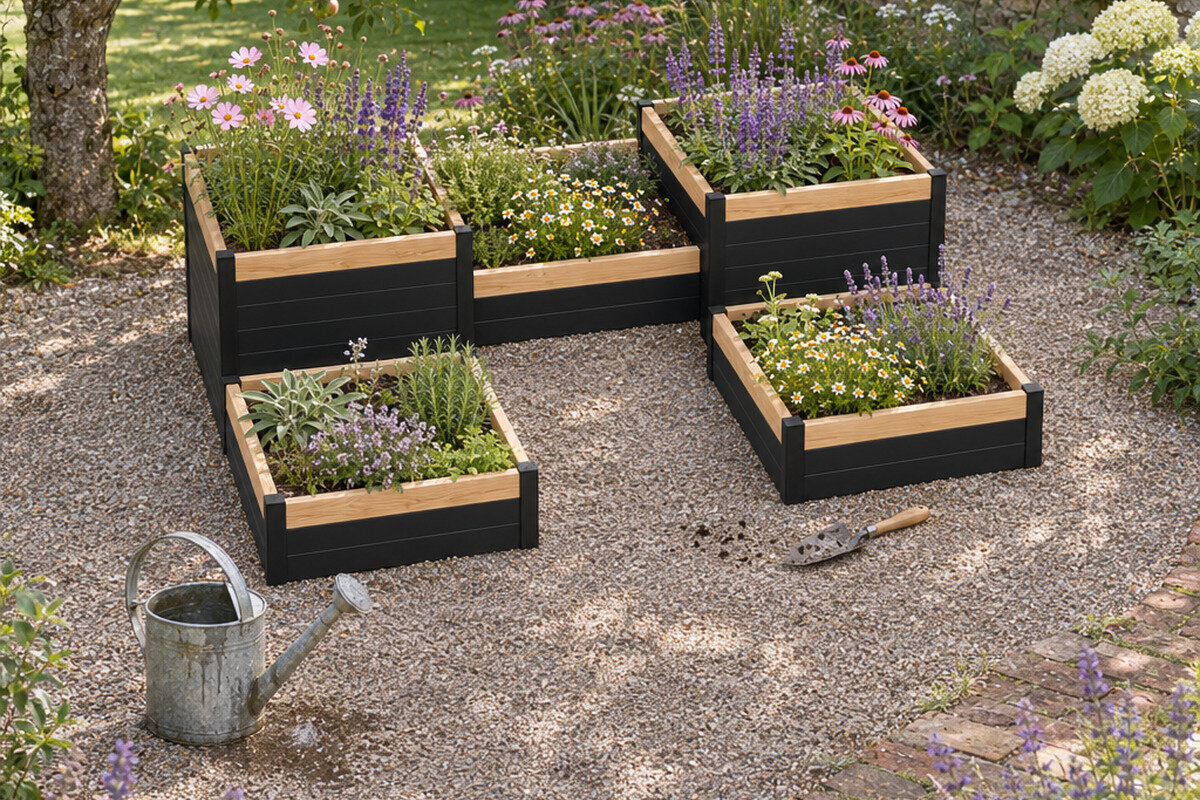
The Bloomcabin gallery shows ground-standing raised-bed frames, not fence kits or examples of tested fence attachments. The supplied product specifications do not establish that a bed wall or corner post can support a separate barrier. When asking about compatibility, give the supplier the exact bed model, your proposed attachment location, and the fence model. Confirmation for a different frame or a different mounting location does not settle your installation.

05
Hypothetical example: fit a path-side guard for chard
Suppose you see a dog brush the chard each time it rounds the path-side corners of an existing bed. You want to stop that contact, not contain the dog. At the proposed garden bed fence line, you measure 8 feet along the path and mark an 18-inch return at each end, turning away from the path. The runs total 11 feet: 8 feet plus two 1.5-foot returns. This is the length of the proposed line, not an order quantity. Check actual panel spans, corner pieces, and the space occupied by supports before buying.
You compare a framed wire panel with a flexible screen. In this hypothetical layout, the screen’s instructions call for an end support where it would narrow the path, so you set that option aside. The framed panel’s specified supports fit inside the marked area. But holding a sample in the planned position reveals a 2-inch gap over a dip near one return, right where a low chard stem could still be pressed. That number is a site measurement, not a pet-exclusion threshold. You shift the return to a level position that still intercepts the corner contact and remeasure before ordering. If no permitted position closes the route, the candidate fails the fit check.
The far side remains open for watering and harvest, so this garden bed fence needs no gate. Before committing, walk the path and check that neither return projects into it. Then check how much room the chard has to grow without reaching into the path. This garden bed fence can address the contact you saw; it cannot keep out a dog that approaches from the open side or deliberately goes around an end.

06
Rehearse watering and harvest before fixing the layout
Before installing the garden bed fence, use a temporary outline to rehearse a normal visit. Approach with a watering can, reach the farthest plant you need to tend, and work out how you will carry vegetables out. University of Minnesota Extension recommends arranging raised beds so you can reach plants without stepping on the growing soil. Apply that reach check with the barrier in place, not just to the bare bed. A panel can turn a previously reachable corner into one you can no longer tend comfortably.
If your garden bed fence needs a gate or removable panel, check both positions. When open, does it leave a clear approach without blocking the path? When closed, do its lower edge and both sides meet the same opening requirements as the rest of the barrier? Put the opening where you already approach the crop. If routine watering means removing a panel and setting it somewhere awkward, reconsider the layout before buying.
Leave room for the crop at the size you expect to maintain, not just at planting. From the working side, check whether you can tuck in a stray stem or inspect a seam without leaning on the fence. If you switch from a side barrier to a cover, check local crop guidance for pollination and the cover instructions before making it a permanent part of the layout.

07
Check the closed barrier and look for fresh damage
Inspect the garden bed fence in its normal closed position before relying on it. Check the finished lower edge, ends, seams, and any latch against the route on your sketch. Check again after using the access opening rather than assuming it returns to the same position each time. Look from the approach side as well as from inside the bed; a panel face may hide a gap where the run changes direction. Do not use a pet to test whether an opening is safe.
Use your dated photos to tell fresh damage from old. For the path-side chard, check whether stems are still being bent at the two corners when the dog passes normally. No new damage is encouraging if the same contact opportunity has been there; it is less informative if the path has gone unused. Record where any new damage occurs. Marks beside a return point to a different fit question than marks on the open side.
If fresh damage continues, make the next decision from what you find. Correct a loose or misaligned part only as the instructions allow. Reconsider coverage if the approach has changed, or revisit the diagnosis if the damage does not match the original pattern. The garden bed fence is doing its job when the damage it was chosen to stop no longer recurs under comparable conditions and the crops are still practical to tend.

Questions readers ask
Does a garden bed fence have to go all the way around the bed?
No. A partial barrier can be a reasonable choice for repeated contact along one edge if you can leave the other sides open without defeating the goal. If the identified animal can simply walk around the ends and is actively seeking the crop, compare a full perimeter or a different type of protection.
Can I fasten a garden bed fence to an aluminum raised bed?
Only if the bed and fence manufacturers confirm that the proposed connection is permitted and specify how to make it. Do not assume an exposed corner post or a convenient panel lip is a mounting point. If the connection is unconfirmed, look for an independently supported option suitable for your site.
Is a finer garden bed fence always a better choice?
No. Smaller mesh openings do not fix an open end, a low spot under a panel, or the wrong barrier for the route. Compare the finished openings and supported shape first, then consider whether the material leaves adequate room for crop growth and care. If you need insect exclusion, confirm the target and the crop’s pollination needs before choosing a cover.
Buy for the route you can verify
Choose the garden bed fence that closes the relevant route, fits with its approved supports, and leaves you a workable way to water and harvest. After installation, let fresh damage—not the appearance of the barrier—tell you what to check next.
Find a raised bed for your plan
Compare layouts and check the dimensions on the product page.
