
Garden Bed Planter: How to Choose, Set Up, and Plant One

Bloomcabin · Raised-bed guides
Garden Bed Planter: How to Choose, Set Up, and Plant One
Choose a garden bed planter by checking the base first: use an open-bottom frame over suitable prepared ground, or choose a container designed to hold soil and drain on a hard surface. Then measure the space and your reach, compare the wall and bay dimensions, and confirm the inside measurements before ordering fill.
Check the base first
Choose an open-bottom frame for suitable ground, not as a substitute for a container on pavement.
Measure where you’ll work
Mark out the garden bed planter and test your reach before choosing a width.
Price the fill separately
Use measured inside dimensions and intended fill depth to estimate soil.
Plan for mature plants
Check the seed packet and local planting guidance before assigning space to crops.
A garden bed planter can turn a strip along a fence or an unused corner into a defined growing area. But an open-bottom frame that works beside a path may be the wrong purchase for a patio, and a bed that fits between two landmarks may still leave you nowhere to stand while you harvest.
Use this guide to screen out the wrong base, mark a workable layout, and compare the Bloomcabin frames that fit. Then plan assembly, soil, and a first planting without treating the listed footprint as the amount of space you can actually plant.
01
Look underneath before you choose a shape
A garden bed planter may look like a large box in a listing, but the first detail to check is what sits beneath the soil. An open-bottom frame holds growing material in place at the sides and sits directly over prepared ground. A planter designed for a hard surface must hold its growing material without relying on the ground underneath and provide a way for water to drain.
The Bloomcabin raised-bed models in this guide are open-bottom frames with no floor panel. This type of garden bed planter suits someone who has a spot on workable ground and wants to keep plantings in a defined strip, square, or set of bays. It is not a freestanding container. The wall can mark the edge of your growing area, but it does not separate the bed from the soil below.
If your only growing space is a deck, balcony, or paved patio, rule out these open-bottom models for that spot rather than counting on an improvised floor. Look for a container intended for the surface. Where structural capacity is a concern, verify what the site can support with the container, growing material, and water in place. The frame dimensions alone cannot answer that question.
On bare ground, an open-bottom garden bed planter is a candidate, not an automatic yes. If water collects there or you have reason to question the soil’s suitability for food crops, investigate before ordering. A higher wall isn’t evidence that either problem has been solved.

02
Measure the working area, not just the footprint
Mark the proposed garden bed planter footprint with string or a tape measure. Then walk the route you’ll use with a watering can, harvest basket, or bag of soil. Open any nearby gate all the way. If the frame fits only when it takes up the space where you need to stand or turn, it doesn’t fit the way you’ll use it.
Test reach from the sides that will actually remain open. Stand or sit where you expect to work and see whether you can comfortably reach across the proposed bed at working height. Try reaching the far corners, not just the middle of the near edge. If the far side is against a fence, draw the bed as a one-sided planting strip. For wider beds, leave a way to tend the center without stepping into the growing area.
The same listed planting area can produce two different access plans. The square aluminum model and the long, narrow aluminum model each list 10.76 square feet of nominal planting area. The square is 39.37 inches on each side; plan access from at least two opposite sides. The long model has a nominal footprint of 78.74 by 19.69 inches, so it needs more uninterrupted length but less space front to back.
Before settling on a garden bed planter location, check the path to water and watch where shade falls during the day. Compare the light at each candidate spot with what you want to grow. Measure again if you move the proposed outline to avoid shade or leave room for access.

03
Read the dimensions as separate numbers
Read a garden bed planter listing as a set of separate measurements. The nominal footprint describes the listed outside size for layout planning. The listed planting area lets you compare growing space across models. Neither is a substitute for the actual inside length and width. Exact inside measurements aren’t given for the models discussed here; confirm them if a close fit or your soil order depends on them.
Wall height tells you how tall the sides are, not how much soil to order or how deep roots can grow. The narrow classic aluminum model has 3.94-inch walls. The narrow Accoya fusion model has 23.62-inch walls on the same nominal footprint. Its upper 3.94 inches are Accoya boards, its lower 19.69 inches are aluminum, and the corner posts are aluminum. It is not an all-wood bed. Compare the actual materials and parts rather than assuming that a material name describes the whole frame.
On a garden bed planter with a divider, look at each planting bay before you assign crops or estimate fill. The split double aluminum model has two nominal 39.37-by-39.37-inch bays, with 11.81-inch walls on the left and 31.5-inch walls on the right. The shared outside dimensions don’t tell you how much material each bay needs.
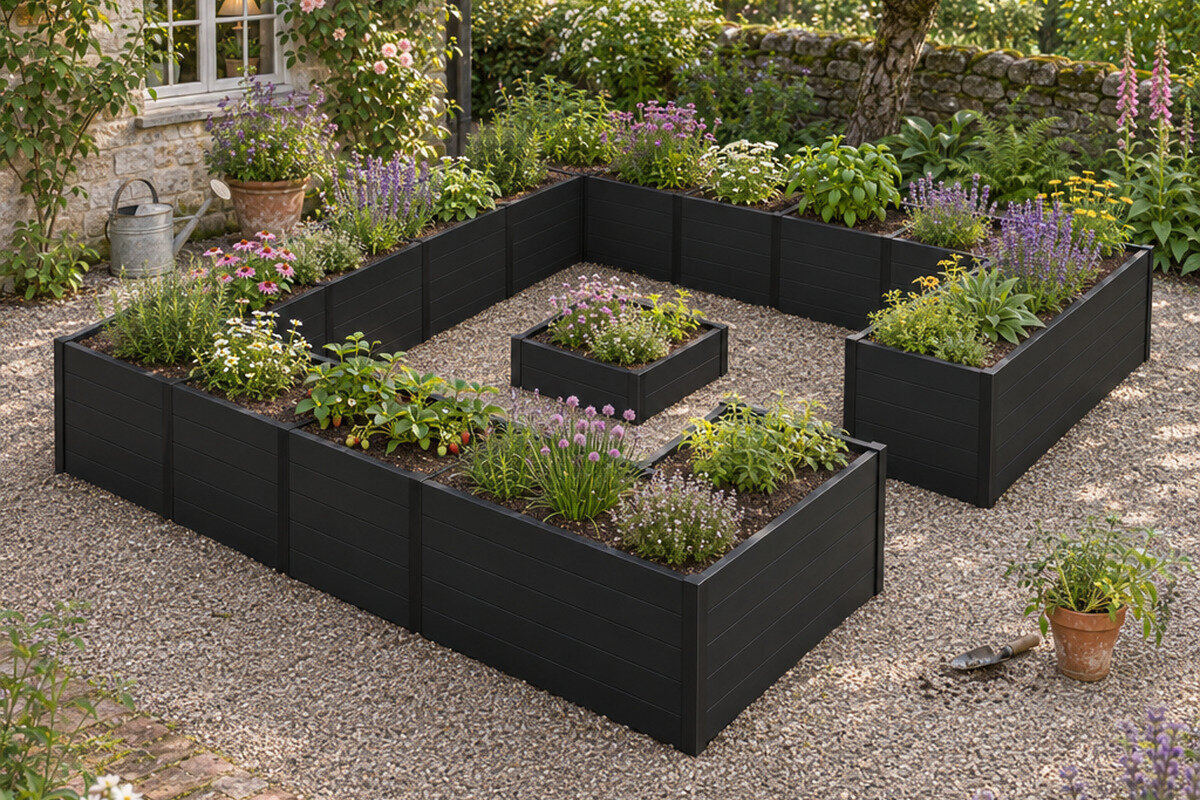
An access opening is not planting space. The uniform-height U-shaped garden bed planter has a nominal 118.11-by-78.74-inch overall footprint with five planting bays around a nominal 39.37-by-39.37-inch access notch. Check whether you can approach that opening from your path before deciding that the shape improves access.

04
Prepare the ground and dry-check the setup
Before assembling an open-bottom garden bed planter, inspect the ground inside the marked outline. Look for low spots where water collects and check whether the frame can sit as directed. For an edible bed, bring any concerns about past site use or soil contamination to your local extension office or a soil-testing service before you cover the ground. Ask what assessment is appropriate for the concern.
The Bloomcabin models shown here are supplied unassembled. Read the instructions for the exact model, then lay out the components and compare them with the parts list. The long, narrow aluminum model uses T connectors where the long wall sections meet; the uniform-height U-shaped model has T connectors and cross connectors. Use the model’s own instructions for placement and assembly rather than copying a joint you can see in another product photo.
If the ground needs preparation, do it before the frame is filled. Use the model’s instructions to check how the frame should sit at ground level. With a divided bed, confirm the divider is in the intended position; with a U-shaped bed, check that the notch opens toward the working path. Resolve a missing part, uncertain joint, or mismatch with the site before loading soil into the frame.
Take one last walk around the empty garden bed planter with whatever you’ll use to move the fill. A layout that works for harvesting by hand may still be awkward to fill from the available path. If you need to change the orientation, now is the time.

05
Estimate fill from the space you’ll actually fill
For a rectangular garden bed planter, measure the inside length and width once the frame is assembled. Decide how deep the added material should be after checking the product instructions, site conditions, and crop needs. Use that intended fill depth, not the full wall height, unless you actually plan to fill to that height and the instructions allow it.
Multiply inside length by inside width by intended fill depth. If all three measurements are in inches, divide the result by 1,728 to get cubic feet. For a divided garden bed planter, calculate the volume of each bay and add the results. If the bays differ in height, set the intended fill depth for each one. Never use the full outside rectangle of a U-shaped frame; that would count the access notch as soil.
Think of that answer as the volume of material you’re trying to place inside the walls, not the total soil available to roots. A shallow frame over suitable ground and the same frame over difficult soil can have the same fill volume but offer different conditions for a crop. If you need help deciding what growing material to use, ask your local extension office or soil supplier about your site and crop plan rather than assuming one mix works everywhere.
If you’re comparing two models before you buy, ask for inside dimensions or wait to order the fill until you can measure the assembled garden bed planter. Compare fill costs separately from frame costs: the shorter and taller versions of the same footprint can call for quite different amounts of material.

06
Worked example: two frames for the same narrow strip
Hypothetical example: A gardener has a 48-by-24-inch strip of exposed ground beside a garden edge and wants a compact garden bed planter for salad leaves. The working path is outside that rectangle, along the full long side. They can reach the far edge from the path, and for this example the underlying soil is assumed suitable for the planned crops.
The narrow classic aluminum frame with 3.94-inch walls and the narrow Accoya fusion frame with 23.62-inch walls both have a nominal footprint of 39.37 by 19.69 inches and a nominal planting area of 5.38 square feet. On paper, that leaves 8.63 inches of spare length and 4.31 inches of spare width across the strip in total, not on each side. The gardener checks the actual clearance before ordering, including room to handle the frame during setup.
They choose the shorter garden bed planter because the goal is to define a strip over suitable soil, not to move the planting surface much higher. The taller model would not add listed planting area. If further inspection raised doubts about the soil beneath the frame, they would stop and reassess the site instead of assuming the taller open-bottom model would isolate it.
For the fill calculation only, suppose the assembled interior measures 38 by 18 inches and the planned fill depth is 3 inches. These are hypothetical inputs, not published product measurements or a recommended fill level. Multiplying gives 2,052 cubic inches; dividing by 1,728 gives about 1.19 cubic feet. On a real installation, the gardener would use measured inside dimensions and a fill depth suited to the setup before buying soil.

07
Plant for the space and care for each bay
Sketch what will go in the garden bed planter before opening a seed packet. Start with crops you’ll use and mark their mature spacing, not just where the seedlings will fit. If a taller crop will cast shade, check its position against the light you observed on-site. Leave the plants you expect to pick most often within easy reach from the path.
Use the seed packet and your local extension planting guide to decide whether to sow directly or set out transplants and when to do it. In the narrow-strip example, the gardener could start with one salad crop that fits the local planting window, leaving space for a later sowing if the timing works. There’s no need to fill every bay or sow the entire strip on the first day.
Once the garden bed planter is planted, check moisture where the seeds or roots are rather than judging from the surface alone. A raised bed can dry faster than nearby ground. Check a newly sown section separately from a bay with established plants, and direct water where it’s needed instead of giving every bay the same amount by habit.
Keep a short record of planting dates, what you harvested, and which corners were awkward to reach. If a bay looked crowded at maturity, use that observation to revise next season’s layout. If growth was poor, check moisture and crop conditions before adding fertilizer; use crop guidance and soil-test recommendations when deciding what to add.

Questions readers ask
Can I put a garden bed planter on a paved patio?
The Bloomcabin frames shown here are designed to sit over prepared ground and have no floor panel. For a paved site, look for a container designed to hold soil and drain on that surface. On a deck or balcony, also verify that the site can support the filled container.
Does a taller garden bed planter give plants deeper roots?
Not necessarily. Taller walls can hold more fill at the same footprint if you use the extra height, but the wall measurement is not a rooting-depth measurement. With an open base, both the depth of the fill and the condition of the ground below matter.
Can I order soil from the listed area of a garden bed planter?
Use the listed area to compare models, not as the sole basis for ordering. Measure inside the assembled bed and use your intended fill depth. For a divided or U-shaped model, calculate each planting bay separately and leave out access openings.
Make the purchase in this order
Verify the base and model specifications, mark the footprint and working path, then check the soil beneath the frame. If those checks pass, choose the garden bed planter that fits the job, measure for fill, and let your local planting guidance determine what goes in first.
Find a raised bed for your plan
Compare layouts and check the dimensions on the product page.
