
Greenhouse vs. cold frame: two ways to hold on to the season
Bloomcabin field guide / season extension
Greenhouse vs. cold frame: two ways to hold on to the season
Under the same winter sun, one structure creates a room of moderated weather. The other makes a close, low pocket of warmth above the soil. The better choice is not simply the larger one. It is the one that matches the amount of growing life you want to enter.
Cold frameLow solar pocket
GreenhouseWalk-in air volume
The real questionHow much season?
01 / The opening proposition
Decide how much atmosphere you need.
A cold frame and a greenhouse are both season extenders, not weather-proof promises. Each captures solar energy, shelters plants from wind, and can soften the handoff between outdoor weather and the crop you want to grow. Their physical scale, however, changes nearly everything: the speed at which they heat, the way they cool after sunset, what fits inside, how you water, and how much attention they need.
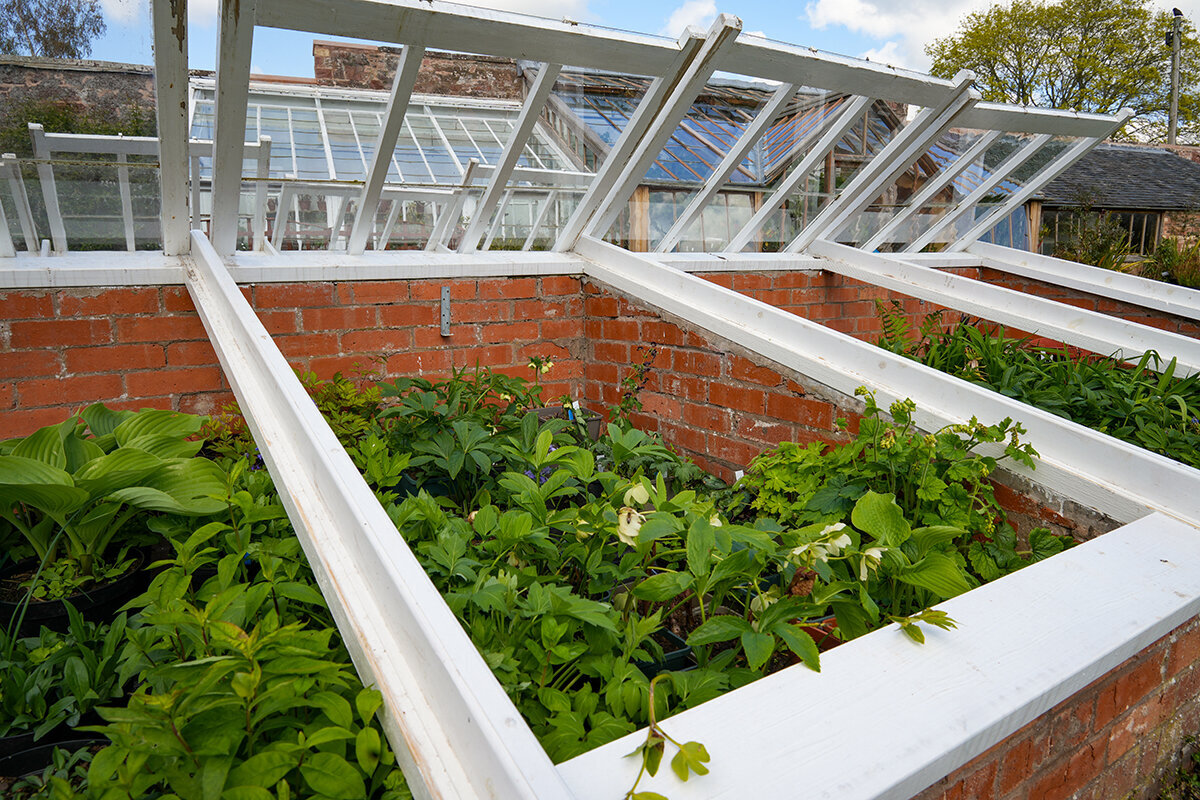
Think of a cold frame as a transparent lid over a precise piece of garden. It is close to the soil, usually unheated, and particularly useful for cool-season crops, hardening off seedlings, and short periods of protection. Think of a greenhouse as a structure you enter. Its greater height and volume make room for benches, trays, tall crops, tools, airflow, and a more deliberate cultivation routine.
For a first experiment with spring lettuce, fall spinach, or a less abrupt move from indoor lights to the garden, a cold frame can be wonderfully exact. For gardeners raising many transplants, tending tall crops through unsettled weather, or wanting to work among plants rather than merely cover them, a greenhouse becomes a different kind of garden infrastructure.
Greenhouse / the tall definition
A glazed structure with enough height to create a working climate.
A home greenhouse is an enclosed growing space with transparent glazing, a door, and usually roof ventilation. It may be unheated, seasonally heated, or equipped with active climate control. The essential distinction is not glass alone; it is usable interior volume. That volume lets warm air rise, gives the gardener room to move, and makes benches, shelving, irrigation, and taller crops practical.
Cold frame / the low definition
A shallow, usually bottomless box with a transparent hinged cover.
Cold frames are commonly built with rot-resistant wood, masonry, or durable sidewalls and a glass or rigid-plastic lid. They are generally unheated, close to the ground, and opened manually or with an automatic opener when sun drives temperatures upward. University of Minnesota Extension describes the essential form as a shallow, unheated box that uses sunlight for daytime warmth and night protection. Read its cold-frame guidance.
Terminology can blur at the edges. Add bottom heat and a cold frame is often called a hotbed. A low tunnel covers a row rather than forming a box. A high tunnel is walk-in but generally soil-based and passively heated. For a homeowner deciding between these familiar structures, the clearest test is simple: do you lift the lid from outside, or open a door and work inside?
Do not confuse enclosed with frost-free. An unheated greenhouse and a cold frame both depend on sun, stored heat, insulation, ventilation, and the severity of the night. Neither should be assumed to protect tender crops during a hard freeze without an appropriate plan.
02 / Cold-frame climate
LOW
Warmth held close to the soil.
A cold frame is tightly coupled to the bed beneath it. Sun enters through the lid, warms the air and soil during the day, and the enclosed space blocks some wind. Because the volume is small, conditions can change quickly: a bright cool day may demand venting, while a clear night can remove stored heat rapidly.
Where a cold frame is at its best
It is exceptionally good at doing a few things well. Start hardy greens earlier, hold salad crops later into fall, protect a small collection of plants from chilling winds, or transition indoor-raised seedlings to real sun and fluctuating outdoor temperatures. Illinois Extension notes that plants may grow in the frame soil itself or in trays and pots, and that the cover should be vented on warm sunny days. See the season-extension notes.
- Good fitSpinach, lettuce, arugula, radishes, scallions, kale, brassica starts, herb starts, and trays being hardened off.
- Daily ritualRead the forecast, open the lid before excess heat builds, check moisture, then close the frame before evening cools.
- Physical limitCrop height and reach are constrained. Plants needing vertical room, staking, or frequent harvest can outgrow the frame's usefulness.
- Design valueA cedar-edged frame can disappear into a raised-bed composition instead of becoming another building in the yard.
03 / Greenhouse climate
A greenhouse gives plants—and the gardener—more room to behave.
Height is not merely an architectural luxury. It creates a larger buffer of air, separates foliage from the roof, and gives warm air somewhere to rise before it is vented. It also makes a cultivation system possible: raised benches for seed trays, shelves for propagation supplies, a central path, vertical supports for vines, and a door through which you can carry soil, pots, and harvest baskets.
That does not make a greenhouse effortless. More exposed glazing means strong solar gain on bright days and more surface through which heat can be lost at night. Ventilation, shading, watering, sanitation, and seasonal reset become part of ownership. Oklahoma State University's hobby-greenhouse guide emphasizes that bright days can overheat a greenhouse even in cold weather, and that ventilation is an all-season requirement. Read the greenhouse management guide.
For serious home gardeners, the payoff is range. A well-sited greenhouse can support propagation in late winter, tender crops during unsettled spring weather, summer production with attentive ventilation, and a longer finish for greens and herbs in fall. The Classic Aluminum Greenhouse is designed for gardeners who want that working room expressed through refined aluminum framing, roof ventilation, and glazing choices suited to the intended use.
04 / Thermal behavior without false certainty
Both collect sun. They manage it differently.
The useful comparison is not a promised temperature increase. It is the route that sunlight, air, soil, moisture, and ventilation take through each structure—and how quickly conditions can change when clouds, wind, or night arrive.
Cold frame
Solar pocket at ground level
Greenhouse
Inhabitable volume above the garden
Sun entersSoil storesLid vents
Sun entersAir risesRoof vents
Cold-frame behavior
Light strikes a small transparent lid and warms contained air, plants, and soil. Much of that useful warmth remains near the bed. Lift or prop the lid to release heat; this is simple, but hands-on and sometimes abrupt. Small air volume also means that conditions can cool quickly after sunset. Soil and any added thermal mass can moderate that swing, but they cannot eliminate the risk of damaging cold.
Greenhouse behavior
Light enters through a larger glazed envelope and warms plants, benches, floor, soil, and air. Warm air tends to stratify upward, while the larger interior gives more room for circulation and crop spacing. Roof vents, doors, side openings, fans, and shading can all help manage heat. Stored daytime warmth still declines at night, so an unheated greenhouse is protective rather than automatically warm enough for every crop or climate.
Read the plant-level climateUse a reliable thermometer at crop height rather than relying on how warm the structure feels when you step inside. Plants can be damaged by heat stress, chilling, excess humidity, or dry media before a brief inspection tells the whole story. Penn State Extension also notes that ventilation helps maintain steadier greenhouse conditions when heat is not required. Explore its greenhouse production overview.
05 / Crops and duration
Choose by what you want to grow for how long.
A cold frame favors low crops and short transitions. A greenhouse earns its footprint when crop height, quantity, succession sowing, or season length becomes the governing concern. Neither replaces outdoor beds; each gives those beds more useful weeks.
- — Cold frame: a dependable place for salad greens, radishes, hardy transplants, and seedlings moving gradually from indoor conditions to the garden.
- — Cold frame: a thoughtful fall finish for greens already nearing harvest, rather than a place to force major new growth in the darkest weeks.
- — Greenhouse: a propagation room for multiple trays, where potting, labeling, watering, and staging can occur at bench height.
- — Greenhouse: a better fit for trellised tomatoes, cucumbers, tall ornamentals, citrus, and tender container plants—provided their light, heat, and ventilation needs are met.
- — Either: a protected place to harden off seedlings before planting warmth-loving crops into variable spring conditions.
- — Neither alone: a substitute for varieties and planting dates that match your local climate. Maryland Extension's vegetable-planting guidance is a useful local-planning model.
06 / Access changes the habit
The daily choreography is radically different.
Cold frames ask you to kneel, lean over a low edge, lift a lid, and reach toward the back. For a compact bed and occasional use, that intimacy is part of their charm. But it matters if mobility, back comfort, safe lifting, or daily tray work are part of the decision. A glazed lid can be awkward in wind, substantial in weight, and hot to handle after full sun.
A greenhouse generally favors standing work. Bench height reduces repeated bending; a central path makes it easier to carry watering cans and flats; roof vents can release heat without exposing the whole crop at once. The tradeoff is a more complete routine: opening and closing, checking water, managing shade, cleaning glazing, and observing pests or disease in an enclosed environment.
↘EnterWalk in or work outside.
↑ReachBench height or back edge.
⌒VentRoof path or lifted lid.
≋WaterSystem routine or close check.
□ResetRoom care or bed care.
Practical implication: a greenhouse can be planned around standing, carrying, staging, and turning with a tray in hand. A cold frame benefits from a narrow enough width to reach its center from the side, a secure lid support, and sufficient clearance for opening. If repeated kneeling or lifting is uncomfortable, that operational difference may matter more than the purchase price.
07 / Footprint, wind, anchoring, permanence
Site for winter light, safe access, and the weather your yard actually receives.
A cold frame can sit beside a kitchen garden or become the top of a raised bed. It needs direct sun when you want it to work, a firm level base, drainage, and enough room for the lid to open without striking a fence or planting. Across much of the United States, a south or southeast exposure can be helpful for shoulder-season light, though the shade patterns of nearby houses and trees are often more important than a compass-perfect orientation.
A greenhouse deserves slower planning. Measure not only the footprint but door clearance, paths, water access, electrical needs if you intend to add equipment, roof runoff, nearby trees, and how snow or wind moves across the site. Oklahoma State University recommends a well-drained, nearly level location with substantial winter light and attention to wind protection. The exact implications differ between a windy Great Plains property, a snowy Northeast yard, a humid Gulf Coast garden, and a dry Western landscape.
For a premium permanent structure, select a model and anchoring method appropriate to local wind and snow exposure, then confirm installation requirements with the manufacturer and local authority. Bloomcabin's greenhouse design guide is a useful starting point for comparing sizes, glazing choices, and siting possibilities.
08 / One year, localized
A season relay, not a promise of year-round tomatoes.
The dates move dramatically from Florida to Minnesota, coastal California to interior Colorado. Treat this as a sequence of jobs, then shift each phase according to local frost dates, crop choices, available light, and the particular weather your site collects.
Late winterStart & shelter
Early springHarden & vent
Late springMove & manage
SummerShade & irrigate
Fall / early winterFinish & protect
In late winter, a greenhouse can organize propagation where light, heat, and ventilation are sufficient, while a cold frame can wake hardy greens or stage cold-tolerant starts on favorable days. In early spring, use the frame to harden seedlings gradually and vent generously in sun; use the greenhouse to pot on transplants and protect tender plants through unsettled nights.
By summer, a cold frame may become an open bed or temporary nursery, while a greenhouse requires focused attention to airflow, shade, and consistent irrigation. In fall, the cold frame is well suited to finishing leafy crops and holding hardy greens through chilly nights. A greenhouse can extend herbs and greens, shelter selected containers, and begin cool-season trays. A productive pairing is often sequential: propagate under cover, grow outdoors, then protect the fall crop close to the bed.
09 / Cost is only one kind of commitment
Ownership effort should be part of the budget.
A cold frame can be a modest, highly useful project. It has a smaller material bill, less visual presence, and a limited maintenance burden. Its true cost is attention at the moments when weather changes quickly. In a bright spring week, the person who remembers to vent it owns a much better cold frame than the one who does not.
A greenhouse requires more initial planning and investment, but it can concentrate a large amount of gardening activity in one place. It also makes accessories, utilities, and long-term maintenance more relevant: gutters, glazing care, vent openers, shelving, shade cloth, irrigation, and possibly heat or circulating air.
- Cold frame maintenanceInspect hinges, supports, glazing, and wood finish; clear leaves and snow safely; keep the lid operating smoothly; renew media and remove diseased plant debris.
- Greenhouse maintenanceClean glazing and gutters, inspect seals and moving parts, maintain vents and irrigation, monitor condensation, sanitize between crop cycles, and follow the structure maker's maintenance guidance.
- Energy expectationAn unheated greenhouse is not the same as a heated winter greenhouse. If you intend to heat, calculate operating implications before selecting crops or equipment.
- Expansion potentialA cold frame is easy to repeat around beds. A greenhouse is more scalable inside itself: add benches, staging, drip irrigation, shading, and a better propagation workflow over time.
10 / The decision tribunal
Choose the structure that matches your gardening ambition—not an abstract ideal.
Use this comparison as a decision tool rather than a scorecard. A cold frame is not a lesser greenhouse; it is a precise answer to a smaller question. A greenhouse is not automatically the mature choice; it is the right answer when working room, crop range, and repeated daily use justify a more permanent climate envelope.
| Decision factor | Cold frame is usually stronger when… | Greenhouse is usually stronger when… |
|---|---|---|
| Crop ambition | You want hardy greens, protected seedlings, and a compact hardening-off station. | You want propagation capacity, tall crops, container collections, or extended multi-crop use. |
| Available space | You can spare a bed-sized footprint but not another garden building. | You have room for structure, access paths, and a location with meaningful winter sun. |
| Access and posture | Kneeling and lid lifting are comfortable, and visits are short. | You value standing work, bench height, tray carrying, and easier reach to plants. |
| Climate management | You prefer a simple lid-and-thermometer ritual for a small area. | You are ready to monitor ventilation, irrigation, humidity, and heat across a larger enclosed space. |
| Permanence | You want a low-profile, integrated garden element that is easy to adapt or relocate. | You want a durable visual anchor that can support a long-term growing system. |
| Future growth | You may add another frame beside another bed as needs develop. | You expect the garden hobby to deepen and want capacity to organize it well. |
Choose a cold frame
When protection is targeted.
You primarily need a protected pocket for greens, seedlings, and seasonal transitions, with minimal footprint and a close relationship to the soil.
Choose a greenhouse
When the growing room is part of the pleasure.
You want standing access, propagation space, taller crops, better organization, and a structure that can evolve with serious gardening. Explore Bloomcabin's Classic Aluminum Greenhouse for a refined walk-in starting point.
Choose both
When each can do its own job.
Use the greenhouse for seed starting and growing volume; use a cold frame beside the beds for hardening off, cool-season harvests, and localized protection.
11 / Frequently asked questions
Small questions with large seasonal consequences.
Is a cold frame basically a small greenhouse?
In everyday language, it can be described that way because both use transparent covers to capture solar warmth. In practical garden planning, the difference is significant: a cold frame is a shallow, low structure operated from outside, while a greenhouse is a walk-in enclosed growing space with much greater air volume, crop height, and workflow capacity.
Will a cold frame keep plants alive through freezing weather?
It can protect cold-tolerant crops through moderate cold, but it does not guarantee frost-free conditions. The outcome depends on the crop, lid fit, daytime sun, wind, soil moisture, overnight low, insulation, and any extra protection used. Open or vent the frame on sunny days to avoid overheating.
Does an unheated greenhouse extend the season?
Yes. It can provide meaningful shelter, a more manageable propagation space, and longer shoulder seasons. It still follows outside weather and available sunlight, however. Winter production of tender crops may require heat, supplemental light, careful ventilation, and a realistic understanding of operating costs.
What is the best first use for a cold frame?
Hardening off seedlings is one of the most forgiving and useful first uses. Start with cool-season greens or brassica starts, learn the venting pattern, and use a thermometer. Once you understand how your frame responds to sun and wind, try spring and fall salad crops.
What should I prioritize when choosing a greenhouse?
Start with site conditions and intended crops, then choose enough working room for benches, paths, watering, and ventilation. Look beyond nominal floor area: door access, roof vents, glazing, anchoring, drainage, snow and wind exposure, and your ability to visit daily are central to long-term satisfaction. For compact gardens, a mini wall greenhouse can offer a useful middle scale between a cold frame and a freestanding structure.
Sources & further reading
Garden guidance worth keeping close.
These university Extension resources informed the practical distinctions in this article. Use them to adapt broad principles to the weather patterns and planting windows where you live.
- University of Minnesota Extension — Extending the growing season: start early, end later
- University of Illinois Extension — Starting a Garden: Season Extension
- Oklahoma State University Extension — The Hobby Greenhouse
- Oregon State University Extension — Growing vegetables in Central Oregon
- University of Maryland Extension — When to Plant Vegetables
- Penn State Extension — Greenhouse Production
Low cedar openingExplore compact growing spaces for close-to-the-bed gardening.
Tall glass openingExplore the Classic Aluminum Greenhouse for a lasting walk-in growing room.
Bloomcabin / plan with intent
Choose how much season you want to step into.
Compare structure sizes, siting needs, glazing, and the crops you want to grow before making your garden's next climate decision.
