
Hot Tub Delivery: Gates, Access Routes and Lifting Options
Delivery access
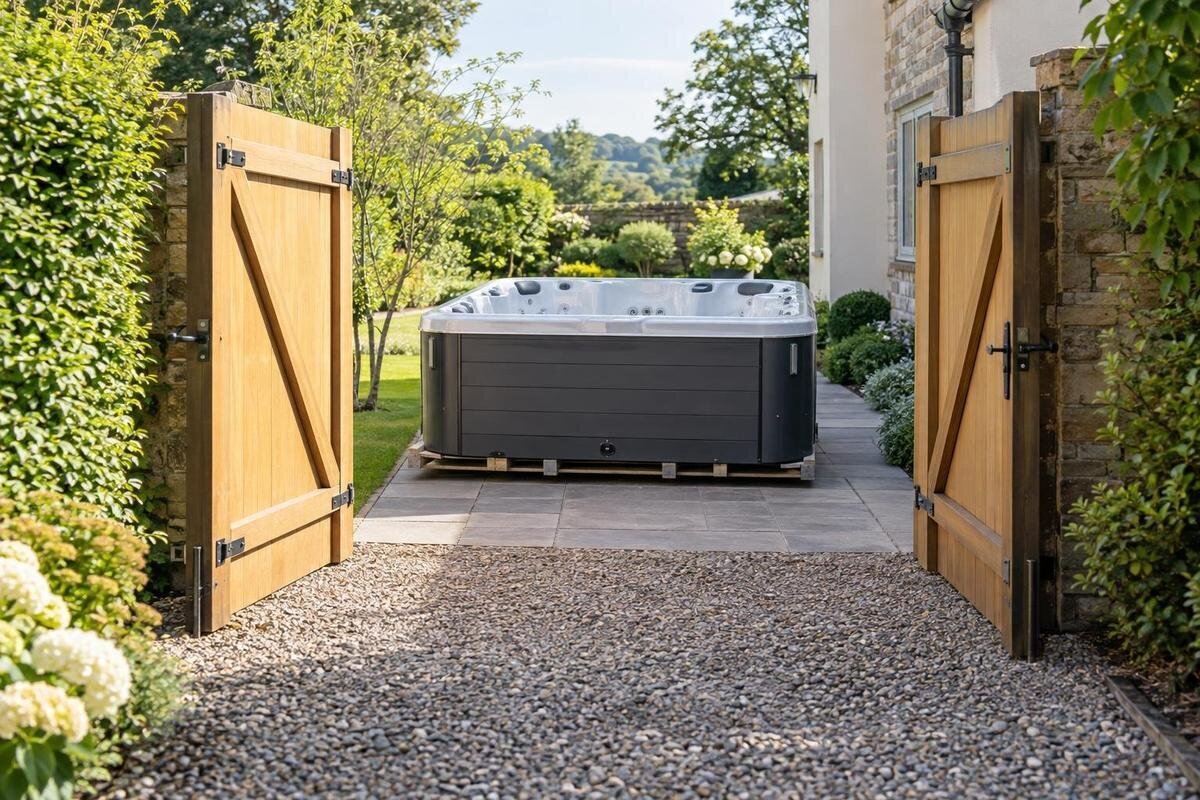
An outdoor hot tub can fit its intended spot and still be impossible to bring there by the planned delivery method. The critical path begins where the delivery vehicle can stop and ends at the installation area; every gate, doorway, turn, step, slope, and overhead restriction between them matters. Before ordering, document that route, compare it with confirmed model-specific shipping dimensions and handling instructions, and ask the carrier whether its service covers the path. If standard delivery is not confirmed, explore a professional lift early, with the supplier, carrier, and lift provider agreeing on responsibilities.
01
Why the full delivery route needs review
Choosing a place where the tub fits is only one part of delivery planning. The shipment must travel there in the form and orientation the carrier uses, along a continuous route whose narrowest opening, tightest turn, lowest overhead point, and steepest level change all matter. A clear destination does not compensate for a gate that cannot open far enough or a corner that cannot be negotiated. Treat the tub’s installed dimensions, the package dimensions, and the handling path as separate questions. A listing for Bloomcabin Hot Tub Cove 2 identifies the model, but the name alone does not establish its shipping size or delivery method.
Before ordering, draw the route from the delivery vehicle’s proposed stopping point to the precise installation area, then compare every segment with the selected model’s confirmed delivery information. Include a side yard, gate, doorway, shared passage, or change in level, even if it looks routine. Note the smallest opening and every place where the shipment would need to turn; the same narrow point can present different problems depending on the shipment’s shape and handling method. Record temporary obstacles too, such as stored items or a gate that does not open fully. A photo of the final spot cannot reveal an earlier pinch point, so ask the seller to review the entire path.
Where can the delivery vehicle stop?
Start at the point where the delivery vehicle is actually expected to stop, not at the property line or driveway entrance. Ask the seller or carrier what vehicle access and stopping conditions it needs, whether the vehicle is expected to enter the driveway or remain at the curb, and how the shipment is transferred from the vehicle. A narrow street, shared drive, steep entry, low branch, or limited turning area can affect the stopping point even when the yard route beyond it is clear. Do not guess whether the truck can reach the house; get the carrier’s requirements for this address and confirm where its standard service ends.
Mark the proposed stop on a simple plan and photograph the approach from both directions. Note the distance and route from that point to the first gate or passage, along with any locked access, slope, or shared entrance. Confirm whether the stated delivery includes moving the shipment beyond the unloading point and, if so, how far. When discussing delivery of Bloomcabin Hot Tub Haven 6, ask which vehicle and handling service the supplier proposes for your address. If the stopping point may change because of a gate, street constraint, or vehicle access, tell the supplier before purchase and ask the carrier to review the actual alternative.
02
Map the full route to the installation area
Walk the route as the shipment would travel it. Draw a line from the confirmed vehicle stop to the final area and label every gate, doorway, narrow passage, turn, set of steps, slope, and overhead obstruction. Map the path’s shape rather than measuring only the straight-line distance; a walkway can narrow at a post, tree, fence, or corner. If there are two possible routes, map them separately and state which one is genuinely available to the delivery crew. A possible shortcut across a neighbor’s property is not a usable route until permission has been confirmed.
Take photos in sequence so someone unfamiliar with the property can follow the route from the stopping place to the destination. Add close-ups of tight points and a sketch showing which way each turn leads. Note whether gates stay open, doors have thresholds, or objects might be moved, and identify who has permission to move them. If you are considering Bloomcabin Hot Tub Fjord 8, send this route record with the exact model name and ask the supplier to match it to current shipping and handling information. Use photos to show the route, not to estimate the tub’s dimensions.
Measure gates, doorways, and tight turns
For each gate or doorway, measure the clear opening with it in the position it would have during delivery. Posts, hinge barrels, latches, handles, trim, or a wall edge can reduce the usable space. Record the opening’s width and height, and note whether the route narrows immediately before or after the frame. Where an opening or passage tapers, measure the restrictive points rather than relying on its widest part. If a gate or panel could be removed, confirm who is authorized to do that, whether the carrier accepts the altered route, and who will restore it. Do not treat a removable obstacle as solved until those arrangements are agreed.
A straight passage and a turn need different evidence. A width measurement alone does not show whether there is room to change direction; note the space to the opposite wall, fence, railing, or other obstruction, and photograph the corner from both approaches. Do not assume the shipment can be tilted, turned on its side, or carried in a particular orientation; ask for the manufacturer’s and carrier’s limits. If you are considering Bloomcabin Hot Tub Aurora 10, have the carrier review the gate and turn together using verified package dimensions, rather than treating each opening as a separate clearance check.
03
Account for steps, slopes, and level changes
Steps, raised thresholds, curb-like transitions, and sloped sections need more than a general note such as ‘uneven.’ Record the number and arrangement of steps, where landings occur, and whether the route changes direction between flights. Note which transitions sit just before or after a narrow space, since their position can affect the handling route. Photograph the full stairway or slope from both ends, with a side view where it helps show the change in level. If you provide measurements, say exactly what each one describes; a note that there are three steps may not tell the carrier how they are arranged.
Ask the carrier which kinds of level changes its service includes and what details it needs to assess them. Policies and equipment vary, so do not infer that a crew can manage stairs, a ramp, or a slope because a previous delivery did so. Do not build an improvised ramp or plan to help lift the tub yourself; any special method should be confirmed by the responsible professionals and checked against the manufacturer’s instructions. If Cove 2 hot tub is on your shortlist, ask the supplier to review the same step and slope record against that shipment’s verified handling requirements.
Check overhead clearance along the route
Look above the route from the vehicle stopping point to the installation area. Low eaves, porch roofs, overhanging branches, awnings, lights, cables, utility lines, or a gate canopy can restrict available height, even where the ground-level opening looks generous. Note the lowest point and whether it occurs along a straight passage or above a turn. Distinguish fixed obstructions from things that might be changed, but do not assume a branch, wire, or fixture can be moved. If utility equipment or lines are involved, keep clear and consult the relevant utility or a qualified professional.
Photograph an overhead obstruction from the direction the shipment would approach, then take another view showing its relation to the opening or corner. If you can measure the clearance safely, record the measurement and the exact point; otherwise mark it as unknown rather than estimate. Ask the carrier what clearance its planned handling method needs, and have a lift provider review the same information if a lift may be necessary. For delivery of Haven 6 hot tub, compare the confirmed shipment height in its planned transport orientation with the available clearance. Have the carrier resolve any unknown measurement before treating the route as clear.
04
Compare measurements with shipping and handling requirements
Compare your route measurements with the dimensions of the shipment as it will arrive, not only the tub’s advertised or assembled dimensions. Ask the seller or manufacturer for current, model-specific measurements of the packaged unit and any transport frame or handling equipment that affects its envelope, if applicable. Clarify which figures describe the tub and which describe the shipment. Ask whether protective packaging or a pallet changes the dimensions, and whether the shipment must pass through the route in a specified orientation. These are details to verify for the chosen model; neither a product image nor a number in a model name is reliable evidence of size.
Request the current moving and lifting instructions, including any stated limits on orientation, approved lifting points, or equipment. Then ask the carrier to confirm that its method follows those instructions and fits the route you documented. Do not interpret lifting points yourself or decide to lay the tub on its side. Send the route sketch, measurements, and photographs together so the supplier can compare them with the shipment and handling assumptions. For the Fjord 8 hot tub, request details for that exact model rather than borrowing specifications from another listing or assuming all models ship alike.
When a crane or other lift may be needed
A lift may be worth investigating when the normal route has a fixed bottleneck, a turn or level change the carrier will not handle, or no path that meets its requirements. That does not automatically mean a crane is feasible or necessary. A qualified provider needs to assess the particular site, the proposed lift, the available working area, delivery access, and the intended set-down point. Share the exact model, verified shipment information, route photos, and overhead notes; a description such as ‘over the fence’ leaves too many questions open. Ask whether the provider needs a site visit before confirming a method.
Compare only options that the supplier, carrier, and qualified lift provider confirm can work together. Ask who takes custody of the shipment, where the lift ends, and whether moving it from that point to the installation area is included. A crane might place a shipment over an obstacle, but that alone does not resolve vehicle access, overhead conditions, coordination, or the remaining route. Another lifting arrangement may or may not be available at your property. Do not plan a do-it-yourself lift or rely on equipment mentioned only in an informal conversation; get the proposed method and its limits in writing before committing to an order.
05
Confirm who arranges delivery and extra handling
Before placing an order, separate the responsibilities of the retailer, carrier, and any lift contractor. Ask who books each service, provides measurements, confirms that the route is acceptable, and coordinates the handoff. Have the seller explain what its stated delivery service includes and excludes, particularly delivery beyond the vehicle, obstacles, steps, and special equipment. If a lift or extra handling is proposed, request a written scope and itemized quote. Ask whether a site survey, equipment, crew, travel, or coordination is included rather than assuming that a charge or service is standard.
Ask who handles permissions and property arrangements if the route uses shared land, crosses a boundary, or places equipment on or near public space. Requirements and private-property terms can depend on the site and proposed method, so confirm them with the relevant local authority, property owner or manager, and lift provider rather than guessing. Clarify responsibility for protecting property and responding to damage, and ask whether the provider’s insurance applies to the proposed work. If ordering Aurora 10 from Bloomcabin, make sure the delivery agreement identifies who arranges and pays for any lift, including services booked separately from the hot tub purchase.
Resolve access questions before placing the order
Prepare a concise access record: a route sketch, the confirmed vehicle stopping point, the narrowest measured openings, relevant heights, turn photos, steps or slopes, overhead restrictions, and any gate or obstacle that may change. Add the exact model name and the supplier’s verified shipping dimensions and handling instructions. Send this information to the carrier and ask it to review the route against its actual delivery service. Ask it to identify assumptions, required clearances, restrictions, or points that need a site visit. A useful reply addresses the route you submitted, not just the general availability of delivery in your area.
Choose standard delivery only when the carrier confirms that its service can handle the documented route and the shipment details match your measurements. If it cannot, resolve the specific blockage: confirm a genuinely available alternate route, compare another model using verified specifications, or arrange a professional lift with responsibilities and any needed permissions settled before purchase. If an opening, turning space, overhead height, or handoff point remains unknown, do not treat the lack of an immediate objection as approval. A clear response about your route is the basis for choosing between delivery methods.
Frequently asked questions
Should I measure the hot tub or the shipping package?
Ask for both, then plan around the shipment in the form the carrier will move. Confirm which measurements describe the tub and which include packaging or a transport frame, if applicable. Also ask whether the carrier requires a particular orientation. Do not assume the tub can be tilted or turned differently to get through a tight space.
Is measuring the gate opening enough?
No. Hinges, posts, latches, and the gate’s actual open position can reduce the usable space. A narrow corner immediately beyond the gate may also prevent a turn even when the opening itself appears adequate. Record the clear opening and the space on both sides of it, then send those details and photos to the carrier.
Will standard delivery include steps or a sloped route?
Only the seller or carrier can confirm what its service covers. Describe the number and arrangement of steps, landings, slopes, and transitions, and ask whether its proposed handling method can manage them. Get the answer for your actual route in writing; a general statement that delivery is available does not confirm access.
When should I investigate a crane or another lift?
Before ordering, as soon as a fixed obstacle or unconfirmed route makes standard delivery uncertain. Give a qualified lift provider the route photos, measurements, and verified shipment information so it can assess the site and proposed method. Confirm that the supplier, carrier, and lift provider can coordinate the delivery and handoff.
Who arranges and pays for extra lifting services?
Do not assume the seller, carrier, or buyer is responsible. Ask who books the lift, obtains any needed permissions, coordinates the delivery, and pays for each service. Request written scopes and quotes, and clarify what happens if the agreed route or conditions change.
Delivery access is a chain: the vehicle must reach a suitable stopping point, the shipment must pass every restriction, and the agreed handling method must cover the final movement. Route photos and measurements become useful when matched to the exact model’s shipping information and confirmed by the seller and carrier. If standard delivery cannot be confirmed, resolve the lift option before ordering rather than relying on the crew to improvise on arrival. That turns a vague access concern into a specific delivery decision.
