
How Many People Are Needed to Assemble a Garden House?
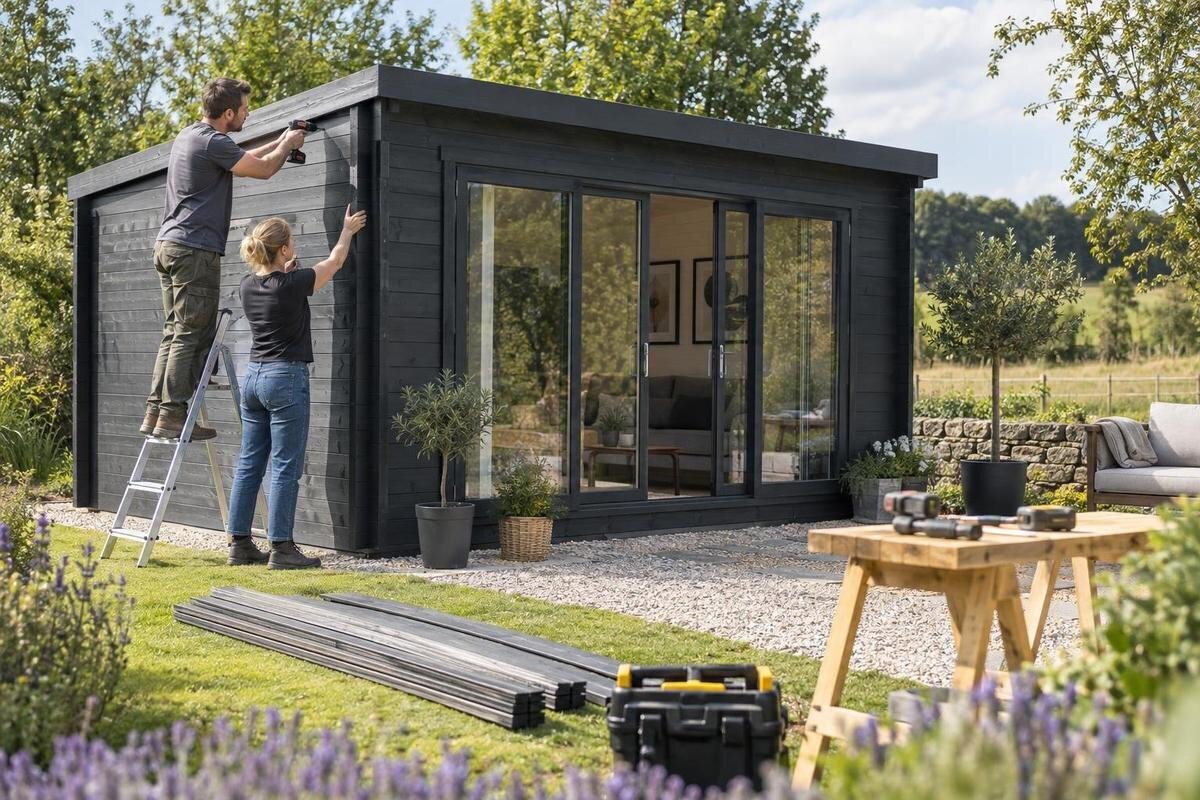
Garden house assembly planning
Wondering how many people are needed to assemble a garden house? The useful answer depends on the exact kit and on the steps that need shared handling. For a do-it-yourself plan, two capable adults are a sensible starting point for the main assembly, not a guarantee for every model. Before ordering or booking help, check the current instructions, component-handling needs, delivery route, and whether helpers can stay for the critical stages. Those details show whether two are enough, a third person is useful, or professional assembly is the better fit.

01
A useful planning baseline is two adults
There is no dependable one-size-fits-all crew number. For a homeowner planning a do-it-yourself build, budget for two capable adults for the main assembly unless the instructions for the exact kit say otherwise. Treat that as a practical starting point, not a guarantee that every garden house can be assembled by two people or finished within a particular time. Some steps may require one person to position a component while another follows the sequence or checks the guide. Two people can coordinate those tasks and pause to confirm a step rather than asking one person to manage several things at once.
One person may handle preparation—reading the guide, laying out specified tools, checking part labels, or clearing the work area—but readiness for those tasks does not prove the full build is suitable for solo work. Do not assume a lone assembler can lift, steady, align, and secure every component. Check for any explicit helper requirement in the maker’s instructions and follow it. If a part or step is beyond what the people present can manage comfortably, add suitable assistance or hire an installer rather than improvising or rushing. Count the team needed for the hardest planned stage, not just the easiest work; do not count someone who can attend only for delivery if the build also needs them. Consider how long that demanding stage may last, too. A helper who can only assist briefly may not cover a task that requires coordinated positioning, checking, and securing in sequence.
Use the exact kit’s assembly instructions
Before counting people, find the current assembly guide for the exact model and variant you may order. A category label or product photo cannot tell you whether particular steps require shared handling. If you are considering the Verdana 1 garden house, use that exact model name when requesting the guide, parts list, and any stated crew requirement. Check the identifier on the documents against the item in your order details or quote; a similar-looking model is not a reliable stand-in. Save the guide and the seller’s response so everyone helping can review the same information before work starts.
Read beyond the cover page. Note any explicit instructions about the number of people, which stages need help, and whether the assembly is expected to follow a particular sequence. If the guide gives a minimum crew size, that takes priority over a general rule; if it asks for more, arrange that before ordering or scheduling labor. If no crew number appears, do not treat silence as permission to work alone. Ask the seller for current guidance on the exact kit, and avoid basing your estimate on a neighbor’s different model or an online video that may show different components. Check whether the guide distinguishes between basic assembly and any optional elements. That distinction can affect who needs to be present and when, even when the main structure appears straightforward.
02
Part size and handling can change the crew
The shape and handling of individual pieces can matter more than the building’s advertised floor area. Long or wide panels, heavy components, pieces that need careful positioning, or parts that are awkward to grip can require another person even when the overall kit seems modest. Check component dimensions and weights if the maker supplies them; otherwise, request the information relevant to carrying and positioning. For the Verdana 2 garden house, as for any model you are evaluating, ask about the actual kit details rather than using the product name as a proxy for effort.
Plan around the hardest handling stage, not the number of parts or boxes. Consider the route from the staging point to the assembly area, the space available to turn, and whether people can reach the work without getting in one another’s way. A component that is manageable in an open area may be harder to control along a narrow path or at an elevated position. Follow the kit’s handling instructions. If a planned move exceeds the team’s experience or capacity, arrange professional help instead of assuming that adding untrained people makes the task manageable. Also consider where a component can be set down safely if the team needs to pause. A clear, level temporary resting place can prevent a rushed decision when a route or position proves more difficult than expected.
When a third helper is worth scheduling
A third person can be useful when the instructions call for additional help, when a planned step needs another set of hands, or when the main assemblers would otherwise have to divide their attention between handling and finding parts. The extra person might read the next step, identify a labeled component, or bring a specified tool—but that support role is different from being asked to hold a component. If you are considering the Durano garden house, ask for any model-specific crew guidance before deciding whether to schedule a third helper.
Book the additional person for the stage when their role is needed, not just for an initial delivery or brief setup if support is needed later. Agree in advance who leads and who assists, and make sure the work area has room for everyone present. More people are not automatically faster: a crowded space or several people giving directions can create delays. If the planned work needs professional skill or equipment, extra friends are not a substitute for an installer who can handle that scope. Tell the third helper the expected arrival time, likely task, and how long they may be needed. Clear expectations make it easier to avoid an unnecessary wait or a gap in coverage during a critical step.

03
Delivery access and staging affect the plan
Treat delivery, unloading, carrying the kit to the site, and assembly as separate questions. A delivery appointment does not by itself tell you who moves each package, how far it is carried, or whether assembly is included. If you are considering Veltor 1, ask the seller what the delivery arrangement covers, where the kit will be left, what package information is available, and whether unloading or assembly is a separate service. Confirm the details before setting the assembly date so you do not mistake delivery staff for a build crew.
Walk the route from the expected drop-off point to the planned work area. Note gates, tight turns, steps, soft ground, slopes, and distance; compare the narrowest points with package dimensions if those are available. Choose a staging area that can be reached without blocking the route or the work zone, and ask for guidance if access is difficult. These checks may show that you need help moving the kit even if two people are enough for assembly, or that the assembly crew and the unloading crew need to be planned separately. Consider where vehicles, pedestrians, pets, and other household activity will be during the move. Keeping that route clear lets the people assigned to handling focus on the task instead of repeatedly stopping to manage avoidable obstacles.
Prepare the workspace before helpers arrive
The assembly crew should not have to solve site preparation while trying to build. Complete the required base or other preparation according to the exact model’s instructions before the scheduled assembly; do not ask helpers to compensate for an unprepared surface or guess what the building needs. If the instructions call for work outside your skills, pause and consult an appropriate professional. For the Orello 1, use the written requirements for the exact item when making this plan, rather than estimating site needs from a photo.
Before the crew arrives, clear the area where parts will be handled and leave room to consult the instructions and move between the work area and the staging spot. Check that the parts have arrived and are accounted for according to the supplied inventory, and gather the tools specified in the manual. Check the forecast and daylight too, since poor working conditions can affect concentration and whether it is sensible to proceed. If a prerequisite is missing, reschedule rather than using extra people to make an unready site work. Let helpers know in advance what has been completed and what remains unavailable. That brief update prevents them from arriving with the expectation that they can begin assembly immediately when a necessary preparatory task is still outstanding.
04
Choose helpers who can stay for the critical steps
Choose helpers for reliability and communication as well as their ability to manage the assigned tasks. Each person should be comfortable following step-by-step directions, saying when something is unclear, and declining a task they cannot manage. An experienced builder may understand sequencing, but experience does not replace the manual; someone new to assembly may still be useful in a clearly defined support role. When checking the requirements for the Modano 1, ask whether the current instructions state a crew size or recommend professional assembly rather than assuming a friend will be available when needed.
If you plan to hire an installer, give them the precise model and variant, the assembly guide, the site-preparation status, and the delivery arrangement before asking for a crew recommendation. Clarify who is responsible for assembly, unloading, and any work outside the kit’s assembly itself. This helps prevent different expectations about what the appointment covers. A professional can also explain whether your own helpers should be present or whether the installer brings the necessary team; do not recruit extra people until the work scope is clear. Share access details and any time limits for the site at the same time. An installer can make a more realistic staffing recommendation when they understand the actual route, work area, and scheduling constraints.
Give each person a clear role
Even a two-person crew works better when duties are agreed before opening the kit. One person can keep the instructions in sequence and call out the next step; another can match labeled components and fasteners to that step. With a third helper, assign a defined role such as fetching a specified item or checking labels, rather than letting several people make separate decisions. Share the guide for the exact model—such as Veltor 2 if that is the one you choose—before dividing tasks, so nobody is relying on a different diagram or version.
Agree on a simple pause rule: if a part, orientation, or instruction is uncertain, stop and check the guide or ask the seller rather than guessing. Confirm that everyone has heard the same next step before beginning work that depends on coordinated handling. Keep tools and loose packaging from obstructing the work route, and avoid having the person following the instructions leave during a step when the team needs their guidance. A clear lead does not have to do every task; the point is to give the crew one shared sequence to follow. Briefly confirm a change of roles before it happens, especially if one person needs to step away. This helps the remaining crew avoid continuing under an assumption that someone is still checking instructions or supporting a component.

05
Estimate availability as well as assembly time
Head count and duration are related but not interchangeable. A larger crew does not guarantee a shorter job, and an assembly-time estimate may exclude delivery, inventory, site preparation, breaks, or follow-up adjustments. If the seller offers a time range for the Veltor 3, ask what it includes and whether it applies to the exact version you are considering. Use any estimate as a planning aid, not a promise; leave room for reading instructions, checking the parts, and resolving questions that come up during the work.
Schedule helpers so the people needed for key steps can stay until those steps are complete. Avoid asking someone to leave halfway through a stage that depends on additional help, and do not plan a tight handoff between people who have not reviewed the instructions. Allow practical margin for daylight, weather, breaks, and interruptions, without trying to make up lost time by rushing. If the work cannot fit into the available window, choose another date or arrange a more dependable crew plan before assembly begins. Identify the latest sensible starting time before the day begins. This gives the team a clear point at which to pause and reschedule instead of beginning a demanding stage when there is no reasonable time to complete it carefully.
Make the crew decision before placing the order
Turn the unknowns into a short decision record before ordering: the exact model and guide, any stated crew requirement, handling notes, site readiness, delivery responsibility, and who can be present. If the guide supports a two-person do-it-yourself plan and both adults can cover the critical stages, two is a reasonable schedule. If another person is specifically needed, confirm that person’s role and availability. When the guide is silent or a handling question remains open, ask the seller before paying or booking labor rather than extrapolating from a different kit.
Use the same information if you compare another garden house or a paid assembly option. Ask what the service includes—unloading, assembly, site preparation, and cleanup may be treated separately—and who supplies workers and tools. A model that appears smaller in a photo is not automatically easier to assemble; compare instructions and handling information that actually apply. If neither your helpers nor an installer can meet the stated requirements, reconsider the timing or the kit before delivery. The best head count is the one that matches the documented tasks and the people you can realistically schedule. Keep the record with your order details so it remains available if the delivery date or helpers change. Revisiting the same questions before the work date can reveal a staffing gap while there is still time to solve it.
Frequently asked questions
Is two people enough to assemble a garden house?
Two capable adults are a practical starting point for many do-it-yourself plans, but the exact kit’s instructions take priority. Parts, site access, and required handling steps may mean you need another helper or a professional installer.
Can I assemble a garden house alone?
You may be able to do preparation and other individual tasks alone, but do not assume that every assembly step is suitable for one person. Check the maker’s instructions and arrange help for any step that requires shared handling.
When should I schedule a third helper?
Schedule a third person if the instructions call for one, a particular step needs additional help, or a defined support task would otherwise distract the main assemblers. Make sure the helper is available when that task takes place.
Does delivery include garden house assembly?
Do not assume that delivery, unloading, carrying the kit to the site, and assembly are part of the same service. Ask the seller what is included and confirm the arrangement before scheduling your helpers.
What if the instructions do not specify a crew size?
Ask the seller for guidance on the exact model and the steps that require shared handling. If you still cannot tell whether the available team can manage the work, consult a qualified installer rather than guessing.
Plan around the exact kit, its most demanding handling step, and the availability of capable help. For a do-it-yourself garden house assembly, two adults are a sensible starting point; the current instructions decide whether that baseline holds, while access, staging, and site readiness may add support needs. Confirm those details before ordering or booking a crew. A clear head count, assigned roles, and shared instructions make the work easier to organize without pretending that one number fits every garden house.
