
How to Clean a Hot Tub Without Damaging Its Surfaces
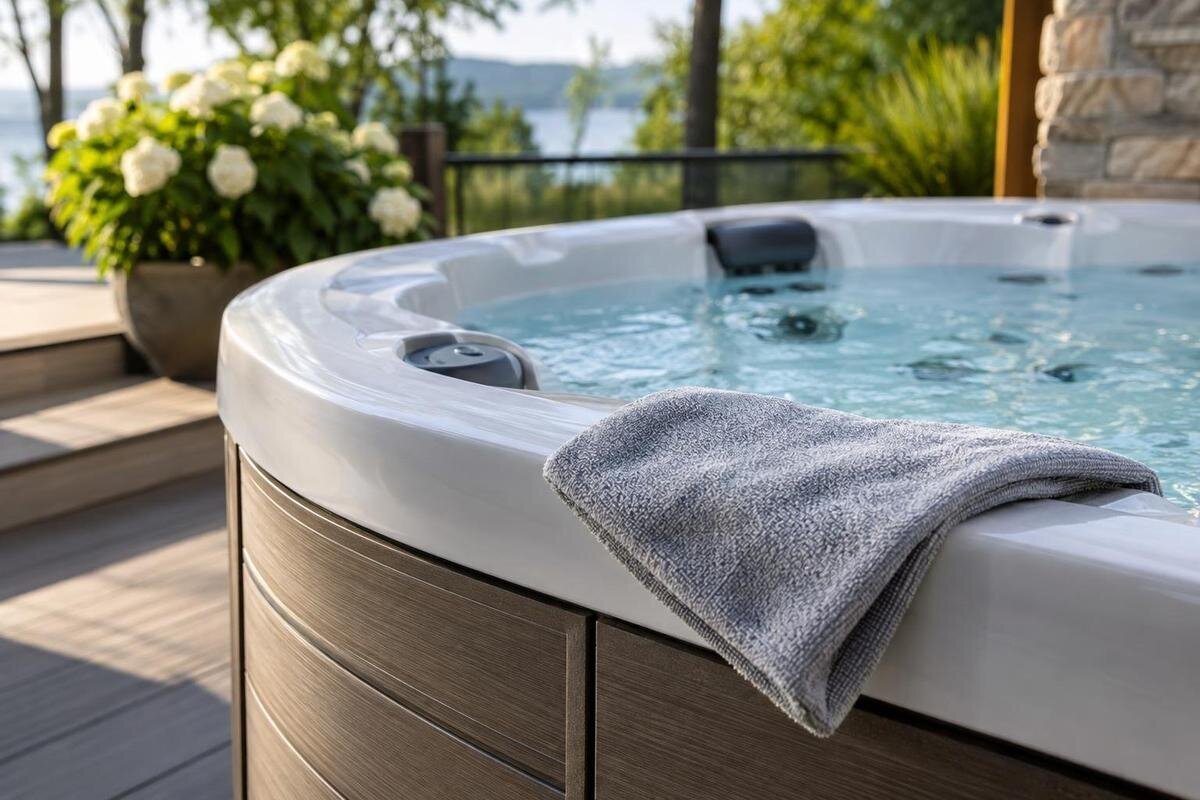
Hot tub surface care
Grime along the waterline can look like a simple wipe-down job, but a hot tub may combine surfaces that respond differently to cleaners and scrubbing. The visible shell, fittings, cover and surrounding panels are not automatically made of the same material; even areas that look alike may have different care limits. The safest way to clean a hot tub without scratching or dulling it is to identify the exact surface, follow the instructions for that model, and use only a cleaner and tool those instructions permit. If the approved method or residue-removal step is unclear, ask the manufacturer before experimenting.

01
Identify the material in each area
A hot tub is better treated as a group of surfaces than as one material. The shell, molded contours, waterline, fittings, headrests, cover and exterior panels—where present—may use different materials or finishes. Identify each part from the exact model documentation, product labels or manufacturer support; don’t conclude from color, gloss or texture. Two pieces that look alike can still have different care limits, and a smooth-looking shell does not reveal its material or finish. A cleaner that is appropriate for one area may be unsuitable for a nearby insert or trim piece. Begin by listing the areas you actually plan to clean, rather than looking for one product for the whole tub.
Keep the shell separate from other components in your notes. Record the material and finish the manufacturer names for each area, including any separate pillow, cover, fitting or cabinet panel. Directions for the shell don’t automatically apply to those parts, or vice versa. When looking at Bloomcabin Hot Tub Cove 2, use the model name to organize your questions, not to infer its construction. Ask for a clear match between each part you want to clean and the instructions that cover it. If the paperwork uses an unfamiliar component name, have the manufacturer identify the part before you buy supplies. Your notes should make it possible to distinguish the main surface from an adjoining piece without relying on appearance alone.
Find cleaning instructions for your exact model
Look for the owner’s manual, a surface-care sheet or written guidance from the manufacturer for the exact model. Match the document to the model number and, if the manufacturer distinguishes versions or components, to the part you plan to clean. A general spa-cleaning article, retailer description or guide for another model is not a substitute. For Bloomcabin Hot Tub Haven 6, ask which instructions cover the model and the particular component you have identified. Save the relevant passage or written response with the document title and the part it addresses. Keep surrounding cautions with the cleaning directions rather than saving an isolated sentence. That gives you a usable reference when comparing cleaner labels and helps you avoid applying directions outside their intended scope.
Read the full care passage, not just a phrase such as “clean with a mild product.” Look for the material named, permitted cleaner types or exact products, prohibited products, tool limits, dilution directions, contact time and instructions for removing residue. A guide may not state every detail. If it is broad or silent about the area you need to clean, don’t fill the gaps with advice for a different tub. Ask the manufacturer what the guidance means for that exact surface, and keep the answer with the manual. If a spot test is recommended, follow the maker’s directions rather than inventing a location or process.
02
Check that the cleaner is suitable for the surface
Check that a cleaning product is intended for the surface in front of you. A label saying “for hot tubs” can refer to water care, equipment, covers or other uses rather than wiping the shell. Even products sold as surface cleaners may be limited to certain materials or exclude particular finishes. Read the intended use, material compatibility, exclusions, application directions and residue-removal instructions. A broad household-cleaning claim doesn’t override the hot tub manufacturer’s restrictions, and words such as “gentle” or “all-purpose” don’t establish approval for every component.
Compare the product label with the tub maker’s guidance. If either is unclear, or the two appear to conflict, ask about the cleaner by its full name or product number. A useful question names the surface, identifies the proposed cleaner and asks whether the entire labeled process is permitted—not simply whether the brand is acceptable. Confirm any dilution, contact time, spot test and removal requirements. When researching Bloomcabin Hot Tub Fjord 8, keep those questions alongside the model information so a general answer doesn’t get mistaken for surface-specific permission. Before buying, make sure you can identify the exact product discussed in the response rather than a similarly named alternative. Don’t mix cleaners or assume that approval for one purpose extends to another.
Choose a compatible cleaning tool
An approved cleaner doesn’t make every scrubber suitable. Friction or grit caught in a tool can mark a sensitive finish, so stiff brushes, scouring pads, abrasive powders, blades and powered tools shouldn’t be default choices. Packaging that says “soft,” “non-scratch” or “safe for plastic” does not establish compatibility with every spa surface. Follow the tub maker’s guidance on cloth, sponge or brush type as well as cleaner choice. If it uses a broad phrase such as “nonabrasive,” ask what tool materials meet that requirement for the identified surface.
Use a clean tool of the type permitted for the specific area; grit carried over from another job can create a different risk from a clean tool. When considering Bloomcabin Hot Tub Aurora 10, ask for enough detail to recognize an acceptable cloth, sponge or brush when shopping. If the answer is only “use a soft cloth,” request clarification before substituting a pad or brush. Check the description of the actual cleaning face, not just the package’s general promise. Keep the permitted tool with its surface-care instructions so it is not confused with supplies used elsewhere. Don’t press harder to compensate for poor results, and don’t use a scraper unless the instructions expressly allow it.
03
Distinguish grime from a change in the surface
Before cleaning, look at the area and note whether the mark appears to sit on top of the finish or whether the surface itself looks different. Appearance alone can’t identify a deposit or diagnose damage: a mark may be residue, discoloration or another change. Compare it with nearby areas and, if useful, take a photograph so you can describe what you see to the manufacturer. If you notice cracking, peeling, a rough patch or a change in gloss, don’t treat it as dirt that needs more force. A surface problem calls for guidance, not an improvised cleaning method.
Once the material and approved method are known, follow the instructions as written. Don’t add an unapproved test, product or extra scrubbing step; if the manufacturer recommends a spot test, use its specified procedure. Keep your description of the original mark separate from what happens during cleaning. For example, distinguish a patch that was already dull from a change in gloss that appeared while you worked. Note the product and tool used so you can explain the sequence without guessing later. If the finish changes, color transfers to the tool or the cleaner behaves unexpectedly, stop. These observations can help you describe the problem when asking whether further cleaning is appropriate.
Clean waterline buildup across adjoining surfaces
Waterline buildup may cross the shell, a fitting, a seam or a separate trim piece, so the area isn’t necessarily one uniform surface. Its appearance doesn’t reveal what it is or which cleaner will remove it. Identify the material beneath the mark and check whether the manufacturer’s surface-care instructions specifically address the waterline. Don’t use one product across the whole rim just because the buildup follows a continuous line. Where surfaces meet, keep their separate instructions in view rather than extending one method across the boundary.
If the manufacturer authorizes a method for that buildup, follow its stated cleaner, tool, application and removal steps. Don’t scrape, increase concentration, extend contact time or make a household mixture to speed up the job unless the instructions explicitly permit it. When reviewing the Bloomcabin Hot Tub Cove 2 listing, note any waterline-care questions you want answered before choosing supplies. Describe where the mark runs and which adjoining parts it touches, rather than asking only how to clean a ring. Request clarification if the approved method covers the shell but says nothing about a fitting or trim piece in the same area. The goal is to understand the limits of the method before applying it along the entire line.
04
Remove cleaner residue as the instructions direct
Residue removal is part of surface cleaning, not an optional finishing detail. The manufacturer or cleaner may specify a particular way to remove a product; there is no single rinse or wipe method to assume for every surface. Check whether the instructions require removal, what method they specify, and whether the product could contact nearby components or the water. Also check any directions about drying. If the product label and hot tub instructions don’t provide a clear, compatible answer, ask before proceeding rather than improvising with more water or another cleaner.
Use a separate clean cloth or other tool for removal only if that tool and method are allowed. Don’t assume that a product intended for spa water is suitable for wiping the shell, or that a surface cleaner is safe to enter the water. As you compare Bloomcabin Hot Tub Haven 6 product details, include residue removal in your care questions rather than treating it as an afterthought. Ask how the application and removal directions fit together for the identified area, including any stated drying step. Before starting, have the permitted removal supplies available and the relevant directions within reach. If the guidance explains how to apply a cleaner but not how to finish the job, resolve that gap before using it.
Stop if the finish changes or the mark will not lift
Set a stopping point before you begin: stop if the surface looks scratched, duller, lighter, rough or otherwise different, or if the cleaner causes an unexpected reaction. Also stop if the mark remains after the manufacturer-approved method. Repeating the same attempt with more pressure, stronger concentration, longer contact or a harsher tool is not a safe next step without specific approval. Persistent marks may need a different explanation, and extra force can make it harder to tell whether the original issue was residue or surface damage.
Note the exact model, the part involved, the product used and the steps already taken; photographs can help describe the change. Contact the hot tub manufacturer or a qualified service professional with that account. If you have already tried more than one approach, include the order in which you used them rather than reporting only the last product. Keep the Bloomcabin Hot Tub Fjord 8 product page with your model information if that is the tub involved, but describe the affected component separately. Ask whether further cleaning is appropriate and what to do about any remaining product. Don’t add a second cleaner or try to neutralize the first one unless the relevant instructions say to.

05
Compare surface-care information before buying
Ask for the material and finish of the shell and any other parts you expect to clean, plus the manufacturer’s care instructions for each. Find out which cleaner products and tool types are permitted, what to avoid, and whether the guidance covers waterline buildup, fittings and places where surfaces meet. When considering Bloomcabin Hot Tub Aurora 10 as a purchase option, organize those answers by component rather than collecting a general promise of easy care. Use the same questions for every model on your shortlist. Leave unanswered items clearly marked instead of filling them in from a photograph or another model’s instructions. This gives you a practical comparison of the information available without assuming that the products share materials or cleaning requirements.
Compare how clearly the instructions answer those questions, not a model’s appearance or an assumption that one finish is easier to maintain. Check whether the guidance distinguishes the shell from the cover, panels and other components, and whether the manufacturer can identify approved products or explain broad terms such as “mild cleaner.” If cleaning instructions aren’t available before purchase, treat that as an information gap to resolve—not proof that the tub is difficult or easy to care for. Clear, usable directions make it easier to choose compatible products later.
Keep a simple surface-care reference
After you have confirmed the method, keep a short reference with the exact model identification, the surface or part, the material named by the manufacturer, the approved cleaner and tool, and the instructions for application and residue removal. Include any stated dilution, contact time, exclusions or spot-test directions. Separate the entries by component so a direction for the shell is not accidentally read as guidance for the cover or a fitting. Keep the original care information and product label with your notes; a summary should not replace their cautions or qualifications. Where an answer came from manufacturer support, retain the wording and the question it answered. This reference is for surface cleaning, not the separate instructions for water care or other maintenance.
Use the reference when you buy a replacement cleaner, clean a different area or explain the instructions to someone else. Before repurchasing, compare the exact product identification with your saved information rather than relying on a familiar package or brand. If you change products, record the newly confirmed instructions and make clear which earlier entry they replace. Keep unresolved questions visible so another person does not mistake a blank space for permission to improvise. If the manual, cleaner label and manufacturer response disagree, retain that conflict in your notes until it is clarified. The result should be a practical record of what is permitted for each surface, not a growing collection of unrelated cleaning tips.
Frequently asked questions
Can I use dish soap on a hot tub shell?
Only if the hot tub manufacturer permits that product for the identified surface and the cleaner’s label allows the use. Don’t assume a household cleaner is compatible or that it can be removed in the way the shell requires. If the instructions are unclear, ask before using it.
Is a sponge labeled “non-scratch” safe for every hot tub surface?
No label can establish compatibility with every finish, and grit trapped in a sponge can also mark a surface. Use only the tool type allowed by the instructions for the area you’re cleaning; ask the manufacturer if the guidance is vague.
Can I use the same cleaner on the shell and the cover?
Only if both sets of care instructions permit that exact cleaner. The shell, cover and other components may have different materials and cleaning limits, so don’t transfer directions from one part to another.
What should I do if I can’t find cleaning instructions?
Pause and contact the manufacturer with the exact model and the area you want to clean. Ask which cleaner and tool are permitted, how to use them, and how to remove residue. Avoid trial and error while those details are unknown.
What if waterline buildup remains after cleaning?
Don’t increase the pressure, concentration or contact time, or switch to a stronger product on your own. Stop after the approved method and ask the manufacturer whether the remaining mark needs another surface-specific approach or may be a change in the finish.
Surface-safe cleaning depends on matching each step to the material, not on finding the strongest cleaner. Before applying a product, be able to identify the surface, confirm the cleaner and tool are permitted, and know how residue should be removed. If any of those answers is missing, getting model-specific guidance is part of cleaning—not a reason to guess. Follow the confirmed instructions and stop if the finish changes unexpectedly.
