
How to Grow Garlic in a Greenhouse
The greenhouse garlic almanac · United States
How to Grow Garlic in a Greenhouse
A beautiful garlic crop is not persuaded by warmth alone. It is built through a measured sequence of cold, roots, leaves, lengthening days, dry-down and patient curing—then held in a greenhouse with enough restraint to let that sequence happen.
For a productive cool-season bed, treat the greenhouse as a weather editor rather than a perpetual summer machine. It can shelter soil from pounding rain, provide dependable access, improve drainage and make spring management precise. Garlic still needs cultivar-appropriate cold exposure before it can make properly divided bulbs.
01 · The premise
Garlic under glass succeeds when the structure protects the crop’s rhythm without erasing the winter that tells it to become a bulb.
Garlic is forgiving in the kitchen-garden sense: one sound clove makes one future bulb. Yet the plant is exacting about sequence. A clove needs time to root and build foliage before the crop moves into bulb division. In many cultivars, cool conditions are part of the instruction. Later, rising temperatures and longer days carry the plant toward bulbing and harvest.
That is why a heated greenhouse can be the wrong first instinct. Constant warmth may create handsome foliage while reducing the cold signal or rushing the crop into small, poorly segmented bulbs. An unheated or lightly protected greenhouse bed is often more useful. It gives the gardener a dry working place, controlled irrigation, less wind exposure and easier ventilation while allowing seasonal temperatures to remain meaningful.
Begin with the cultivar, then plan the greenhouse around it. Hardneck garlic is generally favored in colder regions and usually produces edible scapes. Softneck types tend to be more adaptable to mild winters, make more cloves, braid well and generally store longer. Neither label is a complete climate prescription; named strains differ, and reputable regional seed suppliers remain the best source for local fit.
If you are designing the whole space around cool-season crops, explore Bloomcabin’s greenhouses and conservatories alongside the growing plan. Garlic rewards a layout with a ground bed or deep raised bed, a clear path for lifting bulbs, and roof ventilation that can respond quickly on bright late-winter days.
Before plantingSelect stock
Cool seasonChill & root
SpringBuild leaves
Long daysForm bulbs
Early summerLift & cure
Think of the sequence above as a crop clock rather than a rigid month-by-month timetable. Start with large, sound seed garlic. Cool soil and moisture establish roots; a cultivar-appropriate cold period helps trigger later bulb development. Leaf growth then supplies the energy for clove division, and a final dry period supports harvest and curing.
Extension guidance consistently emphasizes that cold, temperature and day length interact in garlic development. A planning range sometimes used for types needing vernalization is roughly six to eight weeks of cool conditions below 40°F, but the exact requirement varies with cultivar and with the way seed cloves were stored. Treat that range as a starting framework, not a universal refrigerator recipe.
Cold-winter regions
Hardneck garlic can be planted into a greenhouse ground bed in fall, but do not seal the house through winter. Allow cool air to reach the crop and use only enough insulation or mulch to moderate violent swings. In very cold places, the greenhouse can reduce winter stress while still delivering meaningful chill.
Mild-winter regions
Choose softneck or regionally adapted types first. Where winter cold is unreliable, ask the seed supplier whether the planting stock has been conditioned or whether a controlled pre-chill protocol suits that cultivar. Excessively long pre-chilling can encourage bulb initiation before the plant has built enough leaves.
Warm, sunny houses
Vent early. Even when outside air is cool, strong sun can raise greenhouse temperatures quickly. Heat above about 85°F paired with water stress is especially unhelpful during active growth and can interfere with normal bulbing in cold-conditioned garlic.
Clove assembly plate
Tunic
Point up
Roots down
Tunic. Leave the papery clove skin intact. It protects the planting clove from unnecessary drying and minor damage.
Growing point. Set the tapered end upward so the shoot has the correct route to the surface.
Basal plate. The flat root end faces down, making immediate contact with moist soil.
03 · Planting stock
Choose the bulb before you choose the bed.
Planting stock is the crop’s first disease decision. Buy garlic sold for planting from a reputable grower or seed supplier, not random grocery-store garlic. Culinary bulbs can be poorly adapted, treated to inhibit sprouting, or carry problems that are invisible from the outside. Select firm, full bulbs with dry wrappers; discard anything soft, moldy, nicked or suspiciously light.
Hardneck
Often a strong choice for colder U.S. climates. The central stem produces a scape, and the bulb usually has a single ring of larger cloves. Harvest scapes while young if bulb size is the priority; grow a few extra plants if you want scapes as well as full bulbs.
Softneck
Frequently better suited to places with milder winters. It usually lacks a scape, can form many cloves and often offers excellent storage life. Reserve the most substantial outer cloves for next season.
Not elephant garlic
Elephant garlic is a leek relative, not true garlic. It has useful culinary character, but do not use its growth habits to plan a true garlic crop.
Separate bulbs into cloves only a day or two before planting. Leave each clove’s individual wrapper in place, and keep the basal plate intact. This small act limits drying and unnecessary wounds. If a clove is damaged during separation, cook it rather than planting it.
04 · The trench
Place every clove with a little room for winter, roots and a future bulb.
Garlic wants deep, friable soil—not a shallow pot of rich compost over a hard base. In a greenhouse, use a permanent ground bed where possible. If containers are essential, choose broad vessels at least 12 inches deep with unobstructed drainage, then accept that temperature and moisture will fluctuate more quickly than they do in the ground.
Shallow
Correct
Deep
Too shallow: an exposed tip can dry, heave, or suffer from sharper temperature swings.
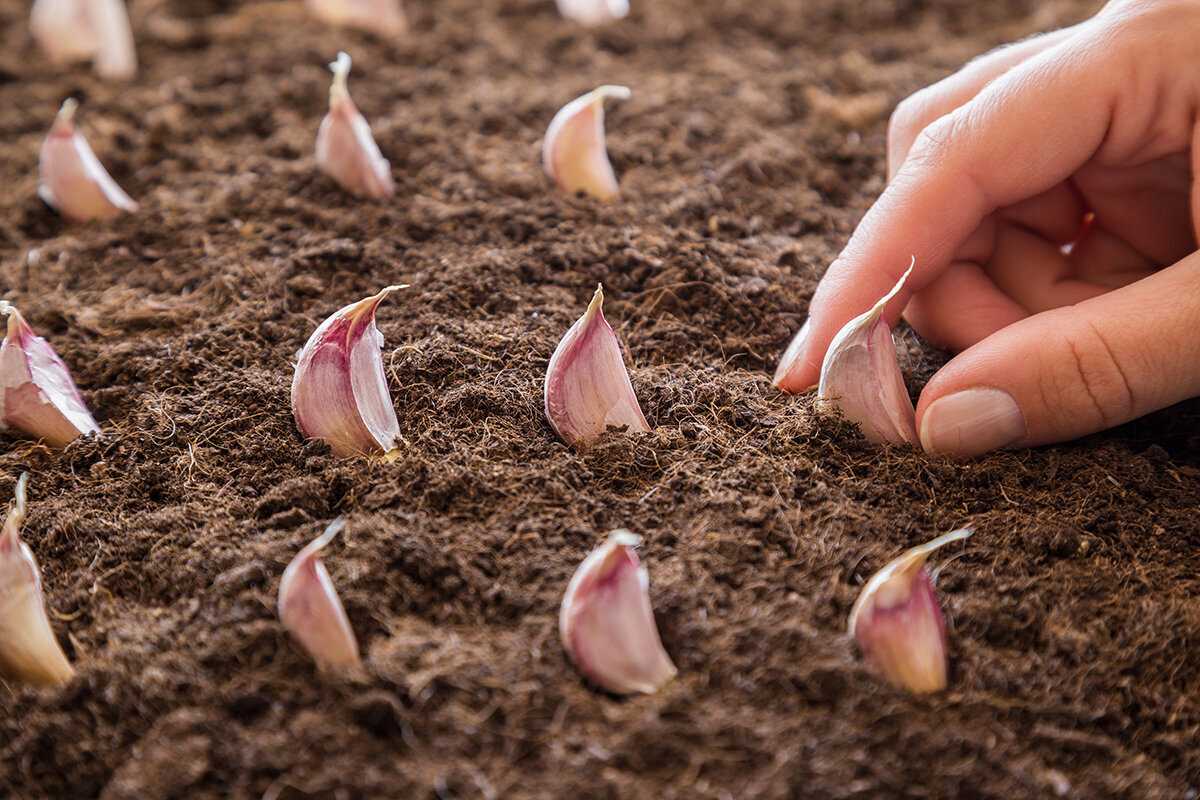
Correct depth: set the pointed tip up, with the base about 2–3 inches below the soil surface in a typical home bed.
Too deep: overly deep placement can delay emergence and makes dense, wet greenhouse soil harder to manage.
Bed geometry that breathes
Space cloves about 6 inches apart for full bulbs. A double-row layout works elegantly: keep rows roughly 6 inches apart within the planting band, then leave a generous path or wider aisle between beds so you never step on the root zone. Raised beds can help where native soil drains slowly, but do not overfill them with fluffy material that collapses by spring.
Before planting, incorporate finished compost and correct drainage or pH issues with a soil test rather than guesswork. Garlic generally performs best in moisture-retentive but well-drained soil around pH 6.0–7.0. Fresh manure is not a shortcut; it can encourage excess nitrogen, uneven growth and storage problems.
Planting checklist
- Plant the largest healthy cloves; save small cloves for the kitchen.
- Pointed end up, basal plate down.
- Water once to settle soil, never to create a saturated trench.
- Use clean straw or leaf mulch only if temperature swings or weeds warrant it.
- Label every variety and planting date. Garlic memories are unreliable by midsummer.
05 · The moisture pulse
Water the root zone, not the greenhouse atmosphere.
Garlic has a relatively shallow root system. The aim is not constant wetness; it is an evenly supplied soil profile that lets roots remain active from establishment through bulb expansion.
Establishment
After planting, water enough to settle soil around the clove. Then monitor below the surface. A cool greenhouse bed dries more slowly than an exposed raised bed, particularly when nights are cold.
Leaf growth and bulb fill
As foliage gathers momentum, deep irrigation becomes more important. Extension guidance commonly uses about 1 inch of water per week as a field reference during active growth, with more frequent but smaller applications in sandy soil. In a greenhouse, use that as a soil-moisture reference rather than an automatic weekly quota: rainfall no longer contributes, and ventilation changes evaporation dramatically. Drip irrigation or slow hand-watering at soil level is preferable to overhead watering.
Approaching harvest
Reduce irrigation about two weeks before harvest. The goal is to let the soil and wrapper surfaces become drier, supporting clean lifting and reducing the chance of disease during curing.
Ventilation is the companion to irrigation. Open roof vents early on bright days, and use a circulating fan if the greenhouse remains humid or still. A thoughtful shading and cooling strategy is particularly useful in late spring, when rising light levels can push a protected house beyond the temperatures garlic enjoys. For broader guidance on siting, watering and airflow, see Bloomcabin’s greenhouse gardening guide for U.S. growers.
06 · Read the leaves
Bulb problems usually began earlier.
Before reaching for fertilizer or a treatment, match the symptom to the season. Garlic is a long crop; its final bulb records choices made months before harvest.
All leaf, little bulb
Most often a timing or cold-exposure problem, though very high nitrogen and late planting can also contribute. Confirm that the cultivar is suitable for the region. Do not expect greenhouse warmth to compensate for missing winter conditions.
Yellowing early
Check soil moisture first. Waterlogged roots, depleted fertility, onion maggot, disease and simple seasonal aging can all look like yellow garlic. Examine roots and bulbs before assuming a nutrient deficiency. Remove and discard clearly diseased plants; do not compost suspicious bulbs.
Small bulbs
Small seed cloves, crowding, weed competition, interrupted irrigation, insufficient leaf growth and premature bulbing all reduce size. A greenhouse helps most by letting you prevent these compounding stresses—especially weeds, rainfall extremes and heat spikes.
Split wrappers
Often a sign of harvesting too late. Once cloves begin forcing through their protective outer layers, storage potential declines. Use split bulbs promptly, and reserve only firm, unblemished bulbs for replanting.
07 · Lift at the right edge
Harvest is a narrow, handsome window.
Garlic is ready neither when every leaf is green nor when the plant has completely collapsed. Exact timing varies by strain and location, but a useful visual cue is browning lower leaves with roughly half, or a little more than half, of the upper foliage still green. Pull one test bulb if uncertain: the cloves should fill the wrappers, but the wrapper layers should still hold the bulb together.
In much of the northern United States, garlic commonly comes in from late June through late July. A greenhouse can advance or delay that window, so let leaf condition and bulb structure—not a date printed on a tag—make the final call.
1
Stop frequent watering
About two weeks beforehand, reduce irrigation and allow the bed to dry moderately. Do not force drought during bulb growth; this is the finishing phase only.
2
Lift; never pull
Use a fork or hand trowel to loosen soil well below the bulb, then lift with the leaves attached. Pulling by the stem can bruise or tear the neck—exactly the damage that shortens storage life.
3
Keep the wrappers on
Gently shake away only large clumps of soil. Do not wash bulbs destined for storage, and do not strip them clean in the excitement of harvest. Their outer skins are the storage envelope.
4
Separate the eating crop from next season’s seed
After curing, set aside the largest, most uniform, disease-free bulbs for planting. This quiet act improves the next crop more effectively than most gadgets.
Curing bay elevation
Shade
No direct sun.
No direct sun.
Airflow
Leave space.
Leave space.
Time
Three to four weeks.
Three to four weeks.
08 · The cedar room
Cure for storage, not for display.
Freshly lifted garlic is edible, but curing is what makes it keep. Hang whole plants in loose bundles, or lay them in a single airy layer on screens or slatted benches. Choose a shaded, dry, well-ventilated place out of rain and direct sunlight. A greenhouse can serve as a curing space only if it can stay shaded, dry and well ventilated; in high summer, a closed glass house is often too hot.
Expect three to four weeks. The necks should feel dry, roots crisp and wrappers papery. Then brush off loose soil, trim roots close to the base, and cut stems to about ½–1 inch unless you are braiding softneck garlic. Sort again before storing: any soft, damaged or questionable bulbs should be used first, not tucked among sound bulbs.
Store cured garlic in breathable bags, open crates or mesh—not sealed plastic—in a cool, dry, dark place with air circulation. Do not refrigerate whole bulbs as a standard storage practice; cold storage can encourage sprouting once bulbs return to room temperature. Storage duration depends on type, curing quality and home conditions, with softneck types generally holding longer than hardnecks.
For a greenhouse that can earn its place across seasons, the Classic Aluminum Greenhouse offers roof ventilation, integrated gutters and configuration options that can support a carefully planned garlic bed in the cool season, then transition to summer crops once bulbs have moved to their curing room.
09 · Field questions
Garlic in a greenhouse: FAQ
Clear answers for the decisions that most influence bulb quality.
Can garlic grow in a heated greenhouse?
It can grow leaves in a heated greenhouse, but heat is not a substitute for the cold exposure many garlic cultivars need before proper bulbing. Use a heated structure for controlled starts or specialty production only when you understand the cultivar’s chilling needs. For a home bulb crop, an unheated or minimally heated greenhouse bed is usually the safer approach.
Do I need to pre-chill garlic cloves in the refrigerator?
Not automatically. In areas with reliable winter chill, fall planting usually provides the natural cold period. In warm-winter locations, some growers use artificial chilling, but cultivar responses differ and over-conditioning can lead to early bulb formation and small bulbs. Ask the garlic supplier for a cultivar-specific recommendation before chilling seed stock.
Can I plant garlic in pots inside a greenhouse?
Yes, if the container is broad, at least 12 inches deep, drains freely and receives appropriate cold exposure. Ground beds are more forgiving because they buffer moisture and temperature. In containers, inspect soil moisture more often and avoid crowding; 6-inch clove spacing remains a practical guide for full bulbs.
Should I remove hardneck garlic scapes?
If maximum bulb size is the goal, remove scapes once they curl and are still tender. They are edible and excellent in pesto, stir-fries and compound butter. Leave some scapes only if you want to observe bulbils or enjoy their ornamental form; do not expect those plants to prioritize the largest bulbs.
Why are my greenhouse garlic bulbs round with no separate cloves?
A single round bulb is commonly associated with insufficient cold exposure, late planting or a crop that did not have enough time to build leaves before bulbing. It can also reflect cultivar mismatch. Use these bulbs in the kitchen and refine cold planning, planting timing and cultivar choice for the next cycle.
What can follow garlic in the greenhouse?
After harvest and bed cleanup, the space is ideal for warm-season crops or a short turnaround of greens, depending on your climate. Avoid immediately following garlic with another allium in the same soil. A crop rotation and clean removal of plant debris help reduce disease carryover. For additional crop ideas, visit Bloomcabin’s guide to unusual crops for a greenhouse.
Sources & further reading
Research behind the season.
- University of Minnesota Extension — Growing garlic in home gardens. Variety selection, planting, spacing, irrigation, harvest and disease-prevention guidance.
- University of Georgia Cooperative Extension — Garlic Production for the Gardener. Vernalization, plant development and garden production fundamentals.
- Oregon State University — Garlic. Temperature, photoperiod and moisture considerations for bulb and clove formation.
- UConn Extension — Garlic Cultivation in Connecticut. Regional fall planting, winter chilling and clean seed-garlic guidance.
- Penn State Extension — Garlic Production. Harvest readiness, rack curing and storage conditions.
- University of Minnesota Extension — Postharvest Handling of Fruit and Vegetable Crops. Postharvest airflow and dry-neck indicators for garlic and onions.
- USDA Risk Management Agency — Garlic feasibility study. Background on vernalization, day length, soil and moisture requirements.
