
How to Grow Melons in a Greenhouse
Bloomcabin growing rooms / United States
How to Grow
Melons in a
Greenhouse
A fragrant melon is not simply grown under glass. It is composed there: warmth held at the root, a vine lifted into light, a flower met in the morning, and a fruit given room to become itself.
A vertical glasshouse guide for warm-season fruit
The central proposition
Give heat a structure,
and sweetness has a chance.
Melons are exuberant, heat-loving vines with surprisingly exacting standards. They ask for warm rooting conditions, bright light, free-draining soil, even moisture while fruit is forming, and air that keeps foliage dry enough to stay healthy.
A greenhouse makes those conditions easier to coordinate, but it also makes the gardener the pollinator, ventilator, and editor of the vine. For most home glasshouses, small- to medium-fruited muskmelons are the elegant choice. They can be trained upward, their ripening perfume reads clearly in a contained space, and their weight can be carried in a simple sling. Watermelons can also be grown under cover, but need more cubic space, stronger support, and very deliberate variety selection. Start with the longest possible run of sun, then design the crop around vertical access rather than allowing it to occupy every inch of floor.
Choose the vine before you choose the support
Four melon personalities
for the glasshouse table.
A variety name matters, but the better first question is how the fruit will inhabit your greenhouse. Seek descriptions such as short season, compact, small fruit, greenhouse suitable, or trellis friendly.
If your summer is brief, shorter days to maturity are a real advantage—not an aesthetic preference. For a first crop, avoid treating the greenhouse as a place to prove that the largest fruit can be made to fit. The most convincing harvest is a melon that can be trained, supported, inspected, and ripened without blocking the path or shading every other crop.
- Netted muskmelonPerfumed, usually orange-fleshed, and often the most satisfying type for a trellis salon. Many ripen with a stem-slip cue, but harvest behavior remains cultivar-specific.
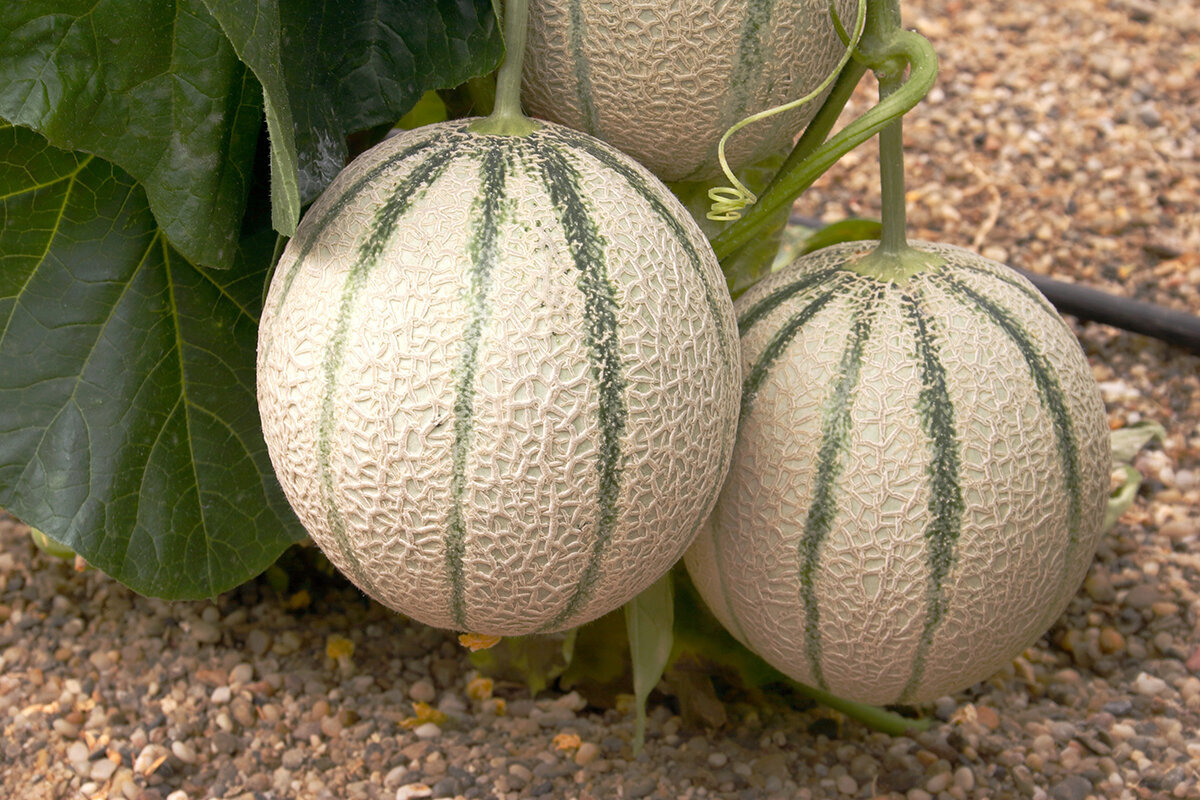
- French-style aromatic melonSmall, intensely scented fruit for gardeners who value fragrance and a short walk from vine to table over bulk yield.
- Honeydew and smooth-skinned typesGraceful, pale-rinded fruit with less obvious visual ripeness. Rely on the seed description, fruit feel, and changing ground color rather than scent alone.
- Small-fruited watermelonA dramatic greenhouse specimen that needs a stout trellis, generous headroom, and a substantial sling. Seedless types also require a compatible pollinizer.
From seed to settled vine
Start warm. Move gently.
Plant only when the room is ready.
01 / Seed
Warm germination
02 / Seedling
First true leaves
03 / Transition
Acclimate
04 / Bed
Plant out
Warm germination. Sow one seed per biodegradable or roomy cell, about 1/2 to 1 inch deep. Melon seed germinates best in genuinely warm media; University of Minnesota Extension gives a 70–90°F range and advises waiting for warm soil rather than planting into a chill. Bottom heat can help in a cool house, but remove it once seedlings are established and give the plants bright light immediately.
First true leaves. Bright light prevents lanky seedlings. Do not pot a melon up repeatedly just because the calendar says so. These vines dislike root disturbance; a well-timed young transplant is better than a large plant whose roots have circled or been broken.
Acclimation and planting. Before final planting, expose seedlings gradually to the greenhouse’s daytime light, airflow, and temperature rhythm. Plant at the same depth as the potting mix. In a cold-climate greenhouse, a soil thermometer and a few patient days will usually outperform a hurried planting. Aim for a compact seedling with a firm root ball, then let greenhouse conditions—not a packet date—determine the handoff.
The root room
Build a bed that drains, then a watering practice that listens.
Melons need fertility, but they do not enjoy a heavy, airless root zone. Their most dependable beginning is a deep bed of fertile, well-drained soil enriched with finished compost—not a shallow pocket of rich material surrounded by cold, compacted earth.
University of Minnesota Extension recommends well-drained soil and a pH of roughly 6.0–6.5 for melons. In a greenhouse border, work finished compost through the full planting area and correct pH or nutrient imbalances from a soil test rather than adding fertilizer by instinct. Raised beds can be useful where native soil drains slowly. Keep the surface tidy: clean mulch or a mineral ground cover helps reduce splash onto leaves, holds soil moisture steadier, and makes fallen flowers or early pest activity easier to see.
For containers, go larger than the minimum whenever the greenhouse footprint allows. CSU’s hobby-greenhouse guidance identifies 5 gallons per muskmelon plant as a minimum; a larger container gives you a more forgiving reservoir of water and nutrients. Use a quality, free-draining growing mix, secure the container so it cannot tip as fruit develops, and expect to monitor moisture more often than you would in a bed.
The central choreography
Train the vine upward
before it makes its own plans.
Roots
Clear stem
Flowers
Fruit
Roof turn
One leader
Airy base
Guide laterals
Turn at roof
Read the elevation from bottom to top. Begin with one main leader and attach it loosely to a dedicated string or trellis. Keep the base clean enough that air can move beneath the canopy, but do not strip healthy leaves indiscriminately. Guide selected laterals outward where they can carry leaves and flowers without meeting another vine in a damp, shaded wall.
Once the leader reaches its allotted height, route it along an overhead wire or tip it according to cultivar vigor and available light. For inspiration on building the room around the crop, explore Bloomcabin’s greenhouse technologies and climate-control approach. A vertical crop works best when ventilation, access, and support points are considered together.
The morning appointment
Pollination is brief,
gentle, and worth being present for.
Under glass, open vents may admit pollinators, but a reliable greenhouse crop should not depend entirely on a passing bee. Melon flowers are often open for only a short morning window.
Recognize
Morning
Transfer
Mark
University of Minnesota Extension notes that a cantaloupe flower has a one-day pollination window, and inadequate pollen transfer can mean fruit that is absent, small, or misshapen. Male flowers sit on slender stems. Female or perfect flowers sit close to the vine with a small swelling at the base—the beginning of the melon.
Choose a dry morning when flowers have newly opened. Use a soft artist’s brush, or gently touch a pollen-bearing male flower to the receptive center of a female bloom. Repeat across open flowers, then use a small tag or colored tie to record the pollination date. Do not judge success the next day; look for steady, symmetrical swelling over the following week. Avoid pollinating flowers wet with condensation, and avoid rough handling while moving through the greenhouse.
If you grow seedless watermelon, remember that pollination is still necessary and a suitable pollen-producing companion plant must be part of the planting plan.
The energy edit
Fewer fruit can make
a more convincing harvest.
A greenhouse vine can look capable of carrying a small orchard. It is not. Every retained fruit competes for leaf area, water, mineral nutrition, and time.
Once several melons have set, select those that are well positioned, evenly shaped, and supported by a healthy canopy. Remove misshapen, damaged, or awkwardly placed fruit early. The correct number per plant varies by type, season length, vigor, and root volume, so crop load should be judged as a conversation with the vine rather than as a universal number printed on a label.
Too much nitrogen can encourage the same problem from another angle: handsome foliage with delayed flowering and fruiting. A soil-test-led feeding plan, coupled with a modest fruit load, gives the plant a clearer assignment.
Keep
well set
well set
Keep
well lit
well lit
Remove
crowded
crowded
Remove
damaged
damaged
Support
the rest
the rest
Choose fruit with space around it. A melon hanging in an airless cluster is difficult to inspect and slow to dry after a humidity event. Selection early in the swelling stage is less wasteful than waiting for a crowded fruit to become heavy, shaded, or impossible to support safely.
A small act of engineering
Make a sling before
the fruit asks for one.
Broad cradle
Expansion room
High attachment
Weekly check
Use soft mesh, old hosiery, fabric strips, or purpose-made netting to distribute weight across the fruit instead of making a narrow pressure line. Tie the sling loosely enough to accommodate substantial enlargement; a support that is perfect on day one can scar a ripening melon if it cannot give.
Transfer the load to a trustworthy overhead line or trellis point, never to the tender fruiting lateral alone. Check every week for constriction, wet fabric, a pulling stem, or a sling that has slipped out of balance. Support is part of crop care, not a one-time installation.
The mineral rhythm
Water evenly. Feed with evidence.
Ease back only as ripeness approaches.
Planting
Vine growth
Fruit set
Finishing
After planting: water the root zone deeply enough to settle soil around roots, then let the surface begin to dry before the next application. The goal is moisture below and air above. As leaf area expands, increase volume rather than alternating drought and saturation, especially in containers that warm quickly.
Flowering and fruit set: these are critical moisture periods. University of Minnesota Extension identifies flowering, fruit set, and maturation as especially sensitive stages for melons. Use drip irrigation or direct soil watering where possible; wet evening foliage invites disease. Check soil below the surface rather than watering only because the greenhouse feels warm.
Finishing fruit: do not abruptly deprive the vine. Instead, reduce excess watering as muskmelons approach maturity while preventing wilt. Utah State University notes that a modest reduction near ripening can improve flavor. Incorporate compost, use a soil test to identify actual needs, and feed lightly in stages where indicated. Late, heavy nitrogen may produce a lavish canopy while postponing the fruit you planted for.
The ventilation loggia
Warmth is useful.
Stagnation is not.
A melon greenhouse should feel sunlit and alive, never sealed. Air movement moderates heat, dries leaf surfaces, supports sturdy growth, and makes hand pollination easier to carry out before flowers become stressed.
Use roof vents together with a low opening or door whenever conditions allow, creating a route for hot air to rise and leave. On severe heat days, add temporary shade cloth outside or above the crop where possible, rather than turning the greenhouse into a permanently dim room. Water soil early in the day, keep paths clear, and avoid dense foliage pressed against glazing or walls.
Bloomcabin’s guide to custom aluminum greenhouses is useful reading when planning ventilation, shade, irrigation, and support details as one coordinated system.
A five-minute conservatory walk
Inspect little and often.
1 / Undersides first
Look beneath young leaves for aphids, whiteflies, mites, eggs, stippling, or sticky residue. Early detection is gentler than a late rescue.
2 / Read the leaf
Powdery patches, yellowing, or dead areas tell you to improve airflow, avoid wet foliage, and identify the problem before reaching for a control product.
3 / Check the stem
Inspect ties, clips, and the base of the plant. Replace anything that rubs or constricts; remove fallen leaves and spent fruit promptly.
4 / Look at the floor
Standing water, algae, and rotting debris raise humidity and provide hiding places for pests. A clean path is part of plant health.
Disease prevention begins with climate management: clean tools, good spacing, airflow, dry foliage, and crop debris removed from the greenhouse. Gummy stem blight and other cucurbit diseases can persist in debris; where symptoms are significant, remove affected material carefully, do not compost diseased vines at home, and consult your local Extension service for identification and region-appropriate recommendations. Always use only products labeled for the crop and situation in your state.
The sensory descent
Harvest by a chorus
of cues, not color alone.
A ripe melon announces itself through several small changes. The sequence differs among types, which is why a seed packet’s days-to-maturity number is a forecast—not a harvest command.
01
Fragrance
02
Rind
03
Stem
04
Timing
Fragrance. Netted muskmelons often develop a warm, sweet perfume at the blossom end. Smooth-skinned types may be much less fragrant, so do not make aroma the only test. Rind and ground color. Look for the variety’s expected shift from green toward buff, cream, or gold beneath any netting. A glossy, hard green rind often signals more time is needed.
Stem behavior. Some muskmelons form a clean slip layer and detach readily at full maturity. Do not assume this applies to every melon; honeydew and watermelon are commonly judged by other cues. Note pollination dates, compare the fruit with its variety description, and use any slight blossom-end softening with restraint. Squeezing aggressively only bruises a fruit you have waited months to taste.
Harvest in the cool of morning with clean pruners when the vine does not release the fruit naturally. Handle netted rinds gently; wash the outside before cutting, keep knives and boards clean, and refrigerate cut melon promptly. A greenhouse harvest is at its best when served simply, while the fragrance is still fresh from the vine.
Questions from the vine room
Greenhouse melon FAQ
How many melon plants can I grow in a small greenhouse?
Start with fewer than the floor plan seems to allow. One trained plant per 5-gallon-or-larger container, or one plant per clearly assigned bed position, is a sensible beginning. Leave a real aisle and enough headroom to work around every vine and fruit.
Do greenhouse melons need hand pollination?
Usually, it is the most dependable approach. Natural pollinators may enter through open vents, but hand pollinating open flowers in the morning makes fruit set much more predictable in an enclosed space.
Why are my flowers dropping but no melons are forming?
The earliest flowers are often male, so some drop is normal. Once female or perfect flowers appear, poor pollination, high heat, cold nights, water stress, or excess nitrogen can all reduce fruit set.
Can I grow melon in a pot under glass?
Yes. Choose a compact or smaller-fruited variety, use at least a 5-gallon container as a baseline, install a strong trellis, and monitor moisture more closely than you would in a greenhouse bed.
Should I remove leaves around ripening melons?
Only remove leaves that are damaged, diseased, or creating persistent congestion. Healthy leaves are the factory that sweetens the fruit. Improve airflow with thoughtful training rather than exposing fruit suddenly to harsh direct sun.
What greenhouse shape works best for vertical melon growing?
Choose enough ridge height for a leader, a top wire or trellis route, and fruit hanging above a clear path. Ventilation matters just as much as height: warm air must have an easy exit as the canopy fills.
Reference colophon
Sources & further reading
University of Minnesota Extension — Growing melons in the home garden
Warm soil, seed starting, soil preparation, pollination, variety timing, and home-garden culture.
Colorado State University Extension — Growing vegetables in a hobby greenhouse
Greenhouse muskmelon container guidance, spacing, temperature, hand pollination, trellising, and airflow.
Utah State University Extension — How to Grow Cantaloupe (Muskmelon) in Your Garden
Planting, irrigation, trellising, fruit support, pollination, and maturity guidance.
University of Minnesota Extension — Flower and fruit set in cucurbits
Pollination windows, crop spacing, and the risks of excessive nitrogen.
University of Minnesota Extension — Irrigation strategies for vegetables
Critical irrigation periods for flowering, fruit set, and melon maturation.
University of Minnesota Extension — Gummy stem blight and black rot
Disease symptoms, crop sanitation, debris management, and lower-risk irrigation practices.
A final invitation
Give the vine somewhere beautiful to climb.
A successful melon greenhouse is not defined by square footage alone. It is made by enough ridge height for a climbing leader, thoughtful ventilation for a living canopy, clear pathways for morning pollination, and secure points from which a ripening fruit can hang.
For a classic, adaptable foundation, explore the Bloomcabin Classic Aluminum Greenhouse. Its clean, traditional geometry is an excellent canvas for a vertical melon room—one that can be arranged around beds, containers, overhead lines, ventilation, and the quiet pleasure of a fragrant harvest.
Explore the Classic GreenhouseContinue planning
Compare proportions with the Classic Plus 385 Aluminum Greenhouse, a wider model suited to generous pathways and larger crop zones.
For broader style and configuration ideas, see Bloomcabin’s guide to premium greenhouse designs tailored to American gardens.
When planning your layout, return to our practical overview of buying a greenhouse in the USA for considerations around siting, style, and ventilation.
