
How to Grow Onions in a Greenhouse
The greenhouse case for onions
Protected growth, not artificial summer
A good onion is built in layers long before it looks like a bulb. Your early task is to grow enough healthy leaves before the local daylight threshold arrives.
What glass changes
A greenhouse smooths the difficult edges of spring: cold rain, saturated soil, crusted seedbeds, and abrupt temperature swings. It makes raising transplants more reliable, keeps a prepared bed workable earlier, and gives you a dry place to cure a lifted crop. It also makes irrigation, ventilation, and sanitation visible daily—an advantage for a shallow-rooted crop that dislikes both drought and stagnant humidity.
What glass does not change
Bulb onions respond primarily to photoperiod. A long-day variety will still wait for long days; a short-day variety may begin bulbing far too early in a northern greenhouse. Supplemental light can extend a day in a controlled experiment, but for a home crop it is usually wiser to select the variety bred for your latitude and let the season provide the cue.
The practical format
For most home gardeners, the most dependable protected-culture plan is to sow indoors or in the greenhouse 10 to 12 weeks before outdoor planting, then grow the bulbs in a deeply prepared greenhouse border or in an adjacent open bed. In mild regions, a ventilated greenhouse border can carry the full crop. In hot-summer regions, use it for the early phase, then avoid trapping mature foliage in excessive heat.
A carefully configured Classic Aluminum Greenhouse makes particular sense for this sequence: seed trays can begin on staging, while a low, accessible border leaves room for upright onion foliage, drip lines, and a central path.
Starting material
Seeds, sets, or transplants?
All three can make onions. They do not ask the same thing of your greenhouse, and they do not carry the same risk of a premature flower stalk.
For control and selection
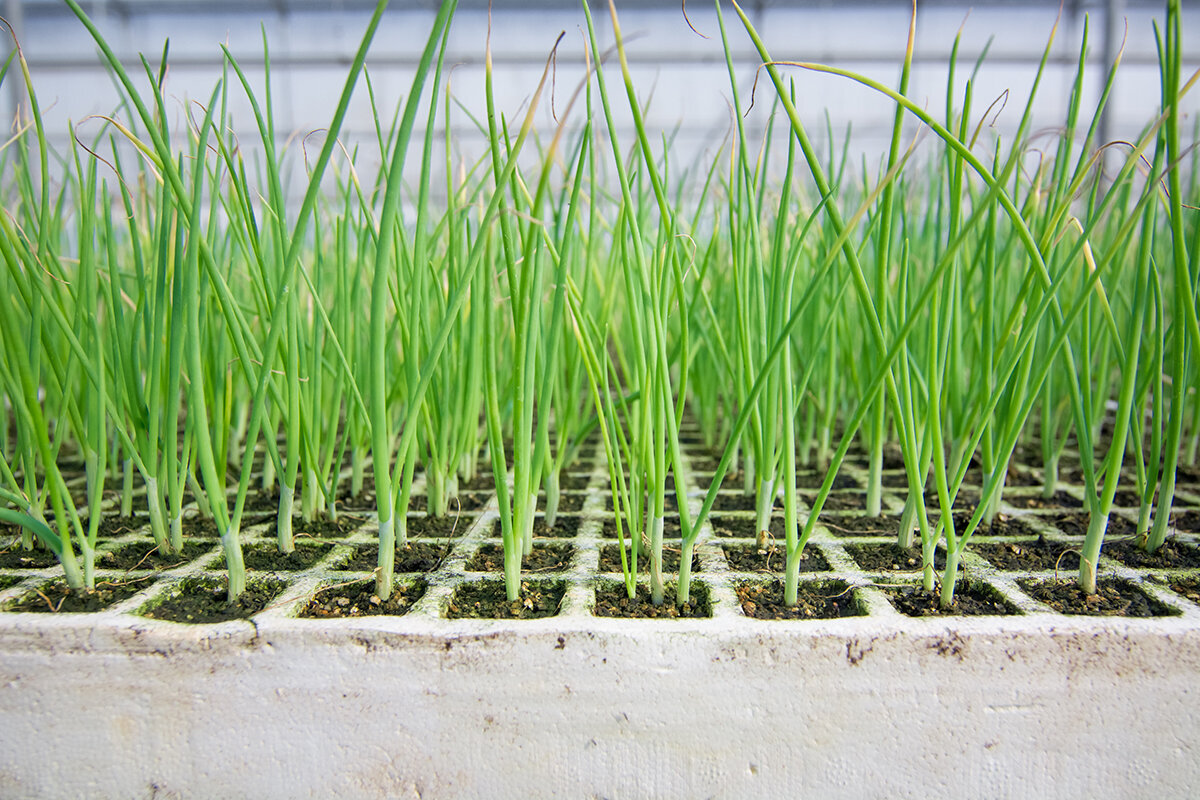
Seed gives the broadest choice of day-length types, storage qualities, color, and shape. It is the strongest route when variety selection matters—which it does for onions. Sow densely in a cell tray or shallow container, keep the mix evenly damp rather than wet, and trim tops lightly if they become long and tangled.
Seed takes planning, but greenhouse propagation creates sturdy starts before the garden season opens.
For speed and green onions
Sets are small dormant bulbs. They are convenient, fast, and pleasant for scallions. For large storage bulbs, choose small, firm sets and avoid oversized material. Larger sets have a greater tendency to bolt after cold exposure, leaving a hard central stem and a bulb that will not store gracefully.
Use sets when simplicity matters more than a highly specific cultivar choice.
For an early bulb crop
Purchased or home-raised transplants shorten the outdoor part of the season. They are an excellent greenhouse compromise: seedlings gain size in a managed environment, then establish quickly in their final spacing. Buy plants that are fresh, upright, and free of decay; avoid very thick, stressed starts.
For a serious household crop, transplants combine precision with momentum.
Bloomcabin verdict. Start from seed when you need a day-length-specific storage onion. Choose transplants when spring arrives late or your greenhouse can produce a strong, uniform batch. Reserve sets for convenience, scallions, and small plantings—not as a universal shortcut to large bulbs.
The photoperiod chamber
Choose the onion by the light it expects
Day length is the silent architect of bulb formation. The greenhouse can shelter the plant, but the cultivar decides when it interprets the season as time to make a bulb.
Propagation and timing
Build leaves first, then make room for the bulb
Sow black onion seed about 1/4 inch deep in a clean, free-draining seed-starting mix. Germination is best in consistently warm media, after which seedlings appreciate bright light and cooler, airy conditions. A greenhouse bench is ideal if night temperatures remain above freezing and the interior is ventilated on bright days; otherwise, begin indoors and move trays beneath glass once weather is settled.
Keep the tray evenly moist, never waterlogged. When seedlings reach roughly pencil-lead thickness, a light trim keeps the tops compact and discourages tangling. The point is not to make them look tidy; it is to send energy into a stout base and fibrous roots. Harden plants gradually before setting them into a greenhouse border or outdoor bed.
For greenhouse-grown bulbs, establish the final planting before seasonal day length triggers the variety. In a cool, protected border, that often means transplanting as soon as the soil is workable and reliably draining. In a cold climate, a frost-protected greenhouse may buy useful weeks; in a warm climate, ventilation and cultivar choice matter more than pushing the calendar later.
For compact properties, a mini wall greenhouse can be a refined propagation room for a modest onion crop. Use deep trays on a stable shelf and transplant the finished starts into a larger in-ground bed rather than trying to force storage bulbs into very small containers.
The anatomy beneath the skin
An onion bulb is not a root
The bulb is a compact stack of enlarged leaf bases held above a short stem called the basal plate. Fine roots emerge from beneath that plate. This matters because deep planting, heavy hilling, or compacted wet soil can obscure the architecture the plant needs to expand cleanly.
Set transplants so their roots are covered and the white shank is anchored, but do not bury the future bulb beneath a mound. Sets generally sit shallowly, with their tips near the surface. As swelling begins, keep the shoulder of the bulb exposed to light and airflow. The foliage may look modest beside the underground promise, but every healthy green leaf is part of the bulb’s eventual capacity.
Prepare a bed with friable, well-drained soil high in organic matter. A soil test is worth the small ceremony: onions perform best in a moderately acidic to near-neutral range, and their fine root system gives little forgiveness to compaction, poor drainage, or wildly unbalanced fertility.
The growing gallery
Spacing, water, fertility, and airflow
For full-size bulbs, set plants about 3 to 4 inches apart. Give rows roughly 12 to 16 inches, adjusting for the bulb size you want and the width of your greenhouse bed. Tighter spacing produces more, smaller onions; wider spacing can produce very large bulbs with thick necks that may cure poorly. A central path is not wasted space: it lets you weed, inspect foliage, and open vents without brushing repeatedly against wet leaves.
Onion roots occupy the upper soil profile, so they respond badly to boom-and-bust watering. Aim for evenly moist soil throughout establishment and bulb expansion; drip irrigation is especially useful under glass because it wets the root zone without soaking foliage. Check moisture several inches down rather than judging only the dry-looking surface. As bulbs reach final size and tops begin to decline, reduce irrigation and stop well before lifting so skins can firm.
When the bulb refuses to cooperate
Read the failure before you correct it
Small bulbs, healthy leaves
The variety may have started bulbing before the plant was large enough, or planting was late. Revisit day-length selection and start date first; water and fertility cannot fully repair a photoperiod mismatch.
Thick necks and soft storage
Excess late nitrogen, too much late irrigation, overcrowding, or lifting before natural maturity can leave neck tissue slow to dry. Taper inputs as bulbs finish and cure in dry moving air.
Silvered, curled foliage
Thrips can scar leaves and reduce photosynthesis. Inspect leaf folds, reduce nearby weeds, avoid drought stress, and remove severely infested debris. Do not let a hot, dusty greenhouse become a refuge for them.
Spots, collapse, or gray decay
Downy mildew, Botrytis, and other diseases thrive where foliage stays wet and air is still. Improve spacing and ventilation, water at the soil, remove infected plants, and rotate alliums away from the same bed for several years.
A greenhouse is not automatically disease-free. Its advantage is that you can see moisture, crowding, and declining foliage early enough to act. Roof vents and optional automatic ventilation are part of the practical equipment conversation described in Bloomcabin’s aluminum greenhouse product information.
Neck fall, lifting, and curing
Let the crop enter its paper season
Storage begins before harvest. When roughly half the tops have fallen naturally and begun to dry, the bulb has reached its mature change of character. Do not bend or twist healthy green leaves down to force the scene; premature collapse is not the same as maturity.
Lift on a dry day if possible. Brush away loose soil, but do not wash bulbs intended for storage or strip off the protective outer skins.
Arrange bulbs in a single layer on mesh or slatted shelves. Do not pile them in a damp corner of the greenhouse. A small circulating fan can help in still weather, but air movement is only useful if the space is dry and shaded.
Sweet and mild onions are for earlier eating. Dense, pungent storage varieties usually keep longer, provided they are fully cured and free of injury.
After the loft
Store only the bulbs that passed inspection
Once cured, trim roots and cut the dry top to a short neck, leaving the protective skin intact. Store whole onions in a cool, dark, dry, well-ventilated place—mesh bags, open crates, or a single layer in slatted shelving are better than sealed plastic. Check them regularly and use any bulb that softens, sprouts, or shows damage first.
Keep storage onions away from moisture-loving crops and from locations that fluctuate between damp and warm. The greenhouse is often an ideal curing room, but it is not necessarily the best winter pantry unless you can keep it dry and protected from freezing. A cool basement, insulated garage, or well-ventilated utility space may be more suitable.
Best candidatesFirm bulbs with dry skins, tight necks, and no bruises.
Use firstSweet onions, split bulbs, thick-necked bulbs, and anything nicked during lifting.
Never doSeal whole onions in plastic bags or store them damp after rinsing.
Seasonal resetRemove spent roots and crop debris, then rotate future onions away from the same soil where disease has appeared.
Frequently asked questions
Greenhouse onion questions, answered plainly
Can onions grow entirely in a greenhouse?
Yes, provided the greenhouse has a deep, well-drained soil border or sufficiently large growing system, ample direct light, and dependable ventilation. The key limitation is not the roof; it is selecting the correct day-length variety and preventing excess heat or humidity as foliage and bulbs mature.
Will grow lights make any onion bulb in any state?
Not reliably. Photoperiod affects bulb initiation, and lighting can technically alter day length, but a home grower is better served by selecting a cultivar suited to local seasonal light. Lights are most useful for raising sturdy seedlings before natural light and temperatures are ready.
Why did my greenhouse onions make leaves but no bulbs?
The usual reasons are a late start, insufficient plant size at the critical day length, a long-day variety grown too far south, or a short-day variety used where it bulbs prematurely and remains small. Crowding, drought stress, and too much shade can also reduce bulb size.
How often should I water onions under glass?
Water according to root-zone moisture, weather, soil texture, and plant size rather than a rigid calendar. The goal is evenly moist—not saturated—soil during establishment and bulb expansion. Drip irrigation and a finger test several inches down are more useful than frequent light surface splashes.
Should I bend the tops to make onions mature?
No. Harvest when a substantial portion of the tops falls naturally. Folding green leaves can damage the neck and does not create the same durable maturity. Let the plant finish, then lift and cure it with warmth, shade, and air movement.
Sources and further reading
Continue with horticultural evidence
- University of Minnesota Extension — Growing onions in home gardens
- Oregon State University Extension — Winter vegetable production and allium photoperiod guidance
- Utah State University Extension — How to grow onions in your garden
- Utah State University Extension — Onion irrigation
- Utah State University Extension — Onion planting and spacing
- Utah State University Extension — Onion soil and fertility management
- Colorado State University Extension — Botrytis, downy mildew, and purple blotch of onion
- Colorado State University Extension — Onion handling and storage
