
How to Pollinate Plants in a Greenhouse
Greenhouse growing / the amber transfer
How to Pollinate Plants in a Greenhouse
A protected greenhouse gives flowers better shelter, but it removes some of the ordinary movement that carries pollen. Restore only the transfer your crop actually needs.
Outdoors, a flower sits in a moving world: wind flexes stems, bees land and depart, and pollen travels in brief repeated encounters. Under glass, that choreography becomes quieter. The grower may need to become the missing current.
That does not mean every greenhouse crop needs a brush, a battery tool or a hive. Pollination is crop-specific. A tomato generally contains both pollen-bearing anthers and a stigma in the same flower, so the useful intervention is a gentle release of pollen. Cucurbits such as squash and many standard cucumbers carry separate male and female flowers, so pollen must cross a visible gap. Strawberries can self-pollinate, but full and even development benefits from broad pollen distribution across the flower.
Begin by designing for climate before you design for labor. Roof vents, thoughtful shading and an orderly planting plan are not ornamental extras while plants are flowering. They help protect pollen viability, avoid heat stress and make routine inspection easier. A well-considered structure such as the Classic Aluminum Greenhouse gives home growers a composed setting in which ventilation, access and crop care can work together. For broader planning, see Bloomcabin’s greenhouse tomato guide and summer greenhouse care notes.
The sequence that matters
Pollination, fertilization and fruit set are not the same event.
They happen in sequence. Keeping the terms separate helps prevent a common greenhouse mistake: repeating a hand-pollination treatment when the actual problem is heat, poor plant water balance, nutrition or an unsuitable variety.
01
Release
Viable pollen leaves anthers02
Transfer
Pollen reaches the stigma03
Reception
Pollen tube begins growth04
Set
Ovary begins to swellRelease
Anthers must mature and shed usable pollen. Cool nights, intense heat, very damp air and plant stress can disrupt this stage before pollen moves at all.
Transfer
Wind, vibration, an insect, a soft brush or direct flower-to-flower contact places pollen onto a receptive stigma. The suitable mechanism depends on the crop.
Reception
After pollen lands, a pollen tube grows toward the ovary. This unseen process is the bridge between pollination and fertilization, and it is also sensitive to poor conditions.
Set
Following fertilization, ovules become seeds and the surrounding ovary starts to enlarge. The plant must still retain that young fruit through later stress.
Use the flower as your first diagnostic tool. A flower dropping without swelling may reflect failed pollination, but it can also be a response to hot days, warm nights, abrupt water stress or excessive nitrogen. One successful transfer is not a guarantee of mature fruit.
Identify the flower before intervening
One greenhouse, several flower architectures.
The appropriate method follows flower biology, not simply the vegetable name. Tomatoes, peppers and eggplants are largely self-fertile, but their pollen benefits from movement. Cucurbits generally require pollen to move from a male flower to a female flower. Strawberry blossoms have many individual ovules, which is why incomplete pollination can appear as an uneven berry.
There is one important exception. Some cucumbers bred for greenhouse production are parthenocarpic. They set fruit without pollination, and unwanted pollination can produce seedy or misshapen fruit. Check the seed packet or plant label before introducing bees or manually moving pollen.
Transfer pathways
Parts together
→
Tomato family: vibrate
Male and female blooms
→
Cucurbits: direct transfer
Many ovules
→
Strawberries: insect visits
Sets without pollen
→
Parthenocarpic: manage climate
Tomatoes, peppers and eggplants: their anthers and stigma sit within the same blossom. A little controlled movement helps pollen release, so gentle vibration or a modest circulating breeze is generally more useful than brushing every flower.
Squash, melons and standard cucumbers: fresh pollen must travel from a newly opened male flower to a newly opened female flower. The short opening period makes observation and timing more important than force.
Strawberries: each flower carries many separate ovules. Repeated insect contact can distribute pollen broadly across the center of the bloom, which can support a more evenly filled berry.
Parthenocarpic crops: these varieties change the task. Instead of trying to create pollen movement, focus on irrigation, root health, air circulation, temperature and the variety instructions supplied with the plant.
Self-fertile aperture
Tomato-like flower
Anther cone around a central stigma.
Separated aperture
Cucurbit flower
Male pollen meets a female stigma.
Many-point aperture
Strawberry blossom
Many ovules contribute to one berry.
In tomato-like flowers, pollen is comparatively heavy. Tapping the support string or lightly vibrating a flower cluster can release it without damaging individual blossoms.
In cucurbits, the small immature fruit directly behind the female flower is the clearest visual cue. Both the male and female flowers must be open together.
In strawberries, a misshapen fruit can suggest incomplete pollination, but pests, frost damage, disease, crowding and root-zone stress can look similar.
Hands-on method laboratory
Make the smallest effective intervention.
Clean tools, dry hands and a light touch protect flowers. Work deliberately rather than aggressively: bruised blossoms, snapped trusses and repeatedly overworked blooms do not improve a crop.
≈
Tomatoes, peppers and eggplants: vibration
These crops can usually pollinate within the same flower, but a still greenhouse may not provide enough movement. On a dry and reasonably temperate day, gently tap the support string or flower cluster. A small battery-powered vibration tool can also be applied lightly to the cluster stem rather than pressed directly onto individual blossoms.
- Target open flowers, not unopened buds or tiny developing fruit.
- Brief, gentle movement is enough. Rough shaking can bruise stems and knock off flowers.
- For tomatoes, a faint dusting of yellow pollen may be visible when conditions favor pollen release.
- Keep air circulating, but do not blast plants with forceful airflow that damages flowers or dries foliage.
↔
Squash, melons and standard cucumbers: direct transfer
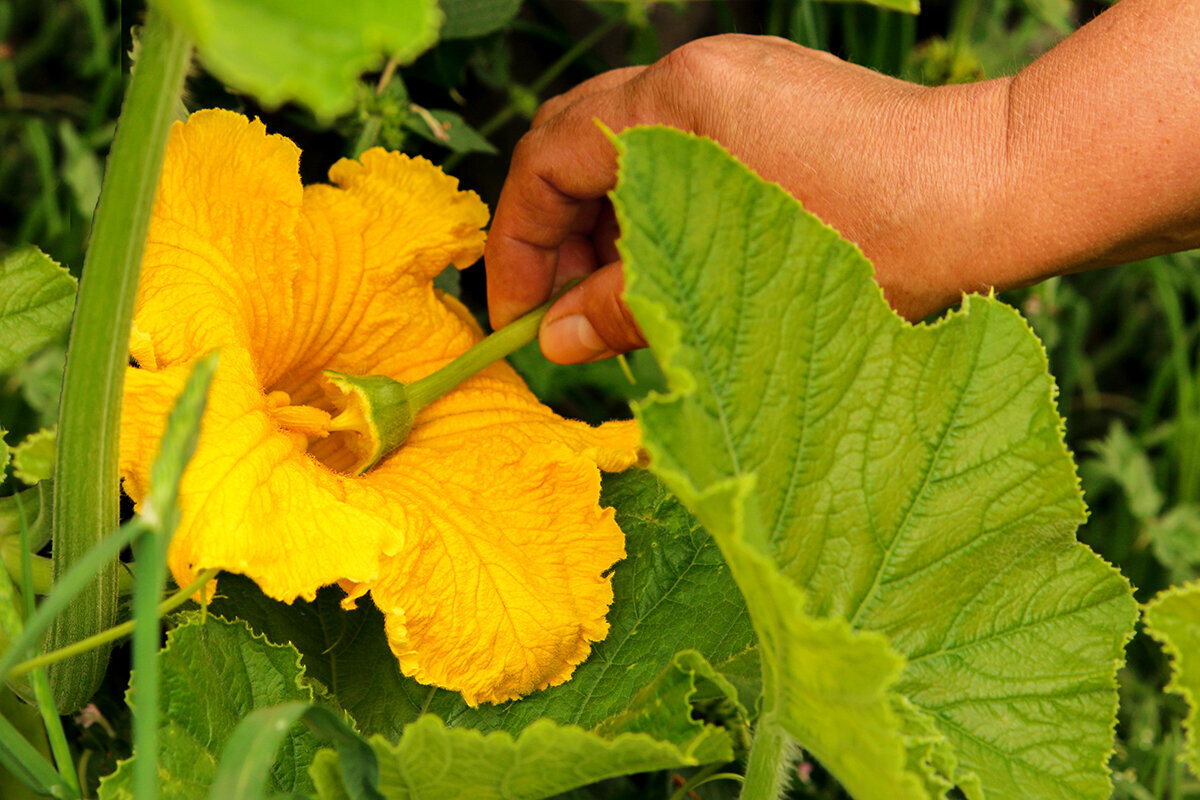
Choose a newly opened male flower with visible pollen. Remove its petals or use a clean, soft artist brush to pick up pollen, then touch the pollen-bearing surface gently to the stigma of a freshly opened female flower. The miniature fruit behind a female bloom makes identification straightforward.
- Work early, while both flowers are fully open and the pollen is fresh.
- Use one male flower for more than one female only while ample pollen remains.
- Mark a hand-pollinated flower with a loose tag if you are monitoring results.
- Do not hand-pollinate a cucumber labeled parthenocarpic.
✦
Strawberries: distribute, do not merely touch
A strawberry is not pollinated at one point. The blossom carries many ovules, and incomplete coverage may produce a small or misshapen berry. Where greenhouse access and local conditions allow, pollinators are usually more effective than trying to brush every flower by hand.
- Maintain open access only when weather, pests and crop management allow.
- Avoid broad-spectrum insecticides during bloom and follow every pesticide label.
- Reserve hand brushing for a few plants, controlled breeding or short gaps in insect activity.
- Inspect distorted berries for pests and frost injury as well as poor pollination.
○
Herbs and seed crops: decide what you harvest
Basil, cilantro, dill and many other herbs do not need flower pollination for a leafy harvest. If your goal is seed, however, flowers and pollinators become relevant. Keep flowering herbs separate from production beds if you want the crop’s energy directed into leaves rather than seed.
- For seed saving, identify whether your plant self-pollinates or crosses readily.
- Use mesh, isolation or deliberate hand pollination when controlled seed is the goal.
- Do not mistake flowering in leafy herbs for a pollination failure; it is often bolting.
For a crop-focused companion, Bloomcabin’s guide to growing tomatoes in a greenhouse connects flower care with training, watering and temperature management.
A timing gradient, not a universal hour
Use the morning window, then read the crop and the weather.
Freshly open cucurbit flowers offer a short daily opportunity, often beginning shortly after sunrise. Tomatoes are commonly worked later in the morning through early afternoon, when pollen is more likely to release well. Yet no clock replaces observation: a cool damp day and a bright dry day behave differently inside the same greenhouse.
DawnInspect cucurbit flowers.
MorningTransfer fresh cucurbit pollen.
Late morningVibrate tomato-family clusters.
AfternoonVent, shade and monitor.
EveningCheck water and temperature.
Cucurbit blooms are usually most practical to work shortly after opening, while tomato-family flowers can often be gently vibrated later in the morning when pollen is less likely to be held by humid air. If flowers look damp, the crop looks heat-stressed or ventilation is poor, correct the environment first and return when conditions improve.
- HumidityVery damp air can make pollen clump rather than shed cleanly. Do not respond by misting flowers. Improve air exchange and water the root zone rather than wetting blooms.
- HeatTomatoes commonly lose fruit set when daytime temperatures push into roughly 88–90°F or when nights remain above about 70°F. Shade and ventilation are fruit-set tools as much as comfort measures.
- Cold nightsTomato pollen formation and pollen-tube growth can be disrupted when nights fall below about 55°F. Avoid assuming a vibration routine can overcome an unsuitable temperature pattern.
- Water balanceEvenly moist growing media supports steady plant function. Alternating drought and saturation can contribute to flower drop and later fruit disorders, even when pollen transfer itself was successful.
A composed climate strategy is the better long-term investment. Review Bloomcabin’s summer greenhouse care guide for ventilation, shade and irrigation practices that help flowers function through warm American summers.
Read the evidence
Fruit-set forensics: not every imperfect fruit began with pollen.
The flower is a moment. The fruit is a record. Observe whether the bloom fell cleanly, whether a tiny fruit began to swell, whether distortion is localized or widespread, and whether the pattern aligns with a heat event, a dry spell, pests or a sudden change in fertilizer.
Healthy transferOvary enlarges steadily.
Clean bloom dropReview weather and transfer.
Partial shapeCheck pollination and pests.
Young fruit abortsLook for later stress.
How to read the sequence: fading petals followed by steady ovary enlargement is encouraging, but it is not the end of crop care. A flower that drops cleanly may indicate poor transfer or stressful temperatures. A distorted berry or cucurbit can indicate incomplete pollination, although insect feeding and other disorders deserve inspection. Initial swelling followed by abortion points more strongly toward later heat, irrigation or vigor stress.
When insects are part of the answer
Invite access thoughtfully; manage it with care.
For tomatoes, bumblebees can provide efficient buzz pollination. For strawberries and standard cucurbits, insect movement can be particularly valuable. In a small home greenhouse, opening the door and vents during favorable weather may permit visits, provided it does not undermine temperature management or create an unacceptable pest risk.
Managed bumblebee colonies are a specialized decision rather than an automatic home-garden upgrade. They require a reliable source, appropriate placement, awareness of pesticide compatibility and attention to supplier guidance. Never release or relocate wild bees into a greenhouse. If you use any pest-control product, follow the label exactly and protect pollinators by avoiding applications to open flowers or active foraging periods unless the label specifically permits that use.
Good access starts outside the greenhouse too. A diverse, pesticide-conscious garden margin provides forage across the season. Inside, keep paths clear and avoid sealing every opening during flowering when weather safely permits. Bloomcabin’s greenhouse collection offers formats for different backyard footprints, while its smart greenhouse overview explores climate-monitoring ideas that can make flowering-season adjustments more deliberate.
A repeatable flowering routine
Ten quiet minutes, three times a week.
For a mixed greenhouse, consistency is more useful than heroic intervention. Give each crop the transfer it needs, then return to climate and plant health.
- Walk during the right window. Check which crops have just-open flowers. For cucurbits, this is generally morning; for tomatoes, late morning can be favorable when conditions are drier.
- Identify the flower mode. Are you looking at a self-fertile cluster, separate male and female flowers, a strawberry bloom with many ovules or a parthenocarpic variety that needs no transfer?
- Perform the correct action. Tap or vibrate tomato-family clusters lightly. Hand-transfer standard cucurbits. Encourage pollinator access for strawberries where practical. Leave parthenocarpic cucumbers alone.
- Check climate before leaving. Read the thermometer, feel the growing medium and adjust ventilation as conditions require. Pollination cannot be separated from the environment that keeps pollen viable.
- Review fruit one week later. Look for swelling ovaries, persistent flower drop and patterns of distortion. Adjust only after you have evidence.
Frequently asked questions
Greenhouse pollination, clarified.
Can I pollinate all greenhouse vegetables with a paintbrush?
No. A brush can transfer pollen between separate male and female cucurbit flowers and can help with a small number of strawberry flowers. It is not the most efficient approach for tomatoes, peppers or eggplants, where gentle vibration of the cluster is usually more appropriate. It is also the wrong approach for parthenocarpic cucumbers bred to set fruit without pollination.
How often should I vibrate tomato flowers?
A modest routine during active flowering is usually enough. Many growers work every other day or a few times each week, focusing on open flower clusters. More force or more frequent handling does not guarantee more fruit. If set remains poor, examine temperature, humidity, watering and variety suitability.
Should I mist flowers to help pollination?
Usually not. Wet conditions can make pollen clump and can increase leaf-wetness disease risk. If the greenhouse is humid, improve ventilation and avoid overhead watering at flowering time. Water the growing media directly and keep blooms as dry as practical.
Why do my greenhouse cucumbers have flowers but no fruit?
First check whether the cultivar is standard or parthenocarpic. Standard cucumbers generally require pollen transfer between male and female flowers. Parthenocarpic greenhouse cucumbers should set fruit without pollination, so poor results point more often to temperature, plant stress, root-zone conditions, light or general crop health.
Can I keep the greenhouse closed while plants are flowering?
Yes, if you provide the appropriate alternative method. Tomatoes can be vibrated manually and standard cucurbits can be hand-pollinated. Closed conditions still need effective ventilation for temperature and humidity management. If you rely on insect pollination, flowers need safe access to the relevant pollinators.
Sources & further reading
Research behind the transfer.
- University of Maryland Extension — high-tunnel tomato pollination, vibration and temperature: https://extension.umd.edu/resource/problems-pollination-high-tunnel-tomatoes
- University of Georgia Cooperative Extension — pollination biology and cucurbit flower timing: https://fieldreport.caes.uga.edu/publications/C934/pollination-of-vegetable-crops/
- University of Minnesota Extension — crop pollination needs and parthenocarpic cucumber guidance: https://extension.umn.edu/pollination/requirements
- University of Minnesota Extension — strawberry pollination and causes of misshapen fruit: https://extension.umn.edu/strawberry-farming/small-or-misshapen-strawberries
- Mississippi State University Extension — greenhouse tomato pollination and relative humidity guidance: https://extension.msstate.edu/sites/default/files/publications/publications/p1828_web.pdf
- Oregon State University Extension — greenhouse tomato agitation and temperature considerations: https://extension.oregonstate.edu/catalog/ec-1333-grow-your-own-tomatoes-tomatillos
- Penn State Extension — heat stress and tomato flower abortion: https://extension.psu.edu/heat-stress-and-tomatoes
Complete the transfer
Let the greenhouse protect the bloom, then give it the movement it needs.
Identify the flower type, choose the lightest effective transfer and check the developing fruit before changing course. That is the calm, repeatable rhythm behind better greenhouse harvests.
01
Identify the flower
Identify the flower
02
Choose the transfer
Choose the transfer
03
Check next week’s fruit
Check next week’s fruit
