
How to Start a Raised Vegetable Garden and Get to Your First Harvest

Bloomcabin · Raised-bed guides
How to Start a Raised Vegetable Garden and Get to Your First Harvest
To start a raised vegetable garden, pick one vegetable you want to harvest, check that your site can support it, and choose a bed you can reach without stepping into it. Measure the assembled bed before ordering fill, then plant according to the variety’s directions and your local growing guidance.
Pick a priority crop
Choose one vegetable you want to harvest, then note its final spacing, planting window, and support needs.
Make the site earn its place
Check light, the water route, and the ground under your raised vegetable garden before you choose a frame.
Measure both sides of the rim
Measure the space inside the walls for planting and the space outside them for working.
Review the first harvest
Use what you picked and how often you tended the bed to decide what to change next time.
A useful first-season goal is to pick something you actually want to eat from a bed you can tend easily. Starting with that crop gives you a way to judge what your raised vegetable garden needs, from room for a support to a soil surface you can reach comfortably.
This guide follows one bed from crop choice to harvest. It focuses on open-bottom frames over prepared ground and uses Bloomcabin models to illustrate the choices. Compare their listed measurements, then confirm the specifications and instructions for the exact model before you order.
01
Decide what you want to pick
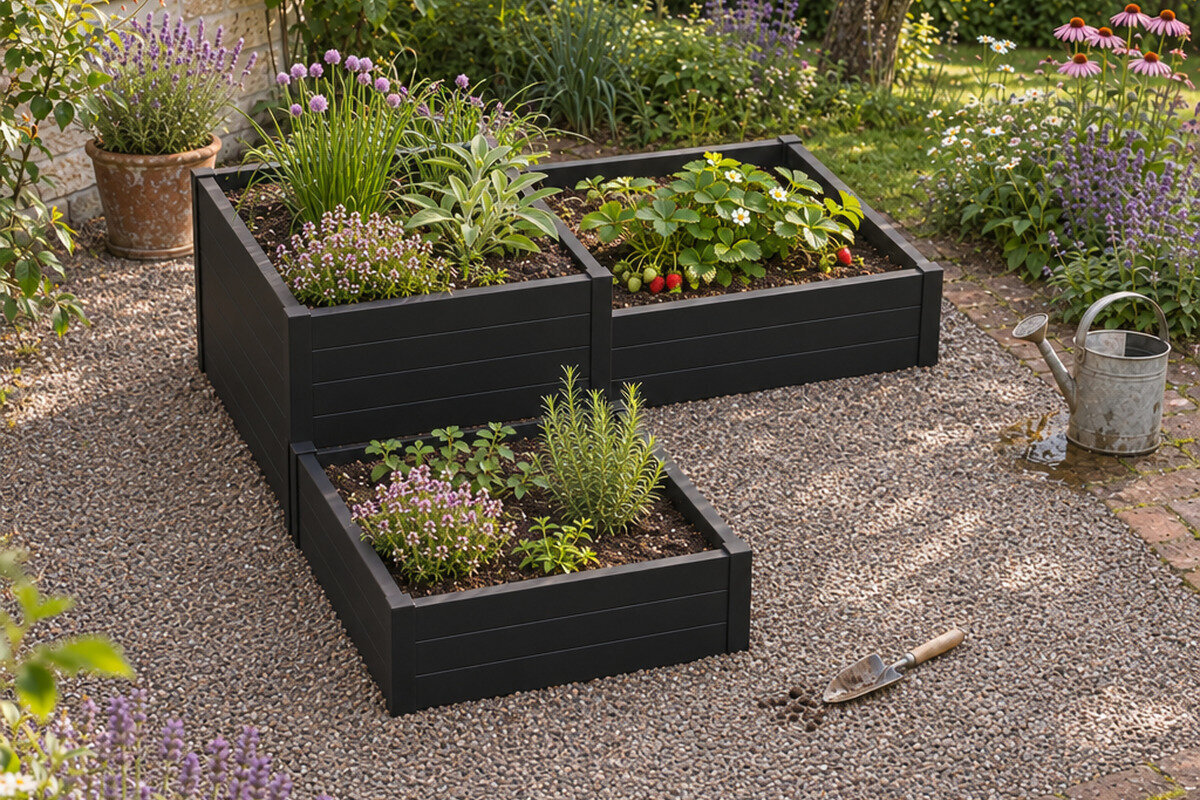
A raised vegetable garden is a growing area whose soil surface sits above the surrounding ground. It can be a mound with sloping sides or a bed with a frame that holds the soil in place. The Bloomcabin examples here are framed and open at the base: they sit on prepared ground rather than holding soil in a container with a floor.
Pick one vegetable you’d be disappointed not to harvest. Write down the variety, how much room mature plants need, whether you’ll sow or transplant, and whether you need a support. Then check local planting guidance. A bed for leaf lettuce you plan to pick from the path has a different job from one that needs to accommodate a cucumber trellis. Choose a second crop only if it fits around the first without getting in the way of watering or picking.
A framed raised vegetable garden makes sense if you want a defined planting area or a working height that feels more comfortable. It still needs appropriate light, water, and soil. If your existing garden ground already suits the crop and is comfortable to work, an in-ground row may do the job without the expense of walls and fill. Compare those costs before you buy, and leave room in the budget for watering equipment or a crop support if you need one.

02
Check the site on an ordinary watering day
Observe the proposed spot at several points in the day and compare what you see with your chosen crop’s light needs. For a crop that needs support, mark where the support would sit as well as where the frame would go. Consider what it would shade and whether you could still reach around it. Before settling on a site for your raised vegetable garden, take the hose or watering can there from the source you’ll actually use. A route you can manage on planting day should also work when the path is shared or the gate is in use.
Look at the ground after rain. If water collects there, address the drainage problem or choose a different spot before you add soil. If you’re unsure about the site’s history or suspect contamination, ask your local Extension office what assessment is appropriate before growing food. An open-bottom raised vegetable garden does not isolate new fill from the soil underneath.
Mark the outside corners and stand where you’d sow, water, and pick. Check for anything that would force you to work from a different side, such as a gate swing or a narrow passage. Keep the markings in place while you compare frames. If the only site is paved, switch to a planter designed for that setting instead of assuming you can adapt an open-bottom model by adding a liner.

03
Choose a shape you can harvest from
Size a raised vegetable garden from the working side inward. At the approximate height you’re considering, see whether you can reach the farthest planting point without stepping on the soil or leaning on the rim. Then try the same movement while leaving room for the support or mature plants. A bed that’s easy to reach when empty can become awkward if the crop you pick most often ends up behind a trellis.
Two Bloomcabin models show why planting area alone won’t settle the choice. The Square Aluminum Raised Garden Bed has a nominal footprint of 39.37 by 39.37 inches, 15.75-inch walls, and a listed nominal planting area of 10.76 square feet. Allow access from at least two opposite sides. The Narrow Aluminum Raised Garden Bed with 23.62-inch walls lists the same planting area on a 78.74-by-19.69-inch footprint. Its narrow shape is worth considering if you can work along only one long edge.
Use the nominal footprint to mark where the raised vegetable garden will sit. Use the listed planting area to compare models, not to decide exactly how many plants fit. For that, confirm the clear interior dimensions and subtract any space needed for supports. Path clearance is a separate measurement outside the frame.
Choose wall height and material for the job you need them to do. Both models above have aluminum wall panels and corner posts. The narrow Accoya fusion model has a wood top course over aluminum panels, not all-wood walls. A higher rim may bring a raised vegetable garden closer to your hands, but compare the intended soil surface, not just the rim, at the position from which you’ll work.

04
Use the empty frame for a final setup check
Before ordering, verify the current US listing and assembly instructions for the model you want. Confirm the outside dimensions, ask for clear interior measurements if your crop plan is tight, and check any preparation or working clearance the instructions require. The Bloomcabin frames discussed here come unassembled. Clear the footprint and prepare the base as directed for that exact model; don’t expect fill to correct uneven ground.
Assemble the raised vegetable garden with the specified hardware and in the order shown in its instructions. Before filling, confirm that the open base sits on the prepared ground as intended and that the frame is oriented the right way. If you use a divided bed, check reach into each bay. For a U-shaped kit, make sure you can enter and leave the access opening from the path you’ll use.
Walk around the empty raised vegetable garden with the hose or watering can and mark the proposed support location. Verify the support’s installation requirements separately rather than assuming you can attach it to the frame. This is also the time to measure the inside, resolve any assembly or clearance issues, and check how you’ll bring in fill without blocking your only working side.

05
Buy soil for the space you’ll actually fill
In an open-bottom raised vegetable garden, the growing layer can connect with the ground below if that soil is suitable for roots. The depth of the fill and the total rooting depth are therefore different measurements. For example, a short frame over suitable ground isn’t limited to the height of its walls, but don’t count on roots getting through a restrictive layer.
Ask what’s in the proposed fill, where it came from, and whether it’s intended for growing vegetables. Use soil testing and local crop guidance to decide what needs amending. Don’t add compost or fertilizer by default if you don’t know what’s already in the mix. Keep a record of what you bought so you can describe the starting soil if plants struggle later.
For a rectangular raised vegetable garden, multiply the clear inside length by the clear inside width and planned fill depth, all in feet, to get cubic feet. Measure to the soil line you plan to use, not the top of the wall. For a divided frame, calculate each bay separately and add the results. Leave a U-shaped kit’s access opening out of the estimate. Then check the volume on the bag or ask the soil supplier how to convert the estimate to its sales units and whether it recommends an allowance for settling.

06
Worked example: Fit two trellised cucumbers into one bed
Hypothetical worked example: A gardener wants vertically trellised cucumbers as the first crop in a raised vegetable garden. They’ve confirmed that the site has suitable light and ground, that water is nearby, and that they can work from two opposite sides. They choose the square aluminum model because the shorter footprint fits their site. They check the variety’s instructions and local planting window before committing to the plan.
Suppose that after assembly they measure a clear interior of 38 by 38 inches and plan a 14-inch fill depth. Those are example measurements, not Bloomcabin specifications. The estimate is 38 × 38 × 14 ÷ 1,728, or about 11.7 cubic feet of fill before settling. They use that number to discuss the soil order instead of multiplying the advertised footprint by the full wall height.
For this raised vegetable garden, assume the chosen variety’s directions agree with the University of Maryland Extension example of 18 inches between vertically trellised cucumber plants. On a clear 38-inch row, they mark two final plant positions: one 10 inches from the first end and the other 28 inches from that end, leaving 10 inches at the far end. That checks the spacing along the row only. They still verify clearance for the trellis and access for picking before sowing.
The two marks are final plant positions, not instructions to sow exactly two seeds. The gardener follows the variety’s directions for sowing depth and thinning. If the directions call for wider spacing or the trellis takes up part of the usable row, they revise the count rather than crowd the plants. They leave the rest of the raised vegetable garden unplanted at first so they can see how much room they need to reach and pick the cucumbers.

07
Build a routine around the first harvest
Before planting your raised vegetable garden, mark the final plant positions or row ends and label what you sow or transplant. Write down the variety and date. If the seed packet calls for thinning, put a reminder with the label so the seedlings don’t all stay in a space you planned for fewer mature plants. Put supports where you can still reach the soil and inspect the plants behind them.
A raised vegetable garden can dry faster than nearby ground. Check moisture where the seeds or roots are, and adjust your attention as the plants establish. Water near the roots rather than relying on a fixed interval. If you mulch to limit moisture loss and weeds, keep emerging rows visible. If you find wilting or chewed leaves on your rounds, identify the cause before treating it.
Check your crop’s harvest cues and look from both working sides if foliage hides what’s ready. After a few pickings, note what you used and what was difficult to reach. If the crop is producing and you’re enjoying it, there’s no need to clear space for something new yet. When a spot does open up, check whether another crop has time to mature locally. The first season should tell you whether your raised vegetable garden needs a different crop, a better watering routine, or more space.

Questions readers ask
How deep should a raised vegetable garden be?
Start with the vegetable’s rooting needs, then measure from the planned soil surface, not from the rim. Count soil below an open-bottom frame only where roots can enter it and the ground is suitable for growing food. A taller wall doesn’t tell you how much usable soil you’ll have.
Can I put a raised vegetable garden on a patio?
Choose a planter intended for hard surfaces and verify its usable soil depth and drainage. Check that the site can support the planter when it’s filled and watered. The Bloomcabin frames discussed here have no floor panel; their listed dimensions do not establish patio suitability or a load rating.
Can I sow a second crop in my raised vegetable garden after harvest?
Yes, if the new crop still has a suitable local planting window. Check the likely harvest timing on the packet against local Extension guidance before you sow. If the first crop is still producing, compare the value of keeping it with what you realistically have time to grow next.
Start with one bed you can tend well
Give your raised vegetable garden one clear job in its first season. Choose the crop, check the site, and measure before you buy fill. Once you’ve picked and eaten what you grew, use that experience to decide whether to change the crop, the setup, or the size of the bed.
Find a raised bed for your plan
Compare layouts and check the dimensions on the product page.
