
Landscape Fabric for Raised Beds: Where It Helps and When to Skip It

Bloomcabin · Raised-bed guides
Landscape Fabric for Raised Beds: Where It Helps and When to Skip It
Landscape fabric for raised beds can make sense as a removable cover between transplants or as a barrier on an adjacent path. It isn't a default liner for an open-bottom bed. Choose it only when the exact product is documented for the placement and you can still plant, water, and reach the soil easily.
Give it one job
Landscape fabric for raised beds is optional. Name the problem and the placement before buying a roll.
Read the product sheet
Look for documentation for the exact product and use. Appearance and “heavy duty” aren't specifications.
Trace the water
Water passing through the sheet doesn't tell you whether it will drain away from the bed.
Plan for removal
Plan how you'll reach the soil, tend the crop, and remove the fabric before installing it.
Start with a walk around the bed. Is the trouble between plants, at a wall joint, or in the aisle? That's where you should compare solutions. A roll sold as landscape fabric for raised beds doesn't tell you which of those jobs it can do, and fabric bought for one spot may be a poor fit for another.
Use two documents to make the choice: the fabric manufacturer's product sheet and the bed's assembly instructions. The first tells you what the sheet is meant to do; the second tells you how the frame goes together. If you can't confirm both the intended use and a compatible installation, skip the fabric or ask for clarification before you cut it.
01
Match the placement to the problem
Before shopping for landscape fabric for raised beds, point to the place where the problem shows up. Weeds between transplants, soil escaping at a wall joint, and weeds in a walking aisle call for different responses. If you can't name a problem the sheet would solve, leave it out.
Keep the base decision separate. Landscape fabric for raised beds sold for a surface or path use is not automatically appropriate underneath a frame. Over suitable prepared ground, an open base can give roots access to soil below. Don't interrupt that connection by default or use a sheet as a substitute for checking poor drainage or suspected contamination.
- On the soil surface: Consider a removable cover if you want to cover the spaces between transplants and can keep their openings accessible. If you direct-sow rows, thin seedlings, or change the layout often, compare it with bare soil or crop-appropriate mulch. Mulch can help limit weeds and moisture loss without requiring a fixed cut pattern.
- Against the walls: If you see soil spilling from one point, check that joint against the assembly instructions first. Consider a liner only if it is documented for sidewall soil contact and you can install it without altering the frame or obstructing drainage.
- On the path: If the problem is weeds where you walk, keep the treatment outside the growing area. Check that the fabric is intended for the planned path covering and that its edges won't protrude into the walkway.

02
Read the specifications for the exact roll
A woven sheet has interlaced strands; a nonwoven sheet is made from fibers held together without weaving. Those terms describe construction, not how quickly water will pass or how a cut edge should be finished. When comparing landscape fabric for raised beds, look for the technical sheet for the exact roll rather than using a photo of the weave as a shortcut.
Compare products at the same level of detail. A thickness figure for one roll and a “heavy duty” label on another don't establish which is better for the job. If landscape fabric for raised beds comes with directions for covering a path but says nothing about exposed use between plants, don't carry the path directions over to the planting area.
- Composition: Look for the named fiber or polymer, any stated material grade, and whether a coating or treatment is disclosed. Record thickness if provided. Weight per area, if that's all the sheet lists, doesn't tell you the thickness.
- Intended use: Look for your exact placement in the instructions. For a vegetable bed, check what the maker says about the intended use around edible crops and in contact with growing soil. An absence of information isn't confirmation of suitability.
- Water and installation: Check for documented water passage, any specified face or orientation, required covering, seam overlap, edge handling, and permitted fasteners. If an answer changes how you would install or water the bed, get it before buying.

03
Measure the assembled frame and check fastening
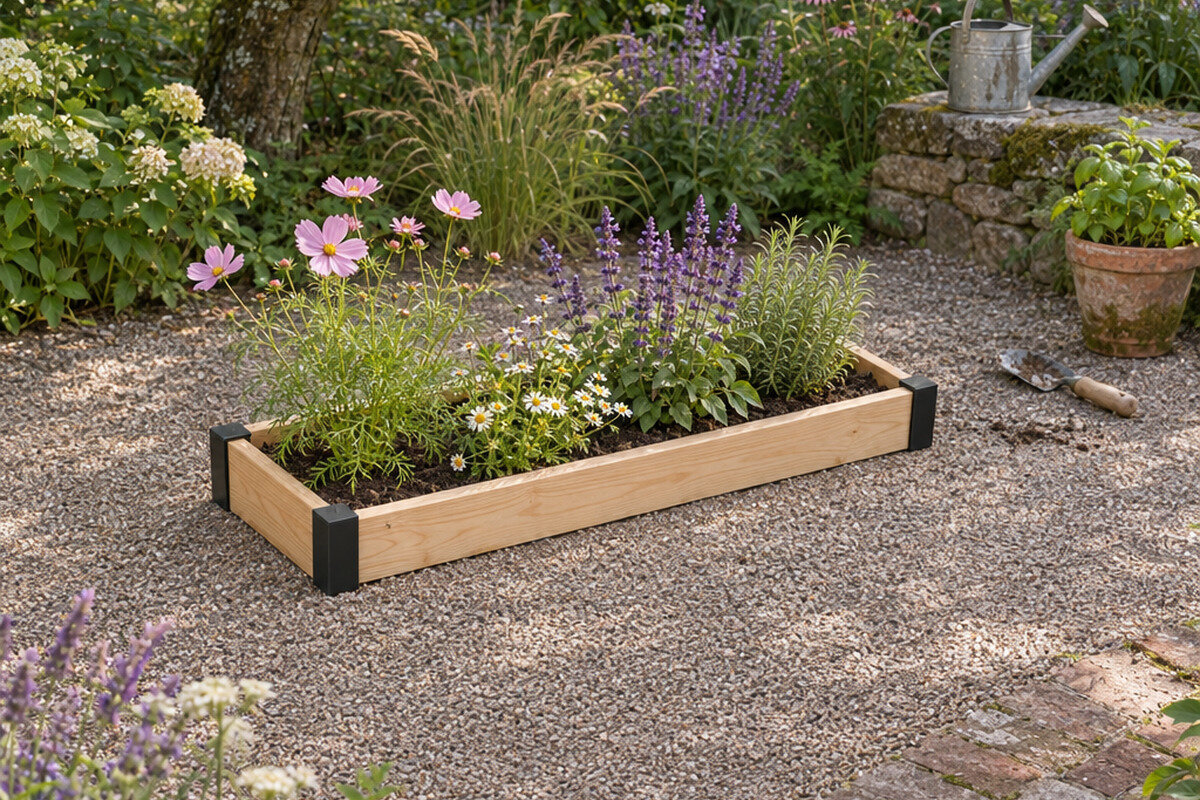
Assemble the raised bed according to its supplied instructions before deciding how any fabric will fit. The Narrow Aluminum Raised Garden Bed 39.37×19.69×3.94 in has a nominal footprint of 39.37 by 19.69 inches, aluminum wall panels and corner posts, and no floor panel. Its 3.94-inch wall height is a frame measurement, not a statement of total rooting depth. On suitable ground, roots may extend below the frame.
Measure where the fabric will actually sit. The nominal footprint isn't a cutting template. For a surface cover, measure the soil surface at the intended fill level. For a sidewall liner, check the usable span and height along each wall and note where posts interrupt the run. Measure the walkway separately if that's where the fabric belongs.
Check fastening before cutting landscape fabric for raised beds. If the fabric calls for an attachment the frame instructions don't address, don't drill panels, trap the sheet in joints, or substitute hardware. Ask about compatibility or choose an arrangement that doesn't modify the frame. A listing for the bed doesn't establish that it accepts a liner.
Think ahead to what happens when you remove landscape fabric for raised beds. A surface cover you can lift between crops presents a different job from a wall liner held behind the fill. If retrieving the liner would mean moving soil, weigh that labor against the problem you're trying to solve.

04
Trace water above and below the fabric
Separate two questions: How will water reach the root zone, and where will excess water go? If you want to water from above landscape fabric for raised beds, verify water passage for that product and install it in the specified orientation. If you plan to water below a surface cover, arrange the irrigation so you can still inspect it and reach the soil to check moisture.
Once the cover is down, watch a normal watering and check the soil at more than one planting opening. If the surface looks wet but the soil below is dry, check whether water is running to the edges or bypassing part of the row. If the soil is saturated, don't assume the sheet caused it. Look at where water enters, whether the growing medium stays wet, and whether excess water has somewhere to go.
A permeable sheet is not a drainage outlet. Landscape fabric for raised beds won't make a low, wet site suitable or turn a floorless frame on paving into a purpose-built container. On a hard surface, start with a setup designed to contain the growing medium and drain. Over ground, assess the underlying site before adding a layer that would make it harder to inspect.

05
Work out the cut and compare the upkeep
Hypothetical worked example: A gardener is weighing landscape fabric for raised beds as a removable surface cover for one row of transplants. The measured soil surface, inside the assembled walls at the intended fill level, is 36 inches wide by 72 inches long. Assume the directions for the candidate fabric allow a single sheet and call for a 2-inch allowance on each edge using a method compatible with the bed.
Add 4 inches to each dimension, not 2: the cut piece is 40 by 76 inches. A 48-inch-wide roll can supply that piece from 76 inches of length, leaving an 8-inch-wide strip along that cut. No seam is needed under these assumptions. This is a cut plan, not a universal allowance or a claim about a Bloomcabin model. If the actual instructions call for a different allowance or edge treatment, recalculate before buying.
Now compare the work, not just the amount of material. With landscape fabric for raised beds, the gardener must mark and cut plant openings, keep them accessible for watering, and decide whether the same layout works next season. With crop-appropriate mulch, there is no fixed cut pattern, but the gardener may need to move mulch aside to plant and redistribute it afterward. With bare soil, there is no cover to buy or remove, but the gardener needs a plan to manage weeds. For a row that moves each season, the simplest option may be the one that doesn't lock in the openings.

06
Lay it out for planting and inspection
Before installing landscape fabric for raised beds on the soil surface, mark the crop layout using the seed packet, plant label, or local extension guidance. Make sure you can reach each opening and the irrigation without stepping into the bed. Lay out the cover to confirm the fit before cutting openings, then follow the fabric maker's instructions for cuts, edges, overlap, and fastening.
Keep the openings usable for the crop and large enough to check soil moisture without dragging the cover across stems. If the planned openings would make it awkward to sow, thin, or replant, revise the layout before cutting. Don't enlarge cuts or add holes to solve a water problem until you know where the water is going and what the instructions allow.
Check exposed edges and openings after watering or other disturbance. If landscape fabric for raised beds shifts, tears, or pulls against a plant, correct it using the documented method or lift it out if it no longer fits the job. For path fabric, check the edges where you step between the bed and the aisle. For a wall liner, inspect any accessible edges without pulling against the filled frame.

07
Decide whether to keep it after the crop
Judge landscape fabric for raised beds by the problem you wanted to solve. Is the space between transplants easier to tend, or are you spending that time weeding around openings and checking for dry spots? If you installed a sidewall liner to address soil loss, check that the original trouble spot has improved. Fix a remaining frame problem according to the bed instructions rather than adding another layer.
When a crop comes out, decide whether the next planting fits the existing openings. If roots have grown through a surface sheet, don't yank it against plants you're keeping. Work around those plants or wait until they're removed, then follow the maker's removal directions and collect any loose pieces. For a liner behind the fill, plan removal when you can safely move the soil rather than pulling on the frame.
Keep the instructions with a note about where the material went and what you'd change next time. Reuse landscape fabric for raised beds only if it's still intact, the next placement is documented, and the old cuts suit the new job. Between crops is also the easiest point to decide that the bed doesn't need a fabric layer at all.

Questions readers ask
Can I reuse landscape fabric for raised beds from an old garden path?
Don't move it into the planting area unless you can identify the exact product, verify that the maker includes the new use, and confirm that the sheet is still in usable condition. If the label is gone or the fabric has brittle areas, tears, or openings in the wrong places, leave it out of the bed.
Can I direct-sow seeds through landscape fabric for raised beds?
You can leave an uncovered strip if the fabric instructions permit that layout, but don't sow underneath an intact sheet. Mark the row and use the seed packet to plan spacing and room for thinning. If several rows need open strips, leaving the surface uncovered may be simpler than cutting around each row.
Does landscape fabric for raised beds need replacing every year?
There is no single replacement interval. Follow the maker's directions and reassess the sheet when you change crops. Check for damaged edges, openings that no longer fit, and areas where the fabric interferes with watering or access. Remove it if there is no longer a job for it to do.
Buy only when the fabric has a clear job
Choose landscape fabric for raised beds only when the product instructions, frame, planting layout, and water path all fit the job. If you can't point to what it improves, leave it out and address the problem where it starts.
Find a raised bed for your plan
Compare layouts and check the dimensions on the product page.
