
Large Metal Raised Garden Beds: How to Judge the Frame and Fit

Bloomcabin · Raised-bed guides
Large Metal Raised Garden Beds: How to Judge the Frame and Fit
Large metal raised garden beds are a good option when the specific frame is documented for what you want to grow and where you’ll install it. Judge the metal and the layout together: a longer run may add joints, and a wider footprint is only useful if you can reach what you plant.
Ask for the specification
For large metal raised garden beds, verify the metal grade, finish, panel thickness, fasteners, and intended use for the exact model.
Look at the joints
Check how long wall sections are joined and whether dividers or supports must stay in place.
Measure where you’ll stand
Compare reachable planting area, not just the outside footprint. Measure paths and access gaps separately.
Plan the base and fill
Confirm the installation surface and drainage before buying soil. Estimate fill from the inside of each bay.
Before comparing large metal raised garden beds, mark out the space you can devote to planting and the paths you need to keep clear. Then decide whether you want one continuous strip, separate bays, or a layout you can step into. That sketch gives you a way to compare two metal frames that look similar in photos but work differently in your yard.
Next, match your sketch to the dimensions, parts diagram, and installation instructions for the model you’d buy. Bloomcabin’s Classic aluminum specifications identify the main frame materials and layouts, but a dimension sheet doesn’t answer every question about finish, hardware, or site suitability. Use the checks below to decide what’s confirmed and what to ask before ordering.
01
Find out what touches the soil
Start with the specification for the exact size and layout you want. For large metal raised garden beds, ask for the metal grade or alloy, panel thickness, any coating or treatment, and the material of the fasteners and connectors. If you plan to grow vegetables or herbs, ask whether the supplier documents that use for the finished frame, including surfaces that touch soil. A finish description or a product photo is not an answer to that question.
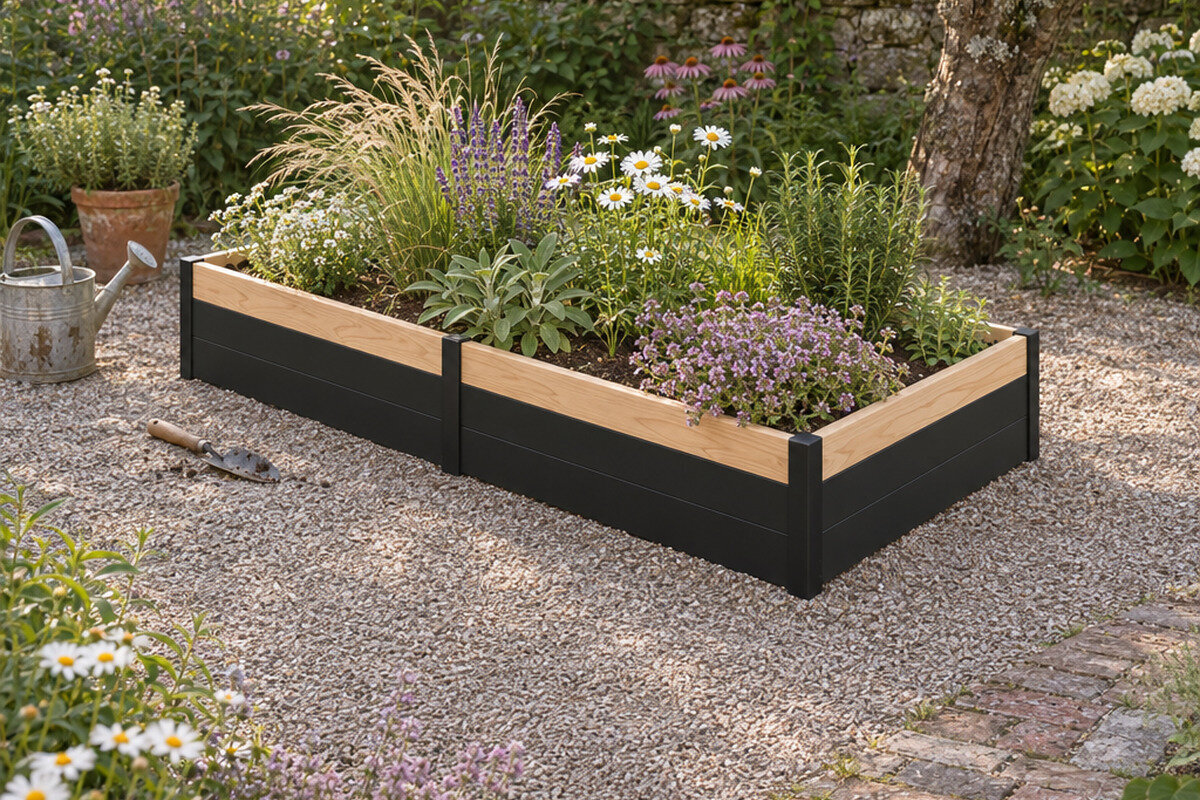
Bloomcabin’s Classic aluminum examples identify the wall panels and corner posts as aluminum. Some configurations also specify aluminum connectors. Those details tell you which parts are metal, but the specifications summarized here do not identify the alloy, finish, panel thickness, or fastener composition. By contrast, Bloomcabin’s narrow Accoya fusion model has aluminum lower wall panels and Accoya boards along the upper 3.94 inches of all four walls. It is a mixed-material design, not an all-aluminum frame.
When comparing large metal raised garden beds with wood or mixed-material frames, ask the same questions about soil contact, compatible hardware, and care. For wood components, verify the species or named material, board thickness, and treatment, if any. If a seller cannot identify the metal grade or explain what finish was applied, mark those details as unknown. An incomplete specification is not proof that a bed is unsuitable, but it gives you less to base your decision on.

02
Read the wall layout, not just the panel thickness
Two large metal raised garden beds with similar outside dimensions can have different wall layouts. A long side might consist of several short panels joined at posts or connectors rather than one uninterrupted sheet. Find those joints on the model’s parts diagram and check whether a divider or support is required. Panel thickness is worth checking, but it does not tell you how far a wall runs between connections or how those connections are built.
For example, Bloomcabin’s long narrow Classic aluminum model has a nominal footprint of 78.74 × 19.69 inches and walls 23.62 inches high. Each long side comprises two 39.37-inch sections joined by an aluminum T connector. The Classic aluminum double bed is also nominally 78.74 inches long, but it is 39.37 inches wide, has 11.81-inch walls, and uses a central divider to separate two bays. The shared length does not mean the two layouts use the same parts or assembly sequence.
If you’re considering large metal raised garden beds because you want one uninterrupted row, check the plan view before you order. A center divider that works well for separate plantings may be in the wrong place for yours. Don’t assume you can omit it, extend the run with spare panels, or swap in hardware from another configuration. If the documented layout doesn’t suit your crop plan, look for a different configuration rather than modifying the frame.

03
Measure the planting area you can actually reach
When comparing large metal raised garden beds, write down three separate measurements: the nominal outside footprint, the planting area, and the space you need to work around it. Ask for actual inside dimensions if your row spacing or fill order depends on them. To test access, mark the outline with string and try reaching the middle from where you’ll actually stand. A fence or hedge can turn a bed you planned to tend from both sides into one you can reach from only one.
The U-shaped Classic aluminum kit illustrates why outside dimensions alone tell you so little. It has a nominal overall footprint of 118.11 × 78.74 inches and a nominal planting area of 53.82 square feet across five bays. Its nominal 39.37 × 39.37-inch notch is an access space, not planting area. Mark the notch separately and check its entrance as well as its width. If a nearby obstruction blocks the entrance, the notch won’t give you the access you expected.
For large metal raised garden beds along a boundary, measure how far you can comfortably reach from the open side before deciding how wide the planting strip should be. For beds with several bays, test reach into each bay rather than just into the one nearest the entrance. Use seed-packet spacing and local extension guidance to sketch the planting layout. If tending the far row would mean stepping into the bed, adjust the footprint or choose a narrower layout.

04
Check the entire area beneath the frame
The Bloomcabin aluminum examples discussed here are open to prepared ground and have no floor panel. When planning a site for large metal raised garden beds, look at the whole area they’ll cover. One end of a long bed may sit over soil that drains readily while the other overlaps a low spot that holds water. Walk the outline after rain if you can, and note where water enters, pools, or leaves. Resolve persistent pooling before filling the frame.
Wall height measures the frame, not the full depth available to roots. Over suitable prepared ground, roots may extend below the frame. Over a hard surface, that connection is absent, and you need a design that accounts for soil containment and drainage. Don’t assume an open-bottom kit is appropriate for pavement or that a deck can support a filled bed. Confirm the intended installation with the supplier and verify the surface separately. If you suspect contamination in the underlying soil, get local advice before relying on an open-bottom frame.
The site check for large metal raised garden beds should also cover the crops’ light needs and access to water. Trace the route a hose will take and check whether it reaches the far end without snagging at a corner. Don’t try to solve drainage by defaulting to a liner or drilling holes. Check the model’s base instructions and address where water can go once it leaves the planting soil.

05
Do a pre-fill check of every joint
Bloomcabin supplies the aluminum examples discussed here unassembled. Before starting on large metal raised garden beds, get the instructions for the exact layout and check the parts against the list. On a multi-bay kit, sort wall sections and connectors by where the diagram puts them, especially at shared walls. Leave room to handle the panels and work at the joints before you bring bags of soil or a wheelbarrow into the area.
Prepare the base and follow the assembly sequence in the instructions. Before adding soil, verify that every required connector, fastener, and divider is in place. Check that the frame sits as the instructions specify, the paths are still clear, and you can reach the intended planting area. If a joint won’t seat or a panel arrives damaged, stop before filling and ask for model-specific guidance. Don’t enlarge holes, add anchors, or substitute hardware based on what fit a different kit.
With large metal raised garden beds, the final position matters more than getting the empty frame together quickly. Decide which end faces the water source and how you’ll bring fill to each bay. Deliver it from a clear path, not across an area you’ve already planted. Plan on assembling and filling in the intended location, unless the instructions specifically allow you to move the frame afterward.

06
Price the usable layout, including soil and paths
Before ordering soil for large metal raised garden beds, get the inside dimensions of each planting bay and choose a fill depth consistent with the model instructions and intended crops. For a simple rectangular bay, multiply inside length by inside width by fill depth, all in feet, to estimate cubic feet. Add the individual estimates for a divided bed. For an irregular kit, use the supplier’s fill guidance rather than multiplying the overall footprint by wall height.
Hypothetical example: A gardener wants two planting bays and has a 7-foot-wide space, including both side paths. Assume a candidate frame is 3.5 feet wide on the outside. Centering it leaves 1.75 feet per side: (7 − 3.5) ÷ 2. The gardener needs 2 feet on each side to move a cart, so the layout fails even if the frame itself fits. Now assume each bay measures 3 feet by 3 feet inside and the planned fill is 10 inches deep. That’s 3 × 3 × 10/12, or 7.5 cubic feet per bay and 15 cubic feet total. These are planning assumptions, not Bloomcabin dimensions or a recommended fill depth.
That example shows why the setup cost of large metal raised garden beds is more than the frame price. Compare fill quantities, delivery or handling costs where applicable, and any site preparation before deciding. Check the source of any purchased topsoil and use a soil test to guide amendments rather than buying a fixed recipe by volume. A smaller layout that leaves working room may be a better fit than one that maximizes planting area on paper.

07
Make sure you can inspect and care for the frame
The finish and hardware determine what care is appropriate for large metal raised garden beds. Ask what cleaners and tools are allowed and how to handle scratches or damaged finishes. Keep the parts list and care instructions so you can identify a replacement if a joint needs attention. A mixed wood-and-metal frame may have separate guidance for different surfaces; don’t assume a treatment suitable for one is suitable for the other.
During routine garden work, look along the longer runs for changes in panel alignment, especially near connectors or dividers. Make a point of checking any joints hidden behind dense foliage. A loose connection, newly exposed edge, or shifting panel is a reason to consult the model instructions before trying to straighten it or fit a substitute part. Don’t use the material label or appearance of the frame to predict its service life.
For long or compartmented large metal raised garden beds, check soil moisture in more than one spot before deciding how to water. An end in afternoon sun may need different attention than a sheltered bay, and seedlings and established plants don’t always need the same care. Base watering on what you find near the roots, not a single schedule for the whole frame. As a final buying check, ask whether you can reach the joints for inspection without moving the bed or trampling its planting area.

Questions readers ask
Are large metal raised garden beds suitable for vegetables?
They can be. Look for written confirmation that the exact model is intended for growing edible crops, then check the proposed site, water access, and rooting depth. An aluminum label identifies the panel material but does not establish the alloy, finish, or suitability of an unidentified replacement part.
Can I join two large metal raised garden beds to make one longer bed?
Only if the supplier documents that configuration. Removing an end wall or divider can change how the remaining panels are supported. If there’s no approved way to join them, compare two independently assembled frames with a kit designed for a longer run.
Is a U-shaped bed easier to reach than a long rectangle?
It depends on where you can stand. A notch can give you another place to work, but it needs a clear entrance and enough room for you to turn or use your tools. Mark the notch and surrounding paths on the ground, then test your reach into each bay.
Choose the frame that fits the site
Choose large metal raised garden beds only after the material documentation, wall layout, working space, and base all fit your plan. If a missing specification could change where you install the bed, what you grow in it, or how you assemble it, get that answer before you buy.
Find a raised bed for your plan
Compare layouts and check the dimensions on the product page.
