
Pallet Collar Raised Bed: Can You Safely Use and Stack the Collars You Found?

Bloomcabin · Raised-bed guides
Pallet Collar Raised Bed: Can You Safely Use and Stack the Collars You Found?
A pallet collar raised bed is an option only if you can verify the history and condition of the exact hinged collars you found and confirm that the proposed arrangement is suitable for retaining wet soil. Start with the collars in front of you, not a presumed stack height.
Identify the set
Label every collar so you can tie its condition, history, and instructions to the actual unit.
Verify the use
Verify that the exact pallet collar raised bed arrangement can retain wet growing medium, even if you plan just one course.
Check the fit
An empty dry fit can reveal rocking, offsets, or gaps. It cannot establish load capacity.
Measure before filling
Measure the usable soil depth before deciding whether another course is worth adding.
Two folded rims from the same pile can look like a ready-made garden bed. But one may have different corner fittings, a less traceable history, or instructions that cover shipping and nothing more. Before planning a pallet collar raised bed, find out what you can verify about each unit separately and what you can verify about the pair.
This guide keeps the collars intact. A course means one complete rim, not a row of loose boards. Label the units, record the setup you want, then work through the checks in order. By the end, you should know which arrangement to measure for fill—or why to leave the collars out of the garden.
01
Identify the hinged rim and label each unit
Start by identifying what you found. A pallet is the platform; a collar is the rim that fits around a load. Look at the unit assembled: four sides form a perimeter, and hinged corners allow the rim to fold for storage. A fixed wooden rectangle can look similar when it is sitting on a pallet. For a pallet collar raised bed, the useful distinction is whether you can confirm that the rim is an intact collar and identify the fittings that join it to another course, if the design allows stacking.
Label the collars A, B, and so on before you move them around. Photograph any marks and the top and bottom of each corner. Note whether the original owner can connect the units to an invoice, model number, or set of instructions. If two rims have the same outside dimensions but different corner hardware, list them separately rather than recording one model for the pair.
Once you can identify the parts of a proposed pallet collar raised bed, sketch which collar would go on the ground and which would go above it. That lets you ask about a specific pairing. If you can identify one rim but not its companion, leave the unidentified unit out of the plan until you can match it to reliable records.
- For each unit, record the supplier, maker or model if known, outside length and width, wall height, and corner details.
- Keep a photo of the assembled rim and each identifying mark with the label for that unit.

02
Trace the material and service history collar by collar
Decide what you intend to grow before evaluating the past use of the collars. For a pallet collar raised bed intended for vegetables or herbs, ask the owner or supplier to identify the wall material, any treatment or coating, and the previous cargo and storage conditions. Find out whether they can speak for the collar's full use history or only the most recent shipment. Ask whether it was stored empty near materials that could have spilled onto it. Keep those answers with the label for that specific unit.
Check for residue, unexplained stains, unusual odors, or replacement panels the owner cannot account for. These are reasons to pause, not ways to identify what was on the collar. A clean-looking face and a legible stamp are not a record of previous use. If the history is unverified or unsuitable for what you plan to grow, exclude the unit rather than trying to make the history question go away with paint or a liner.
Don't assume every rim came from the same place just because you found them together. If one collar has a traceable history and the other doesn't, keep the first as a candidate for a pallet collar raised bed and set the second aside. The remaining collar still has to pass the condition and loading checks.
- Ask what the sides are made of, whether they were treated or coated, and whether any panel or hardware was replaced.
- Record what the collar held, where it was stored, and how the owner knows. Mark any gap in that account as unknown.

03
Check the hinges, the diagonals, and the mating edges
With the collar empty and resting on a flat surface, open it as directed and check the hardware before adding another course. Look for bent hardware, loose fasteners, splits around attachments, missing parts, and undocumented repairs. Do not force a stiff or misaligned hinge. In a pallet collar raised bed, one damaged corner is enough to set a unit aside even if the other three look sound.
Look along each side for a bow or twist, and compare the two corner-to-corner measurements using equivalent points on the rim. If the rim is designed to be rectangular, noticeably different diagonals are a reason to check whether it opened fully, is distorted, or has a misaligned corner. Use any tolerances the maker specifies rather than inventing a universal cutoff. Matching diagonals do not clear a damaged hinge or confirm that the next collar will seat.
Next, compare the actual surfaces that will meet in the pallet collar raised bed. Line up the collars side by side and check the corner fittings, their orientation, and the edges that carry the upper rim. An apparent match in length and width does not tell you whether one collar's fittings will engage the other as intended. Note any difference before asking the maker or supplier to confirm the pairing.
- Inspect all four corners, including the fasteners and the material immediately around them.
- Compare mating edges and corner fittings with the maker's drawings or compatibility guidance, not just with each other.

04
Get two answers in writing: stacking and soil retention
Separate two questions: May these exact models be stacked as shown, and may that arrangement retain wet growing medium to the depth you plan? A transport instruction may answer the first question without answering the second. For a pallet collar raised bed, don't assume that a shipping load rating tells you what the walls and joints can retain when the fill is wet.
Ask the maker or supplier to tie its response to the units in your sketch. Confirm the permitted number and order of courses, required orientation, support beneath the bottom rim, and any fill limit or other conditions. Ask whether approval for the pallet collar raised bed applies to the collars resting directly on prepared ground or requires a base that is part of the documented system. Instructions that require a different base or configuration do not cover your plan as drawn.
If you have approval for one course to retain wet growing medium but nothing about the second, only one course is an option. If you have stacking instructions but no confirmation about soil containment, leave the pallet collar raised bed unfilled. Extra screws, straps, or stakes do not turn a transport instruction into a garden-use specification.
- Send the maker or supplier the model details, corner photos, planned course order, and intended fill depth.
- Ask for written guidance covering wet growing medium, the required bearing surface, and any limits on stacking or filling.

05
Dry-fit on the ground where the bed will sit
Dry-fit the pallet collar raised bed only after you have checked the history, condition, compatibility, and instructions. Use the actual site rather than a smooth work surface somewhere else. Prepare a firm, level bearing surface as directed, and check where the bottom rim makes contact. Look for a high spot that lifts a corner or a low area that leaves a stretch of the rim unsupported where it should bear.
Assemble the empty courses in the documented order and orientation. Walk around each seam. Is one corner sitting high? Is a fitting caught on an edge instead of seated? Does the bottom rim rock under gentle hand pressure? If you find a problem, take the empty arrangement apart and determine whether the site or the fit is at fault. Correct only what the instructions allow, then check again. Don't count on a load of soil to press the parts into place.
Before you commit to the pallet collar raised bed, also check whether you can reach the middle without stepping into it and whether you have water nearby. An open-bottom frame on suitable soil is a different setup from one on paving. If the proposal involves a deck or another load-sensitive surface, this dry fit tells you nothing about what the surface can support when the bed is full.
- Dry-fit the empty arrangement on the intended bearing surface and look at every corner from the outside.
- Stop if you find rocking, offset courses, interference, or a gap the instructions do not account for.

06
Measure the soil space you gain with a second course
Measure the pallet collar raised bed after the empty frame is seated. Take the clear inside length and width, not the outside footprint. Measure vertically from where the added soil will start to your intended fill line, within any documented fill limit. A joined pair may not add the full height of the upper rim to the usable fill depth. Measure the assembled result rather than adding two catalog wall heights.
Hypothetical garden-planning example: You're comparing a documented single course and a documented two-course pallet collar raised bed for a planting plan that calls for 10 inches of added soil. Assume both arrangements have a clear, unobstructed interior of 42 by 36 inches. Once you've allowed for the space above the soil line, the single course measures 6 inches of usable fill depth and the pair measures 14 inches.
The inside area is 3.5 feet × 3 feet = 10.5 square feet. At 6 inches, the single course takes 10.5 × (6 ÷ 12) = 5.25 cubic feet. At its full 14-inch usable depth, the pair takes 10.5 × (14 ÷ 12) = 12.25 cubic feet. If you use the pair but fill only to the planned 10 inches, the estimate is 10.5 × (10 ÷ 12) = 8.75 cubic feet. Here the single course falls short; the pair meets the plan without being filled to its usable limit.
Those numbers estimate fill, not weight or capacity. If your real planting decision depends on total rooting depth, assess the ground under the pallet collar raised bed as well. Roots may extend below an open-bottom frame over suitable soil, so the number of inches you add is not necessarily the depth available to roots.
- For an unobstructed rectangular interior, multiply inside length, inside width, and usable fill depth in feet to get cubic feet.
- If the clear cross section changes between courses, measure and calculate the sections separately rather than using the biggest dimensions throughout.

07
Choose the stack, one verified course, or a garden frame
Review the notes for the pallet collar raised bed before buying fill. A failed check on the upper collar rules out the pair, but it need not rule out the lower collar if the lower one passes on its own. Conversely, a well-documented pair is no reason to stack if one verified course gives you enough fill depth at a suitable site. Keep the chosen order and fill limit with your notes so you can reassemble the same arrangement if you move the bed, and repeat the site check before filling it again.
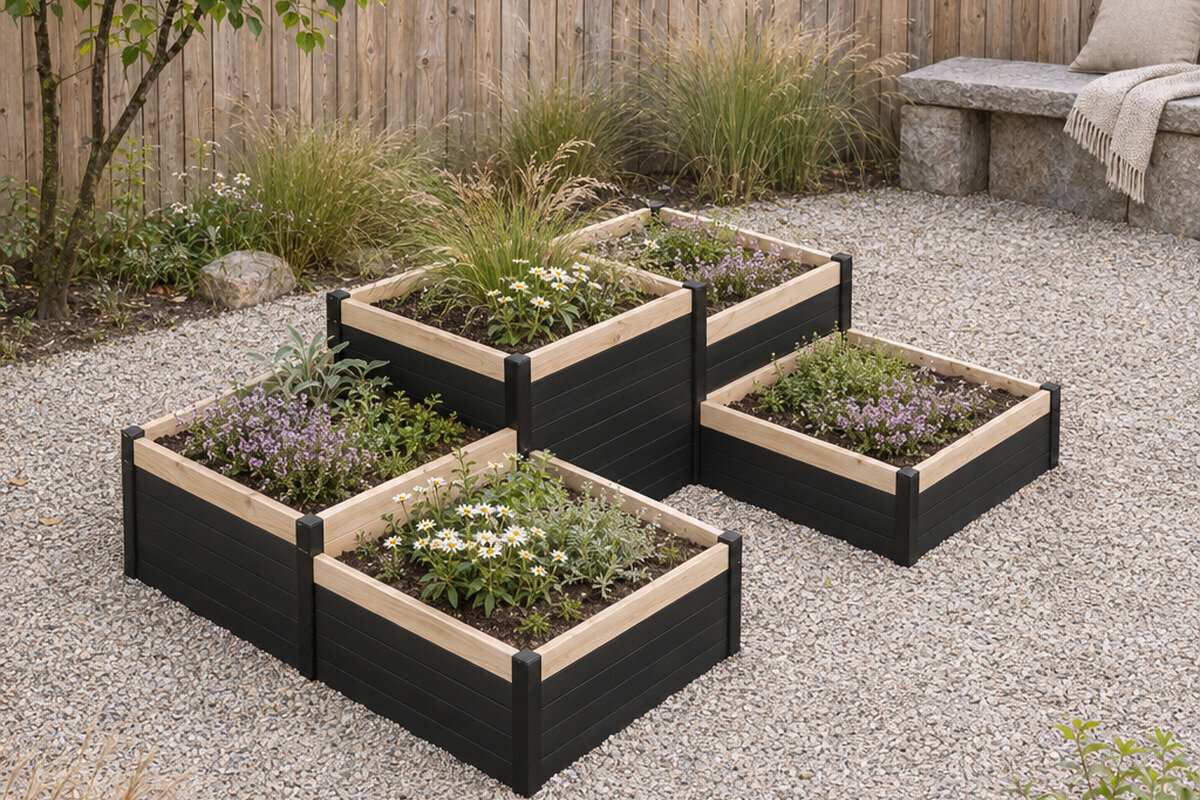
If the pallet collar raised bed doesn't pass, compare a purpose-made frame by site footprint, wall height, and assembly requirements. The Bloomcabin gallery shows ground-standing raised garden beds, not pallet collars or examples of a tested collar stack. For example, the Narrow Accoya Raised Garden Bed has a nominal footprint of 39.37 × 19.69 inches and a wall height of 23.62 inches. Its lower wall panels and corner posts are aluminum, with Accoya boards at the top of all four walls. The base is open to prepared ground, with no floor panel. Those specifications help you compare footprint, materials, and wall height; they don't supply an internal fill measurement or tell you what your site can support.
- Use the documented stack only if every collar passes and the added depth serves your planting plan.
- Use one course if it is independently verified for soil retention and meets the plan. If neither option qualifies, choose a purpose-made frame.

Questions readers ask
Can I use a pallet collar raised bed if the instructions only describe shipping?
Not on the strength of those instructions alone. Ask for written confirmation that covers retaining wet growing medium in your proposed arrangement. If the answer covers only stacking for transport, it does not resolve whether you can fill even a single course at your site.
Does a treatment stamp tell me enough about the wood?
No. Ask the supplier what the mark applies to and what it means. Even a mark you can verify does not tell you what happened to that collar during use or storage. For a pallet collar raised bed, you need both material information and a history that fits the intended planting.
Can I use a liner to make a pallet collar raised bed with an unknown history?
Don't rely on a liner to clear a collar with an uncertain history. It does not tell you what the material was exposed to, and it does not repair a hinge, correct a poor fit, or establish that the frame can retain wet soil. Leave that collar out.
Make the decision before ordering soil
Keep the unit photos, written use guidance, dry-fit notes, and fill measurements together. Proceed with the pallet collar raised bed only in the arrangement those records support. If the evidence stops at one course, so should the bed.
Find a raised bed for your plan
Compare layouts and check the dimensions on the product page.
