
Portable Planter Box: How to Choose, Set Up, and Move One

Bloomcabin · Raised-bed guides
Portable Planter Box: How to Choose, Set Up, and Move One
Choose a portable planter box according to when it needs to move. If it must travel with wet soil and plants inside, buy a floor-equipped container the supplier explicitly approves for loaded movement on your surface. If you only need to relocate it between seasons, an empty-only setup may be enough.
Decide when it must move
A portable planter box you can relocate empty isn't necessarily safe to move with wet mix and plants inside.
Walk the route first
Measure turns, thresholds, and the space you need to stand or reach, not just the parking spot.
Verify brakes and ratings
Check what the brakes lock and ask whether the supplier's rating applies when the planter is rolling.
Plan where water goes
Keep outlets clear and direct runoff somewhere it won't cross a walkway or collect under the base.
A portable planter box might be a small container you can carry, a larger one on locking casters, or a box meant to stay put until you empty it. The useful question isn't whether you can shift it in the store. It's whether you can get it from its growing spot to its next destination in the condition it will actually be in.
Start by walking that route, then check the product's weight limits, usable planting space, and drainage. If you don't need to move a planted container at all, compare it with a raised frame you assemble on prepared ground. That can be a good growing setup, but it doesn't solve the same problem as a planter you need to roll across a patio.
01
Choose how often you need to move it
If you're moving your garden when you change apartments or reorganize a yard, a portable planter box that moves only when empty may be enough. Look for a container you can unload and handle as directed, or use a ground frame you can disassemble at the end of the season. If you're chasing afternoon sun or regularly clearing a patio for guests, unloading every time defeats the purpose. For that job, buy for loaded movement from the start.
For a small box you expect to carry while planted, check that the supplier permits it and identifies how to lift it. A molded rim or side opening isn't necessarily a rated handle. A wheeled portable planter box suits a different job: the supplier needs to approve the assembled box and wheel system for loaded travel on the type of surface you have. A photo of the wheels doesn't answer that question.
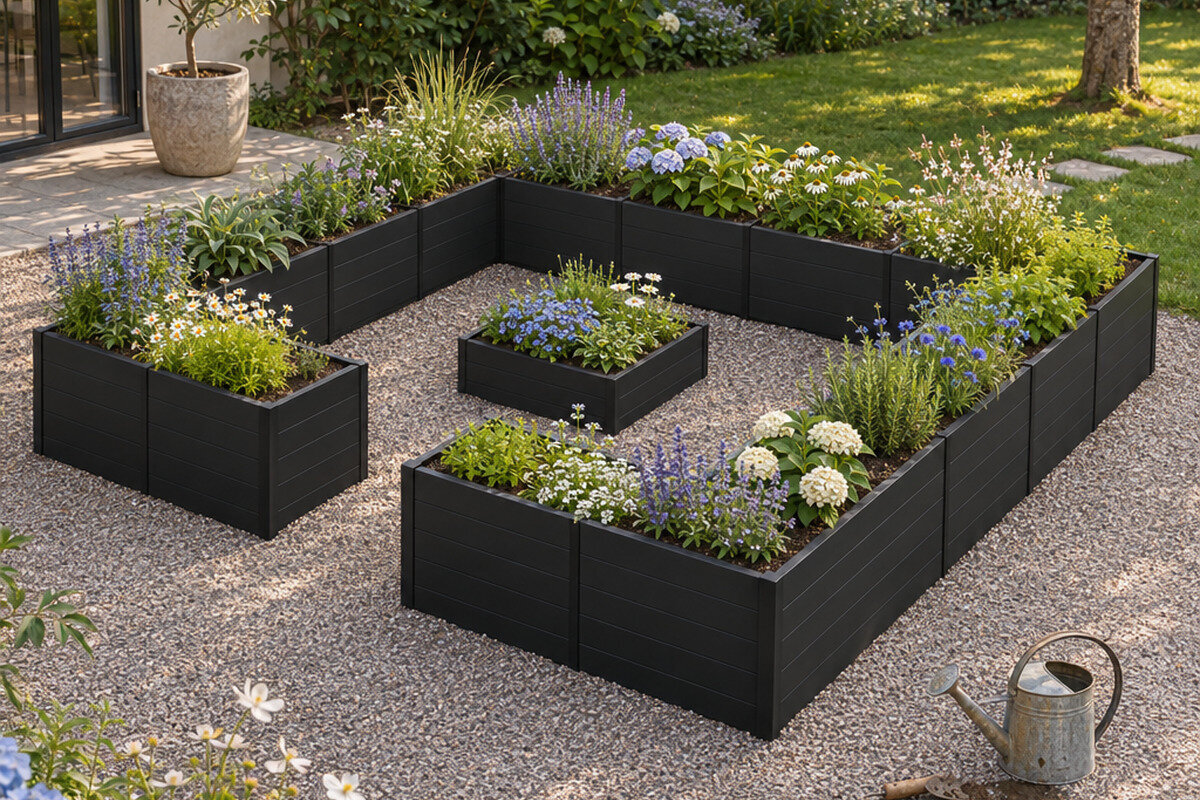
If your search for a portable planter box leads to Bloomcabin's illustrated raised beds, note the difference: these kits ship unassembled and have no floor panel. They are meant to stand over prepared ground, not to carry their growing soil from place to place. The Classic aluminum versions have aluminum walls and corner posts; the Accoya fusion model adds Accoya boards at the top of its aluminum walls. The supplied specifications do not document wheels, brakes, or a loaded movement rating. Consider one if you can assemble it in its growing spot and leave it there while planted.

02
Measure the route and the parking spot
Measure the route between the growing spot and the place the planter will go next. A portable planter box can fit through a gate on paper and still be too awkward to turn just beyond it. Check the narrowest clear opening with the door or gate held in its usable position. Compare that opening with the widest assembled point, including wheels, handles, or mounted accessories. At corners, leave room for the person doing the pushing as well as the box.
On a concrete patio, walk the route and note raised joints, cracks, grade changes, and the lip at any doorway. Even if the concrete itself is suitable, a wheel that catches at a joint can stop the planter abruptly. On pavers, check for uneven edges or loose blocks. On grass or gravel, wheels may sink or bog down; don't assume a model approved for smooth pavement will travel there. If the route includes a slope, step, or threshold the supplier does not approve, choose a different route or keep the planter on one side of it.
The parking spot for a portable planter box needs separate attention. Check light for the crop, access to water, and room to work without reaching past an obstruction. Make sure the parked box doesn't narrow an exit or put you in the path of a swinging door. Mark its outside dimensions and try reaching the back from the side you will actually use. If you can't reach it comfortably, reserve access on another side or pick a narrower box.

03
Get the loaded rating in writing
Before buying a wheeled portable planter box, ask the supplier for the rating of the complete configuration: container, frame, wheels or approved base, and attachment points. Ask for the permitted total loaded weight while moving, whether the parked limit differs, and which surfaces the rating covers. Clarify whether a published capacity is the weight you can add or the total weight including the empty planter. Individual caster ratings aren't a substitute for an assembled-unit rating.
For a portable planter box that needs to move filled, write down everything that travels with it: the empty assembly, growing mix at a realistically wet weight, plants and their root balls, attached supports, and any water held separately in a tray or reservoir. Don't count water already included in the wet mix twice. If all you know is the mix's volume or dry bag weight, ask the mix supplier for relevant wet-weight information or weigh the mix before relying on your estimate. A volume tells you how much space it occupies, not what the wheels must carry.
The surface has its own limits. Before putting a loaded portable planter box on a deck or balcony, have the responsible building professional confirm that the planned location and concentrated loads at the feet or wheels are appropriate. The supplier's planter rating doesn't establish what the deck can hold, and floor approval doesn't mean the planter can move while filled. If the loaded movement rating is missing, exclude that model from a plan that depends on moving it while planted.

04
Check the brakes before the first move
Assemble the portable planter box according to the exact model's instructions. Before filling, check that the base sits level and doesn't rock and that all wheels sit firmly against the surface. Find out whether each brake locks just the wheel's rotation or also the caster's swivel, and which brakes the supplier expects you to engage when parked. With the box empty on its intended level spot, engage the brakes as directed and check gently for rolling or pivoting. If it shifts or rocks, address that before filling. This is a setup check, not a loaded performance test.
Make the first trip with the portable planter box empty, using the approved route and handling points. Pause at turns and transitions. A route that works empty does not establish that it works loaded. For a permitted loaded move, clear the path, secure or remove loose accessories as directed, release the brakes only when ready to move, and travel slowly. If a wheel catches, stop rather than forcing it or tipping the planter to get it past the obstruction. Park on the approved level spot and reengage the brakes before working.
Never use the brakes on a portable planter box as permission to park on a slope or as a remedy for a top-heavy setup. Check for loose hardware, wobble, or a brake that no longer holds before another move. If the supplier permits only empty relocation, unload the box first. For an open-bottom frame, follow the model's disassembly and reassembly instructions instead of dragging the assembled frame through the soil.

05
Match drainage and root space to the construction
A portable planter box on pavement needs a floor designed to retain the growing mix and a way for surplus water to escape. Check where the outlets discharge when the box is parked. If the design uses a removable tray, make sure you can reach and empty it without lifting the filled unit. Keep runoff away from doorways and walking routes. After the first watering, confirm that the outlets aren't blocked and that water is going where you planned. For an open-bottom frame over soil, check the ground itself: an open base doesn't fix a poorly drained site.
Compare the usable inside width and fill depth of a portable planter box with your crop's mature size and root needs. Allow for any space below the rim required by the filling instructions. The outside dimensions tell you what will fit at the site; they don't tell you how much growing mix to buy. For a simple rectangular container, multiply actual inside length by inside width by intended fill depth, with all three measurements in feet, to estimate cubic feet. For tapered boxes or boxes with internal features, use the supplier's fill volume for your configuration.
For comparison, Bloomcabin's Narrow Aluminum Raised Garden Bed has a nominal footprint of 39.37 × 19.69 inches, a stated planting area of 5.38 square feet, and walls 3.94 inches high. That wall height describes the frame, not the total rooting depth: roots may extend into suitable soil below. It's an option for a narrow strip on prepared ground, not evidence that a floor-equipped container of the same outside size offers the same growing space.

06
Fill and plant only after the route checks out
Set up the portable planter box in its growing position before filling. Choose a container mix suited to your crops and the box's design, then follow the supplier's fill instructions rather than packing soil to the rim. For leaf lettuce or herbs, check seed-packet spacing and local Cooperative Extension guidance for varieties and planting dates. Put taller plants where they won't shade shorter ones you expect to harvest regularly. Check the mix before watering rather than setting one schedule for the season; conditions may change when you move the planter from a sheltered spot to a sunnier one.
Hypothetical example: A gardener wants a portable planter box for leaf lettuce that can roll between two spots on a concrete patio. The shortest route crosses a raised doorway threshold, but a longer route stays on level concrete. The gardener rules out the threshold unless the supplier explicitly approves that transition. On the longer route, they check the sharpest turn, verify that each parking spot leaves room to harvest, and check that neither spot drains toward the door.
For planning only, assume the assembled box and wheel base weigh 25 pounds, the wet mix weighs 80 pounds, the plants and tray together weigh 5 pounds, and the tray could separately hold 10 pounds of water. The combined estimate is 120 pounds. Those are hypothetical inputs, not specifications for any product. The gardener would check actual weights and buy only if the supplier confirms that the complete configuration is rated above the planned moving weight on that route. Before rolling, they'd empty the tray as directed rather than relying on the lower weight of dry mix. If no candidate has a documented loaded movement rating, they'd choose one growing spot and plan to relocate the box only when empty.

07
Keep seasonal moves from becoming weekly chores
Before you settle into a routine, try the jobs you'll do most often with the planter parked and braked: watering, harvesting, clearing outlets, and checking the growing mix near the back. If you have to unlock and turn the portable planter box just to reach the drain or pick from the far side, change its parking orientation while you can do so safely. That small adjustment can save a loaded move every time you tend it.
As plants grow, check that foliage or supports don't snag at gates or extend into a walkway. Check the wheel mounts and brakes as directed by the supplier, and clear leaves or spilled mix from the travel route. If you add a support, top up the mix, or change the container setup, revisit the loaded weight before the next trip. The number you worked out at purchase applies only to the configuration you accounted for.
When it's time to retire or relocate a portable planter box that isn't rated to travel filled, plan a place for the plants and mix before you start unloading. Follow the handling instructions for the empty container or disassemble the ground frame as directed. Either way, check the new location for reach, drainage, and stability before filling again instead of assuming the previous setup will carry over.

Questions readers ask
Can I move a portable planter box after watering it?
Only if the supplier permits loaded movement on that route and the actual weight, including water retained in the mix, is within the applicable rating. Let runoff finish before moving, but don't assume a drained box is light. If you can't confirm the weight or the movement rating, leave it parked or unload it as directed.
Can I put an open-bottom Bloomcabin raised bed on a patio?
The illustrated models are open to prepared ground and have no floor panel. The supplied specifications don't document a patio installation. If your growing site is paved, choose a container designed to hold its own growing mix and drain on that surface rather than improvising a floor for a ground frame.
Can I add casters to a portable planter box that was sold without them?
Only use a wheel kit or combination approved for the exact container and intended load. Casters rated to carry a certain weight don't prove that the planter floor, caster mounts, or assembled unit can handle it in motion. If the supplier doesn't approve the setup, leave the box stationary or relocate it empty as directed.
Buy for the move you'll actually make
A portable planter box earns its place when it fits both the growing site and the trip away from it. Verify the exact model's instructions and loaded rating before buying. If the route or rating doesn't check out, move the box empty or choose a spot where it can stay planted.
Find a raised bed for your plan
Compare layouts and check the dimensions on the product page.
