
Powdery mildew in a greenhouse: prevent the second surface.
Crop health / greenhouse field guide
Powdery mildew in a greenhouse: prevent the second surface.
A pale, friable coating can look almost decorative from a distance. On living foliage, it is a reason to slow down: identify the surface, interrupt spread, and rebuild the climate around the next clean leaf.
+
Recognition note. Do not assume every white mark is mildew, and do not assume wiping a colony away has cured the leaf. A reliable response combines diagnosis, separation, canopy correction and crop-approved intervention.
First response
Contain the question before you chase the answer.
Powdery mildew is common enough that a white patch can provoke an immediate spray-and-pray response. Resist that impulse. The first task is to stop a potentially active colony from becoming a greenhouse-wide surface while preserving enough evidence to decide what it is. Powdery mildew fungi live on living host tissue, reproduce with spores that can move on air currents, and are not one interchangeable organism. A mildew on squash does not automatically explain a pale mark on a nearby rose, basil pot, cucumber or zinnia.
That distinction matters in a mixed home greenhouse. You may be growing edible leaves beside flowering ornamentals, young transplants beside established containers, and cultivars with very different sensitivity to crop-protection products. A product or practice appropriate for one crop may be unsuitable for another. Begin with the plant, the distribution of symptoms and the conditions around the plant, rather than with a generic remedy.
01
Pause movement. Isolate the affected pot or tray if you can do so without brushing it through the crop. Keep leaves from touching neighboring plants and place it where inspection is easy.
02
Photograph both leaf surfaces. Take a close image and a wider image showing the plant’s position. Note whether new growth, lower leaves, shaded interiors, flowers or stems are involved.
03
Inspect nearby plants. Look at least one bench-width beyond the first find, concentrating on crowded centers and areas beside glazing, walls, shelves or fan obstructions.
04
Review recent conditions. Warm days, cool nights, closed vents, dense foliage, late irrigation or condensation give a diagnosis more useful context than one humidity reading.
Lookalikes
Read the deposit, not just the color.
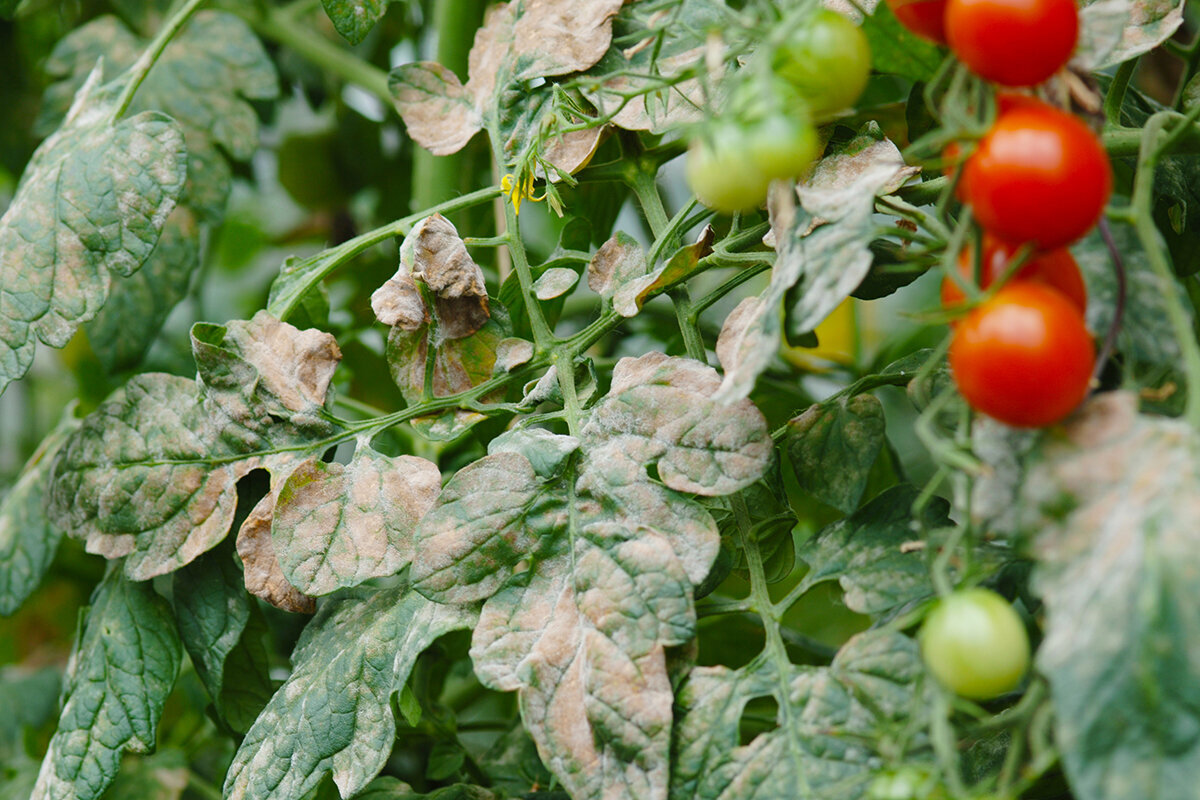
Powdery mildew often appears as white to gray, powder-like spots that enlarge and merge. Dried spray, mineral residue from hard water, a plant’s natural bloom and other foliar diseases can also leave pale marks. A careful visual check is useful triage, not laboratory confirmation. Avoid rubbing over the plant as a test; unnecessary handling can spread spores and damage tender tissue.
soft colonydroplet ringnatural bloomtissue injury
| Surface under review | Typical appearance | Distribution clue | Careful check | Limit of a quick check |
|---|---|---|---|---|
| Powdery mildew | Soft white, off-white or gray colonies; separate islands may merge into a haze. | Often on leaves and young shoots. The upper or lower surface may be involved depending on the host and mildew species. | A tiny colony can smear or lift onto a dark, dry tool or tissue. Leaves may yellow, distort or develop corky symptoms on some crops. | Visible powder can be removed while fungal feeding structures remain associated with living tissue. |
| Spray residue | A more uniform film, dots, rings or streaks; it may be shiny rather than fuzzy. | It frequently follows a nozzle path and repeats across exposed leaves, pots and nearby surfaces. | Compare it with the last application, water quality and coverage pattern. Check sheltered undersides as well. | Residue and mildew can coexist after a treatment has been applied to an infected crop. |
| Mineral deposits | Chalky spots or rings with hard edges left after droplets dry. | Common on upper leaf surfaces, glazing and pots after overhead watering or misting with mineral-rich water. | Look for the same deposit on nonliving surfaces. Marks usually track a droplet edge. | Water spotting can conceal an early disease, so examine tissue response and new growth too. |
| Natural wax or bloom | An even, integrated bluish-white or silvery surface rather than distinct colonies. | Usually consistent across normal leaves, stems or fruit of that species or cultivar. | It appears built into the plant surface and does not expand as irregular, isolated patches. | Do not scrub it away. Natural bloom can be protective and varies with cultivar and conditions. |
| Other foliar diseases | May begin pale but can progress to angular spots, fuzzy gray mold, water-soaked lesions or dead tissue. | The pattern may follow leaf wetness, splash, wounds or the susceptibility of a particular crop. | Look for necrotic centers, halos, spores of another color, stem lesions or rapid collapse. | When symptoms are ambiguous or a crop is valuable, Extension diagnostics are more dependable than a visual guess. |
This comparison is intended for practical triage. A wipe observation is not proof, and powdery mildew symptoms are not identical across all host crops.
The hidden room around a leaf
Whole-house readings can conceal a crowded, still canopy.
Greenhouse weather is not the same thing as leaf weather. Air, heat and moisture compress around close foliage, behind containers, under benches and in shaded interior growth. That boundary layer is where an apparently acceptable greenhouse can still offer powdery mildew favorable conditions.
Dense spacing narrows the air corridor.
Leaves that overlap do more than shade one another. They limit the paths that moving air can take, slow drying after irrigation or condensation, and hide the first affected tissue. Give mature plants their finished width, not merely enough room to fit the pot.
Cool periods turn stored moisture into local humidity.
After a warm day, moisture released by plants and media remains in the greenhouse. As temperatures fall, relative humidity rises and condensation may form on cool surfaces. When conditions allow, late-day heat and measured ventilation can help reduce night humidity; the best method still depends on crop needs, weather and energy constraints.
Shade is a climate condition, not only a light condition.
Overgrown interiors, permanently shaded bench corners and foliage pressed against a wall can remain cooler and less ventilated. Many powdery mildews benefit from moderate temperatures, shade and high humidity, although species differ in their response to free water on foliage.
Weak exchange and harsh drafts are different problems.
A fan aimed straight at one crop can dry or stress it while leaving another bench unmoved. The goal is gentle circulation through the full canopy, paired with a deliberate route for stale air to leave and replacement air to enter.
Host matters
There is no single powdery mildew story.
Powdery mildew pathogens are often host-specialized. Symptom location, seasonal pressure and suitable management vary with the crop and the pathogen. Use these groups to guide observation, not to make an automatic diagnosis. When buying seed or transplants, look for documented resistance or lower susceptibility where it is available for the exact crop you grow.
I
Cucurbits
Cucumber, melon, squash and pumpkin can develop conspicuous pale colonies that enlarge across leaves. Their fast growth can quickly make a shaded canopy, particularly where vines are trained close together.
- Inspect older and interior leaves.
- Keep trellised growth orderly and open.
- Check resistance claims for the specific crop.
II
Herbs and edible leaves
Basil, mint and sage are not interchangeable hosts, but dense pots and frequent harvest can create difficult-to-see pockets. For food crops, labeling, harvest intervals and crop registration are essential when considering a product.
- Do not use ornamental-only products on edibles.
- Harvest with clean tools.
- Keep pots from merging into one canopy.
III
Flowers and ornamentals
Rose, zinnia, begonia and chrysanthemum may be susceptible, but visible symptoms differ. Some show distorted growth, while others develop dry, corky or scab-like areas with little obvious powder.
- Examine buds, young shoots and lower foliage.
- Quarantine new plants before they join the house.
- Keep cultivar notes from season to season.
IV
Perennials and carryovers
Overwintered material, retained plant tissue and plants kept year-round can bridge seasons for some mildew-host combinations. A greenhouse that appears clean after summer may still contain living hosts that require inspection.
- Review carryovers before spring crowding begins.
- Remove lingering diseased tissue.
- Separate propagation from mature stock where possible.
A useful rule: diagnose on the actual crop. A label, Extension recommendation or cultural method should match the plant you are growing, not merely the words powdery mildew.
Airflow choreography
Give air a route, then give foliage room to receive it.
Ventilation is air exchange: warm, moist air leaves and replacement air enters. Circulation is movement within the greenhouse. Both matter, but neither works well if benches are packed solid or a mature canopy blocks the route. Map the greenhouse as it stands now, rather than as it looked before plants reached full size.
Bloomcabin’s custom aluminum greenhouse guide explores roof vents, side openings, shading and accessory choices that can be organized around a growing plan. The practical details of roof-window and automatic-opener choices are also covered in the aluminum greenhouse FAQ.
High outlet
Rise ↑ route
High outlet
Circulation fan
Open canopy
Sheltered zone
Low inlet
Clear aisle →
Clear obstruction
Morning: Inspect foliage and condensation before warming conditions disguise the prior night’s humidity. This is the clearest time to find wet glazing, crowded leaves and persistent still pockets.
Midday: Use vents, shading and circulation to manage heat without allowing the canopy to become stagnant. A fan should guide air along a bench, not create a harsh blast across one plant.
Late day: Avoid carrying excess moisture into a cool night. Use a crop-appropriate heat-and-vent approach for your climate, and check that vents and circulation equipment remain unobstructed.
Ordered intervention
Treat the infection and the setting that invited it.
There is no rescue bottle that makes a crowded, damp and poorly exchanged canopy healthy. Conversely, cultural corrections may not be enough if colonies are expanding through a susceptible crop. A successful plan is sequenced: reduce inoculum, correct the conditions, choose only label-appropriate tools, then judge success by clean growth rather than by whether old leaves look perfect.
Folio 01 / remove
Make a removal decision.
For a small, isolated outbreak, remove heavily colonized leaves, shoots or whole plants when doing so will meaningfully reduce the source of spores. Use clean, dedicated pruners; place material directly into a bag or covered container; and avoid carrying it through healthy foliage. When a plant is severely affected, expendable and close to susceptible neighbors, complete removal can be more sensible than keeping a persistent source.
Do not strip a plant so hard that you create sudden stress or expose it to scorch. The objective is inoculum reduction and airflow, not cosmetic perfection.
Folio 02 / reset
Correct the cultural pressure.
Open the canopy through spacing, selective pruning and bench organization. Water at a time that permits surfaces to dry promptly, and favor delivery methods that avoid unnecessary foliage wetness when other leaf diseases are a concern. Avoid excessive nitrogen that pushes lush, crowded replacement growth.
Wash hands, disinfect tools between plants while disease is active, remove fallen leaves and clear algae-prone debris or standing water from the growing space.
Folio 03 / select
Choose products by crop and label.
For active disease, possible approaches can include protectant, contact, biological and systemic fungicide products. Availability, registration, crop safety and performance vary by product, crop and state. Oils, sulfur-containing materials, biologicals and other fungicides can also have temperature, timing, compatibility or phytotoxicity limitations.
Read the current label for the exact crop, site, rate, interval, protective equipment, re-entry and pre-harvest instructions. If the label directs or sensitivity is uncertain, test on a small, inconspicuous group first.
Folio 04 / rotate and review
Do not repeat one mode of action blindly.
Where fungicides are used repeatedly, rotate among effective fungicide groups in accordance with label directions and local Extension guidance. Resistance is not solved by applying more often or at a stronger-than-labeled rate. Keep a written record of product, active ingredient or group, crop, date, weather and result.
Review after new growth appears. A leaf colonized before treatment may remain marked. The more useful question is whether fresh foliage stays clear and nearby plants remain free of new colonies.
Label threshold
In the United States, pesticide labels are legally enforceable. Use only a product registered and labeled for your crop and intended use, and follow the directions exactly. Greenhouse use, edible versus ornamental crops, temperature limits, repeat intervals and compatibility instructions all require a deliberate check.
Containment test
Judge recovery by the next leaf.
Old damage is an archive, not a verdict. Powdery mildew scars, yellowing or distortion may remain visible after active spread has been checked. Instead of asking whether every affected leaf has returned to beauty, look for a consistent change in the greenhouse: new tissue emerges clean, adjacent plants stay clear, and the microclimate does not return to a still, crowded condition.
Give yourself a defined observation period. This prevents the common mistake of interpreting an unchanged old lesion as a failed treatment, or assuming that a clean-looking leaf is proof that an uninspected neighboring plant is healthy.
48 hours
Reinspect isolated plants and their nearest neighbors. Note whether colonies are expanding, whether an application caused injury, and whether leaves receive gentle, even air movement.
7 days
Review new symptoms, sanitation and the irrigation and vent schedule. Follow any label interval precisely; do not improvise repeat applications.
New growth
Date the first clean leaves in your crop notes. If fresh foliage becomes colonized, reconsider the diagnosis, coverage, host susceptibility and environmental correction.
Old damage
Active colony
Treated tissue
Clean growth
- Old damageMay remain after spread is halted; cosmetic reversal is not the goal.
- Active colonyFresh powder expands, reaches new tissue or appears on neighboring plants.
- Treated tissueMonitor for crop response and phytotoxicity without judging too quickly.
- Clean growthThe clearest evidence that containment and climate correction are working.
FAQ
Questions worth asking before the next application.
Can powdery mildew spread when foliage is dry?
Yes. Powdery mildew differs from many foliar diseases because free water on the leaf surface is not universally required for infection. Moderate temperatures, shade, high humidity and weak air movement can favor outbreaks. Water management still matters because condensation and prolonged wet foliage can create conditions for other damaging diseases.
Should I mist or wash powdery mildew off leaves?
Do not treat rinsing as a universal cure. Penn State notes that water can suppress certain powdery mildew infections under suitable conditions, while other pathogens and host responses make routine overhead wetting risky. In a mixed home greenhouse, diagnosis, spacing and gentle air movement are safer first priorities than indiscriminate washing.
Will a fan alone stop powdery mildew?
No. A fan can improve circulation but cannot remove established infection, replace sanitation, correct crowded spacing or provide fresh-air exchange by itself. Look for dead zones behind pots, benches and tall crops, then pair circulation with venting and sensible watering.
Can I use the same mildew treatment on vegetables and ornamentals?
Not automatically. Crop registration, pre-harvest intervals, product rates, plant sensitivity and permitted use sites vary. A product labeled for ornamentals is not necessarily suitable for edible crops. Read the current product label for the precise crop and follow applicable state requirements.
Is powdery mildew the same on every plant?
No. Powdery mildew is a broad name for many fungi, and many are specialized to particular hosts or host groups. Symptoms and management details vary. Diagnose the plant in front of you rather than assuming a mildew on one crop explains every pale mark in the greenhouse.
Sources and further reading
Continue with crop-specific guidance.
These U.S. Extension, university and regulatory resources informed this guide. Product registrations and labels can change, so consult the current label and your local Cooperative Extension office for advice tailored to your crop and state.
- Penn State Extension — Powdery Mildew
- Penn State Extension — Sources of Plant Disease in Greenhouses
- Penn State Extension — High Tunnel Production
- UC IPM — Powdery Mildew in Floriculture and Ornamental Nurseries
- Colorado State University Extension — Powdery Mildews
- U.S. Environmental Protection Agency — Introduction to Pesticide Labels
Keep the next leaf unmarked
A healthier greenhouse is a sequence of small, visible decisions.
Open the canopy.
Verify the diagnosis.
Protect new growth.
Thoughtful equipment supports the routine. For inspiration on making ventilation, shelving, shading and finishes part of one coherent growing space, see Bloomcabin’s guide to greenhouse colors, finishes and accessories and the broader overview of premium greenhouse designs for American gardens.
