
Raised Galvanized Planter: What to Check Before You Buy

Bloomcabin · Raised-bed guides
Raised Galvanized Planter: What to Check Before You Buy
A raised galvanized planter can be a good choice if the seller documents the zinc-coated steel, the intended growing use, and a base that works at your site. For a patio, look for a supported floor and a clear drainage route. For prepared ground, an open-bottom frame may be the better fit.
Verify the material
A raised galvanized planter should be identified as zinc-coated steel in the specifications, not just shown with a silver finish.
Read the specifications
Check the steel grade, coating, panel thickness, fasteners, and instructions for the exact model.
Check for a floor
A frame that sits on prepared ground is not the same as a container that supports soil on a patio.
Measure twice
Use outside dimensions for placement and inside dimensions and fill depth to estimate soil.
The first decision is not how tall the planter should be. It is whether you need a container that holds its own soil or a frame that relies on the ground beneath it. Two models can look nearly identical from the side and require entirely different setups.
Once you know which design you need, verify what the raised galvanized planter is made of, how it goes together, and what the manufacturer says it can be used for. That order helps you rule out a poor fit before you spend time comparing dimensions or ordering soil.
01
Identify the steel beneath the finish
Galvanized steel is steel with a zinc coating intended to protect it from corrosion. That tells you what the coating is for, but not how thick it is, what other finishes are present, or how long it will last at your site. When a listing says “metal” in the specification but calls the item a raised galvanized planter in the headline, ask the seller to confirm in writing what the walls are made of and which surfaces are coated. A photograph cannot resolve the discrepancy.
Check the parts that will actually contact soil or collect water. The walls, corners, floor, and fasteners need not all be made of the same material. Ask whether the inside has an additional finish or liner, and whether any parts supplied with the kit need separate care. If the listing is for several sizes or finishes, match the answer to the exact model you would order rather than borrowing a specification from another version.
Be more selective about a secondhand raised galvanized planter. Look for a legible model label and ask what the container previously held, whether it was repainted, and whether the floor or hardware was replaced. A clear answer about the original steel does not identify a later coating or tell you what an old container held. For growing food, choose a documented alternative if those details remain unknown.

02
Compare the panels, joints, and documented uses
Make a short comparison sheet for each raised galvanized planter you are considering. Record the steel grade if given, the zinc coating specification, any additional finish, and the steel panel thickness. If a seller gives only a gauge or a thickness that includes the finish, ask for the steel thickness in inches before comparing listings. If two sellers report different measurements, mark them as not directly comparable instead of deciding that the larger number means the stronger planter.
Look next at how the raised galvanized planter holds its shape. Note where panels join, how long walls are supported, which braces are included, and how the top edges are finished where your hands will rest. Thickness is worth comparing, but it does not tell you how the complete assembly handles fill. Ask for the specified fill limit and the fastener material or coating, and check whether replacement hardware is available. If a raised galvanized planter comes in more than one length, verify that the parts list and instructions apply to the length you want.
Put the manufacturer’s stated uses in a separate column. If you plan to grow vegetables or herbs, ask for documentation that covers that use with the supplied soil-contact surfaces. If you are comparing a wood-topped alternative, verify the named wood or species where provided, its treatment, thickness, and care instructions too. Write “not stated” where the evidence stops. That is more useful than treating a missing specification as either proof of a defect or permission to assume suitability.

03
Decide what will hold the soil and where water will go
For a raised galvanized planter that will sit on prepared ground, start with the soil underneath. Look at the spot after rain if you can: does water stand there or flow in from a nearby path? Decide whether you can address poor drainage before filling. If there is reason to suspect contamination, get local guidance before using an open-bottom model for food crops. Adding new soil inside a frame does not, by itself, resolve a problem below it.
On concrete or pavers, the same raised galvanized planter presents a different question: what physically holds the soil, and where does the water go? Choose a model with a floor and a drainage design intended for that placement. Check whether the outlets will remain clear when the planter is set down and whether water would cross a walking route, collect against a building, or drain where you cannot manage it. Do not assume that setting a ground frame on pavement supplies the missing floor.
A deck or balcony adds another decision. Confirm the filled weight, including the planter, moist growing medium, and water it can retain. Have the suitability of the proposed location checked if its capacity is uncertain. A manufacturer’s planter rating, if provided, describes the planter; it does not establish what your deck or balcony can support.

04
Measure the working space and usable soil depth
Measure the proposed location for a raised galvanized planter at its widest outside points, allowing for rims, corner pieces, or feet if the design has them. Leave enough room to work from the sides you can actually reach. A simple check is to mark the outside dimensions on the ground and try reaching the center from the positions you will use for planting and harvesting. If the bed will sit against a wall, do that check from the front rather than counting access you will not have.
Next, ask for the assembled inside length and width and the depth to the intended fill line. The overall height of a raised galvanized planter can include clearance below the floor or space above the soil. In a closed container, rooting depth depends on the usable growing medium above the base. In a ground frame, roots may also have access to suitable soil beneath it. Decide what you want to grow before judging whether the available depth is enough; use crop-specific seed instructions or local extension guidance if you are unsure.
Separate nominal planting area from the inside space you can actually fill. Dividers, taper, and layout features can change that space. For a rectangular container with straight interior walls, multiply inside length by inside width by fill depth, all in feet, to estimate cubic feet of growing medium. For a divided or irregular layout, measure the fill areas separately or use the supplier’s documented volume instead of multiplying the full outside dimensions.

05
Check the assembly before filling, then inspect it in use
Before assembling a raised galvanized planter, lay out the parts and match them to the manual for the exact size and base. Check for missing fasteners, damaged edges, and finish damage, especially where parts will meet or touch soil. If anything is missing or a hole does not line up as shown, stop and ask the supplier rather than drilling new holes, substituting hardware, or omitting a brace. Follow the specified sequence for fitting and tightening parts.
When a raised galvanized planter has a floor, confirm that every support shown in the instructions is installed and the drain openings are unobstructed before filling. For an open-bottom model, prepare the ground as directed and check that the frame sits as intended along its perimeter. Place either design in its final position before adding soil, and follow the manufacturer’s fill limit. Do not use soil to force an out-of-square frame into place.
Once the raised galvanized planter is in service, look for changes you can act on: loose joints, walls moving out of alignment, damaged finishes, or water lingering where it should drain. Clear accessible outlets as the instructions allow. If you find coating damage, ask about an approved repair for that surface and intended use rather than applying a general-purpose coating. Keep plant care separate from frame care: check moisture where the roots are and adjust watering to the crop and its stage, not to a fixed schedule for metal beds.

06
Work through a patio purchase before ordering
Hypothetical example: You want to grow salad greens on a paved patio and are comparing two models. The first raised galvanized planter is an open-bottom steel frame. The seller documents its coating and outdoor garden use, but the instructions call for prepared ground. It fits the available space, yet you rule it out because it has no floor to retain soil on the patio. The coating documentation answers the material question, not the placement question.
The second raised galvanized planter is documented for edible planting on hard surfaces. Assume it has straight interior walls, measures 36 by 18 inches inside, and has a usable fill depth of 10 inches. The volume to the fill line is 3 feet × 1.5 feet × 10/12 foot, or 3.75 cubic feet. That is a growing-medium estimate, not a filled weight or a guarantee that the depth suits every salad crop. Check the crop guidance separately.
Before ordering the second model, confirm its outside dimensions and locate the outlets on the assembly drawing. If an outlet would empty across the route to the patio door, try a different orientation and recheck reach and clearance. If you cannot find a position that works, keep looking. The better-documented model is the better candidate, but only if the installation works in the space you have.

07
Compare alternatives without confusing the materials
If your plan calls for a raised galvanized planter specifically, start by filtering for documented galvanized steel. Do not substitute another metal simply because the shape and dimensions match. If your real priority is an open-bottom frame for prepared ground and zinc-coated steel is optional, compare alternatives on their actual construction, access, base, and maintenance instructions rather than assuming one material will outlast another.
For example, Bloomcabin’s Square Aluminum Raised Garden Bed 39.37×39.37×15.75 in has aluminum wall panels and corner posts, a nominal footprint of 39.37 by 39.37 inches, and a wall height of 15.75 inches. It is open to prepared ground, with no floor panel. That makes it a relevant layout comparison for a ground-level raised galvanized planter, but not a galvanized option or a substitute for the floored container in the patio example.
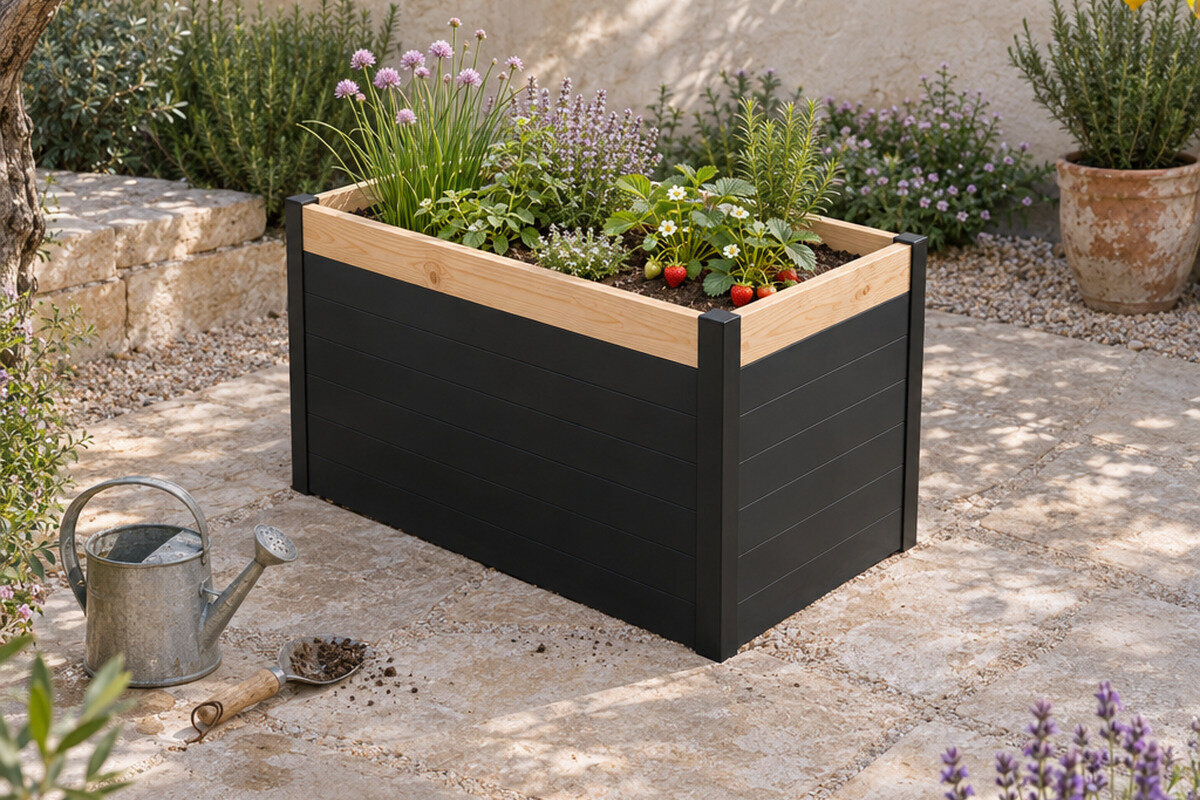
The Narrow Accoya Raised Garden Bed 39.37×19.69×23.62 in is another open-bottom comparison. Its top 3.94 inches on all four walls are Accoya boards; the lower wall sections and corner posts are aluminum. If that arrangement appeals to you, ask what care applies to each material and to the hardware that joins them. Whether you choose a mixed-material frame or a raised galvanized planter, buy the one whose documentation answers the questions that could change your decision.

Questions readers ask
Is a raised galvanized planter suitable for growing vegetables?
It can be if the documentation for the exact model supports that use and the site and rooting depth suit your crops. Ask what the soil touches, including any coating, liner, or replacement floor. If the seller cannot identify those materials or document the intended use, choose a better-documented model rather than assuming the label settles the question.
Can I turn an open-bottom raised galvanized planter into a patio container by adding a liner?
Do not assume so. A liner does not provide a structural floor or show that the frame can support the filled container. Use a model intended for hard surfaces, or ask the manufacturer whether it offers a compatible base with documented support and drainage instructions. Verify the site can take the filled load separately.
Is an aluminum bed the same as a raised galvanized planter?
No. Galvanized steel is steel with a zinc coating; aluminum is a different metal. Bloomcabin’s listed Classic models are aluminum, and the listed Accoya fusion example combines aluminum with wood at the top. Compare them as alternatives only if your material requirement allows it.
Make the purchase decision
Before buying a raised galvanized planter, make sure you can name the material, explain what supports the soil, and point to where excess water will go. If any of those answers depends on a guess, get the specification or choose a different model.
Find a raised bed for your plan
Compare layouts and check the dimensions on the product page.
