
Raised Planter Box on Wheels: How to Choose, Set Up, and Move It

Bloomcabin · Raised-bed guides
Raised Planter Box on Wheels: How to Choose, Set Up, and Move It
Choose a raised planter box on wheels with a load-bearing floor, brakes you can reach, and a supplier rating that covers how you’ll use it. If you need to roll it after watering, verify that the complete assembly is rated to move at its filled weight on your route. Otherwise, choose its final spot while it’s empty and plan to leave it there once planted.
Buy for the move you need
Buy a raised planter box on wheels for filled travel only if the supplier confirms that the complete assembly is rated to move on your route.
Measure the whole route
Measure the tightest turn, both parking spots, and your working reach—not just the straight gate opening.
Budget for wet weight
Use the actual fill depth and the weight of watered mix, not the outside dimensions or the bag’s dry weight.
Plan where it will park
Lock the planter in its approved parking position and leave space for runoff, watering, and brake access.
Picture the trip you want the planter to make: from a sunny stretch of patio to a second spot that keeps the walkway clear. A raised planter box on wheels has to fit both stops, clear the turn between them, and stay put while you’re planting or harvesting. If the plan depends on moving a full box, settle that question before comparing finishes or buying soil.
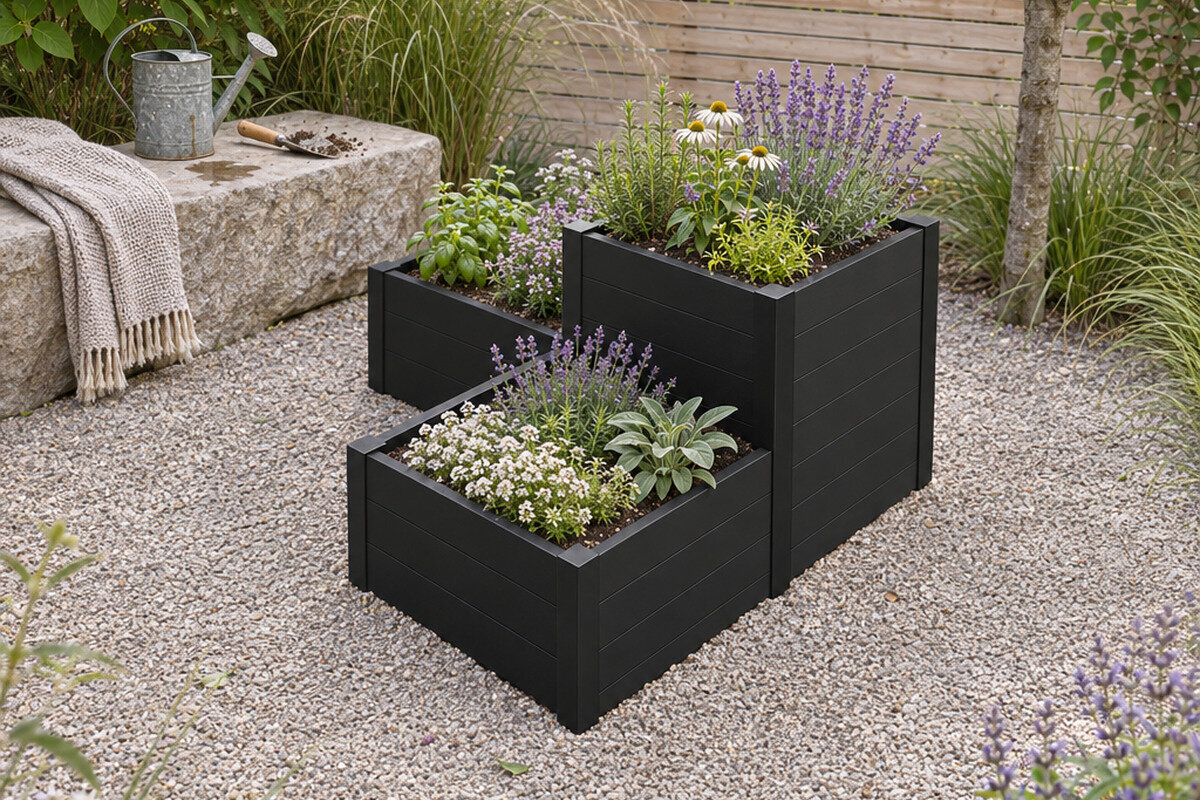
Start with a sketch of the patio, the crops you want to grow, and how you’ll reach them. Use those notes to compare outside dimensions, usable root space, and rim height. Then get the exact model’s assembly and movement instructions from the supplier. The Bloomcabin beds pictured here are included as a comparison for gardeners who decide they’d rather use a stationary frame on prepared ground.
01
Choose a box that carries its own soil
A raised planter box on wheels for a paved patio needs a floor that supports the growing mix, a structure that carries that load, and wheels attached as part of the approved assembly. Look for a model drawing or installation manual that shows how the box, support frame, and casters fit together. A photo can show the shape of the planter, but it cannot tell you what movement the assembled unit is designed to handle.
Decide whether you need to roll the box with plants inside or just position it before planting. If your goal is to shift the garden between a growing spot and a second parking spot, a raised planter box on wheels that can move only when empty won’t do the job. If you simply want to set it in place without carrying it, empty movement may be enough. Even then, confirm the box is rated to hold its intended filled load while parked.
The Bloomcabin beds shown here are stationary alternatives for prepared ground, not examples of a raised planter box on wheels. The Narrow Aluminum Raised Garden Bed 39.37×19.69×3.94 in, for example, has a nominal footprint of 39.37 × 19.69 inches, walls 3.94 inches high, and no floor panel. Its walls border a planting strip rather than supporting a raised container of mix. Choose that kind of frame for a ground-based bed, not as a shortcut to a mobile one.

02
Measure both parking spots and the path between them
Walk the route before buying and mark both parking spots. For a raised planter box on wheels, check the widest outside dimension with handles, brake pedals, and swivel casters in their relevant positions. Measure gate openings between the actual obstructions, not between the posts if a latch sticks out. On a tight turn, mark the planter’s footprint on the patio and check the space its corners need to swing. A clear straight opening does not guarantee a clear turn.
A raised planter box on wheels may roll on smooth, level concrete but be unsuitable for the wide joints, raised edges, or uneven sections elsewhere on the same route. Check paver lips, drainage channels, thresholds, and changes in slope. Loose gravel, soft soil, or gaps between boards call for specific supplier confirmation, not a guess based on wheel diameter. If the approved route ends at a step, choose a parking spot on the same level rather than planning to lift or tip the box across it.
At each stop, check that you can stand or sit where you’ll tend the plants without blocking a door or path. For a raised planter box on wheels parked against a wall, try reaching across a surface at the proposed rim height. If you can’t comfortably reach the far edge, choose a narrower box or leave a usable aisle on the other side. Make sure you can also reach every brake you’ll need to operate without reaching under the planter.

03
Get separate limits for parking and rolling
Ask for two figures for the exact raised planter box on wheels you’re considering: the maximum load it can hold while parked and the maximum load it can carry while rolling. Confirm whether each figure is a payload limit or a total that includes the empty planter. Ask which surfaces and slopes are allowed, and whether the rating applies to the wheels supplied with that exact model. Adding up individual caster ratings does not establish a rating for the box, its mounting points, or its frame.
Estimate the load using the empty weight, the growing mix at its expected wet weight, and plants, supports, and any water held separately in a reservoir or tray. Compare the right total with the supplier’s limit. If you can’t establish the wet weight of the proposed fill, don’t use its dry bag weight to approve the setup. Check the site separately: the rating for a raised planter box on wheels does not tell you whether a deck, balcony, or other elevated surface can take the load concentrated at its wheels.
For a raised planter box on wheels that will spend most of its time parked, find out which casters lock, whether the locks stop rolling, swiveling, or both, and which must be engaged. Confirm the approved parking position and surface. A brake that stops a wheel from rolling does not prevent the whole planter from tipping. Don’t lean on the rim for support, and ask before adding a tall trellis or other attachment that changes the load or exposes the box to more wind.

04
Check usable root depth and where the water goes
Check the internal length and width of a raised planter box on wheels for planting area, then check usable mix depth separately. The outside footprint is for route planning; rim height is for working comfort; the usable depth is for roots. A deep-looking box may have a raised insert or space below the planting compartment. Unlike an open-bottom frame on prepared ground, a contained box cannot give roots access to the soil below it.
Find out where water leaves the raised planter box on wheels and whether the outlet needs clearance or an approved collection tray. Trace the runoff at both parking spots. Avoid sending water across a doorway or along the path you’ll use to roll the planter. If the only place you can park puts a drain above a surface that must stay dry, solve that before filling. Don’t plug drain openings or drill new ones to make a location work unless the manufacturer directs you to do so.
If the instructions permit, pour a small amount of water into the empty planting compartment to see where it exits. That checks the runoff path, not how the mix will drain once planted. Choose a growing mix intended for containers and suitable for your crops, and verify its weight for the load calculation. If the raised planter box on wheels has an approved tray, make it easy to reach and empty as directed without moving the entire unit.

05
Work the numbers before you order
Hypothetical setup example: You want to move a raised planter box on wheels between two level concrete parking spots. Assume the gate has a clear opening of 32 inches and the widest part of the assembled planter across the gate is 24 inches, including its hardware. That leaves 8 inches of straight clearance in total. A turn immediately beyond the gate still needs its own check, as does a raised seam along the route. Neither obstacle is accounted for in the 8 inches.
Suppose the raised planter box on wheels has a rectangular interior that measures 30 inches by 16 inches and the instructions allow 9 inches of mix. Those assumed dimensions give 4,320 cubic inches, or 2.5 cubic feet, of fill. For this example only, use a wet mix weight of 40 pounds per cubic foot, an empty planter weight of 35 pounds, and another 15 pounds for plants, accessories, and any water held apart from the mix. The estimated total is 150 pounds: 100 pounds of wet mix plus 35 plus 15. The wet mix figure already includes water held in the mix.
The decision: If the supplier documents only a stationary limit for that raised planter box on wheels, even a comfortable fit through the gate and a load below the stationary limit won’t clear it for filled travel. If rolling is essential, choose a model with a documented moving limit and confirm that the route is permitted. If rolling is optional, choose the parking spot with the better combination of light, water access, and reach, then fill there after confirming the stationary capacity.

06
Do the first trip empty, then fill at the destination
Assemble the raised planter box on wheels using the instructions for the exact model. Install the supplied hardware as directed and inspect the floor, support frame, wheel mounts, and brakes before loading. With the planter empty, follow the instructions to check that it rolls, steers, and locks as intended. If an empty caster catches on a joint or the frame rocks at the destination, correct the route or parking spot before filling. A successful empty trial checks fit and operation; it does not establish loaded capacity.
Before adding mix, park on the approved surface and set the brakes as instructed. Fill to the intended depth without exceeding the verified load limit, and follow the manufacturer’s directions for distributing the load. If your raised planter box on wheels is approved for filled travel, clear the route before each move and use the specified push point and brake sequence. Don’t push against an engaged lock, pull on plant supports, or force a wheel over an obstruction. If the box starts to tilt or catches unexpectedly, stop instead of applying more force. Reset the brakes at the destination.

07
Grow for the main parking spot and keep the route usable
Plan crops around the spot where the raised planter box on wheels will spend most of its time. Compare the available light with crop requirements, then use seed packets and local Extension guidance to check mature size, spacing, and sowing or transplant timing. For a shallow box, start by checking whether the varieties of leaf lettuce or herbs you want fit the actual root depth. Don’t assume you can solve a poor light match by moving the planter every day.
Keep water within easy reach and check the mix before watering rather than following a fixed calendar. After watering, look for runoff where you expect it and correct any problem before it leaves the path slippery or the outlet obstructed. Keep the manual for your raised planter box on wheels handy: adding more mix, a support, or an accessory may change the load you originally checked. If a brake no longer holds as described or a wheel mount loosens, stop moving the planter until the problem is addressed according to the manufacturer’s instructions.

Questions readers ask
Can I move a raised planter box on wheels right after watering?
Only if the supplier permits movement at the actual loaded weight and under the route conditions. Let any free water drain as directed, but remember that the mix still holds water. A planter that rolled easily when dry or empty has not demonstrated that it can roll safely after watering.
Can I add wheels to one of the Bloomcabin beds shown here?
Don’t buy one of these open-bottom frames for that purpose. The supplied specifications don’t document a load-bearing floor, wheel mounting, or any capacity for rolling while filled. An approved mobile design would need to account for the floor and the entire supporting assembly, not just the casters.
Do I need a deeper box or a taller one?
Choose depth for the crop and rim height for the gardener. A deeper box gives roots more room if that depth is actually filled with suitable mix, but it also increases the potential load. A taller stand changes working height without adding root space. Check the two dimensions separately.
Decide before the soil goes in
Buy a raised planter box on wheels for the move you actually need to make. Confirm the filled load and route with the supplier, verify the surface separately, and check reach, braking, and drainage before filling. If the instructions cover only empty movement, make the growing spot work as a permanent parking spot.
Find a raised bed for your plan
Compare layouts and check the dimensions on the product page.
