
Recycled Plastic Garden Beds: What to Check Before You Buy

Bloomcabin · Raised-bed guides
Recycled Plastic Garden Beds: What to Check Before You Buy
Recycled plastic garden beds can be a good choice when the maker documents what touches the soil, what the bed is designed to grow, and how the frame should be supported and drained. For vegetables or herbs, choose a model with written guidance for edible growing rather than relying on the recycled-content claim.
Identify the material
For recycled plastic garden beds, ask what the finished walls are made from and which parts contain recycled material.
Verify edible use
For herbs and vegetables, look for written guidance that covers contact with the growing mix, not just outdoor use.
Check the whole frame
Compare panel thickness, unsupported spans, bracing, fasteners, and permitted fill height together.
Plan the drainage
Decide where water will go before you assemble the bed or order soil.
If you're comparing recycled plastic garden beds for a vegetable patch, put the material specification and the assembly guide side by side. The first tells you what you're putting next to the growing mix; the second tells you whether that particular frame works at the height, length, and location you have in mind. One document can't replace the other.
Start with the decision that could rule a bed out: whether the maker documents the material and its intended use. Then check the wall supports, base, and drainage before measuring for soil. This order saves you from planning around a frame that fits the available space but isn't documented for the job.
01
Find out what the walls are made of
When comparing recycled plastic garden beds, ask for a specification that names the polymer or blend, the grade or material specification, and the stated recycled content. Check whether that content applies to the wall panels, selected parts, or the whole kit. Also ask whether the surfaces that will touch the growing mix have any coating or treatment. A recycled-content claim doesn't answer those questions, even when it includes a percentage.
Look at the wall profile as well as the material name. For recycled plastic garden beds made from hollow or ribbed panels, ask whether the listed thickness describes the panel from face to face or the wall of the profile itself. For a solid board, confirm the actual board thickness. Don't rank one panel above another on thickness alone: you still need to know how the pieces are supported and joined.
Save the model number, specification sheet, and installation guide together. If you find recycled plastic garden beds made from reclaimed boards with no product paperwork, ask who made the boards and whether their previous use is known. Sorting them by color, shape, or apparent condition won't establish their composition. Record missing information as unknown rather than taking it as evidence of either suitability or harm.

02
Look for guidance that covers edible crops
If you're buying recycled plastic garden beds for herbs or vegetables, ask: “Does your guidance cover this model with its inside surfaces in direct contact with growing mix for edible crops?” That gets a more useful answer than asking whether the plastic is safe. It identifies the product, the contact surface, and the use you actually have in mind.
“For outdoor use” and “made with recycled material” describe different things, and neither answers that question. If recycled plastic garden beds carry a testing or certification claim, request the document and check what was assessed. Does it name the finished panel or only a raw ingredient? Does it address the use in question or a different property? Written guidance is useful within its scope; it isn't a promise about every exposure or installation.
If the maker specifies a liner for edible use, verify which liner is called for and how it must be installed without defeating drainage. Don't improvise a liner as a substitute for missing information about the walls. If two sets of recycled plastic garden beds fit your space but only one has documentation that addresses your intended use, treat that difference as part of the buying decision. If neither does, keep looking rather than relying on the material label.

03
Compare wall spans, joints, and usable space
Compare how recycled plastic garden beds hold the growing mix in place. A side with supports at several points isn't the same design as a side supported only at the corners. Ask which braces or posts the chosen layout requires, how far the wall can run between supports, and where the instructions set the fill line. Check the specified screws or clips and whether the assembly guide calls for spacing at joints. If fit or movement allowances aren't clear, ask before cutting boards or tightening hardware by guesswork.
Compare options at the same usable depth, not just the same wall height. Put the outside footprint, clear inside planting dimensions, and intended fill depth in separate columns. Record aisle clearance separately: the gap needed to reach the plants isn't part of the planting area. When comparing recycled plastic garden beds with wood, ask for the wood species or grade and any treatment. For metal, check the panel material, any surface finish, and the joint details. Compare the care instructions and availability of replacement parts for each.
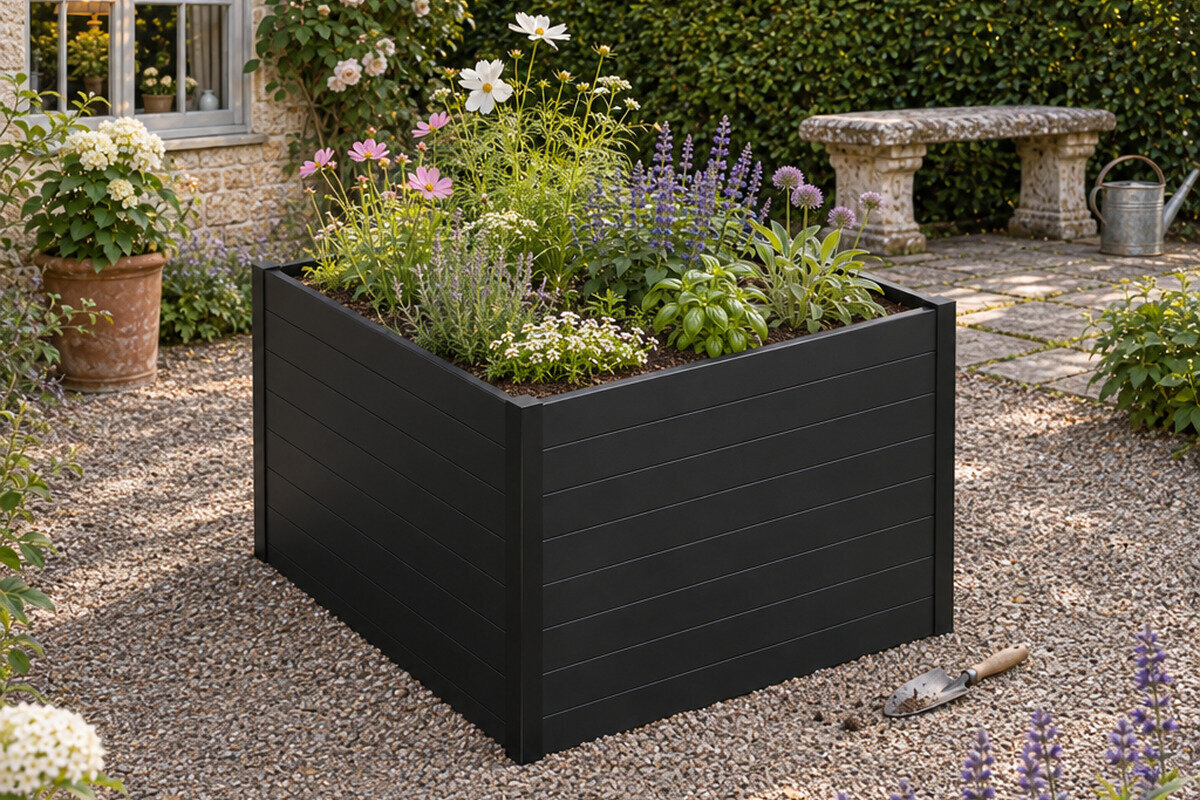
If recycled plastic isn't essential, the Square Aluminum Raised Garden Bed 39.37×39.37×15.75 in is a Bloomcabin alternative with aluminum wall panels and corner posts and an open base. The listed footprint is nominal; verify the clear inside dimensions before ordering soil. The Bloomcabin beds shown here are aluminum or aluminum with Accoya upper boards, not recycled plastic.

04
Trace the water path before choosing the base
Before ordering recycled plastic garden beds, mark the outside corners at the proposed site. Leave room to approach the bed, then stand where you would weed or harvest and see whether you can reach the center without stepping in. Check that the spot gets the light your crops need and that you can bring water to it. If there's a fence on one side, check your reach from the side that will actually stay open.
For an open-bottom frame on soil, inspect what's underneath before placing it. Look after rain for spots where water collects and check whether runoff from a downspout or path crosses the footprint. Roots may be able to grow below the walls if the underlying soil is suitable. If it stays waterlogged or you suspect contamination, investigate before planting; putting a frame over the area doesn't resolve the underlying problem.
Recycled plastic garden beds for hard surfaces need a different check. Look for a base or soil-retaining assembly intended for that location and identify where water exits. Follow the likely flow path: will it collect by a door, cross a walkway, or end up against the house? Confirm that the site can support the filled and watered bed, especially if the surface is a deck or balcony. If you can't verify support or provide a suitable route for drainage, move the bed or choose a design intended for the site.

05
Work through a one-bed purchase and soil estimate
Hypothetical example: You're comparing recycled plastic garden beds for a lettuce-and-herb strip beside a fence. One option is an open-bottom kit whose written instructions cover edible crops and show the braces and fasteners required for that layout. The other uses secondhand plastic boards that fit the space but have no documentation for their composition or past use. You can reach across the kit from the path, and you've checked that the soil below is suitable. For this use, the kit is the better-supported choice; the appearance of the secondhand boards doesn't settle what you'd be putting against the soil.
Assume the chosen kit has a clear rectangular interior 5 feet long by 2 feet wide, with no divider or other pieces that meaningfully displace soil. Its walls are 12 inches tall, but you're planning 9 inches of fill, which the hypothetical instructions allow. The planting area is 5 × 2 = 10 square feet. Nine inches is 0.75 foot, so the planned volume is 10 × 0.75 = 7.5 cubic feet before settling. That figure is for fill inside the frame, not total rooting depth or a recommendation for how deep to grow those crops.
For recycled plastic garden beds with several bays or stepped walls, measure each planting bay and calculate its volume at the intended fill depth, then add the results. Don't include a walkway or access notch in the calculation. Before ordering soil, check seed instructions or local extension guidance for crop needs, then make sure the usable depth in your chosen installation meets them.

06
Check the frame while it's still easy to adjust
Set up recycled plastic garden beds using the instructions for the exact configuration you bought. Lay out the panels, supports, and fasteners against the parts list before assembly. Identify which pieces belong on the long walls and where any intermediate supports go. If a connector is missing or a fastener doesn't match the list, get the correct part before filling instead of substituting one that happens to fit the hole.
Prepare the base as directed and assemble on the intended footprint. Before filling, check that the frame sits as instructed without rocking, the joints are seated, and every required support is in place. Verify that any drains are clear and that any specified liner is fitted without blocking them. If the kit doesn't fit the site as planned, don't force the corners together or drill new holes without checking whether those changes are allowed.
When filling recycled plastic garden beds, follow the model's fill instructions and check the long sides and joints for unexpected movement. Stop adding soil if a joint starts opening or a wall moves out of position, and consult the maker before continuing. It's easier to correct a missing support before the bed is full. Buy growing media from a source that can describe what you're getting, and base amendments on soil-test results and crop needs rather than assuming every bed needs the same mix.

07
Maintain the frame and watch for changes
Save the care guide for your recycled plastic garden beds and note any instructions for cleaning, inspecting, or replacing parts. When you check the frame, look along the long walls and inspect the corners, fasteners, and supports. Watch for a joint that's opening, a wall that's changing shape, or a drain that's getting blocked. A photo taken after assembly gives you a useful comparison if you notice a change later.
Clean recycled plastic garden beds only with methods the maker permits. If you find a split panel or a connector that won't stay seated, identify the part and ask about an approved repair or replacement before making another change. If an open-bottom bed begins to pool water, check whether the surrounding ground has changed or runoff is entering the bed. On a hard surface, check the outlet and the route water takes after it leaves. The fix depends on where the water is being held up.
Manage the growing mix separately from the frame. Check moisture near the roots before watering, and pay closer attention when seeds are germinating or plants are getting established. If plants wilt, check the mix rather than assuming they need more water; a drainage problem can leave it wet below the surface. Use crop guidance and what you observe in the bed to decide when to water again.

Questions readers ask
Does a resin code prove recycled plastic garden beds are suitable for vegetables?
No. A code may help identify the resin on a marked part, but it doesn't document the finished bed's additives, surface treatments, or intended use. Ask for information tied to the finished product and confirm that it covers the surfaces touching the growing mix.
Can recycled plastic garden beds go directly on a patio?
Only choose a model whose instructions cover that installation. Check how the bed retains soil, where it drains, and whether the surface can support it when filled and watered. An open-bottom frame isn't a substitute for a planter designed to retain soil over paving.
Can I extend recycled plastic garden beds with matching-looking boards?
Not on appearance alone. Ask whether the manufacturer supports the longer layout and supplies compatible boards, fasteners, and supports. Extending a wall may change the unsupported span. Even if the new boards look identical, verify their grade, thickness, and suitability for contact with the growing mix.
Buy the bed you can verify
When two recycled plastic garden beds both fit the space, favor the one with clearer documentation for your crops, assembly, and site. Confirm the inside dimensions and the drainage route before buying soil. If the seller can't say what will touch the growing mix, keep looking.
Find a raised bed for your plan
Compare layouts and check the dimensions on the product page.
