
Redwood Raised Garden Bed: Is It Worth Buying?

Bloomcabin · Raised-bed guides
Redwood Raised Garden Bed: Is It Worth Buying?
A redwood raised garden bed can be a good choice if you want a wood frame with better natural decay resistance than untreated pine or fir. Buy for the boards and design you can verify, not the name alone: check the grade, what touches the soil, and how the walls are supported.
Know what you're paying for
A redwood raised garden bed offers better natural decay resistance than untreated pine or fir, but the species name isn't a service-life rating.
Tie the quote to the boards
Get the species, grade, and actual board thickness in writing for the stock you'll receive.
Check what touches soil
Verify treatment and finish separately, including the materials on the soil-facing side.
Check the whole installation
Confirm the hardware, supports, drainage route, and access for repairs before buying.
Start by asking what the price of a redwood raised garden bed actually buys. A kit may identify its wall material without telling you the grade or actual board thickness. A lumber quote may identify the grade but leave out the hardware and supports you'll need. Get those details before comparing the two prices.
Then check the specification against the job. An open-bottom frame on garden soil, a planter on paving, and a bed tucked against a fence pose different questions about drainage and access. Use those conditions to decide which details the seller needs to confirm before you place the order.
01
Find out what the redwood premium buys
Redwood is a reasonable material to shortlist for a garden frame. Oregon State University Extension identifies it as more decay resistant than untreated pine or fir. That's a useful comparison if you're pricing an untreated wood frame, but it's not a prediction of how long a particular redwood raised garden bed will last. It doesn't tell you how an individual lumber grade will perform in contact with soil or how long the joints will stay sound.
Ask the seller to put the species and grade on the quote and explain what that grade means for the actual order. If it mentions heartwood or sapwood, ask which parts of the boards the designation covers and whether the lot can contain a mix. Don't infer the grade from the color of a display piece. If the price of a redwood raised garden bed depends on a particular grade, make sure the quote doesn't quietly allow a substitute that lacks the feature you're paying for.
Read the grade description alongside the assembly drawing. For example, ask about restrictions on knots and splits where the drawing puts a fastener near the end of a board. When the stock arrives, lay out the pieces and check those locations before cutting or drilling. If a split crosses a fastening point, ask for a replacement or an instruction that addresses it. Don't move the joint on your own just to make the piece work.

02
Separate the treatment history from the finish
For a redwood raised garden bed intended for vegetables, request two answers: whether the wood was preservative-treated and whether a separate finish was applied. “Untreated” doesn't answer the second question. If the wood was pressure-treated, ask for the preservative identity and intended end use on the label or end tag. If there is a stain or sealer, get the name and application instructions. Guidance for general exterior use doesn't necessarily cover the face that touches growing soil.
For a kit, make a short list of soil-contact materials: the boards, any finish on the inner faces, and any liner or other supplied component in contact with the fill. Ask which ones the instructions cover and what the maker requires if you cut or drill a board. A documented intended use is useful for screening a redwood raised garden bed; it isn't an independent safety test or a guarantee about other materials you add.
Treat a salvage quote differently from one for new, traceable stock. A clean face or a fresh cut won't establish what was applied to the wood. Extension guidance advises against using railroad ties and older pressure-treated wood of uncertain composition for edible crops. If a seller can't establish the history of reclaimed boards, choose documented stock for the food-growing bed rather than counting on a liner to make an unknown material suitable.

03
Match the board thickness to the joint detail
Ask for actual thickness, not just a nominal lumber size. On a redwood raised garden bed, thickness affects how much clear planting space remains and how far the specified fastener engages. It isn't a rating for the amount of soil a wall can retain. Read the thickness alongside the wall height, the distance between supports, and the drawing for the corners and any joints along the sides.
Before accepting a kit quote, ask for the parts list and assembly instructions. For loose lumber, price the stock against a plan that identifies the same details: board dimensions, fastener type and length, and any intermediate support. Ask which hardware is compatible with the boards and any treatment or finish. If you're adapting a plan for a taller or longer redwood raised garden bed, find instructions that cover the new dimensions rather than copying the hardware from the smaller frame.
At assembly, sort the parts before fastening anything and follow the specified pilot-hole and fastener locations. Set the empty frame on the prepared base and check that it sits without rocking and that corners and supports line up with the drawing. If a joint gaps or a fastener has split a board, resolve it while the frame is empty and each part is accessible. Don't use the weight of the fill to force the frame into position.

04
Confirm what will happen under the bottom course
A redwood raised garden bed with an open bottom is a good candidate for suitable prepared ground, not a way to fix a spot that routinely holds water. Look at the proposed site after rain. If water pools there or the underlying soil may be unsuitable for food growing, investigate before ordering. Where roots can enter suitable soil below, the height of the boards is not the same as total rooting depth.
If the redwood raised garden bed will sit beside paving, mark out where all four walls and the opening underneath will land. A frame without a floor is not a soil-retaining patio container. For an entirely hard-surface installation, choose a design documented for that surface and work out where runoff can go without collecting against the frame or crossing a walkway. On a deck or balcony, get the surface capacity checked for the filled, watered setup before committing.
Use the outer dimensions for placement, including any posts that stick out, and the clear inside dimensions for planting and fill. Mark the accessible edges and try reaching the middle without stepping into the bed. Choose the depth of fill after checking what you're growing, the soil below, and relevant seed or local Extension guidance. These checks can change the size you order even if you have already settled on redwood.

05
Worked example: decide what makes two quotes comparable
Hypothetical example: Maya is comparing two quotes for a redwood raised garden bed for leafy greens and herbs on prepared ground beside a path. Both frames fit the marked footprint. One quote describes the boards as redwood but doesn't say what grade will ship or whether the inner faces are finished. The other names the species and grade, documents that the boards are untreated and uncoated, and supplies the actual thickness, hardware list, and instructions for an open-bottom vegetable bed. Maya asks the first seller for those same details before treating the quotes as equivalent.
The better-documented redwood raised garden bed has a confirmed clear interior of 6 feet by 2 feet, with no pieces projecting into the fill. Maya can reach across it from the path. After checking her crop guidance and the soil below, she chooses a 10-inch fill depth for this site. The area is 12 square feet, and 10 inches is 10/12 of a foot. Multiplying gives 10 cubic feet of fill before any allowance for settling. That's a volume estimate, not a recommended depth for every crop or a measure of the soil the walls can safely retain.
The cheaper quote could still earn a place on her shortlist. If the seller confirms equivalent stock but leaves out hardware or supports included in the other quote, Maya adds those items before comparing prices. If the inside measurements differ, she repeats the reach and fill checks. If all she gets back is another photo, the discount doesn't resolve the material questions.

06
Plan for the board you may need to replace
Before filling a redwood raised garden bed, save the stock description, finish information, and hardware list. Ask whether you can buy a matching replacement board and whether changing the bottom course requires taking apart the upper courses. If one side will be close to a fence, check whether there's room to inspect it and reach its hardware. A cheaper frame can be the worse buy if a minor repair requires clearing the whole bed.
When you inspect the frame, look for changes that affect how it holds together: a side bowing out, a corner opening, or a split spreading from a fastener. If the wall has moved while loaded, keep clear and get advice on unloading it safely before removing any fasteners. For routine upkeep on a redwood raised garden bed, follow the supplier's cleaning and refinishing instructions for each face. If the instructions only cover the exposed exterior, don't extend them to the soil-facing side.

07
Compare alternatives by what their walls are made of
When comparing a redwood raised garden bed with another wood frame, ask both sellers for the same information: the grade supplied, the surfaces that touch soil, the supports and fasteners included, and whether individual boards can be replaced. With metal, compare the complete wall and connection design rather than judging a panel by the same thickness standard as a wood board. Include the cost of any separate hardware or finish the instructions require.
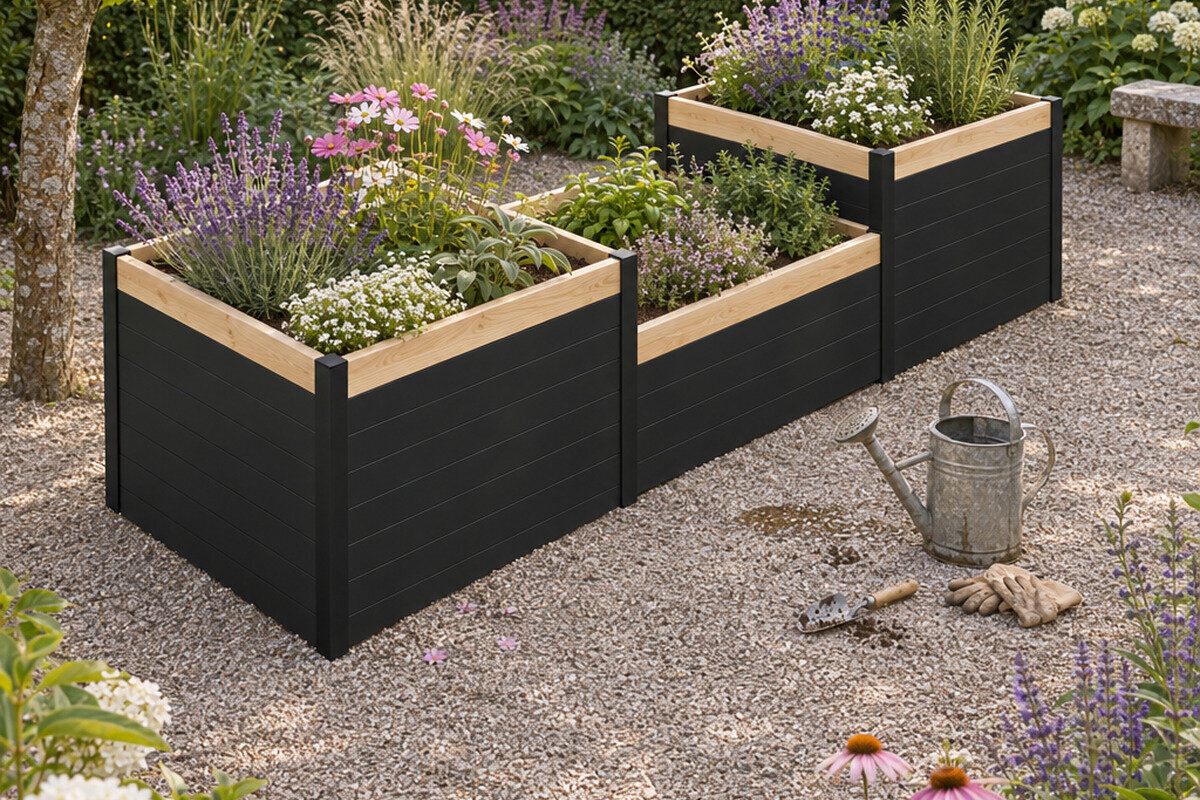
The Bloomcabin gallery shows ground-standing alternatives, not redwood examples. The Narrow Accoya Raised Garden Bed 39.37×19.69×23.62 in is a useful example of why the wall description matters. Its nominal footprint is 39.37 by 19.69 inches, and its walls are 23.62 inches high. Accoya boards form the top 3.94 inches of each wall; the lower panels and corner posts are aluminum. It comes unassembled, with an open base and no floor panel.
If full redwood walls are the reason you're shopping for a redwood raised garden bed, that model doesn't meet the brief. If you're more interested in a narrow open-bottom frame with wood visible at the top, compare its layout with your site and confirm the actual clear planting dimensions. The nominal dimensions and gallery images don't establish which frame will last longer.

Questions readers ask
Is an untreated redwood raised garden bed automatically suitable for vegetables?
Not on the strength of that label alone. Confirm that “untreated” describes the actual boards, then check separately for stains, sealers, and other materials that will touch the soil. If the boards are reclaimed and the seller cannot document their previous use or treatment, choose traceable stock for the vegetable bed.
Should I seal the inside of a redwood raised garden bed?
Don't seal it by default. If the bed instructions call for a finish, check that the finish maker documents the intended application on the soil-facing surface. Directions for an exposed exterior face don't automatically apply inside the bed. For an existing finish, identify it before deciding how to maintain or replace it.
Can I reuse the existing screws when replacing a side board?
Check the original instructions and the condition of the hardware. A board that matches the old one in length may differ in actual thickness, which changes how the screws engage. Use the specified hardware for the replacement, and don't remove a board or its fasteners while it is still retaining soil.
Make the purchase conditional on the quote
Buy a redwood raised garden bed when the quote identifies the stock and soil-contact materials, the wall design suits the site, and you can inspect and repair it once filled. If the seller can't answer one of those questions, resolve it before paying a premium for the wood.
Find a raised bed for your plan
Compare layouts and check the dimensions on the product page.
