
Standing Planter Box Outdoor Guide: Choose, Set Up, and Plant

Bloomcabin · Raised-bed guides
Standing Planter Box Outdoor Guide: Choose, Set Up, and Plant
For a standing planter box outdoor setup, choose a legged container with a supported floor and drainage if you need to hold soil above a patio or deck. Choose an open-bottom raised frame for suitable prepared ground. Before filling either, check the working height, rooting depth, drainage path, stability, and any applicable load limits.
Look underneath first
Legs raise a container with a floor. An open-bottom frame holds soil above grade and is intended for prepared ground.
Measure your reach
Mock up the rim and far edge before buying. Check that you can plant and harvest without leaning on the box.
Verify both loads
For a standing planter box outdoor installation on a deck, verify the planter’s limits and the deck’s capacity separately.
Plan from the inside
Choose crops using actual soil depth, inside dimensions, available light, and local planting guidance.
Start your standing planter box outdoor plan with one crop you want to grow and one spot you’re considering. Those two choices tell you what to check first: the crop’s space and light needs, whether you can reach the planting area comfortably, and what will support the box once the soil is wet.
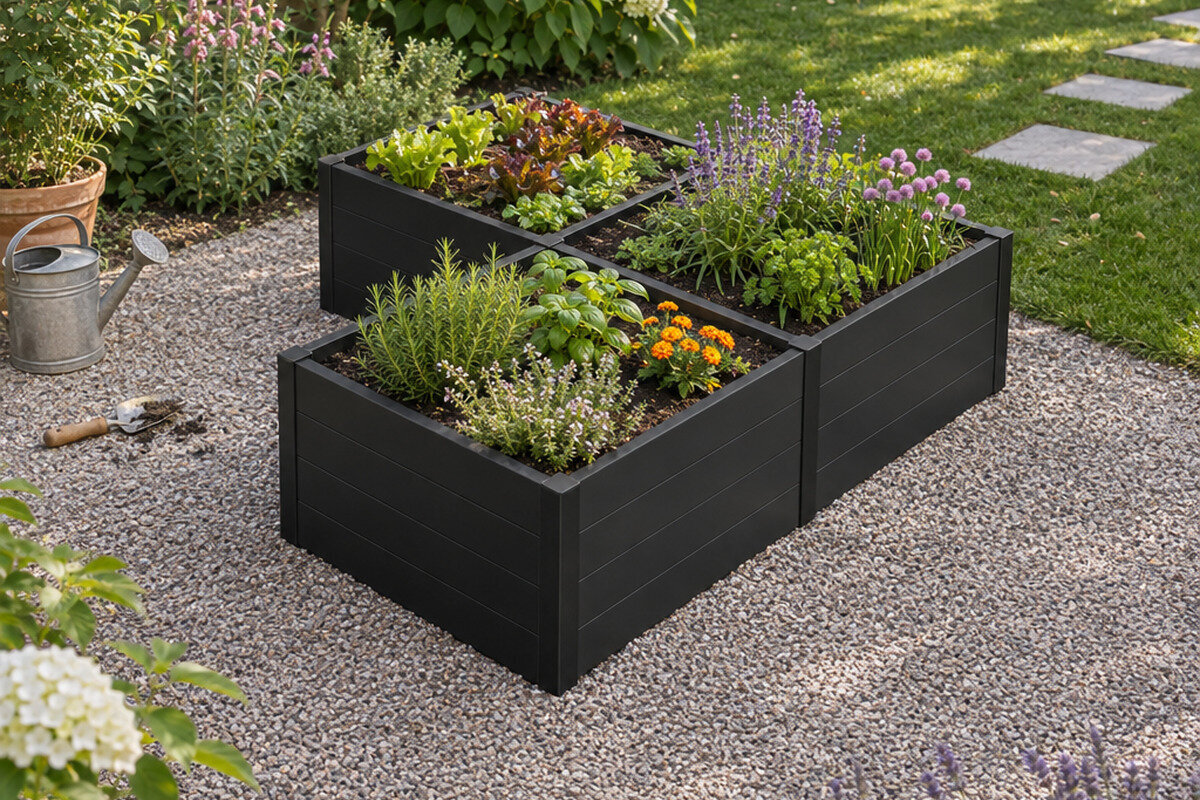
The Bloomcabin examples shown here are raised garden beds, not containers on legs. Use them to compare open-bottom layouts for a garden site. If you need a floor, clearance underneath, or approval for a deck, look for those features and limits explicitly in the specifications for the model you’re considering.
01
Choose between a legged container and a ground frame
Ground contact is the first fork in a standing planter box outdoor plan. Over suitable garden soil, an open-bottom frame creates a defined growing area and lets the new fill meet the ground beneath it. If you need clearance underneath or all the growing medium must stay inside a box, shop for a purpose-built elevated container. Check the underside in the specifications or assembly diagram: a tall wall is not a raised floor.
The Bloomcabin beds shown are unassembled, open-bottom frames for prepared ground. The square Classic aluminum raised bed has a nominal footprint of 39.37 by 39.37 inches and a wall height of 15.75 inches. Its nominal planting area is 10.76 square feet. That figure is useful for comparing layouts, not for finding its exact inside dimensions or fill volume. There is no floor panel to hold soil above pavement.
Where you work matters as much as where the planter stands. If your standing planter box outdoor setup needs to work from a chair, check the approach and clearance for your knees as well as reach over the rim. A tall ground frame can reduce bending but still give you no room underneath to pull up close. Get the actual clearance dimensions before choosing a legged model for seated use.

02
Walk the site before buying
Outline your standing planter box outdoor location with tape on paving or string on soil. Mark the full outside footprint, including any projections shown in the product drawing. Open nearby doors and gates, walk the route with a watering can, and make sure you can still reach the hose and clean behind the box. Leave space on the side you’ll actually work from, not just where the open area looks widest.
Check the site after rain or during normal irrigation. Notice whether water collects under the proposed footing or runs toward a doorway or across a walkway. For a standing planter box outdoor placement on a balcony, also consider where water leaving the planter would go below. With an open-bottom bed, look at the ground as well as the frame: poor drainage or questionable soil does not become suitable just because new soil goes on top.
Observe the site’s light during the day and compare it with the needs of the crops you want to grow. A bright spot near a wall may be shaded for part of the day, and nearby plants may change that pattern as they grow. If your first location makes watering awkward, leaves no safe outlet for runoff, or puts your crops in the wrong light, move the outline before you move a box.

03
Measure reach, rim height, and usable soil depth separately
For working height, mock up the rim with a stable table or counter close to the height you’re considering. Mark the distance to the farthest point you’d need to tend. Reach toward it as if thinning seedlings or cutting greens, not just touching the edge. If you have to brace your weight on the rim or twist to reach, choose a narrower box or leave access on both sides. Don’t count on a wall-facing side you can’t walk up to.
For crop fit, measure from the base of the growing area to the intended soil surface. In a legged container, account for any floor or insert that raises the base and any space the instructions leave below the rim. In an open-bottom frame, distinguish the fill depth inside the walls from total rooting depth. Roots may reach into suitable ground below, but a frame over compacted or otherwise unsuitable ground doesn’t guarantee that extra space.
Width also has two jobs in a standing planter box outdoor layout. Outside width tells you whether it fits the site; inside width tells you whether the planting rows fit the box. Use the actual interior width and length with crop spacing guidance. If your standing planter box outdoor purchase hinges on fitting a particular row or reaching a back corner, get those measurements from the seller rather than scaling a gallery photo.

04
Compare materials and layouts without assuming performance
When comparing materials for a standing planter box outdoor purchase, check which parts are made of what. The Classic aluminum examples have aluminum wall panels and corner posts. The narrow Accoya fusion raised bed has a nominal footprint of 39.37 by 19.69 inches and 23.62-inch walls; aluminum forms the lower 19.69 inches, and Accoya boards form the top 3.94 inches. It is not an all-wood bed. Neither the wall height nor the material tells you what a freestanding planter floor can support.
For a legged container, look past the wall finish. Check the specifications for outdoor use, how the floor is supported, where drainage exits, and whether the manufacturer approves your proposed surface and any accessories you plan to use. If you’re growing food, check the intended use of the container and any component that contacts the growing medium. Use the care instructions for the actual materials and finish, not assumptions based on how the box looks.
The right standing planter box outdoor layout is the one you can tend once the plants fill out. A narrow bed can suit a spot worked from one long side. A divided model lets you organize crops in separate bays, but dividers affect the space available for planting. If you’re considering a U-shaped frame, check the clear width and depth of the access notch as well as the outside dimensions. A notch you can enter but can’t comfortably turn in may not solve the access problem.

05
Check stability, drainage, and both load limits before filling
Assemble your standing planter box outdoor setup in its final location, following the instructions for the exact model. Before filling, check that joints are secure, every support bears as intended, and the empty box does not rock or twist. If it does, correct the site or assembly as directed. Don’t compensate with scrap shims, an improvised floor, or anchoring the manufacturer hasn’t approved. For an exposed site, ask whether there are placement restrictions, especially if you plan to add a tall crop support.
Give water a clear exit. For an open-bottom bed, check that the ground beneath it can accept drainage. For a container with a floor, keep the designed outlets clear and confirm runoff can go somewhere without pooling under the supports or crossing a walking route. If the instructions permit it, try a small amount of water through the empty container to see where it exits. That checks the outlet and route, not how the planted container will drain.
For a standing planter box outdoor installation, ask the manufacturer what its documented limit covers: wet contents alone or the whole loaded unit. Estimate the installed weight separately using the empty box, the growing medium at its expected wet weight, plants, supports, and any water held in a reservoir or tray. On a deck or balcony, have a qualified professional confirm that the structure can carry the load at the proposed location, including how it is concentrated at the feet. No filled-weight rating is documented here for the illustrated Bloomcabin frames. If the applicable planter limit or site capacity cannot be verified, don’t fill the box at that location.

06
Calculate fill and use it to make a go-or-no-go decision
A standing planter box outdoor fill estimate starts at the inside walls and ends at the intended soil line. For a straight-sided rectangular planting area, multiply inside length by inside width by fill depth, all in feet, to get cubic feet. For multiple bays, calculate each separately and add the results. For a tapered container, use the manufacturer’s stated fill volume at the intended level rather than treating the widest opening as the width throughout.
Hypothetical worked example: A gardener is choosing a legged box for salad greens on a paved patio. Assume the straight-sided interior is 3 feet long by 2 feet wide, the approved fill depth is 10 inches, and local crop guidance confirms the intended varieties fit that depth and the site’s light. The volume is 3 × 2 × (10 ÷ 12) = 5 cubic feet. These are assumed dimensions, not a Bloomcabin specification.
The gardener uses 5 cubic feet to request a wet-weight estimate for the chosen growing medium, then compares the estimated contents with the box’s documented limit and the total installed weight with what the patio can support. If the seller only gives a dry bag weight and the wet load can’t be established, the gardener pauses rather than using the dry number. Once the standing planter box outdoor setup clears those checks, the gardener chooses a medium suited to the container and crops, not a universal mix.

07
Plant for easy harvest and adjust care as conditions change
Start your standing planter box outdoor planting plan with crops you’ll use and can reach easily at harvest. Draw the actual inside shape and mark rows or plant positions using the spacing for each variety. Put frequently picked greens or herbs within easy reach, and check where taller plants will cast shade as they mature. If you’re using transplants raised indoors, follow local guidance on acclimating them before planting. Use seed instructions and local extension advice to choose dates rather than relying on a national calendar.
Once planted, check moisture in the growing medium instead of watering only because the surface looks dry or because you watered on that day last week. Check again as weather and plant size change. After heavy rain, look for blocked outlets, unexpected pooling, or changes in how the box sits. If a support shifts or the frame starts to lean, stop using it and follow the manufacturer’s instructions for correcting the problem safely.
Keep a short standing planter box outdoor care record: which crops fit without crowding, which spots dried first, and whether anything made harvesting awkward. Those notes tell you what to change next season. For example, if one corner was hard to reach, plant a crop that needs less frequent attention there next time rather than repeating the same layout.

Questions readers ask
Can I add a floor to an open-bottom frame for a standing planter box outdoor installation?
Not unless the manufacturer explicitly supports that conversion and provides instructions and load limits for it. A floor has to support the wet contents as well as let water out. For a hard surface, look for a purpose-built, drained container approved for the site instead of assuming a liner or panel makes the frame suitable.
Does a taller bed always provide more usable soil depth?
No. On a legged planter, the legs can raise the rim without deepening the planting tray. On an open-bottom bed, roots may reach below the frame if the underlying soil is suitable. Compare depth at the recommended fill line, and count soil below a frame only after checking its condition.
Should I fill the planter before moving it into position?
No. Put it in its approved location while empty, then check its supports, access, and drainage before adding growing medium. If it later needs to move, follow the manufacturer’s instructions for unloading and handling it rather than assuming it can be lifted or rolled while full.
Make the decision before the soil arrives
Before committing to a standing planter box outdoor setup, confirm the construction, try the reach, and verify where water and weight will go. Then use the actual planting dimensions and local crop guidance to decide what to grow. It’s much easier to change the location or box while it’s still empty.
Find a raised bed for your plan
Compare layouts and check the dimensions on the product page.
