
Stepped Garden Beds: How to Choose, Set Up, and Use Them

Bloomcabin · Raised-bed guides
Stepped Garden Beds: How to Choose, Set Up, and Use Them
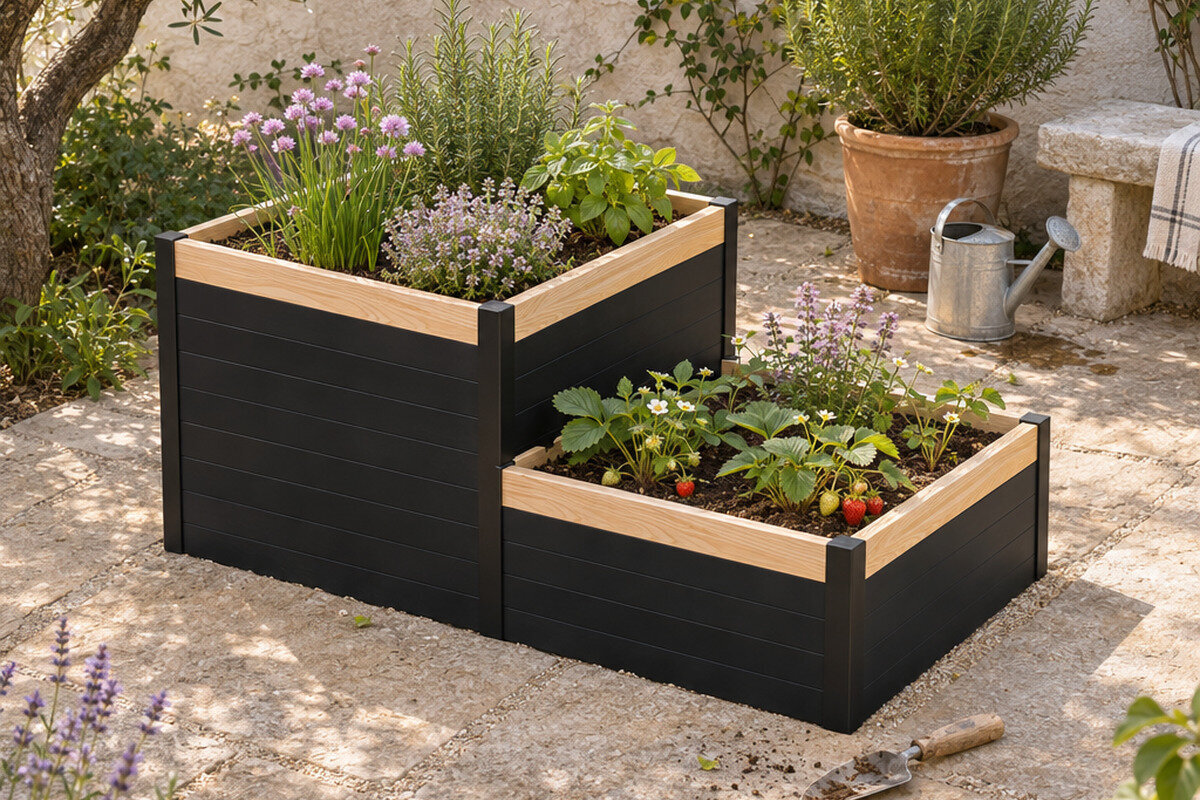
Stepped garden beds are raised growing areas arranged at two or more heights. Choose them when the height change makes planting or tending easier. Before you buy, mark the frame and working paths on the ground, then check whether you can reach each bay and give its crops the light and rooting space they need.
Give the step a job
Choose stepped garden beds when different planting heights improve reach, planting layout, or both.
Measure working space
Mark paths and openings as well as the frame. A bed that fits on paper can still block access.
Check depth separately
Wall height, planned fill depth, and usable rooting depth are three different measurements.
Order soil by bay
Measure the inside of each bay and add the individual fill volumes.
The useful question is not how tall stepped garden beds can be, but what the higher section lets you do. It might put frequently harvested crops at a more comfortable working height. It might also cast shade on the lower section or put the far corner out of reach. Start with how you want to tend the bed, then choose the shape.
Bloomcabin’s raised garden bed range includes both unequal-height and equal-height layouts. Use the product specifications to tell them apart: a divider or a U-shaped outline does not make a bed stepped. Once you find a layout that suits your space, use the exact kit instructions and your local growing guidance to plan the setup and planting.
01
Decide what the height change should accomplish
Stepped garden beds can be arranged as separate planters at different elevations or as adjoining bays with unequal wall heights. Those designs are not interchangeable. Separate planters may have their own bases; adjoining open-bottom bays sit over prepared ground. Neither the word “stepped” nor a photo tells you what is under the soil. Check the plan and base construction before settling on a design.
For a straight layout, the Split Double Aluminum Raised Garden Bed has two compartments. Their listed wall heights are 11.81 inches on the left and 31.5 inches on the right. The Framed U-Shaped Aluminum Raised Garden Bed has five compartments: the back row measures 23.62, 11.81, and 23.62 inches in wall height from left to right, and both front arms are 11.81 inches high. Both models use aluminum wall panels and have open bottoms. The U shape changes how you approach the bays; the raised rear corners create the height difference.
For stepped garden beds along a straight path, a split layout makes sense if you want one higher working edge and one lower bay. A U-shaped layout is worth considering if you want more planting zones and can approach them through the notch and around the frame. If all you want is to separate two crops, compare the Double Aluminum Raised Garden Bed 78.74×39.37×11.81 in: it has a divider, but both bays have 11.81-inch walls. There is no need to plan for two fill depths just to keep crops apart.

02
Measure the bays, then test your reach
When comparing stepped garden beds, write down three measurements: the nominal footprint, the planting dimensions, and the space you need to work. The Split Double has a nominal footprint of 78.74 × 39.37 inches and a listed nominal planting area of 21.53 square feet across two bays. The Framed U-Shaped model has a nominal footprint of 118.11 × 78.74 inches and a listed nominal planting area of 53.82 square feet across five bays. Both list nominal bays of 39.37 × 39.37 inches. Those bay dimensions are not verified inside measurements for ordering fill.
The Framed U-Shaped model’s nominal 39.37 × 39.37-inch notch is an opening, not another planting bay or a guarantee of maneuvering room. Tape out the frame and notch, then try entering with the tools you use. If you garden from a seat or use a mobility aid, test the approach, turning space, and position from which you would actually work.
Mock up the wall heights of stepped garden beds as well as the footprint. A box or a mark on a stake can show whether a higher edge brings plants closer or makes it harder to lean far enough to reach the center. Test from every side you intend to use. If a fence blocks one approach, check the far corners from the remaining sides. Choose a layout you can tend without stepping onto the growing soil.

03
Check sun, hose access, and the ground underneath
Before you choose a location for stepped garden beds, mark the tall and low sections on the ground and note where the sun falls at different times of day. Consider shade from the taller walls, nearby structures, and crops at their mature height. If you plan to trellis a crop, include the trellis in your sketch. Where the tall section would shade a crop that needs more sun, try a different orientation or swap the planting assignments before ordering.
Walk the route from the water source to the proposed bed. Check whether a hose can reach the far bay without dragging through another planting or crossing a path you need to keep clear. On a U-shaped layout, try bringing the hose into the notch and back out without catching it on the corners. A convenient route matters more than the straight-line distance from the tap.
The open bottoms of the featured stepped garden beds put the fill in contact with the prepared ground. Check whether water pools after rain and whether the site history gives you reason to question the soil’s suitability for food crops. Ask your local Extension office what to assess if you find a problem or do not know the site history. Taller walls alone do not fix standing water or isolate roots from unsuitable soil. If those concerns cannot be addressed, change sites or choose a system designed to separate the growing medium from the ground.

04
Orient the empty frame before adding soil
Get the instructions for the exact configuration before preparing the site. The two featured Bloomcabin models are supplied unassembled. Compare the parts with the instructions and identify the taller panels and divider positions before you start. Do not use a photograph to infer how a shared wall is assembled or assume that the straight model and the U-shaped model use the same connection at every joint.
For open-bottom stepped garden beds, prepare a firm, level site as directed for the kit. Mark which end or corners are meant to be high, and leave enough room to work around the empty frame. If placing a kit as shown would put the high end in the wrong spot, check whether you can orient the whole frame differently. Do not assume that individual bays can be reversed or moved within the assembly.
Before filling stepped garden beds, check that the dividers and connections match the instructions and that the frame sits as intended. Walk the access route again with the assembled walls in place. This is the time to find out that a tall corner blocks a gate swing or that the wheelbarrow cannot turn into the notch. Follow the manufacturer’s fill directions, including any stated sequence. If the instructions do not cover your proposed base or siting conditions, verify the setup rather than improvising supports.

05
Assign crops and estimate fill one bay at a time
Make a planting plan for stepped garden beds before buying soil. For example, if you want leaf lettuce and a trellised vegetable in separate bays, start with the seed packet or plant label for spacing and depth, then check local Extension guidance for timing. Sketch where you will reach to harvest the lettuce and where you will stand to tend the trellis. Assign the crops only after checking that the supports and mature plants will not block access or shade a bay that needs more sun.
Wall height tells you how tall the frame is, not where roots must stop. In an open-bottom bed, roots may extend below the fill if the native soil is suitable. Conversely, a high wall does not guarantee a matching depth of usable soil. Account for the planned soil surface below the rim and check what is under the bed before counting that ground as growing space.
Estimate fill for stepped garden beds from the actual interior measurements. For each rectangular bay, multiply inside length by inside width by the intended fill depth, all in feet, and sum the cubic feet. Do not multiply the overall footprint by the highest wall: that counts openings and treats lower bays as if they were taller. Confirm any irregular dimensions before ordering. Check the quality of purchased soil and use a soil test to guide amendments rather than assuming each bay needs the same mix or fertilizer.

06
Water and tend the high and low bays separately
Check moisture separately in stepped garden beds, especially after planting. The lower bay’s surface is not a reliable guide to what is happening in the high bay. Exposure, crop growth, and the soil in each zone may differ. Check where the roots are growing, and pay particular attention to the seed zone while crops are germinating. If you use drip tubing, watch where the water actually lands; adjust placement if one row is being missed.
Water near the roots when the crop needs it. Mulch can limit moisture loss and weeds where it suits the planting, but it does not replace checking the soil. If plants in one compartment wilt, do not automatically water every bay more or feed the whole bed. Check that compartment first for dry or wet soil and look for other signs that explain the problem.
Use the separate zones in stepped garden beds to keep useful notes. Label what went into each compartment and record any access or shade problem alongside crop observations. For example, if you left part of the lower bay unharvested because it was hard to reach behind a support, relocate the support or put a less frequently harvested crop there next time. If it was the frame itself that blocked your reach, adjust the planting area you use rather than relying on a different crop to solve the access problem.

07
Worked example: fit two heights beside a clear passage
Hypothetical worked example: A gardener comparing stepped garden beds has a level, 120 × 108-inch patch of ground. They want two growing zones at different heights and need a continuous 36-inch passage alongside the long edge for their own tools. That passage width is their planning requirement, not a standard. In both layouts, they orient the longer side along the 120-inch edge.
At its widest point, the Framed U-Shaped bed would leave 108 − 78.74 = 29.26 inches across the width, even before allowing space on the other side. Its notch offers access into the bed, but it does not provide the required continuous passage. The Split Double leaves 108 − 39.37 = 68.63 inches across the width, enough on paper to set aside 36 inches on one side and leave 32.63 inches on the other. The gardener chooses the split layout for a site mock-up and checks that both long sides can actually be approached.
For a fill estimate, suppose the gardener measures both assembled bays at exactly 3 × 3 feet inside and plans 9 inches of fill in the low bay and 24 inches in the high bay. These are hypothetical measurements and fill depths, not Bloomcabin specifications. The low bay takes 9 square feet × 0.75 feet = 6.75 cubic feet. The high bay takes 9 square feet × 2 feet = 18 cubic feet, for a total of 24.75 cubic feet. That is the value of pricing fill for stepped garden beds by compartment: the footprint comparison chooses the layout, while the measurements inside the assembled frame determine the soil estimate.

Questions readers ask
Do stepped garden beds need separate watering lines?
Not necessarily. Start by checking moisture in each bay. If one bay consistently needs water at a different time, separate controls may make sense. Decide from the crops, exposure, and soil conditions you observe, not from the height difference alone.
Can stepped garden beds level a sloping yard?
Do not use the wall-height difference as evidence that a frame can retain a slope. The two featured Bloomcabin models are open-bottom frames for prepared ground. If the site needs retaining or substantial grading, resolve that separately and confirm the bed’s installation requirements before buying.
Can I put open-bottom stepped garden beds on a patio?
The featured frames have no floor to contain soil. For a patio, look for a system intended for that surface, with a way to contain soil and manage drainage. Verify that the surface can support the filled system and that runoff has somewhere appropriate to go.
Choose the step you will actually use
Choose stepped garden beds only when the height difference earns its place. Verify the wall layout and kit instructions, mark your working space before assembly, and measure each bay before ordering fill. If the height change adds shade or makes a bay harder to reach without solving a problem, an equal-height bed is the better choice.
Find a raised bed for your plan
Compare layouts and check the dimensions on the product page.
