
Stone Raised Beds: How to Choose a Wall That Fits Your Garden

Bloomcabin · Raised-bed guides
Stone Raised Beds: How to Choose a Wall That Fits Your Garden
Stone raised beds are a good fit when you want a permanent garden edge and can verify that the wall system suits your site. Choose the material, check how it will hold soil, and confirm where water can go before you commit. If the stone’s identity, finish, or installation requirements are unclear, keep shopping rather than guessing.
Start with the wall system
Stone raised beds are a good candidate for a permanent layout when the chosen wall system fits the site and is intended to retain soil.
Verify what touches the soil
Ask for the exact material, finish, prior use if reclaimed, and guidance for contact with growing soil.
Measure inside the walls
Use the clear inside dimensions for planting and soil calculations, and check your reach from the actual paths.
Plan beyond installation
Know where water goes and how you would repair a shifted or damaged unit before you fill the bed.
Two listings for stone raised beds can show almost identical walls and describe very different builds. One might use quarried blocks, another manufactured units, and a third a stone facing over a separate structure. The difference matters when you ask what holds the soil, what touches it, and what you would need to do if the wall shifts.
Start with one real spot in your yard and a short list of what you want to grow. Then compare the proposed walls for that spot: what the units are made of, how much planting room they leave, what the installation requires, and whether you can inspect and repair the finished bed.
01
Know what will actually hold the soil
The first decision is what you are buying. Stone raised beds can be built with quarried stone or with manufactured masonry units sold for a stone look. A thin stone facing may give a bed the same appearance, but the structure behind it still has to hold the soil. If a listing says only “stackable” or “stone finish,” ask whether the units are sold as edging, facing, or part of a soil-retaining system.
Look at how the pieces fit, not just how the exposed edges look. Irregular pieces may need sorting to find suitable bearing faces and workable corners. Uniform units give you more predictable dimensions for laying out a rectangle, but matching dimensions do not make pieces interchangeable between systems. Ask to see how a straight run ends or turns a corner; that detail may determine whether the plan fits your space without cutting or ordering different pieces.
Stone raised beds make more sense when you want the edge to stay put than when you expect to change the layout. Before choosing masonry for a more comfortable working height, ask what the proposed wall needs at that height. For stone raised beds, a taller face means planning for more retained fill, not simply ordering another row of the same units. A low bed on level ground and a taller wall along a slope are different jobs.

02
Get documentation for the units and everything between them
For stone raised beds, get two separate answers in writing: whether the assembly is intended to retain soil in the proposed configuration, and what the supplier can document about the materials that will contact the growing soil. A guide showing how to assemble the wall does not by itself establish suitability around edible crops. Conversely, knowing the stone type does not tell you whether the proposed stack or joint will work.
A batch of reclaimed units might suit the look of stone raised beds while leaving its coating or prior use unknown. Record that uncertainty rather than treating a clean appearance as proof. For an herb or vegetable bed, choose a documented alternative if you cannot verify the materials that would contact the growing soil.
Compare the delivery with the product sheet before laying the first course. If the units for your stone raised beds turn out to be a different thickness or have a different joint profile, recheck the layout and instructions before proceeding. Even a substitution that looks similar can change the finished inside dimensions or how the corners connect.
- Verify the stone type or manufactured unit designation, any stated grade, the actual unit thickness, and the finish on faces that will contact soil.
- Ask about coatings, sealers, or other treatments. For reclaimed material, ask where it came from and whether its previous use and any old finish are known.
- Confirm any specified pins, clips, or other fasteners, along with the mortar or adhesive if the design calls for one. Get the instructions for the exact units and layout.

03
Measure the planting space you’ll actually use
Draw three outlines for stone raised beds: the outside of the finished wall, the clear inside planting space, and the area you need to leave open for access. Include any cap that projects into a path. Mark the layout on the ground and try the longest reach from where you will actually stand or kneel. If a fence blocks one side, assess the bed from the accessible side rather than assuming you can reach half the width from either edge.
Write down wall height, planned fill depth, and available rooting depth separately. You may leave space between the soil and the top of the wall. In an open-bottom design, roots may also have access to suitable soil below; on pavement, you cannot count on that extra depth. Check the available depth against the plants you intend to grow rather than choosing wall height by appearance alone.
When comparing two designs for stone raised beds, hold the usable planting area constant and see how much yard each one takes up. Thicker walls can mean a wider finished bed for the same planting area. A design that fits on paper may still leave too little room to carry soil through a gate or work beside the wall. Test the route with the tools or cart you plan to use.

04
Plan the build from the base to the last course
Before committing to stone raised beds, ask for a drawing or installation instructions covering the proposed wall height, corners, base, and joints. Ask how the design accounts for the ground conditions at your site. If the plan also holds back an existing slope, or if the instructions do not cover the intended height or layout, get a site-specific design rather than adapting a low-bed detail.
For dry-stacked stone raised beds, check how the instructions specify bearing surfaces, corner placement, and the way courses overlap or interlock. For a mortared design, verify the required support, joint materials, and instructions on when to backfill. Do not add mortar to a dry-stack plan or omit the connectors from a manufactured system because the pieces seem to fit without them.
Once you have the instructions, stage the pieces near the work area and make a handling plan based on the unit weights. Mark the corners and check the footprint against the plan before preparing the base. As you assemble, check alignment and fit at each course rather than trying to correct an out-of-line wall at the top. Before filling stone raised beds, check that the base, corners, joints, and any specified drainage details match the design. Stop if units rock or a joint does not seat as shown.

05
Decide where water will go before filling
Start the drainage check after rain if you can. Note where water stands, what runs in from uphill, and where water could leave the bed without causing a problem elsewhere. For open-bottom stone raised beds, check the soil beneath the footprint as well as the soil you plan to bring in. A stone perimeter does not solve a persistently wet site, and raising the planting surface does not by itself resolve concerns about contaminated ground.
Do not assume gaps between stones are a drainage plan. Ask how the proposed system handles water behind the wall and how it keeps planting soil from washing out. If the design specifies a filter material or outlet, keep it in the plan and make sure the outlet remains accessible. Do not substitute a liner or a layer of gravel for a drainage detail you have not yet resolved.
On pavement, stone raised beds need a design suited to a hard surface, a confirmed route for drainage, and a check that the surface can support the filled installation. On soil or pavement, check the source and condition of the growing mix before ordering a large quantity. After filling and planting, check moisture where the roots are rather than judging from the color of the stone or watering on a fixed schedule.

06
Compare repairs, footprint, and effort—not just looks
Ask how you would inspect and repair stone raised beds without taking the entire bed apart. After heavy rain or a season of use, look for changes such as a leaning section, shifted units, opened joints, or soil washing out at the base. Check whether a drain outlet is blocked. If a wall is moving, address the cause before topping up the soil or patching the visible gap.
Compare the full job for stone raised beds and any other frame you are considering: base preparation, delivery and handling, wall thickness, fill quantity, replacement parts, and whether the design can be dismantled. A panel frame may be worth considering if a masonry layout would take too much path space or if you do not want to move individual masonry units. Check the panel frame’s actual dimensions and assembly requirements rather than assuming it solves either problem.
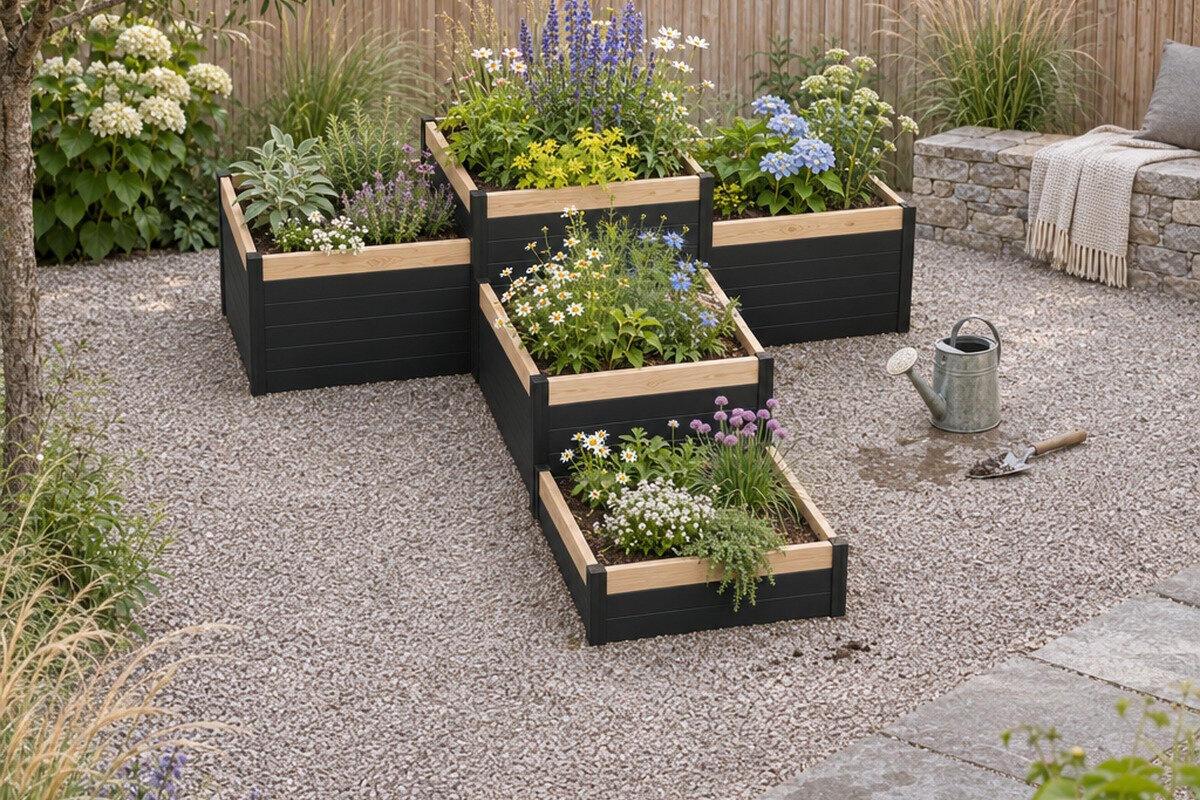
The Bloomcabin examples shown here are aluminum frames, with Accoya wood at the top of the walls on the illustrated fusion model; none are stone. For a compact comparison, the Square Aluminum Raised Garden Bed has a nominal footprint of 39.37 × 39.37 inches, 15.75-inch walls, and an open bottom for prepared ground. Use the published footprint to screen the location, then verify the clear planting width if it matters to your plan. The specifications are not a patio load rating.

07
Worked example: screen two quotes for a narrow garden
Hypothetical example: A gardener wants an open-bottom bed for herbs and salad greens on level ground, with access along both long sides. To compare options for stone raised beds, they sketch a finished outside rectangle of 4 by 8 feet, with assumed 6-inch-thick walls and no projecting caps. Subtracting 6 inches at both ends of each dimension leaves 3 by 7 feet inside. That is 21 square feet of planting area, not the 32 square feet shown by the outside rectangle.
Assume 12-inch walls and a 10-inch fill depth, leaving 2 inches between the soil and the rim. With straight, vertical inside faces, the fill estimate is 21 square feet × 10/12 foot, or 17.5 cubic feet. That is the geometric volume above ground, not a measure of total rooting depth or a guarantee of how much mix to order. The gardener checks the finished dimensions before ordering and tests whether a 1.5-foot reach from either long side feels comfortable.
The first quote is for reclaimed stone with an unidentified coating and no installation detail for the proposed corners. The gardener sets it aside. The second option identifies the units and finish and provides instructions for the intended wall layout. Before accepting it, the gardener checks guidance for edible gardening and verifies that the proposed base and drainage suit the site. The measurements make the options comparable; the documentation determines which stone raised beds are worth pursuing. None of the example dimensions is a construction specification.

Questions readers ask
Are stone raised beds suitable for vegetables?
They can be, provided the wall system suits the site and you can verify that the materials in contact with the growing soil are appropriate for the intended use. Ask about the units, coatings, and any mortar or adhesive. If you cannot identify an old finish or confirm the source of reclaimed pieces, choose a documented option rather than assuming a liner makes the assembly suitable.
Can stone raised beds go on a patio?
Possibly, but check the patio and the bed as a complete installation. Have an appropriately qualified professional assess the surface for the weight of the walls, moist growing mix, and other components. Confirm that the chosen design works on a hard surface and has a drainage route that does not send water toward a building or across a walking route.
Can I take apart and move stone raised beds later?
That depends on the assembly. Ask whether the design can be dismantled, which parts can be reused, and how the units are meant to be handled. A system assembled without mortar may still need its base rebuilt at the new location. If you expect to move the bed, compare the work of removing the soil, moving the pieces, and preparing the next site before buying.
Make the call before ordering materials
Choose stone raised beds when the documented wall system fits the site, leaves enough usable growing space, and has a clear assembly and drainage plan. If an essential answer is missing, ask for it before delivery. It is easier to change the plan before the wall is built and filled.
Find a raised bed for your plan
Compare layouts and check the dimensions on the product page.
