
Vegetable Planters: How to Choose, Set Up, and Plant a Raised Bed

Bloomcabin · Raised-bed guides
Vegetable Planters: How to Choose, Set Up, and Plant a Raised Bed
Choose vegetable planters by what will sit beneath them and what you want to grow. Use an open-bottom raised bed over suitable prepared ground, or a container with a base and drainage when it has to hold its own soil. Then check reach, rooting depth, and fill volume before you buy.
Start with the base
Choose an open-bottom frame for prepared ground or a true container when the planter must hold its own soil.
Measure your reach
Size vegetable planters for the crops and the space you need to tend them, not just the space the frame takes up.
Measure before ordering soil
Use inside dimensions and intended fill depth to estimate soil. Wall height alone doesn't tell you how deep roots can grow.
Plant for your location
Use seed packets and local growing advice to turn a crop list into a planting plan.
The best vegetable planters for a first crop aren't necessarily the biggest ones that fit. Start with vegetables you'll eat and a spot that meets their light needs. Then draw the bed and the paths around it. A narrow strip you can tend from one side may be more useful than a square bed you can barely reach across.
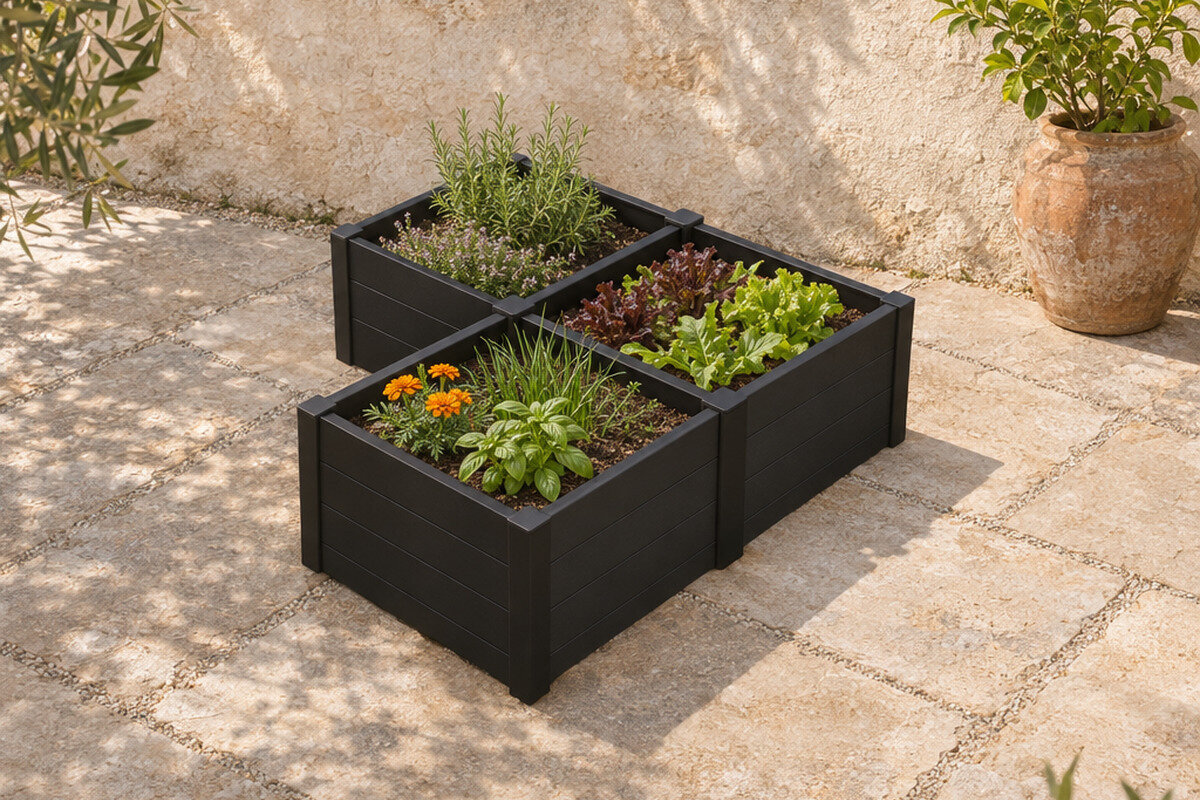
The Bloomcabin raised beds shown here are unassembled, open-bottom frames with aluminum wall panels; one listed design has Accoya wood at the tops of its walls. None of these models has a floor panel. Use the listed US measurements to compare layouts, then verify the clear inside dimensions and the exact model's assembly instructions before committing to a crop layout or soil order.
01
Choose the base before the material
Vegetable planters describe a use, not a single construction. In this guide, the pictured Bloomcabin models are raised frames: the walls hold the added soil at the sides, and the base is open to prepared ground. A container, by contrast, has a base that holds the growing medium and needs a way for water to exit. That difference matters more than the shape of the rim. If you need to keep all the soil off the surface below, start with a container designed for that setting rather than adapting an open frame.
Open-bottom vegetable planters suit a gardener who wants a defined patch, has suitable ground, and can bring soil and water to it. They're a poor shortcut for a low spot that stays wet or a site where the underlying soil may be contaminated. More wall height gives you room for more fill, but don't assume it fixes either problem. If you can't establish that the ground is appropriate for food gardening, choose a different site or get local advice before installing a bed there.
For the material decision, compare the actual wall construction. The classic models shown use aluminum wall panels. In the 23.62-inch-high narrow Accoya fusion model, the upper 3.94 inches of each wall are Accoya wood and the lower 19.69 inches are aluminum. It is not an all-wood box. Whichever finish you prefer, rule out vegetable planters that fail your base or access requirements before comparing appearances.

02
Read the dimensions like a gardener
When comparing vegetable planters, read length and width as nominal site-planning dimensions, not as verified clear space inside the walls. The 39.37-by-19.69-inch narrow aluminum model has 3.94-inch walls and a nominal planting area of 5.38 square feet. The 39.37-by-39.37-inch square aluminum model has 15.75-inch walls and a nominal planting area of 10.76 square feet. The square gives you more listed planting area, but the extra width is only useful if you can reach what you put there.
Read height separately. Wall height tells you where the rim sits relative to the base, not how much soil you'll add or how far roots can grow. If you leave space below the rim, your fill depth is less than the wall height. If the ground beneath the frame is suitable for roots, the total rooting depth can extend below the base. For a shallow frame, that distinction is especially important: don't choose a crop based on the wall height alone, and don't count on roots penetrating unsuitable ground.
For vegetable planters with multiple bays, check each one rather than relying on the overall footprint. The double aluminum bed has two nominal 39.37-by-39.37-inch bays; the split double pairs an 11.81-inch wall height on the left with a 31.5-inch height on the right. On the U-shaped kit, the nominal 39.37-by-39.37-inch notch is access space, not planting area. Verify clear inside dimensions for planting and clear openings for access if either is a tight fit.

03
Try the layout before buying the bed
Before ordering vegetable planters, outline the nominal footprint with string or stakes. Walk from the gate or storage area to the bed carrying the bucket or tools you expect to use. Try turning at the corners and crouching where you'll sow and harvest. Include anything that will narrow the route, such as a gate swinging inward or a hose crossing the path. An outline that fits with the gate closed may not leave room to get a load of soil through.
Test reach from the sides that will actually stay open. For the listed square bed, allow access from at least two opposite sides. If one side faces a fence, don't count that side in your reach test. Narrow vegetable planters can make better use of a one-sided path, but still check whether you can reach the far edge without leaning on the wall. If more than one person will tend the bed, have the person with the shortest comfortable reach try the layout.
Make a last check of light and water before committing. Observe when a fence, tree, or building shades the planting area, then compare what you see with the crops' light needs. Try bringing the hose or watering can to the far end, not just to the nearest corner. If you're comparing two locations for vegetable planters, choose the one where you can both grow the intended crops and do routine jobs without moving furniture or squeezing past an obstacle.

04
Prepare the ground and check the assembled kit
Set up vegetable planters before scheduling a bulk soil delivery. Confirm the model and check what the assembly manual requires for the site, tools, and handling of parts. The listed frames arrive unassembled. Clear the footprint and prepare a level site in accordance with the instructions. If the cleared area reveals a drainage problem or ground conditions you hadn't planned for, pause. It's easier to change locations now than after you've filled the frame.
Lay out the parts by side or bay before joining them. For example, the 78.74-by-19.69-inch long narrow aluminum bed uses two 39.37-inch wall sections along each long side, joined by aluminum T connectors. Don't use the gallery photo as an assembly diagram or assume the same arrangement applies to another kit. Follow the model's instructions for the sequence, connections, and any required support. If a part is missing or doesn't match the manual, resolve that before filling rather than improvising a substitute.
Before filling vegetable planters, check the assembled walls and dividers against the instructions and repeat your access test. Use the assembled bed to confirm the clear inside measurements for the soil estimate. For an open-bottom frame on prepared ground, select the fill with local soil and crop advice rather than a universal recipe. Ask what the supplier's mix contains and whether it suits the intended planting. Choose a fill line below the rim that leaves room for watering and any mulch you intend to add.

05
Work out how much soil to order
To estimate fill for rectangular vegetable planters, multiply the clear inside length by the clear inside width and the planned fill depth. Use feet throughout to get cubic feet directly. For a divided bed, calculate each bay separately and add the results; bays with different wall heights may need different fill depths. For a U-shaped kit, leave the access notch out entirely. Confirm the supplier's units before ordering so an estimate in cubic feet isn't mistaken for an order in cubic yards.
Hypothetical example: Choose and fill a first salad bed. Say a gardener wants separate patches of leaf lettuce and radishes and is comparing two vegetable planters. Both the 3.94-inch-high narrow frame and the 15.75-inch-high square aluminum bed fit the yard. The gardener can keep opposite sides of the square clear, and a sketch based on seed-packet spacing makes better use of its extra planting area. They choose the square, not because lettuce and radishes require that wall height, but because they can reach both patches and want a greater depth of added soil than the shallow frame provides.
For illustration, assume the assembled square measures 3 feet by 3 feet inside and the fill will be 1 foot deep. That's 3 × 3 × 1, or 9 cubic feet. The 3-foot inside measurements are hypothetical, not verified dimensions for the linked model. At purchase or setup, the gardener would verify the actual measurements and fill line and redo the calculation. The same approach works for other rectangular vegetable planters; the useful number is the volume below your chosen fill line, not the volume of the box on the product page.

06
Turn your crop list into a planting map
Lay out vegetable planters around what you'll pick and eat. Start with a short list, and check spacing for the varieties you'll actually buy. On a sketch, assign each crop a patch or row using the clear inside dimensions. If the seedlings fit but the mature plants won't, cut the number of plants or choose a more compact variety. Draw in any supports before planting so you can see where tall crops might cast shade or get in the way of harvest.
In the hypothetical salad bed, the gardener can put the radish patch near the side that's easiest to approach for thinning and pulling roots, with leaf lettuce reachable from the opposite side. They can check packet spacing by laying a tape measure along each proposed row before opening the seed packets. If the rows don't fit, it's better to shorten them and hold back some seed than to count the space occupied by the walls as growing area.
Set the planting date for vegetable planters using your local Extension guidance and the packet for each crop. The same layout can work in different places without using the same dates. Check whether each variety should be sown in place or transplanted, and acclimate tender indoor-grown starts before setting them out. Label the rows with the variety and planting date. That gives you something to check if one patch comes up before another or if you want to repeat a crop later.

07
Adjust care to what you find in the bed
Vegetable planters can dry faster than nearby ground, so start by checking the soil rather than choosing a watering day. Check the seed zone where crops are germinating and the root zone for established plants. A dry-looking surface doesn't necessarily tell you what is happening farther down. Direct water where the roots are growing, and recheck after watering if you aren't sure whether it reached the intended depth.
Use the first few weeks to see whether different parts of the bed need different attention. Check the exposed edge and the middle separately, particularly after windy weather or rain. If you're comparing two vegetable planters, don't assume they need the same amount of water because they hold the same crop. A quick note on where the soil felt dry can help you decide which part to check first on the next visit. Where mulch suits the crop, it can reduce moisture loss and weed growth.
When leaves wilt or yellow, check whether the change affects one plant, one patch, or the whole bed. Compare moisture in the affected area with a healthy patch and look for visible damage before deciding how to respond. Don't add fertilizer just because a leaf changed color; use soil-test results and crop guidance to decide whether feeding is needed. At the end of the planting, note which patches were easy to reach and which crowded their neighbors. Use that information to adjust the next layout before buying more seed.

Questions readers ask
Can I use these vegetable planters on a patio?
The listed Bloomcabin models are open-bottom frames for prepared ground, not containers with drainage holes in a floor. For a patio, look for a container designed for that surface and check where runoff can go. For a deck or other elevated surface, verify the permitted load against the weight of the filled, watered container before buying.
Will shallow vegetable planters work if the ground underneath is compacted?
Don't count compacted ground as usable rooting depth just because the frame has no floor. Assess the soil before choosing a shallow bed. If the site isn't suitable for roots and you can't prepare it, use a different location or choose a container that provides the depth your crops need without relying on the ground.
Can vegetable planters with dividers keep two crops on different watering routines?
Dividers give you separate bays to plant and tend, so you can direct water to one bay at a time. They are not evidence of watertight separation, particularly in a frame open to the ground. Check moisture in each bay rather than assuming that both need water whenever one does.
Make the first bed easy to use
Start with the smallest of the vegetable planters that fits the crops you actually want and leaves you room to tend them. Mark the footprint, check the ground and your reach, then verify the inside measurements before ordering fill. You'll have a bed sized for the garden you can care for, not just the space you can squeeze it into.
Find a raised bed for your plan
Compare layouts and check the dimensions on the product page.
