
Vertical Raised Garden Bed: How to Choose, Set Up, and Plant One

Bloomcabin · Raised-bed guides
Vertical Raised Garden Bed: How to Choose, Set Up, and Plant One
Choose a vertical raised garden bed by deciding what you want to raise. For climbing crops, use a soil bed with a suitable trellis. For planting at several heights, choose a tiered planter. If you mainly want to bend less, look for a higher soil surface you can comfortably reach across.
Decide what goes up
A vertical raised garden bed can meet different goals. Train crops upward with a support, stack planting space with tiers, or raise the soil surface for easier reach.
Measure the whole setup
Measure the frame, support, mature foliage, and working path. The footprint on the product page is only part of the space you’ll need.
Match the base to the site
Check the soil-retaining base and drainage route before buying. An open-bottom ground frame is not a patio container.
Choose crops that fit
Choose crops for the usable root space, light, and support you can provide. Check the seed packet and local planting guidance before laying out the bed.
The quickest way to rule out the wrong vertical raised garden bed is to ask where the soil goes and what holds the plants up. A trellis supports stems, tiers hold separate pockets of soil, and a tall frame raises one continuous planting surface. Those designs solve different problems, even when they fit into a similar footprint.
Start with a crop and a location. Want peas beside a narrow garden path? Measure the bed and support together. Growing herbs on paving? Look for contained planting pockets and a way to manage runoff. The Bloomcabin examples below help you compare ground-bed bases; they are not tiered units and are not specified as trellis kits.
01
Choose what needs to go up
A trellised vertical raised garden bed keeps the soil in a horizontal bay and gives climbing crops a separate structure to grow on. It suits gardeners who have room for a soil bed but want vines to grow up rather than spread into a path. The crop still needs room at its roots, and you need a way to reach the far side of the support or harvest everything from the side you can access.
In a tiered vertical raised garden bed, the planting positions themselves sit at different levels. Choose that arrangement if you want multiple planting levels rather than one continuous soil surface. Check the inside depth and width of each pocket, whether you can reach the top one with a watering can, and where runoff from each level goes. A tall unit can still offer too little soil space for the crops you want.
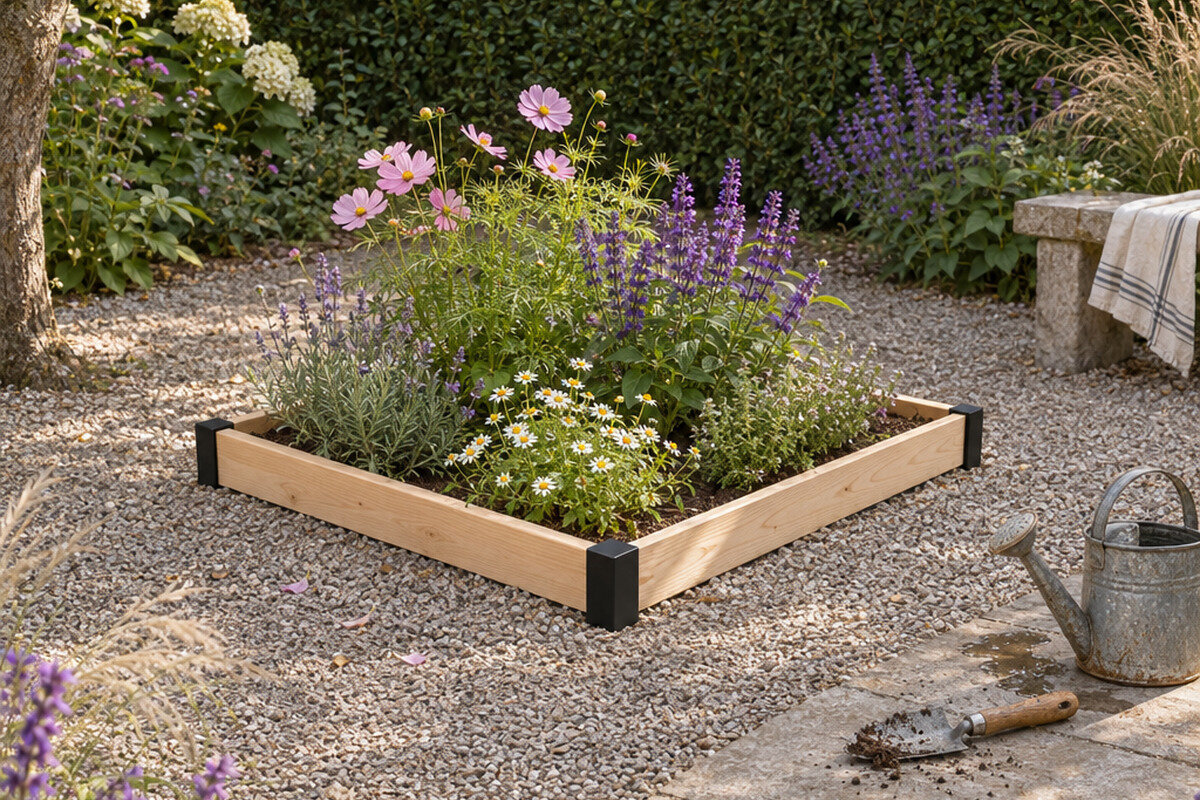
If your goal is to work higher off the ground, choose for reach rather than for the word “vertical.” A tall open-bottom frame gives you one higher soil surface when filled, not several planting levels. The Bloomcabin frames shown here have horizontal planting bays and no floor panel. Even the configurations with walls of different heights are not stacked planters. They can be considered as ground-bed bases for a separately planned support, not as complete vertical growing systems.

02
Measure the working space, not just the footprint
Mark the nominal outside footprint of the vertical raised garden bed with tape, string, or cardboard. Then mark the support or upright structure separately; its feet or other components may take space outside the frame. Leave room for gates to open, for tools to pass, and for you to crouch or turn while harvesting. Test the working space with the tools you actually use.
A vertical raised garden bed against a fence may leave only one working side. Reach across your marked footprint from that side before committing. Picture the mature vines or leaves as well as the empty structure: if they’ll project into the path or hide crops behind the trellis, shift the layout or give yourself another approach. On a tiered unit, check your reach to the back of the highest pocket, not just the height of its front edge.
Before deciding where the tall side of a vertical raised garden bed should go, watch how sunlight moves across the proposed site. Put the crops that need the best light where the structure and mature plants won’t block it for much of their growing day. Check nearby beds as well as lower tiers, then make sure the hose or watering can can reach every planting position.

03
Compare root space, rim height, and wall materials
Keep four measurements separate when comparing a vertical raised garden bed: nominal outside footprint, actual inside planting dimensions, wall height, and usable fill depth. A listed planting area describes the growing surface; it does not tell you how much soil to order. If you’re buying tiers, get the measurements for each pocket rather than relying on the height or width of the assembled unit.
Wall height can help you compare working height, but in an open-bottom vertical raised garden bed it isn’t necessarily the limit of root growth. Roots may extend into suitable soil beneath the frame. A contained pocket has only the soil space it holds. If the bottom slopes or narrows, check the usable dimensions where most of the soil will sit, not just the opening at the top.
The Narrow Aluminum Raised Garden Bed 39.37×19.69×3.94 in and the Narrow Accoya Raised Garden Bed 39.37×19.69×23.62 in illustrate the difference between footprint and wall height. Each has a nominal footprint of 39.37 by 19.69 inches and a listed planting area of 5.38 square feet, but their walls are 3.94 inches and 23.62 inches high, respectively. The taller model has Accoya along the top 3.94 inches of its walls, with aluminum below. Neither frame’s material or wall height establishes that it can carry an attached trellis.

04
Set up the base and support before filling
Start with the surface under the vertical raised garden bed. For the illustrated open-bottom frames, prepare a level site on suitable ground according to the model instructions. If water stands there or you have reason to suspect contamination, address the site question before filling. A taller wall is not, by itself, a drainage fix or a barrier between roots and the underlying soil.
For a standing tiered unit, check that the manufacturer allows the intended surface and describes how the complete unit must be supported. Check where water exits before placing it next to a doorway or over a surface you need to keep dry. If you cannot confirm where excess water will go, change the site or select a design whose drainage you can manage.
Before filling a trellised vertical raised garden bed, lay out the frame and support together. Compare the frame parts with the assembly instructions, then follow the instructions for each component, including the required order of installation. Check that the completed support won’t block access to the planting row. If the specifications don’t confirm a connection between the support and frame, don’t drill into the wall or assume it can take that load. Resolve the support layout while the bed is still empty and easy to work around.

05
Order fill and assign crops by planting position
Estimate fill for a vertical raised garden bed from the actual internal dimensions and the planned soil level. For rectangular compartments, convert the inside length, width, and fill depth to feet, multiply to find cubic feet, then add the separate volumes. For a U-shaped frame, leave the access notch out of the calculation. For tapered planting pockets, ask for the stated fill capacity instead of treating the top opening as a rectangle that extends all the way to the bottom.
When shopping for soil for a ground frame, ask where the material comes from and what it contains. Use a soil test and local recommendations to decide what to add. For individual planting pockets, check the planter’s instructions and crop guidance for a medium suited to contained roots and that drainage design. Don’t choose the same fill automatically just because both systems are described as raised beds.
Plan the planting positions in your vertical raised garden bed before sowing. For a trellised layout, put climbing varieties where new growth can reach the support, and leave harvest access once the plants fill in. With tiers, assign crops pocket by pocket: a spot that has enough root space may still get too little light or sit directly under runoff. Use the seed packet and local Extension guidance to settle variety, spacing, and planting time.

06
Worked example: fit climbing peas beside a path
Hypothetical setup example: You want a vertical raised garden bed for climbing peas and have a garden edge 90 inches long with 60 inches between the back boundary and the opposite edge of the path. You want to preserve at least 36 inches of that width for your own working route. Assume you’ve checked that the ground and light are suitable and that local planting guidance supports the pea variety and timing you have in mind.
Compare the Narrow Aluminum Raised Garden Bed 78.74×19.69×23.62 in with the Square Aluminum Raised Garden Bed 39.37×39.37×15.75 in. Both list 10.76 square feet of planting area. At its nominal footprint, the narrow frame leaves 90 − 78.74 = 11.26 inches along the length and 60 − 19.69 = 40.31 inches across the path side. The square frame leaves 60 − 39.37 = 20.63 inches across that same side, so it misses your path target even before you add a support.
The narrow frame is the better candidate for this vertical raised garden bed, but the 40.31 inches is preliminary clearance, not a finished aisle. The selected support and mature foliage still need to fit without taking the route below your target. Mark their space on the ground and check the ends, too: the 11.26 inches is leftover length, not working clearance at both ends.
If that check works, pair the frame with a separately supported trellis whose instructions suit the site. Put the pea row within reach of the support and place it so you can pick from the path. If the support needs more width or harvesting requires access from the back, change the site or support layout rather than squeezing the vertical raised garden bed into the marked strip.

07
Keep every planting position reachable and watered
After planting a vertical raised garden bed, check moisture where the roots are growing. With tiers, compare the top and bottom pockets before assuming they need the same amount of water. On a trellised bed, pull foliage aside if needed to see whether water is reaching the soil along the row. Adjust as the weather and plants change rather than watering every planting position on the same fixed schedule.
Keep the working route open as growth fills in. Guide new shoots toward the support as appropriate for the crop, and check whether you can still reach the places you need to pick from. If watering and harvesting always require reaching through a wall of leaves, move the next planting row or choose a variety you can manage from the available side.
Inspect a vertical raised garden bed when you notice a change: runoff crosses the path, a pocket repeatedly stays wet, or a support starts to move. Check the affected area rather than treating every level or crop alike. Follow the manufacturer’s instructions if part of the structure needs attention. At the end of the season, note which planting positions were easiest to water and harvest before committing to the same layout again.

Questions readers ask
Can I attach a trellis directly to a vertical raised garden bed?
Only if the frame and support instructions confirm that connection. The supplied specifications for the Bloomcabin frames do not establish a trellis attachment method. If compatibility is not documented, look for a separate support intended for your site and install it according to its own instructions.
Can a vertical raised garden bed go on a patio or deck?
Choose a unit intended for that surface, with a soil-retaining base and a way to manage drainage. The Bloomcabin examples described here are open to prepared ground and have no floor panel. On a deck, verify that the structure can support the proposed setup when filled and wet before installing it.
How much soil does a vertical raised garden bed need?
Calculate fill from the actual inside dimensions and intended fill depth. For a hypothetical rectangular bay measuring 36 inches by 18 inches inside and filled to 10 inches, convert to feet and multiply: 3 × 1.5 × (10 ÷ 12) = 3.75 cubic feet. This is not a Bloomcabin fill specification. Calculate separate bays or tiers individually, and ask for the stated fill capacity if the pockets are irregular.
Make the choice on the ground
Before you buy a vertical raised garden bed, mark the full layout and try reaching the spots you’ll need to water and harvest. Then verify the inside dimensions, base, and support requirements, and check local guidance for your crops. If the layout only works while the bed is empty, revise it before you fill it.
Find a raised bed for your plan
Compare layouts and check the dimensions on the product page.
