
Whiteflies in a Greenhouse: How to Get Rid of Them
Greenhouse health / Integrated pest management
Whiteflies in a Greenhouse: How to Get Rid of Them
The bright flutter is not the whole problem. Useful control begins on the hidden side of the leaf, where the next generation is already arranged along the veins.
01 / The visible disturbance
A white cloud is only the front edge of the infestation.
Brush a tomato, cucumber, hibiscus, poinsettia, pepper, or young herb plant and a small white cloud lifts from the foliage. It is an unmistakable signal, but adults are only one moving part of a whitefly population. Eggs, newly hatched crawlers, and later attached immature stages remain on leaf undersides. Those quieter stages explain why an apparently successful response can be followed by another flutter days or weeks later.
Whiteflies feed from plant sap. Heavy feeding can leave foliage pale, yellowed, stunted, or prematurely shed. Their honeydew is often the more conspicuous clue in a home greenhouse: a sticky shine on leaves, fruit, benches, or pots that supports dark sooty mold. In some crops and regions, certain Bemisia whiteflies can also spread plant viruses. The right response depends on the crop, likely whitefly species, population level, and whether beneficial insects are part of the plan.
A well-organized greenhouse gives you an advantage. It is a defined environment that can be inspected, screened, cleaned, and managed deliberately. In a permanent structure such as the Bloomcabin Classic Aluminum Greenhouse, make scouting part of watering, pruning, and ventilation routines instead of an emergency task reserved for visible damage.
02 / Identification before intervention
Read the underside constellation.
A 10× hand lens turns a vague pest problem into a stage-by-stage decision. Exact appearance and development speed vary with species, crop, temperature, and greenhouse conditions, but the inspection logic is dependable.
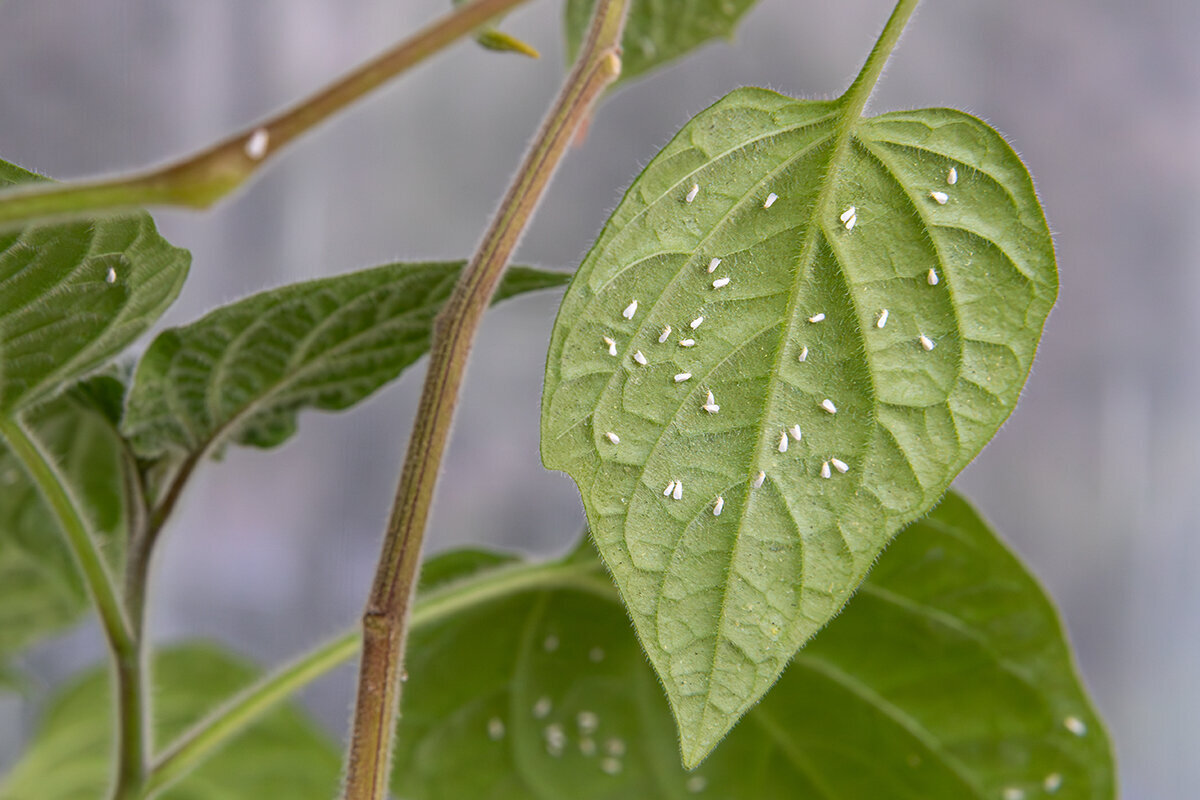
Start with several plants and several leaves rather than the one leaf that happens to be easy to reach. Look along veins, on tender new growth, and on mature leaves beneath a dense canopy. Whitefly populations rarely distribute themselves evenly: a single crowded plant may be a nursery, while a nearby plant carries only adults or fresh eggs.
Eggs
Near veins; often in arcs.
Crawler
Briefly mobile after hatching.
Attached immature
Flat and fixed below the leaf.
Adult
Powdery flyer disturbed from foliage.
One leaf, four observations: use the map to orient the inspection, then confirm what is present across the crop.
Use the map as a prompt, not a diagnosis by itself. Eggs are tiny and may darken as they develop. The crawler moves only briefly before settling. Subsequent immature stages can resemble pale scale-like specks because they remain attached to the underside. Adults are easy to spot, yet they reveal only the airborne portion of the population.
Look for evidence as well as insects: fresh honeydew, sooty mold, pale feeding injury, shed skins, and a growing number of attached immatures. Greenhouse whitefly adults generally rest with wings held relatively flat, while many Bemisia adults hold theirs more roof-like. That is only a field clue; later immature stages offer a stronger basis for species identification. If a valuable crop is involved, symptoms are unusual, or a virus is suspected, ask local Extension or a diagnostic service for help before committing to a specialized biological-control program.
03 / Do not treat the wrong visitor
Whiteflies versus the other small flyers.
Whitefly
When disturbed: a small white flutter rises from foliage.
Where to confirm: leaf undersides, especially tender growth, with eggs and flattened attached immature stages.
Common clue: honeydew and sooty mold as pressure builds.
Fungus gnat
Dark, mosquito-like adults hover around moist potting mix. Their larvae belong in the growing medium, not as fixed forms beneath leaves.
Thrips
Slender insects associated with silvery scarring, distorted growth, and tiny dark fecal spots rather than a powdery white cloud.
Winged aphid
Usually larger and pear-shaped, often with visible rear cornicles. Colonies are commonly obvious on shoots and stems.
Identification changes management. A sticky card may catch all four groups, while only a turned leaf can show whitefly eggs and settled immature stages. Do not assume that a product selected for fungus gnats, aphids, or thrips will solve a whitefly problem safely or effectively.
04 / Make observation repeatable
Walk the same route, at the same pace.
Randomly noticing pests is better than not looking, but it cannot show whether a population is moving, concentrating, or declining. Establish a compact scouting transect that follows likely pathways: doors and vents, recently introduced plants, dense crop blocks, upper growth, lower leaves, then weeds and debris below benches. Carry a hand lens and use a notebook or phone record that is simple enough to maintain.
1
Entrance
Door, vents, new arrivals.
2
Hot spots
Plants releasing adults.
3
Upper canopy
Tender tips and eggs.
4
Lower canopy
Mature leaves; immatures.
5
Floor line
Weeds and debris.
For a compact collection, inspect a meaningful sample of each crop type instead of revisiting the plant nearest the door. In a larger house, divide the growing area into crop blocks and inspect the same number of plants in each block. Record the date, crop, location, adult activity, immature-stage presence, honeydew, and any treatment or beneficial release. Consistency is more useful than a made-up universal action threshold.
Give special attention to plants that are lush, sheltered, or difficult to reach. Whiteflies can build quietly in a back corner or beneath a crowded canopy. Mark a few hot-spot plants with a discreet tag so they become reference plants at the next visit. A clean reference plant is useful too: it helps distinguish an expanding infestation from old damage that simply remains visible.
05 / Controlled yellow fieldwork
Yellow sticky cards are monitors, not cures.
Read the signal
TrendAdults only; hidden stages remain on leaves.
One method, every visit
- Number each card.
- Keep its greenhouse zone.
- Count the same area.
- Record date and result.
Adult whiteflies are attracted to yellow cards. Used consistently, cards can reveal arrival, relative adult activity, and whether the adult population is rising or easing after an intervention. They cannot prove that eggs, crawlers, or attached immature stages have disappeared from foliage. Treat every card as one instrument in an inspection program, not as a stand-alone eradication device.
Place cards in the same zones from one check to the next, generally near canopy level and adjusted upward as plants grow. Count the whole card or the same marked section every time; changing the counting area halfway through a season destroys the comparison. Replace a card when dust, condensation, debris, or captured insects obscure its surface, and compare the replacement only with the prior card from that exact location.
In a small private greenhouse, one card near the entry zone and one in each distinct crop area often gives a clearer story than a single card hung at random. Pair every count with leaf observations. A lower adult count is encouraging, but fresh crawlers or many live attached immatures mean the population has not yet been resolved. Avoid placing cards where they interfere with beneficial releases or where direct sun and splashing will make records unreliable.
06 / Timing is hidden architecture
Why one intervention rarely meets every whitefly.
Greenhouse populations do not pass through life stages in a neat, synchronized circle. Adults keep laying eggs while older immatures remain attached and another cohort begins to hatch. Warm protected conditions can shorten development, but they also make overlap more likely. That is why an action that reaches exposed adults and crawlers may leave eggs or protected late stages behind.
The practical response is not to apply products more aggressively. It is to build follow-up into the first decision: reduce the reservoir, inspect the stages that remain, use compatible biological or contact tools where appropriate, and return to the same plants before the next cohort gains momentum.
Overlapping population waves
Adults lay eggs.
Crawlers settle and feed.
Attached stages persist; adults emerge.
The offset arcs are a field reminder: more than one stage is usually present at a visit. Follow-up belongs in the plan from the beginning, and any repeat timing must follow the specific product label, the crop, growing conditions, and local expert guidance rather than a generic internet schedule.
07 / Reduce the reservoir
Isolate, remove selectively, and close easy entry points.
Quarantine introductions
Keep new plants separate before they join the collection. Tap foliage, turn leaves, and inspect carefully; whiteflies commonly arrive on infested starts.
Remove severe leaves
When pressure is localized, remove only heavily colonized leaves that the plant can spare. Bag material before carrying it through the greenhouse.
Eliminate bridge hosts
Weeds, volunteer seedlings, forgotten houseplants, and crop debris can retain whiteflies between crops. Clear beneath benches and around pots.
Removal is selective, not punitive. Stripping too much foliage can weaken a plant, reduce its ability to recover, and expose fruit or tender tissue. Instead, prioritize leaves carrying dense clusters of eggs and immatures, or remove a severely infested expendable plant that is serving as a major source of adults. Seal removed material in a bag; do not leave it in an open waste container inside the greenhouse.
Exclusion works best before establishment. Fine insect screening at vents and openings can reduce adult entry, but it has to be balanced against airflow needs and summer heat. Door habits matter as much as screens: close doors promptly, keep infested plants away from the entry, and avoid creating a cluttered transition area where new plants wait uninspected. Bloomcabin’s greenhouse design guidance can help when planning access, ventilation, and work zones around regular crop care.
Clean glazing and orderly benches are not cosmetic details in an IPM program. They improve visibility of honeydew, make leaf undersides easier to reach, and allow sticky cards to remain in consistent places. If you are planning more capacity for a serious collection, explore Bloomcabin greenhouses and conservatories with routine inspection and circulation in mind.
08 / Ecological control, started early
Beneficial insects work with timing, not magic.
Parasitoids and predators
For greenhouse whitefly, the parasitoid Encarsia formosa is a well-established biological-control option. It is most useful when whitefly numbers are still low and long-lasting incompatible pesticide residues have not undermined the release. Some Bemisia infestations may require a different parasitoid strategy, including an appropriate Eretmocerus species. A reputable insectary or local greenhouse adviser can help match the beneficial to the whitefly, crop, temperature range, and scale of the house.
Predators can contribute as well. Lacewing larvae, certain lady beetles, and other generalist predators may consume whitefly eggs or immature stages, but they are not interchangeable with a parasitoid program. Ask which organism fits this pest, crop, density, environmental range, and product history rather than asking for a universal best beneficial.
Inspect for parasitoid evidence before removing every darkened immature stage. Greenhouse whiteflies parasitized by Encarsia formosa can darken, and parasitoid emergence differs from whitefly emergence. A hand lens and trustworthy identification guidance help prevent accidental removal of the control workforce you have introduced.
Biological control is a program, not a decorative release. It requires scouting, identification, environmental suitability, and patience enough to let the natural enemy work. It also benefits from access: a bench layout that lets you inspect undersides, move through crop blocks, and distribute releases carefully is far more useful than a beautiful but unreachable jungle. For related planning considerations, see Bloomcabin’s article on smart greenhouse solutions.
09 / Match the tool to the stage
Control is a set of gates, not a single product.
Sanitation
Removes infested foliage and reservoirs.
Sticky cards
Tracks flying adult activity.
Biologicals
Builds sustained suppression over time.
Contact materials
Require direct underside coverage.
Sanitation and removal can remove whole clusters of eggs and attached stages when severely infested leaves, weeds, debris, or plants are taken out and discarded. It cannot reach insects remaining elsewhere in the crop. Sticky cards detect and track flying adults, but do not count every immature stage. Parasitoids and predators can offer sustained suppression when introduced early and protected from harmful residues, but need correct species matching and time. Contact materials can suppress exposed adults and immatures only where spray actually reaches them.
Contact coverage is literal
Insecticidal soaps and horticultural oils act by contact, not by wishful proximity. Whiteflies are usually concentrated on leaf undersides, so coverage technique, crop tolerance, temperature, water stress, and label directions are decisive. If the label directs a test treatment, or plant sensitivity is uncertain, test a limited area first. Do not improvise mixtures or substitute dishwashing liquid for a pesticide product labeled as insecticidal soap.
For edible crops, confirm that the current product label includes the crop or crop group and follow all directions for rate, application method, harvest restrictions where applicable, protective equipment, re-entry instructions, and beneficial-insect cautions. EPA labeling guidance makes clear that pesticide use must be consistent with product labeling; state and local requirements can also affect what is permitted.
10 / Chemical decisions are conditional
Use locally approved insecticides with restraint and a record.
There is no responsible universal spray schedule for a US home greenhouse. Product availability, registration, crop listing, state requirements, whitefly species, plant size, and the presence of biological controls all change the decision. Read the current label every time. The crop must be covered by the label, and all directions for use, restrictions, intervals, and safety instructions must be followed exactly.
When an insecticide is justified, avoid repeating the same mode of action through successive whitefly generations merely by changing brand names. Resistance management relies on choosing compatible modes of action according to product directions and local advice. Whiteflies, particularly some Bemisia populations, have a well-documented capacity to develop resistance. Keep a complete application record so that you can make informed decisions and protect any future beneficial-insect release.
Seek Extension or professional help for persistent outbreaks, suspected virus symptoms, commercial-scale crops, or questions involving restricted-use products. A strong integrated program uses chemistry as one deliberately placed tool, never as a substitute for inspection, sanitation, coverage, and stage-aware follow-up.
11 / The proof comes after the first response
Judge recovery by the next leaves, not by a quiet afternoon.
A removal pass, treatment, or beneficial release can make a greenhouse look calmer immediately. That is welcome, but it is not the finish line. Recovery is visible when the same scouting route shows fewer adults on comparable sticky cards, fewer new eggs and crawlers on tender leaves, fewer live attached immatures, and less fresh honeydew. Old sooty mold and cast skins can remain after the insects are controlled, so look for new evidence rather than expecting every plant to look freshly polished overnight.
A
First revisit
Return to marked hot-spot plants and turn several leaves. Record the stages still present, then remove newly severe foliage before it becomes another nursery.
B
Compare the trend
Compare each numbered sticky card with its own earlier count and pair the number with what you find on leaves. A lower card count alone is encouraging, not conclusive.
C
Rebalance
If new immatures continue to accumulate, revisit coverage, sanitation, identification, beneficial compatibility, and possible reinfestation through new plants or openings.
Continue the routine after pressure falls. The most resilient greenhouse is not one that never receives an insect; it is one where a small arrival is noticed before it becomes a canopy-wide population. Clear paths, a place for a hand lens and record sheet, sensible ventilation, and access to the back of each bench convert good intentions into a durable habit.
FAQ / United States greenhouse gardeners
Whitefly questions, answered plainly.
Will yellow sticky traps get rid of whiteflies in my greenhouse?
No. Yellow sticky cards catch and monitor adults, and may modestly reduce adult activity, but they do not reliably eliminate eggs, crawlers, or attached immature stages under leaves. Use cards to detect movement and track trends alongside direct leaf inspections.
Should I throw away every plant with whiteflies?
Not necessarily. Isolate it immediately, assess how many leaves and life stages are involved, and remove only heavily colonized foliage when the plant can tolerate it. Discarding a severely infested, expendable plant can be sensible when it is acting as a substantial reservoir for the rest of the greenhouse.
Why do whiteflies come back after I spray?
Several stages may have been present at once. A material that suppresses exposed adults may not affect eggs or settled stages equally, and poor underside coverage leaves targets untouched. New plants, surviving weeds, or adult entry through openings can also restart the population.
Can I use beneficial insects after treating whiteflies?
Possibly, but compatibility depends on the exact product, active ingredient, application date, residual activity, crop, and beneficial species. Keep records and consult the beneficial supplier or local Extension professional before release. Broad-spectrum or persistent products can undermine a release program.
Are whiteflies a concern on tomatoes, cucumbers, peppers, and herbs?
They can reduce vigor and leave honeydew that soils fruit and foliage. Some species can also transmit plant viruses in certain crops and regions. For edible plants, use only methods and products specifically appropriate for the crop and follow all harvest and safety directions.
How often should I check for whiteflies?
Inspect at least weekly during active growth, and more often around known hot spots, recent introductions, or rising card counts. The best interval is one you can repeat consistently enough to see change. Never substitute a generic schedule for a product label or local professional direction.
Sources & further reading
Build your program on current, primary guidance.
Whitefly species, beneficial availability, product labels, and state requirements vary. These US university, Extension, regulatory, and resistance-management sources support the stage-based approach described here.
- UC Statewide Integrated Pest Management Program — Whiteflies in Floriculture and Ornamental Nurseries
- University of New Hampshire Extension — Greenhouse Whitefly Fact Sheet
- Colorado State University Extension — Greenhouse Whitefly
- University of Maryland Extension — Whiteflies on Indoor Plants
- UC IPM Natural Enemies Gallery — Encarsia formosa
- Penn State Extension — Planning for Biological Control in Greenhouses
- US Environmental Protection Agency — Pesticide Labeling Questions and Answers
- Insecticide Resistance Action Committee — Mode of Action and Resistance Management
