
15 Questions to Ask a Greenhouse Supplier Before You Order
Greenhouse buying guide
Quick answer: ask about the whole ownership experience
The most useful questions to ask a greenhouse supplier cover more than the frame and glazing. Ask what is included, how the chosen model fits your site, what foundation and access are needed, and what happens if you need guidance after delivery. Clear answers reduce surprises during the most expensive or disruptive stages of the project.
Also ask for documents that match the configuration you are considering, not general marketing language. A written order summary, installation information, warranty terms, and a clear point of contact are practical signs that you can evaluate the purchase properly. Compare answers between suppliers on the same assumptions.
01
Product fit
Confirm the exact model, dimensions, glazing, doors, ventilation, finishes, and included components so the greenhouse you imagine matches the one being ordered.
02
Site readiness
Discuss foundation, drainage, sun exposure, wind, clearance, assembly space, and the route from curbside delivery to the final location before selecting a size.
03
After-order clarity
Request a clear outline of ordering, delivery coordination, installation resources, replacement-part support, and written warranty scope before approving the final specification.
The questions that make a greenhouse order easier to trust
When buying a greenhouse, it is easy to compare only dimensions, appearance, and the headline price. Those details matter, but they do not explain what arrives, what you need to prepare, or where responsibilities begin and end. A capable supplier should welcome clear questions and answer them in writing when the answer affects your order, site work, or installation plan.
Use this guide as a conversation starter rather than a test with one universal answer. A compact backyard greenhouse, an ornate garden focal point, and a structure beside the house can all call for different decisions. Your climate, access route, growing ambitions, existing hardscape, and comfort with assembly should shape the questions you prioritize.
The strongest greenhouse purchase is one in which the product and the practical plan agree. Bring photos, rough site measurements, and notes about sun, wind, drainage, and access when you speak with a supplier. That preparation makes answers more specific and gives you a useful record to compare before you commit.
01 · Questions 1–2
What exactly is included with this greenhouse?
Begin by asking the supplier to describe the complete product package for your selected configuration. Clarify the frame, glazing, roof vents, door style, base or anchoring components, hardware, gutters, shelves, and any accessories shown in photography. Product images can be inspirational, but they may include optional items. A line-by-line answer helps prevent an order built on assumptions.
Then ask which choices affect the final specification. Color, glazing type, door position, roof ventilation, decorative details, and accessories can change both planning and assembly. Ask for an order summary that records these selections in plain language. It is much easier to spot a missing option before ordering than after the components have reached your property.
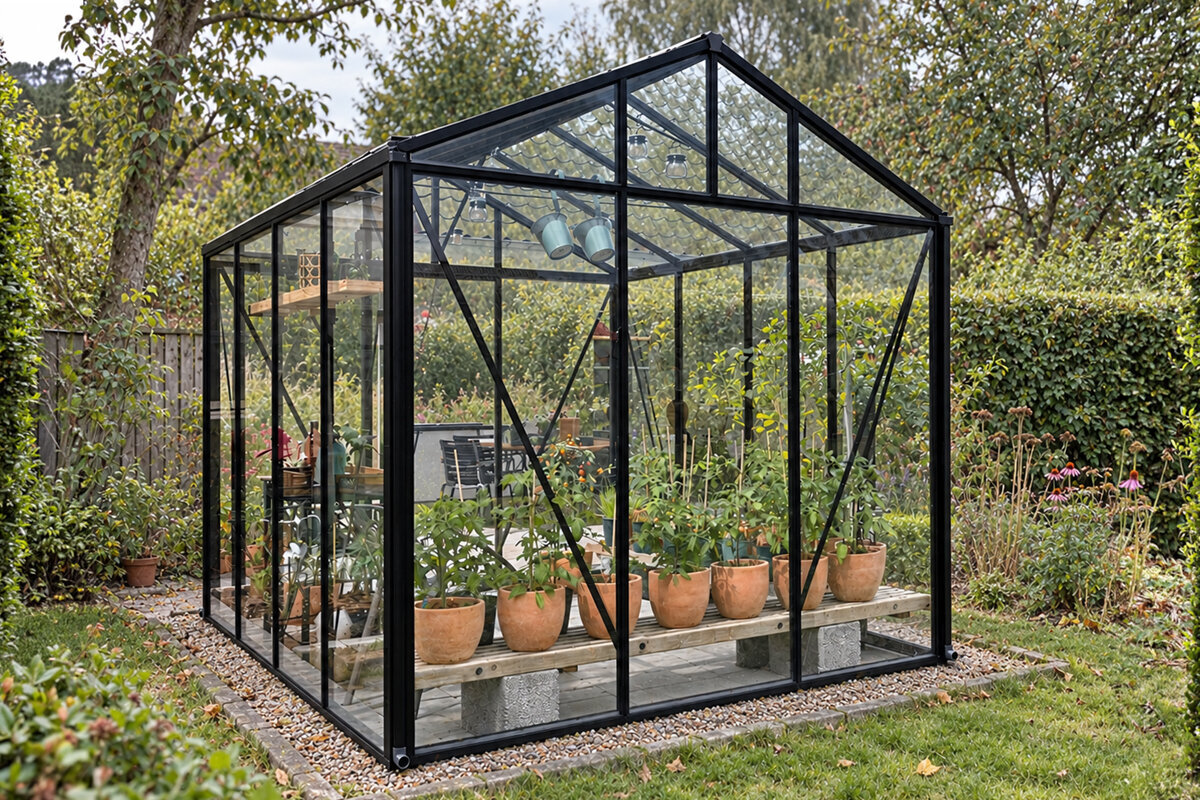
Ask whether visible benches, staging, planters, and interior accessories are included, optional, or simply shown for styling.
Request the exact product documents for your chosen configuration rather than relying on a general collection page.
For a freestanding garden structure, start by reviewing a standard Classic greenhouse and its listed options.
02 · Questions 3–4
Will this model work on my chosen site?
A supplier cannot assess your entire yard from a product name, so describe the proposed location carefully. Share approximate measurements, nearby walls or trees, slope, existing paving, and the direction of the strongest seasonal weather. Ask what clearances are needed around the greenhouse for access, cleaning, glazing work, and safe installation. Also discuss whether doors and vents will have the room they need to operate.
Sun is another practical conversation. Ask how the structure’s orientation, door placement, and shaded periods may affect your intended use. A greenhouse for spring starts has different priorities from one used for summer crops or display planting. The goal is not to find a universal perfect location, but to understand the compromises of your particular site before you choose a model.
Provide photos taken from several angles, including the approach route and any adjacent fence, wall, mature tree, or overhead feature.
Ask which site details the supplier needs before offering configuration guidance, and keep copies of the information supplied.
When the available footprint sits alongside the home, explore a full-size regular Lean-To greenhouse with the wall and access conditions in mind.
03 · Questions 5–6
What foundation and ground preparation are expected?
Foundation questions deserve early attention because ground preparation often determines the rhythm of the whole project. Ask what kind of level, stable support the selected greenhouse requires and whether a base is part of the product or a separate site task. Ask how drainage should be considered, especially where runoff collects after heavy rain or snowmelt. A beautiful frame cannot compensate for an unsuitable surface beneath it.
Ask who is responsible for checking measurements before construction begins. If you plan concrete, pavers, a perimeter base, or another solution, confirm the finished footprint, tolerances, and anchoring approach against the supplier’s current instructions. If the site is sloped or near existing utilities, a qualified local contractor can help you assess the groundwork without guessing from a generic diagram.
Confirm the required finished dimensions before ordering materials or scheduling a contractor for foundation work.
Ask whether the installation instructions specify drainage, level checks, anchoring points, or sequencing that affects site preparation.
A standard Classic greenhouse for a prepared foundation is easier to evaluate once the support requirements are documented.
04 · Questions 7–8
How will delivery and access be handled?
Ask the supplier how delivery coordination works and what information they need from you ahead of time. Explain driveway width, gates, stairs, tight turns, unpaved surfaces, and the distance from the drop-off point to the planned greenhouse site. Do not assume that a vehicle can reach a backyard or that packaged components can be moved easily through a narrow side passage. Access should be planned as carefully as the foundation.
It is equally helpful to ask how the shipment is organized and how you should inspect it on arrival. Find out what paperwork accompanies the order, how components are identified, and what to do if you notice an issue. You are not seeking a delivery-time promise; you are establishing a workable process for receiving, storing, and checking the materials before installation begins.
Measure gates, passageways, turns, and any changes in elevation along the entire route to the installation area.
Ask where components can be kept dry, secure, and accessible if assembly cannot begin immediately after arrival.
For projects close to the house, consider access needs alongside a full-size regular Lean-To greenhouse layout before finalizing the order.
05 · Questions 9–10
Who installs it, and what does installation involve?
Ask whether the supplier provides assembly instructions, support, professional installation options, or a recommended way to find local help. Clarify what preparation must be complete before installers arrive if you choose outside assistance. This may include the foundation, safe working space, electrical arrangements for tools, and a clear route for materials. A realistic installation discussion is more useful than assuming every greenhouse kit suits every experience level.
Ask how the instructions are structured and whether they correspond directly to the configuration you selected. It is sensible to understand the broad assembly sequence, the tools likely needed, and when glazing, doors, vents, or accessories are fitted. If you will assemble it yourself, review the documents early and decide whether additional hands or professional support are appropriate for your comfort and schedule.
Ask for current assembly documentation early enough to identify the skills, tools, lifting, and time coordination involved.
Confirm whether modifications to the site or product could affect installation guidance or the supplier’s ability to assist.
If you prefer a familiar freestanding form, compare the assembly information for a standard Classic greenhouse kit before deciding who will build it.
06 · Questions 11–12
How should I evaluate durability and maintenance?
Rather than asking whether a greenhouse is simply “strong,” ask questions tied to your conditions. Describe exposed winds, snow accumulation, coastal air, falling debris, intense sun, and the maintenance access available around the site. Ask which product documents explain the intended configuration, anchoring, care, and operating guidance. This gives you a more useful basis for judgment than a broad claim that may not apply to every location or installation.
Maintenance is part of ownership, not an afterthought. Ask how the frame, glazing, gutters, moving parts, and seals should be cleaned and inspected, along with any limits on cleaning products. Find out how replacement components are identified if an accident occurs later. Clear care guidance can help you make room in your seasonal garden routine for the greenhouse instead of treating it as a maintenance-free object.
Ask which environmental conditions should be discussed before selection, including local exposure and the way the greenhouse will be anchored.
Request practical care guidance for glazing, frame finishes, vents, doors, drainage paths, and replacement-part identification.
For a structure using an existing wall as part of its setting, ask about upkeep around a full-size regular Lean-To greenhouse design and its adjoining surfaces.
07 · Questions 13–14
What support is available after I order?
A supplier relationship should not become unclear once an order is placed. Ask who will be your point of contact for order questions, document requests, missing-item reports, and assembly guidance. Find out how configuration details are recorded so future conversations refer to the correct greenhouse. This is especially valuable if you order accessories later or need to identify a component after seasons of use.
Ask about the practical route for obtaining replacement parts, without assuming availability or timing. Understand what details, photographs, or order information may be needed to identify the item. It is also worth asking whether care information is available in a format you can save. A supplier that explains its support pathway plainly lets you assess the ownership experience as well as the original purchase.
Save your order confirmation, configuration record, installation documents, and photographs of labels or component references after delivery.
Ask what information to provide when requesting help, so an issue can be described accurately without unnecessary back-and-forth.
Keep the configuration record for your standard Classic greenhouse purchase with your other home and garden project documents.
08 · Question 15
What does the written warranty cover?
Ask for the applicable written warranty before ordering, then read it alongside the product and installation instructions. A warranty can be meaningful only when you understand its scope, exclusions, claim process, care expectations, and whether it applies to your chosen configuration. Bloomcabin greenhouses have a 12-year warranty, but the written conditions are the essential reference for what is covered and how a claim is handled.
Warranty questions should never replace sound site planning and careful installation. Ask whether there are responsibilities you should meet regarding foundation, anchoring, assembly, maintenance, or reporting an issue. If you expect a greenhouse to be included in homeowners insurance, ask your insurer directly how your policy treats an outbuilding or attached garden structure. Coverage depends on the policy and property, not a supplier’s general answer.
Read the current written warranty in full and retain it with your order documentation and installation instructions.
Ask your local authority about permits or property requirements when they may apply to your site and project.
Before choosing a wall-side design, review the written terms that apply to a full-size regular Lean-To greenhouse warranty and your final configuration.
What a useful supplier answer looks like
Use this comparison to separate a helpful, decision-ready answer from a vague reassurance. The goal is not to demand a perfect answer to every scenario; it is to identify whether the supplier can connect the selected greenhouse to your site, order, and long-term ownership plan.
Included components
Names supplied items and optional extras clearly.
Can this appear on my order summary?
Site suitability
Requests dimensions, photos, orientation, and access details.
What clearances should I preserve?
Foundation preparation
Refers to current requirements and finished dimensions.
Who should verify measurements before construction?
Delivery access
Explains coordination and information needed in advance.
What route constraints should I report?
Installation
Shares applicable instructions and preparation expectations.
Which tasks remain my responsibility?
A simple way to prepare your supplier conversation
Gather the basics before you call, email, or request a quote. Better information leads to more relevant answers and helps you compare options without repeatedly revisiting the same assumptions.
01
Map the site
Note approximate footprint, orientation, nearby structures, slopes, drainage patterns, and clearance around doors or vents. Take photos in daylight from the approach route and proposed location.
02
Measure the route
Record driveway, gate, passage, and turn dimensions, plus stairs or grade changes. Include the distance between likely drop-off space and the finished greenhouse location.
03
Define your use
Decide whether you primarily want propagation space, food growing, seasonal protection, display planting, or a combination. This helps frame questions about layout and ventilation.
04
List your selections
Write down the model, preferred size, glazing, color, door location, and accessories you are considering. Mark which choices remain uncertain and need supplier clarification.
05
Request written details
Ask for product documents, an itemized order summary, installation information, warranty terms, and the support contact path. Save responses so competing options can be compared fairly.
Pre-order greenhouse supplier checklist
Use these questions as a final check before you approve an order. If an answer affects your site work, budget planning, or ability to install the greenhouse, ask for it in a form you can retain.
01. Can I identify every included frame, glazing, vent, door, base, gutter, hardware, and accessory component?
02. Does the selected configuration match my measured footprint, clearance needs, sun pattern, and intended growing use?
03. Have I confirmed the finished foundation dimensions, level requirements, anchoring approach, and drainage considerations?
04. Have I explained all delivery access constraints, including gates, turns, slopes, stairs, and backyard carrying distance?
05. Do I understand what must be prepared before assembly and whether I need professional installation help?
06. Have I reviewed care guidance for frame finishes, glazing, moving parts, gutters, and seasonal inspections?
07. Do I know who to contact for order questions, assembly support, component identification, or future replacement requests?
08. Have I read the applicable written warranty and checked local authority or insurer questions independently where relevant?
Frequently asked questions
What are the most important questions to ask a greenhouse supplier?
Start with what is included, whether the selected greenhouse suits your site, and what foundation preparation is needed. Then cover delivery access, installation, care, after-order support, and warranty terms. These subjects connect the product itself to the practical work that happens before and after the order.
Should I ask about permits before ordering a greenhouse?
Yes, if permits, zoning, setbacks, historic-district rules, or similar requirements may apply where you live. A supplier can provide product information, but only the relevant local authority can clarify local requirements for your property. Check early, because the answer may affect location, size, foundation, or timing.
What delivery details should I share with a supplier?
Share the access route, not just your street address. Include driveway conditions, gates, narrow passages, turns, slopes, stairs, overhead obstructions, and the distance to the final site. Explain where materials could be placed temporarily. These details help you plan the receiving process realistically.
Is a greenhouse foundation always necessary?
The right support depends on the selected greenhouse and the conditions of the site. Ask the supplier for the current requirements for your configuration, then use those details when discussing ground preparation with a qualified local contractor if needed. Avoid starting hardscape work from approximate product dimensions alone.
How do I compare warranty answers from different suppliers?
Compare the written terms rather than the headline duration alone. Look at what components are covered, exclusions, customer responsibilities, claim steps, and the documents you must retain. Also check whether installation, anchoring, care, or site conditions affect the scope. Ask questions before the purchase, not after a problem occurs.
Can a supplier tell me whether my greenhouse is insured?
A supplier may explain the product, but your insurer determines how a policy treats a greenhouse or related damage. Contact the insurer directly with the planned location, structure type, and installation details. Ask what documentation they need and whether the project changes any relevant coverage or notification requirements.
Explore greenhouse options
Order with fewer assumptions
The best questions to ask a greenhouse supplier are the ones that connect the catalog image to your actual property. By discussing the product, site, foundation, access, installation, support, and warranty in advance, you create a more complete picture of what the project will require.
Keep the answers, drawings, and product documents together as you compare options. Bloomcabin can be part of that process, but the important outcome is a greenhouse choice that fits your growing plans and can be prepared for thoughtfully from the ground up.
Use your site notes and checklist to compare the greenhouse styles that suit your garden plan.
