
Aphids in a Greenhouse Identify, prevent and control the colony before it spreads.
Greenhouse casefile / T39
Aphids in a Greenhouse Identify, prevent and control the colony before it spreads.
The first clue is rarely the insect. It is the shine on a leaf, the curl in a new tip, a pale husk lodged beside a vein. Read those clues in the right order and aphids become a contained greenhouse problem rather than a season-long habit.
Good greenhouse management begins with access: young growth can be reached, undersides can be examined, and new plants can be held apart long enough to tell their story. The ventilated, considered structure of a Classic Aluminum Greenhouse gives serious home gardeners a clean working setting for that discipline.
Chapter 01 / The evidence
Read the plant before reaching for a treatment.
One symptom alone does not prove aphids. Nutrient stress, heat, mites and handling damage can each distort tissue. The reliable diagnosis is a chain: inspect the plant closely, find living insects or fresh cast skins, then connect that evidence with feeding-related symptoms.
Live colony
Cast skins
Honeydew
Sooty growth
Distortion
Live colony
Look for small, soft-bodied insects on tender tips, stems, buds and leaf undersides. Adults, nymphs and an occasional winged adult can occur together.
Cast skins
White or silvery papery shells are shed skins. They are not active whiteflies and are not powdery mildew.
Honeydew
Aphids release excess sugar as sticky honeydew. It leaves a glossy, tacky film on foliage, pots, benches and leaves below the feeding site.
Sooty growth
Dark sooty fungi can grow on honeydew. The fungus is secondary; the honeydew-producing insects are the primary problem.
Distortion
Young leaves may pucker, twist, curl or stall. Damage is especially consequential on seedlings, herbs, peppers, tomatoes, cucumbers and flowering ornamentals.
Ants are supporting evidence, not a verdict. They are attracted to honeydew and can interfere with natural enemies; their presence should prompt a careful inspection of the plants above and around their route.
Chapter 02 / Identification
How to identify aphids at close range.
Hand-lens elevation
- Pear-shaped body
- Long legs and antennae
- Cornicles
- Winged or wingless
Pear-shaped body. Most aphids are delicate and soft rather than hard-shelled, typically less than 1/8 inch long. A hand lens makes the profile easier to see, especially when the colony is crowded along a midrib.
Long legs, antennae and cornicles. Many aphids have conspicuous antennae and two small tube-like projections near the rear, commonly called cornicles or tiny tailpipes. The features help distinguish them from the flatter, more fixed adult scale insects often found on stems.
Winged and wingless forms. Both forms are aphids. A winged individual is a disperser, not necessarily a different pest. Its appearance is an instruction to widen your inspection to nearby plants, doors, vents and recently introduced stock.
Inspect the feeding location. Aphids commonly concentrate where sap is easy to reach: new leaves, flower stems, buds and soft shoots. Finding the right-shaped insect in that setting is more meaningful than relying on color alone.
Comparison strip / do not confuse the evidence
Whiteflies
Thrips
Soft scale
Helpful larvae
Whiteflies
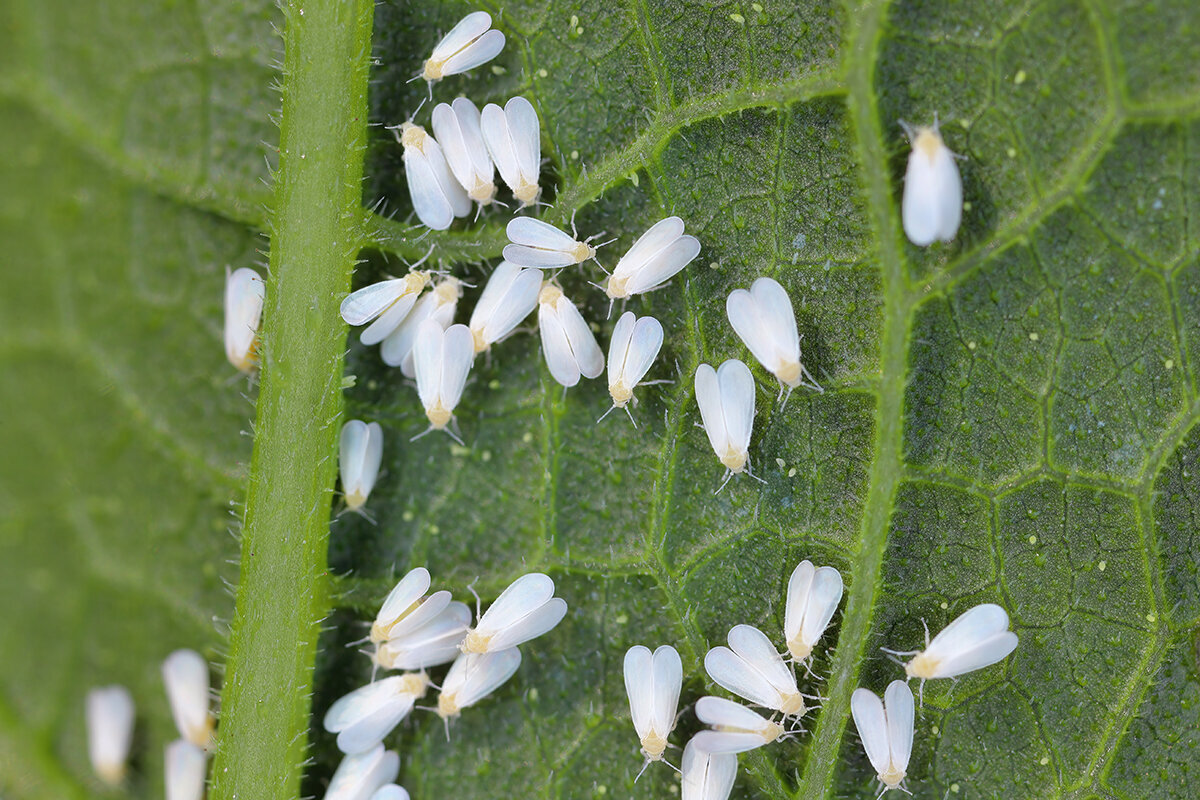
Small white winged adults flutter up when foliage is disturbed. Their immature stages are scale-like beneath leaves, unlike a mobile aphid colony.
Thrips
Thrips are slender and fast-moving. Their feeding often leaves silvery scarring and dark fecal specks rather than honeydew.
Soft scale
Scale can make honeydew, but adult scale insects are raised, fixed bumps rather than mobile pear-shaped insects clustered on new growth.
Helpful larvae
Lady beetle and lacewing larvae hunt aphids. Pause before removing an unfamiliar insect moving through a colony; it may be working for you.
Chapter 03 / Acceleration
A colony does not stay small because it looks small today.
Warm, protected greenhouse conditions and a continuous supply of tender tissue allow aphids to build rapidly. Many common species produce live young without mating during much of the growing season, and development speed changes with temperature, crop, species and plant quality. There is no responsible universal countdown—but there is a consistent reason to act early.
01Arrival
02Feeding cluster
03Honeydew
04Dispersal
Aphids first establish on one accessible plant, then increase as wingless individuals feed and reproduce among protected leaves and buds. Cast skins and honeydew become easier to find as the colony thickens. Under crowding, plant decline or other changing conditions, winged forms may appear and travel to fresh hosts. The timing is condition-dependent, which is precisely why a weekly greenhouse route matters more than a fixed date on a calendar.
Winged aphids can also arrive through openings or on incoming material. Treat one infested basil pot, pepper start or flowering annual as a greenhouse-wide scouting trigger. Aphids may transmit plant viruses in susceptible crops, so a severely distorted or suspicious plant deserves a separate assessment rather than being shared, propagated or moved around the structure.
Chapter 04 / Scouting map
The greenhouse hotspots most often missed.
Walk the same route each time. Starting at the door and ending at the newest plants makes a small greenhouse legible: you will notice what changed, rather than merely seeing what is obvious.
- 1
Youngest growth
Inspect folded leaves, tips and soft stems first. Aphids favor vigorous, expanding tissue. - 2
Leaf undersides and midribs
Turn leaves over, especially low or crowded foliage where spray coverage and casual observation both fail. - 3
Incoming plants
New herbs, nursery starts, cuttings and overwintered houseplants are frequent entry points. - 4
Weeds, baskets and edges
Volunteer weeds and hanging plants can carry a colony above eye level or out of sight. - 5
Doors and vents
These are entry corridors for winged aphids and should be included in visual monitoring.
Yellow sticky cards are useful for detecting winged aphids near entrances and vents, but they are monitors—not a control method and not a substitute for examining plants. For a considered layout that keeps paths and plant access workable, see Bloomcabin’s US greenhouse setup, layout and care guide.
Chapter 05 / The perimeter
Prevent the next colony with exclusion, quarantine and balanced growth.
ScreenFine mesh, clear airflow.
QuarantineHold new plants apart.
SanitationRemove weeds and debris.
VigorAvoid overly soft growth.
RecordNote crop, date and place.
Quarantine does not need to be elaborate. A separate bench, a bright porch or a protected holding area can work if it allows a plant to be inspected closely for several days before it reaches the main crop. Look beneath leaves, around stems and inside tight new growth. If you find aphids, keep that plant isolated until there is no fresh evidence and no active colony.
Exclude what you can without turning the greenhouse into a stagnant box. Greenhouse openings can be screened to reduce entry by winged adults, but the screened area must still provide enough airflow for the crop. In a home setting, shade, roof vents and orderly spacing are part of that balance. Bloomcabin’s aluminum greenhouse information is a useful starting point for considering ventilation, glazing and accessories as one growing system.
Weeds matter because they can be unnoticed reservoirs of aphids. Pull weeds beneath benches, beside the foundation and along the approach to the door. Also inspect decorative or overwintered plants: a geranium, citrus or tender houseplant held in a quiet corner can repopulate vegetable seedlings when the new season starts.
Finally, resist the urge to force every crop with heavy feeding. Tender, lush growth is especially attractive to aphids. Feed according to crop, container volume and growth stage; water consistently; and space plants so new growth can be inspected without breaking stems or brushing colonies onto neighboring leaves.
Chapter 06 / Control ladder
Start with the least disruptive action that can still reach the colony.
Aphid management is not a contest to find the strongest product. It is a coverage-and-follow-up problem. Escalate only when the prior step is not enough for the crop, infestation level and practical access you have.
01
Isolate and mark the source.
Move a manageable plant away from the main collection if doing so will not brush aphids onto others. Tag it with the date and crop. Stop taking cuttings, sharing pots or moving the plant through the greenhouse until the inspection record is clean.
02
Remove the densest evidence.
Prune and bag badly curled tips, heavily colonized buds or foliage that cannot be reached. Do not compost visibly infested material in or beside the greenhouse. On sturdy plants, a directed stream of water can physically dislodge exposed aphids; support leaves with one hand and allow plants to dry with good airflow.
03
Choose living control with a plan.
Where multiple plants are involved, beneficial insects can be more elegant than repeated broad spraying—but they must match the aphid, crop, temperature, light conditions and any pesticide residues already present.
04
Use a labeled contact treatment when direct reach is realistic.
Insecticidal soaps and horticultural oils can work well when they thoroughly contact exposed aphids. They do not solve colonies protected inside curled leaves or deep bud folds. Read the entire label for the exact crop and greenhouse use, test a small area only as directed, and avoid treating heat- or drought-stressed plants.
Field note / Biological control
Useful allies require compatibility, not wishful thinking.
Lady beetles, lacewings, aphid midges and parasitoid wasps are all associated with aphid suppression. In a greenhouse, the most dependable choice depends on the crop and pest species, the size and age of the infestation, and the environment you can maintain.
Predators consume aphids; parasitoids develop in or on them, often leaving rounded, discolored aphid mummies. Do not remove every odd-looking aphid without checking: a mummy may be proof that a parasitoid is already working.
Chapter 07 / Direct treatment
Soaps, oils and conventional products: let the label set the boundary.
Contact soaps and oils
These products are often the practical next step for a home greenhouse because they have little or no residual action. Their limitation is equally important: the insect must be contacted. Turn leaves, open the plant canopy gently and reach the sheltered side of stems. Freshly emerged aphids after treatment are possible because protected insects or missed pockets were not reached.
Plant safety is crop-specific
Even a product commonly used for aphids can injure a sensitive cultivar or stressed plant. Heat, strong sun, drought stress, tender transplants, sulfur interactions and adjuvant restrictions can matter. Test only as the label directs, wait for the stated observation period, and never mix products simply because they are individually familiar.
Systemic and conventional options
Some products move within plant tissue or retain more residual activity, which can be useful in certain professionally managed settings but adds consequences for edible crops, flowering plants, pollinators, beneficial insects and re-entry. A label for ornamental greenhouse plants is not automatically a label for greenhouse tomatoes, peppers, herbs or leafy greens.
US legal use is label use
Read the EPA registration label, not only retailer copy. Confirm the precise crop or crop group, greenhouse or indoor-site language, target pest, application method, harvest interval where applicable, protective equipment, maximum use and state-specific requirements. If a crop is not listed, do not assume it is covered.
Avoid the false certainty of a calendar spray. No universal concentration, product or spray interval is safe for every US greenhouse crop and aphid species. Follow the chosen product label exactly, account for its resistance-management language, and avoid repeated use of the same mode of action when a conventional insecticide is necessary. If you are building a biological-control program, obtain compatibility guidance before treating.
Chapter 08 / Recovery
Coverage is only half the work. Reinspection closes the case.
Contact treatments, water sprays and pruning reduce what you can reach on a given day. They do not prove that every folded leaf or adjacent plant is clear. Make the recheck part of the action, not an afterthought. This is an inspection rhythm—not a replacement for product-label directions or crop-specific Extension advice.
| When | Scope | Record | Decision |
|---|---|---|---|
| Day 0 | Source and neighbors | Live aphids | Isolate |
| Day 2–3 | Fresh growth | New activity | Reach misses |
| Day 7 | Nearby crop | Trend | Reassess |
| Weekly | Hotspots | Recurring source | Record |
Day 0
Inspect the source plant, immediate neighbors, doors and benches. Record live aphids, cast skins, honeydew, winged adults, pruning and any treatment used. Clean tools after handling the source.
Day 2–3
Return to the youngest growth and hidden leaf undersides. Separate fresh live aphids from old cast skins, and note whether water, pruning or direct treatment missed folded tissue.
Day 7
Inspect the original plant and nearest crop row or bench. Look for new honeydew, distortion, winged aphids on monitors and parasitoid mummies where biological control is in use.
Following weeks
Continue a weekly route through recurring hotspots and newly purchased plants. A rising count often exposes a missed weed, inaccessible crop zone or incoming host.
Clean honeydew after the colony is controlled.
Wipe benches, pots, glazing near the crop and hard surfaces with a mild cleaning approach suitable for the material, then rinse as appropriate. On foliage, a gentle water rinse can remove some sticky residue and improve light interception, but do not abrade tender leaves. Sooty growth may fade as honeydew stops accumulating; the goal is plant function and clean monitoring, not cosmetic perfection overnight.
Support damaged plants with steady care rather than corrective overfeeding. Remove only tissue that is dead, badly deformed or impossible to inspect. Maintain airflow, appropriate watering and sensible spacing while new leaves reveal whether the plant is recovering normally.
US greenhouse FAQ
Questions that matter once you have found the first colony.
Can I use insecticidal soap on greenhouse vegetables?
Only if that exact product label permits use on your specific edible crop and greenhouse setting. Check crop or crop-group listing, instructions, harvest restrictions and all precautions. Do not rely on a label written only for ornamentals.
Do aphids die if I spray them with water?
A directed stream can dislodge many exposed aphids from sturdy plants and is a useful small-colony tactic. It will not reliably reach aphids inside tightly curled leaves, buds or dense canopy growth, so inspect again soon afterward.
Are ants causing the aphid problem?
No. Ants are attracted to honeydew and may protect or move honeydew-producing insects, making control more difficult. Treat the aphid colony and reduce ant access where practical rather than treating ants as the sole cause.
Why are aphids back after I treated the plant?
The usual reasons are missed sheltered insects, a nearby untreated host, a newly introduced plant, weeds, or winged aphids arriving through an opening. Reinspect surrounding plants and trace the route rather than escalating immediately to a stronger product.
Will ladybugs solve a heavy aphid infestation?
They can contribute, but a large outbreak may exceed what a single predator release can quickly suppress. Correct identification, source removal, supplier guidance and compatible prior pesticide use determine whether biological control will be effective.
Should I discard an infested plant?
Not always. A small colony on a valuable, accessible plant can often be isolated and managed. Discarding may be sensible when a plant is heavily infested, badly distorted, difficult to treat without spreading insects, or suspected of virus problems.
Sources and further reading
Keep authoritative guidance close at hand.
- UC Statewide Integrated Pest Management Program, Aphids: identification, damage and management.
- UC Statewide Integrated Pest Management Program, Aphids in floriculture and ornamental nurseries.
- Oklahoma State University Extension, Arthropod pest management in greenhouses and interiorscapes.
- University of Minnesota Extension, Aphids in home yards and gardens.
- Penn State Extension, Planning for biological control in greenhouses.
- US Environmental Protection Agency, Read the Label First: Protect Your Garden.
- US Environmental Protection Agency, How to search pesticide ingredients and labels.
The final record
Close the case before the colony writes the next chapter.
Aphids reward attention before they reward force. Find the living insects, remove the easiest source, protect your options and make reinspection a fixed greenhouse ritual.
Three decisive actions
- Inspect the youngest growth.
- Isolate the source.
- Book the recheck in your growing calendar.
Build that routine around a greenhouse made for calm access, ventilation and lasting cultivation.
Explore the Classic Aluminum Greenhouse