
Backyard Garden Box: How to Choose, Set Up, and Plant One

Bloomcabin · Raised-bed guides
Backyard Garden Box: How to Choose, Set Up, and Plant One
Choose a backyard garden box that fits your crops and leaves room to work. For an open-bottom model, start with a suitable patch of ground, check that you can reach the entire planting area, and choose a wall height based on the rooting space and fill you need.
Measure the working area
Measure the space a backyard garden box leaves for walking, reaching, and carrying tools, not just the space it occupies.
Check below the walls
Verify usable rooting depth and the condition of the ground below. The listed wall height does not answer either question by itself.
Calculate fill from the inside
Estimate soil volume from clear inside dimensions and your intended fill depth, one rectangular bay at a time.
Plant for your site
Start with crops that match the spot’s light, then use packet directions and local planting guidance to plan spacing and timing.
The first measurement to take is not the length of the frame. It is the space you can devote to both planting and tending it. A backyard garden box may fit along a fence on paper yet leave too little room to kneel, bring in soil, or pick leaves at the far edge.
This guide follows one bed from a marked-out patch of yard to the first planting. A worked fence-side example shows how to rule out a bed that fits the available length but leaves no useful aisle. The same checks work beside a lawn, along a path, or in an open corner of the yard.
01
Decide whether an open-bottom bed suits your yard
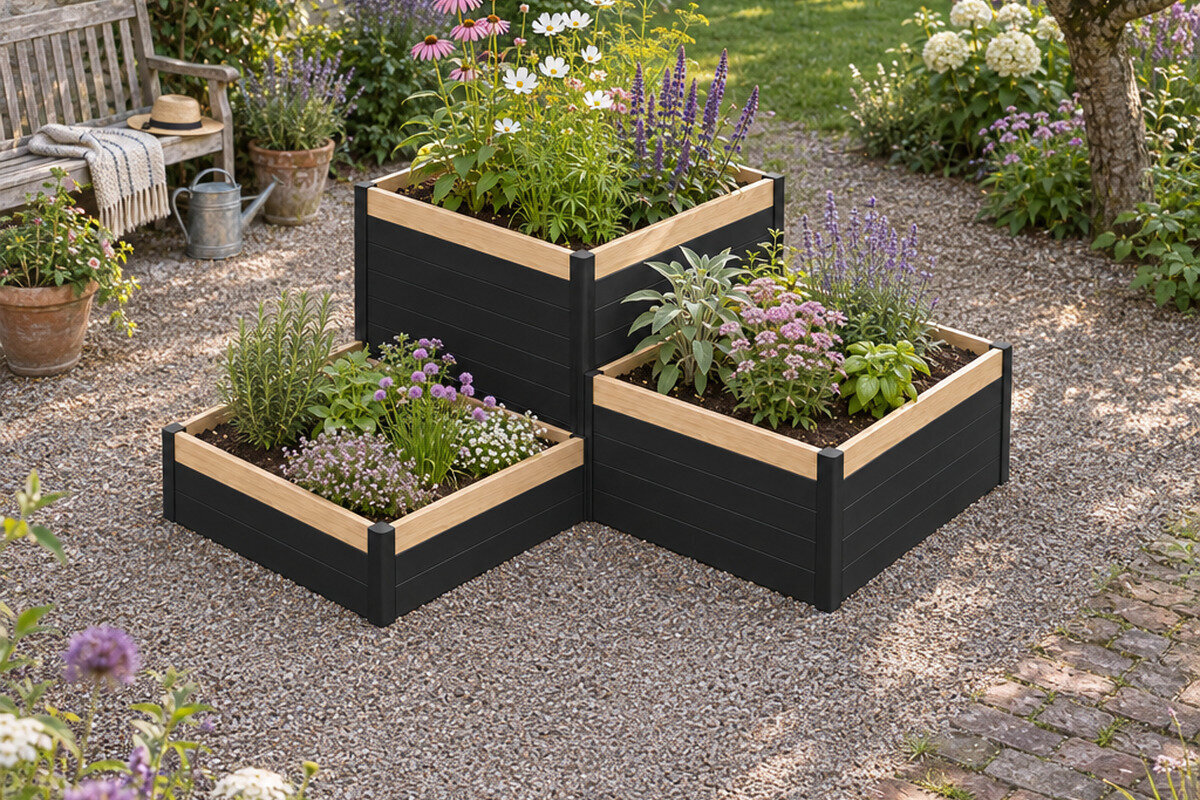
Here, a backyard garden box means a framed raised bed installed on the ground. The Bloomcabin examples are supplied unassembled and have no floor panel. Their walls hold the added soil in a defined area, while the bottom remains open to the prepared ground. They are not elevated planters with legs or containers that keep the growing soil separate from the yard.
A frame makes sense if you have a suitable patch of ground and want a clear boundary between your planting space and the rest of the yard. That boundary can simplify a small planting plan: you can give salad greens one strip and leave the neighboring lawn or path in use. But the frame and fill cost money, and even a compact bed needs room for you to work. If the available patch is already cramped, draw the aisle before drawing the bed.
An open-bottom backyard garden box is not a fix for ground that regularly holds standing water or soil you suspect is contaminated. If you are unsure about past use of the spot, ask your local extension office what testing or site assessment makes sense before growing food there. If the only available spot is paved, start with a different question: what kind of planter is designed to retain soil and drain on that surface?

02
Measure the bed, then measure the room to work
To size a backyard garden box, mark its outside outline where it would sit. Then stand where you would actually sow, weed, and harvest. For a fence-side bed, test your reach from the aisle without assuming you can work from behind it. Try the motion with a low marker for the near wall and again at the height of the model you are considering. Measure the route to the bed, too: an aisle that feels fine when empty may be tight when you are carrying a bag of soil.
The Narrow Aluminum Raised Garden Bed 39.37×19.69×3.94 in has a nominal 39.37-by-19.69-inch footprint, a 3.94-inch wall height, and 5.38 square feet of nominal planting area. The Square Aluminum Raised Garden Bed 39.37×39.37×15.75 in has a nominal 39.37-by-39.37-inch footprint, a 15.75-inch wall height, and 10.76 square feet of nominal planting area. Plan access from at least two opposite sides for the square model.
Use the footprint to place the backyard garden box and the nominal planting area to compare models. Neither tells you how much unobstructed space is inside the walls. Before laying out a crop row or buying a support that must fit inside, confirm the clear interior dimensions. For a divided model, check each bay separately rather than treating the listed total planting area as one continuous patch. If the interior dimensions are not listed, request them or measure the assembled frame before buying fitted accessories.

03
Choose wall height and materials separately from width
Choose wall height for two separate reasons: how high you want the planting surface and how much soil you need above the existing grade. A low backyard garden box over suitable soil can offer more rooting depth than its walls suggest. Conversely, a taller frame gives you room to add more soil, but its wall height does not tell you the final fill level or whether roots can continue into the ground. Check crop-specific growing guidance and assess the ground before relying on either source of depth.
If width is the limiting factor, compare two heights without changing the footprint. The Narrow Accoya Raised Garden Bed 39.37×19.69×23.62 in has the same nominal footprint and planting area as the low narrow aluminum model, but its walls are 23.62 inches high. It is not an all-wood bed: Accoya forms the top 3.94 inches of all four walls, with aluminum panels below and aluminum corner posts.
A taller backyard garden box may put the planting surface closer to where you want to work, depending on where you fill it. It will also take more soil than a shorter bed of comparable interior size if you fill both to comparable distances below their rims. Compare those trade-offs before choosing a height. If the goal is simply to grow a narrow strip of greens on suitable ground, extra wall height does not buy more planting area.

04
Test the location with a fence-side layout
Check the site before settling on a model. Watch where the house, fence, and trees shade the proposed spot during the day. Compare the light you observe with your crop instructions, and walk the route from the water source to the bed. After rain, look for pooling in the proposed planting area and aisle. A backyard garden box that fits on paper still needs a workable location in the yard.
Hypothetical setup example: You want a backyard garden box for leaf lettuce and herbs along a fence. After allowing for any space needed next to the fence, you have a 72-inch run and 48 inches from the planned rear bed edge to the edge of the lawn. You will work only from the front and want at least 24 inches of clear aisle for your own use. Assume you have checked the light, water access, and soil beneath the site and found them suitable for the planting you have in mind.
With the low narrow aluminum model running lengthwise along the fence, its nominal depth of 19.69 inches leaves 28.31 inches of aisle: 48 minus 19.69. The square model would leave only 8.63 inches and would lack opposite-side access. The Narrow Aluminum Raised Garden Bed 78.74×19.69×23.62 in would leave the same aisle as the short narrow model, but its nominal length exceeds the 72-inch run by 6.74 inches.
The low narrow model is the candidate to verify, not an automatic purchase. Confirm the required installation space, check that you can reach the rear planting edge from the aisle, and make sure plant growth will not obstruct the route. The 24-inch aisle is an assumption for this example, not a general clearance recommendation.

05
Assemble the frame and inspect it before filling
Once you have chosen a backyard garden box, read the instructions for that exact configuration before clearing the site or opening bags of soil. Check the parts against the list and identify which wall sections go where. Prepare the ground as directed, then mark the footprint again. If you had to shift the outline to avoid an obstacle, repeat the access check; even a small move can take room away from a tight aisle.
Assemble the frame in the specified order with the listed parts. Do not borrow a connection or anchoring method from the photo of a different model. Before filling a backyard garden box, compare the assembled walls and joints with the instructions, verify how the frame sits on the prepared ground, and make sure no required part or step was missed. If something does not line up as shown, resolve it while the frame is empty rather than using the fill to hold it in place.
Make one final pass with whatever you will use to bring in soil: a bucket, a bag, or a cart. Check that you can get to the planting bay without crossing the growing area or blocking a gate you still need to use. On a divided bed, make sure you can reach every bay from a practical unloading spot before you start filling.

06
Calculate fill from the space inside the walls
Estimate fill for a backyard garden box from the clear dimensions inside the walls and the depth you actually intend to fill. For a rectangular bay, convert the inside length, inside width, and fill depth to feet, then multiply to get cubic feet. For a divided or U-shaped bed, estimate each planting bay separately and add the results. Do not count a divider or an access notch as soil space, and use separate fill depths if the bays differ.
Hypothetical fill calculation, not a Bloomcabin specification: An assembled rectangular bay measures 36 inches by 18 inches inside. At a planned fill depth of 10 inches, the estimate is 3 feet × 1.5 feet × 10/12 foot, or 3.75 cubic feet. If buying bags, compare that estimate with the volume printed on each bag. This calculation covers the space you intend to fill; it does not account for rooting space beneath the frame.
Before buying soil for your backyard garden box, ask the supplier what is in the material and where it came from. If you are reusing yard soil or deciding whether to add compost or fertilizer, get soil-testing advice rather than treating any one recipe as standard. Keep the two decisions separate: the volume calculation tells you how much space to fill, while soil and crop guidance tell you what belongs in it.

07
Plan the first planting around access and local conditions
For the first planting in a backyard garden box, sketch the usable area before opening seed packets. For the hypothetical fence-side strip, check how much room the chosen lettuce variety needs and reserve an end for an herb only if its mature size fits. If the spacing does not fit, reduce the number of plants rather than squeezing in another row. Use packet directions for sowing depth, spacing, and thinning, and consult local extension guidance for when to plant in your part of the United States.
Plan to check the soil more closely while seeds germinate and transplants settle in. A backyard garden box can dry faster than nearby ground, so the condition of the lawn is not a reason to water or skip watering. Check moisture in the bed itself, and when established plants need water, apply it near their roots. If you use mulch to reduce moisture loss and weeds, leave newly sown rows accessible so you can see what is emerging.
At harvest, notice which plants you can reach without leaning over their neighbors and whether anything has spilled into the aisle. Mark those spots on your planting sketch. That record gives you a specific change for the next planting: fewer plants along the working edge, a different crop at the far end, or more space between a frequently harvested row and the one behind it.

Questions readers ask
How wide should a backyard garden box be if I can reach it from only one side?
Use your actual reach rather than a standard width. Mark the intended near wall, account for its height, and check whether you can reach the far planting edge comfortably. If you cannot, choose a narrower bed or move it away from the boundary to create access on the other side.
Can I put an open-bottom backyard garden box on a patio?
Do not assume a frame designed for prepared ground can serve as a patio planter. The illustrated models have no floor. On paving, roots cannot reach earth below, and the setup needs a way to retain soil while letting water drain. Confirm product instructions and surface suitability before proceeding, or choose a planter intended for that surface.
Can I use soil from my yard to fill a backyard garden box?
That depends on the soil and where it came from. Use local soil-testing guidance if you are unsure whether it suits the crops you want to grow, especially if you suspect contamination. If you buy soil instead, ask what the material contains and keep the fill estimate separate from any decision about amendments.
Mark the outline before you buy
Mark the backyard garden box and its working aisle, then try reaching the farthest planting spot. If the site suits your crops and the layout is comfortable, confirm the model’s dimensions and instructions before ordering soil or making a planting plan.
Find a raised bed for your plan
Compare layouts and check the dimensions on the product page.
