
Beds That Raise the Growing Surface: How to Choose and Set One Up

Bloomcabin · Raised-bed guides
Beds That Raise the Growing Surface: How to Choose and Set One Up
Beds that raise the soil above ground level are called raised garden beds. For an open-bottom model, choose the width you can comfortably reach across and the lowest wall height that meets your working-height and growing needs. Then check the ground beneath it and measure the actual interior before ordering soil.
Test the working height
For beds that raise the planting surface, test your reach at the planned soil level, not just at the rim.
Draw the paths first
A narrow bed can work along an edge; a square bed may need paths on opposite sides.
Check the ground
An open-bottom frame needs a suitable site. A taller wall is not a fix for poor drainage or suspect soil.
Measure before ordering
Estimate fill from inside dimensions and planned soil depth, not the catalog footprint.
Two beds that raise the soil can take up the same space and feel completely different to work in. Imagine a narrow strip beside a garden edge: a low frame gives the planting area a border, while a tall frame can bring it closer to your hands. Neither helps much if you can’t reach the back row from the path.
Use this guide to choose between those setups, verify the dimensions that matter, and get the bed ready for its first planting. The examples use Bloomcabin’s US specifications; the worked estimate shows how to go from those listed dimensions to measurements you can actually use to buy fill.
01
Decide what raising the soil will change
The Bloomcabin beds in this guide are frames that hold soil above the surrounding ground. They have no floor panel and sit over prepared ground. Beds that raise the soil this way suit gardeners who want a defined growing area or a higher surface for tasks such as sowing and harvesting. They are not planters on legs, and they are not the right default for a deck or paved patio.
Low beds that raise the surface by only a few inches can define a planting strip without adding much height. They make more sense when you’re comfortable working near ground level and the soil below is suitable for the crops you want. Taller beds that raise the planting surface can bring everyday tasks closer to you, but a taller frame at the same width usually means more fill if you intend to bring the soil near the rim. Budget for the frame, fill, and a way to move that fill to the site.
Decide what you want to change before choosing the wall height. If the issue is bending, set a cardboard marker at the intended soil level and try the motion you’d use to pick leaves. If the issue is soil quality, investigate the site before choosing a frame. And if you mainly want a defined row and don’t need rigid sides, compare the space a framed bed takes with the room an unframed mound needs for its sloped edges.

02
Fit the bed and the paths into the same sketch
Mark the bed outline and the paths on the ground. In a side yard, the real width limit may be the space left when a gate opens or when a wheelbarrow passes. When comparing beds that raise the soil beside a boundary, test the far edge from the side you’ll actually use. Reach toward an imaginary plant without bracing yourself on the frame or stepping into the soil. Repeat the test at the planned planting height.
For a one-sided layout, the Narrow Aluminum Raised Garden Bed 39.37×19.69×3.94 in gives you a nominal footprint of 39.37 × 19.69 inches and a listed nominal planting area of 5.38 square feet. The Square Aluminum Raised Garden Bed 39.37×39.37×15.75 in has a nominal footprint of 39.37 × 39.37 inches and a nominal planting area of 10.76 square feet. Plan to approach that square model from at least two opposite sides. Keep the listed planting areas separate from the clear inside dimensions you’ll need for a planting or fill plan.
When beds that raise the soil have multiple bays, consider where you’ll stand to work in each one. Bloomcabin’s U-Shaped Aluminum Raised Garden Bed 118.11×78.74×11.81 in has five bays and a nominal 39.37 × 39.37-inch access notch. Treat the notch as one approach, not proof that you can reach every corner or turn with your equipment. Beds that raise several growing areas in one frame still need usable paths around the outside wherever the interior approach leaves a gap in your reach.

03
Separate wall height from usable growing depth
On a product page, separate the nominal outside footprint, the clear inside length and width, the wall height, and the depth you plan to fill. The first helps you lay out the site; the next two measurements of the interior, together with your fill depth, tell you how much soil to buy. The wall height is a frame specification, not a statement that the soil will sit flush with the top.
For open-bottom beds that raise soil over suitable ground, roots may extend below the frame. A short wall doesn’t necessarily mean a shallow root zone, and a tall one doesn’t establish what lies beneath it. When comparing beds that raise the surface for a specific crop, check the crop’s rooting and spacing needs against the growing space you can provide. If the substrate blocks roots, don’t count any depth below it.
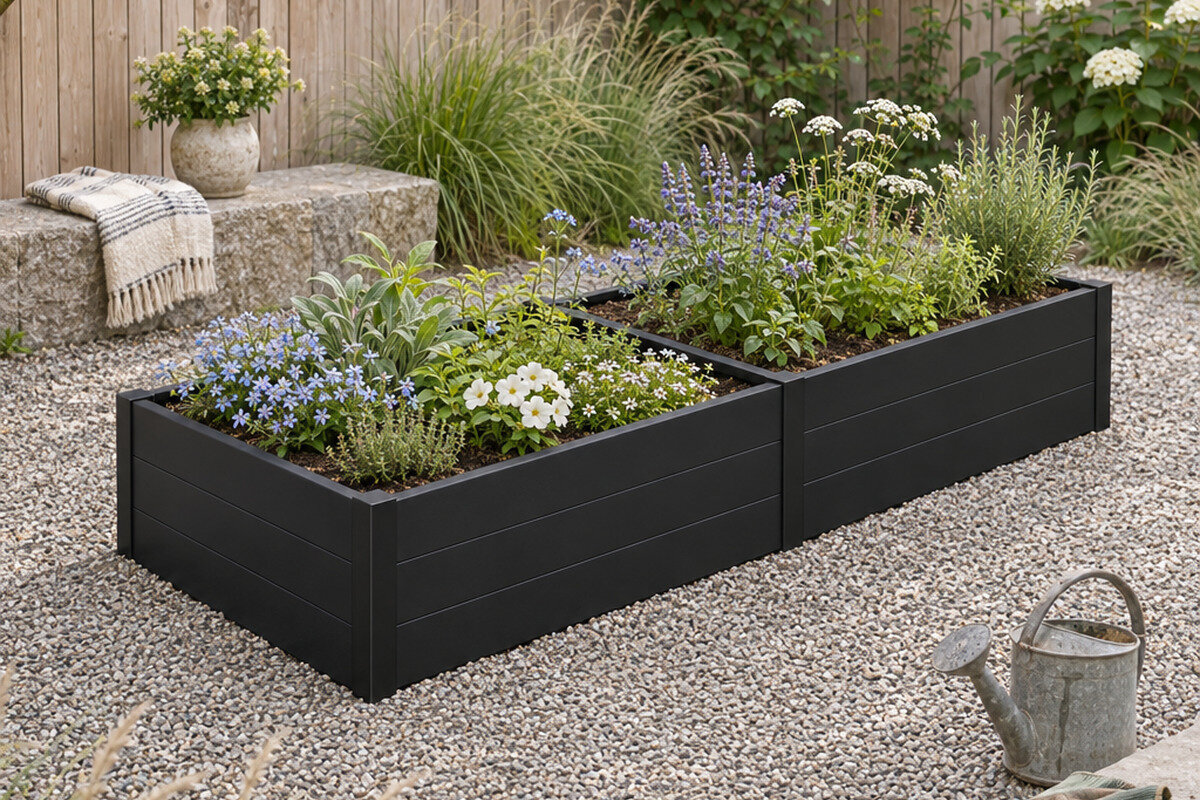
Look at each bay separately when comparing beds that raise adjoining plots to different heights. The Split Double Aluminum Raised Garden Bed lists walls of 11.81 inches for one bay and 31.5 inches for the other. Its taller bay may suit the tasks you want to do with less bending, but it tells you nothing about the fill depth on the shorter side. Decide which plants you’ll tend most often and which side you’ll approach before assigning crops to either bay.

04
Verify the frame you’ll actually assemble
Use the materials list to confirm what you’re buying. The Classic aluminum models compared here have aluminum wall panels and corner posts. On the Narrow Accoya Raised Garden Bed 39.37×19.69×23.62 in, Accoya boards form the top 3.94 inches of all four walls, while aluminum forms the lower 19.69 inches and the corner posts. It is a wood-top and aluminum frame, not an all-wood bed.
For beds that raise a planting strip along an edge, check whether the length comes from one wall section or several. The Narrow Aluminum Raised Garden Bed 78.74×19.69×23.62 in uses two 39.37-inch panels on each long side, joined by aluminum T connectors. That detail helps you identify the right assembly instructions. It doesn’t tell you whether a different support, connector, or installation surface is acceptable.
The Bloomcabin frames described here are supplied unassembled. Before ordering, pull up the current US specifications and instructions for the exact model and height you’ve selected. Check the parts list, tools, how much room assembly requires, and whether the instructions call for anything specific at the base. Beds that raise the same area of soil can have different wall and connector layouts. If an assembly detail affects whether the bed fits your site, resolve it before the kit arrives rather than inferring it from a gallery photo.

05
Prepare the site, then check the assembled frame
Check light against your crop list and make sure water can reach the site. Try the hose route while the outline is still on the ground. If getting to the far end means dragging the hose over the planting area or through a gate that needs to stay closed, adjust the layout now.
Beds that raise the soil won’t necessarily correct an underlying drainage or contamination problem. If water collects where the bed is going or you’re unsure about the soil’s history, investigate before committing to the site. Ask your local extension office what kind of assessment is appropriate before growing food there.
Treat pavement and decks as a separate decision. Beds that raise soil in open-bottom frames are not automatically suitable for hard surfaces. Confirm that the manufacturer permits the installation and that the setup can contain the soil and drain appropriately. For a deck or any other elevated surface, verify that the structure can support the loaded setup before buying or filling it. If you can’t confirm those details, use a planter designed for the site instead.
- Clear the marked footprint and prepare the ground as directed by the instructions for your model. Deal with obvious high spots before positioning the frame.
- Lay out parts by side or bay. Identify any dividers and height changes before assembly, then follow the manufacturer’s sequence and hardware instructions.
- Before filling, check that the assembled bed sits as intended, the access paths are still clear, and you can bring soil to every bay. Measure the clear interior now if you couldn’t verify it earlier.

06
Work a real footprint through to a fill estimate
For rectangular beds that raise a single planting bay, multiply the clear inside length, inside width, and planned fill depth in inches. Divide by 1,728 to get cubic feet. For beds that raise multiple bays, calculate each bay separately and add the volumes; a divider, an access notch, or a change in fill height makes the overall rectangle the wrong shortcut.
Hypothetical worked example: You have a 46-inch-long, 24-inch-deep strip of suitable garden ground, with a separate path along the front. You want salad greens and less bending when you harvest. The short aluminum model and the tall Accoya fusion model linked above share a nominal 39.37 × 19.69-inch footprint. Either fits the outline on paper, with 6.63 inches to spare along the strip and 4.31 inches across it. That spare space is not the path; the path is already outside the strip.
You mock up the soil level and find the taller option more comfortable from the front path. For the fill calculation only, suppose that after assembly you measure 38 × 18 inches inside and plan to fill 20 inches deep. The estimate is 38 × 18 × 20 = 13,680 cubic inches, or about 7.9 cubic feet. Those are hypothetical inside measurements, not Bloomcabin specifications. If the measured interior or planned depth is different, use your numbers rather than ordering from this example.
When pricing fill for beds that raise soil substantially, compare suppliers using the same volume unit. Look into the source and characteristics of purchased soil, and use soil-test results to guide amendments rather than adding compost or fertilizer by default. If you haven’t verified the volume or the soil source, price the options first and place the order once those checks are done.

07
Plant for the way you’ll tend and harvest
Map your first planting on the inside area, not the outside dimensions. For a one-sided strip, put the plants you expect to pick most often within easy reach. In a divided bed, make a separate plan for each bay so paths and dividers don’t disappear from your spacing calculations. Use seed packets or plant tags for spacing and your local extension office for regional planting timing.
Beds that raise the soil can dry faster than the ground around them. Check moisture where the crop is growing instead of watering by the calendar. Pay particular attention to seeded rows and new transplants; when you water, direct it toward the root zone. Mulch can help limit moisture loss and weeds where it suits the planting.
The first few weeks will tell you whether the layout works as well as the measurements suggested. Note where reaching is awkward, where the hose gets caught, and which crops you tend more often than expected. For beds that raise different bays to different heights, those observations can help you assign crops next time. If a plant looks stressed, identify the likely cause before feeding or treating it. A change in layout or watering may be more useful than adding anything to the soil.

Questions readers ask
Are beds that raise the soil the same as planters on legs?
No. The Bloomcabin frames discussed here sit on prepared ground and have no floor panel. Their walls hold soil above grade; they do not suspend the growing area. If you need space underneath the planter or a base that contains the soil, look for a design that explicitly provides it.
Can beds that raise the soil give me a comfortable working height?
They can, but rim height alone won’t tell you. Mock up both the rim and your intended soil level, then try reaching to the far side from your actual path. If you garden seated, check the approach and turning space as well. A taller wall does not create knee clearance underneath.
Should I order the soil at the same time as the frame?
Only if you can verify the clear interior dimensions and intended fill depth first. Otherwise, assemble and measure before ordering. For a divided bed, calculate each bay separately. Compare the resulting cubic feet with the volume stated on the bag or by the bulk supplier.
Make the choice on the ground
When comparing beds that raise the growing surface, start by marking a footprint and testing your reach at the intended soil level. Confirm the exact model and site requirements before ordering the frame, then verify the clear interior before buying the fill.
Find a raised bed for your plan
Compare layouts and check the dimensions on the product page.
