
Bucket Raised Garden: How to Tell if Your Bucket Is Suitable

Bloomcabin · Raised-bed guides
Bucket Raised Garden: How to Tell if Your Bucket Is Suitable
A bucket raised garden can work if the specific bucket is suitable for what you want to grow, has enough room for roots, and can drain where you plan to put it. “Bucket” describes the container, not its material. For edible crops, start with documented suitability and a known history; if you can't verify either, choose a different container.
Identify the bucket
A bucket raised garden describes the container's shape and use, not what it is made of. Check the exact model.
Verify the use
For edible crops, choose a container with clear use guidance and a known history.
Check the fit
Measure the space available to roots and check where drainage water will go.
Test before filling
Set up and test drainage while the bucket is empty and easy to move.
Before you spend money on a bucket raised garden, pick one container to assess. Whether it's a bucket you already own or one you're considering buying, read its markings and look up the exact model. Then measure it and check the proposed location. A bucket can pass the material check and still be too shallow or awkward to drain.
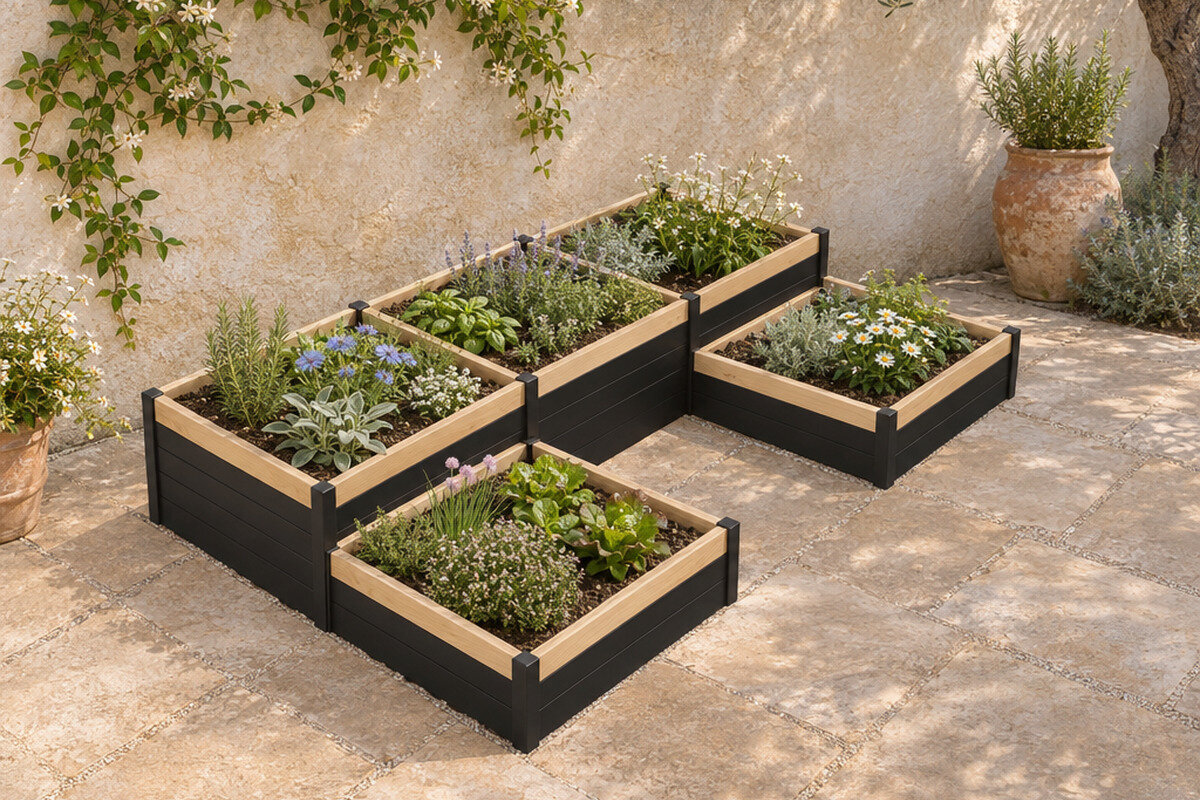
The decision is different if what you want is a frame around a growing area on prepared soil. The Bloomcabin beds shown with this guide are open-bottom frames, not buckets. Use them as a comparison when deciding whether you need a self-contained growing space or a planting area that connects to the ground.
01
Make the go/no-go call before buying supplies
The first decision for a bucket raised garden is whether the bucket in front of you is worth setting up. Start with a model number, a product sheet, or an answer from the maker that applies to that exact item. If you have only a loose bucket with no way to identify it, don't transfer a specification from another container that looks the same. Color, shape, and a sturdy feel don't establish composition or intended use.
Check the bucket's history separately. A new container comes without the uncertainty of a previous owner's use, but you still need to know what the maker designed it for. With a reused bucket, establish what it held and whether the maker's guidance supports your intended use. If the previous contents are unknown, don't choose it for edible crops. Cleaning a bucket doesn't answer the question of what was in it, and a generic food-storage label isn't a set of planting or modification instructions.
Use three outcomes for your bucket raised garden: proceed to the fit checks if documentation supports the intended use and the history is known; pause if a model-specific answer is obtainable; replace the bucket if a key question can't be answered. Make that decision before buying growing mix or making holes. A purpose-made planter with clear instructions is a better comparison than another unmarked bucket, even if both occupy the same space.

02
Read the material, finish, and hardware details
For a bucket raised garden, record the material and the grade if specified; for any wooden parts, check the species and whether the wood is treated. Ask about coatings or liners on surfaces that will contact growing mix or water. A plastic resin marking or a label that says only “metal” is a starting point. Neither identifies every component or tells you how the maker expects the finished container to be used outdoors.
Check wall and base thickness if the maker reports them, but don't use thickness as a substitute for a filled-use rating or instructions. The base, rim, seams, and attachment points matter too. Look for cracks, distortion, sharp edges, separation at joints, or damaged coatings. A bucket with a defect at the base is a poor candidate even if its material is well documented. Don't rely on paint or a liner to repair a structural defect or make unknown previous contents irrelevant.
If your bucket raised garden includes a stand, bracket, or separately attached part, verify the specified fasteners, how the bucket is supposed to sit on the support, and the supplier's assembly instructions. A handle intended to carry an empty bucket is not evidence that the rim can support a filled one. If documentation is incomplete, ask a specific question: “Is this model intended to sit outdoors, filled with growing mix, for the crops I want to grow?” Then ask separately whether the proposed support or modification is allowed.

03
Measure the growing space, not just the rim
Measure a bucket raised garden from the inside for the crop and from the outside for the site. Use the intended fill line, not the rim, when checking growing depth. Inside the bucket, note any taper, molded insert, or other feature that reduces usable space. Outside, measure the widest point, including anything that projects where you'll need clearance. If you use a saucer or base, include its footprint when you measure the setup.
Check crop guidance against the actual usable depth and width. A wide opening doesn't make up for a shallow fill line, and a deep bucket doesn't necessarily leave enough room for plants that need more space side to side. Use seed or plant instructions and local Extension guidance to match the crop to the available light and space, and choose the planting time for your area. Place the bucket where you can reach it easily with water and tend it without moving other containers.
The depth measurement changes if you're comparing your bucket raised garden with an open-bottom frame. A bucket on pavement provides no soil below its base for roots to enter. In a frame on prepared ground, roots may extend into the soil below, depending on its condition. Compare the bucket's usable depth with the frame's site-specific rooting space, not simply its advertised wall height. Keep access space separate from both the planting area and the outside footprint.

04
Dry-fit the container and any support
Put the empty bucket in its planned location. Think through the space you'll need to water, inspect the outlets, and remove the container if it needs replacing. A bucket raised garden can sit directly on a suitable, stable surface if the container's instructions and drainage design allow it. If you want it at a more comfortable working height, treat the support as a separate purchase or design decision rather than stacking whatever is available.
For a stand or other assembly, inventory the parts against the maker's instructions before you start. Use the specified hardware and verify that the support and the surface beneath it suit the filled setup, including moist growing mix and any accessories. Don't judge a stand by how steady it feels with an empty bucket. If you can't confirm suitability for a deck or balcony, seek guidance for that location before filling.
Set out any trays or other approved accessories during this dry fit. Check that the bucket doesn't rock, the base sits as intended, and the outlets aren't obstructed by the support. If you plan a row of containers, check whether you can inspect each one without lifting its neighbor. The useful advantage of a bucket raised garden is that you can set up one container at a time. If an empty trial setup reveals an access or placement problem, fix one position before repeating it.

05
Follow the runoff to its destination
Trace the water path before you fill a bucket raised garden: from the growing mix, through the intended outlets, and onto or into whatever receives the runoff. Start with the maker's drainage instructions. If the bucket lacks outlets, don't assume it can be drilled, and don't guess a hole pattern. Use a design with documented drainage or follow the exact model's guidance for permitted modifications.
If the design permits it, use a little water in the empty container to check that the outlets are clear and see where the water lands. That check can expose a blocked opening or a puddle in the wrong place, but it doesn't establish how the growing mix will drain. Check again after filling and watering. If you use a saucer, leave room to inspect and empty it as needed. On a hard surface, plan for overflow so it doesn't run across a walkway or onto a neighboring area.
Don't copy the drainage plan for a bucket raised garden when switching to an open-bottom frame. With a frame, the prepared ground is part of the water path. Check where water tends to collect after rain and get local guidance if the site's drainage or soil condition is uncertain. An open base doesn't fix those conditions. For the bucket itself, choose a growing mix suited to the container and crop rather than assuming the fill you'd use over garden soil is the right choice.

06
Check the bucket as well as the plants
Make the first few watering checks part of setting up your bucket raised garden. Check moisture in the growing mix before watering again rather than adopting a fixed interval. Pay particular attention while seeds are germinating or transplants are establishing, and direct water near the roots. If a plant looks stressed, check the growing conditions and drainage before assuming it needs fertilizer. Use crop guidance to decide whether feeding is appropriate.
Inspect the container as well as the plants. After rain or after moving anything nearby, look for water collecting where you didn't expect it, a shifted base, or outlets blocked by debris. Check seams, the rim, and any support hardware for changes. If the container cracks, loses its footing, or shows damage to a coating where it contacts the mix, stop and consult the manufacturer's care or replacement instructions instead of guessing at a repair.
Before reusing a bucket raised garden for another crop, confirm that the bucket still meets the original checks. Look for damage while it is empty, review the maker's cleaning and storage guidance, and make sure the next crop fits the usable dimensions. Keep the model information with your garden notes. If you need to replace a bucket or a support component later, you can look up what fit instead of buying by appearance.

07
Work through a patio choice before buying
Hypothetical example: You have an 18-by-36-inch clear strip on a level patio for a bucket raised garden and want two containers for herbs. Assume each documented planter, including its approved saucer, measures no more than 12 inches across at its widest point. Two take up 24 inches along the strip, leaving 12 inches: 3 at each end and 6 between them if you center the pair. Across the strip, a centered 12-inch setup leaves 3 inches on each side. Those are layout assumptions, not recommended crop spacing or minimum access clearances.
Now verify the things the tape measure can't settle. Can you reach both planters from outside the strip? Can you empty the saucers without lifting a full container? Does the usable depth meet the guidance for the herbs you've picked? If an unmarked bucket also fits but its previous contents are unknown, it still fails the edible-use check. If the documented pair fits but runoff can't be managed there, change the location rather than treating the footprint calculation as approval.
If you're comparing that bucket raised garden with a ground-based option, the Narrow Aluminum Raised Garden Bed 39.37×19.69×3.94 in has a nominal footprint of 39.37 by 19.69 inches, a 3.94-inch wall height, and a nominal planting area of 5.38 square feet. Its footprint exceeds the hypothetical strip in both directions, and it has no floor panel. That model has aluminum wall panels and corner posts; the narrow Accoya fusion model uses Accoya boards at the top of the walls and aluminum below. Both are supplied unassembled and open to prepared ground. Compare them for a site that calls for a frame, not as substitutes for containers that need to hold growing mix on a patio.

Questions readers ask
Is a recycling symbol enough to approve a bucket raised garden for vegetables?
No. A resin marking can help identify the base plastic, but it doesn't tell you what the bucket previously held or whether the maker recommends that exact model for edible gardening. Verify both the container's intended use and its history. If you can't establish them, choose another container for vegetables.
Does a bucket raised garden need a stand?
No. It can sit on a stable, suitable surface if the placement leaves the drainage outlets clear. Use a stand only if you need the extra working height and can verify that the support is suitable for the filled setup. Don't assume a carrying handle, rim, or improvised platform is designed to bear that load.
Can I use an open-bottom frame in place of a bucket raised garden on a patio?
Don't treat them as interchangeable. A bucket holds its growing mix within its own base and walls. The Bloomcabin frames discussed here have no floor and are described for use over prepared ground. For a patio, choose a container designed for that placement unless the frame maker specifically documents a suitable hard-surface installation.
Use the bucket only if it passes the checks
Approve a bucket raised garden only after you've checked the material and history, measured usable root space, and tested the placement and drainage. Replace a bucket you can't verify for edible crops, and reserve an open-bottom frame for a site and installation its instructions support.
Find a raised bed for your plan
Compare layouts and check the dimensions on the product page.
