
DIY Pallet Garden Box: Cut List and Step-by-Step Build

Bloomcabin · Raised-bed guides
DIY Pallet Garden Box: Cut List and Step-by-Step Build
Build a DIY pallet garden box by fastening two courses of reclaimed slats to solid corner posts. The plan below makes a 36-by-18-inch open-bottom frame and shows what to check before buying hardware, cutting boards, or adding soil.
Start with the footprint
The example finishes at 36 by 18 inches outside, with 7-inch walls and no floor.
Measure the usable wood
Use only sound boards with a known source and use history. Count clear cutting lengths after you remove damaged ends.
Back the joints
Fasten both wall courses into solid corner posts. Midpoint cleats keep the long-wall courses aligned; they are not ground anchors.
Inspect before filling
Set the DIY pallet garden box on suitable, draining soil. Check for rocking, splits, and loose joints before adding fill.
This DIY pallet garden box starts with loose boards, not an intact pallet. Taking the pallet apart lets you reject damaged pieces, cut the walls to length, and see exactly where each screw will land. Use reclaimed slats for the walls and separate, sound stock for the posts and cleats if the pallet does not supply it.
The example is a low box that sits directly on suitable garden soil. It has no legs or floor to carry the fill. Before committing to the cuts, check that you have four usable full-length slats and a site where an open bottom makes sense. Those two checks determine whether you can use this plan as drawn.
01
1. Draw the box and mark its footprint
Hypothetical worked example: draw a DIY pallet garden box with outside dimensions of 36 by 18 inches and a wall height of 7 inches. Assume each slat actually measures 0.75 inch thick and 3.5 inches wide. The full-length walls are 36 inches long. For each end board, subtract the two 0.75-inch long-wall thicknesses from 18 inches to get a cut length of 16.5 inches. The clear rectangle inside the walls is 34.5 by 16.5 inches before subtracting the posts and cleats.
Mark out that rectangle on the ground before preparing the wood. Leave a place to stand or kneel outside it, and check that you can reach the middle from the sides you will actually use. Pick a spot with light appropriate to the plants you intend to grow and water within reach. The sketch records the box dimensions, not the access space around it.
If the slats for your DIY pallet garden box have a different measured thickness, recalculate the end cuts and recheck the fasteners. If the board widths differ, sort them into matching courses or redraw the wall height. Do not use screws to pull mismatched courses into line.
- Top view: draw the 36-by-18-inch outside rectangle. Run the two long walls the full length and fit each short wall between them.
- Side view: draw two 3.5-inch courses stacked edge to edge, with the posts flush at the bottom and top. Leave the bottom open.
- Inside view: mark a post in each corner and a cleat halfway along each long wall. Keep their footprints on the sketch for the fill calculation.

02
2. Sort the pallet wood and gather the hardware
Before dismantling a pallet for your DIY pallet garden box, find out what it carried and whether the wood was treated or exposed to spills. Choose clean, sound, untreated wood with a known history. Reject pieces with unidentified stains or residue, persistent odors, decay, or splits through the areas where screws will go. A visible stamp does not tell you what the pallet encountered later.
Pull the boards apart without forcing the pieces you want to save. Remove nails and inspect both faces and cut lines for metal before sawing. Mark damaged ends and measure what remains. A board that measures 36 inches overall is no use for a full-length side if it needs trimming. Keep a spare slat if you have one, especially if usable material is scarce.
Plan on 40 exterior wood screws for this DIY pallet garden box: 32 at the corners and eight at the midpoint cleats. Buy a few extras. A 2-inch screw is a candidate for the assumed stock, not a universal specification. Follow the supplier’s instructions for wood compatibility, pilot holes, edge distance, and engagement. Test the screw in matching scrap, especially at a cleat where the wood behind the slat is thinner than at a corner.
- Pallet slats: four at 36 inches and four at 16.5 inches, all finished at the assumed 0.75-inch thickness and 3.5-inch course height.
- Corner stock: four 7-inch posts, each 3.5 by 3.5 inches in actual cross section.
- Cleat stock: two 7-inch pieces, each 1.5 by 3.5 inches in actual cross section. The broad face sits flat against the inside wall.
- Tools: tape measure, pencil, square, pry bar or pallet puller, nail puller, saw, drill/driver and bits, clamps, level, eye protection, and hearing protection as appropriate.

03
3. Cut the pieces and dry-fit both courses
Cut and label the boards for the DIY pallet garden box on a flat work surface. Mark the long sides and ends by course so you can put the same pieces back in place after dry-fitting. Cut the posts and cleats to the measured height of the two courses together. On this sketch that is 7 inches. Smooth splinters on exposed edges of the accepted boards before assembly.
Lay out the bottom course with the short boards between the long ones. Set the posts inside the corners so each one touches the back of both adjacent board ends. Clamp or hold the layout in place, check the outside dimensions, and measure both diagonals from corresponding outside corners. If the diagonals differ, adjust the rectangle before drilling. If a board won’t sit against its post without being forced, replace or recut it.
Now dry-fit the second course of the DIY pallet garden box. Both courses should bear against the posts, with their outside faces aligned and no obvious path for fill to spill between them. Mark the post locations on the outside faces so you know where to drill. Each wall in each course uses one continuous slat; an unsupported splice halfway down a wall is not part of this plan.

04
4. Fasten the corners and tie the long-wall courses together
Assemble the bottom course of the DIY pallet garden box first. Clamp each corner, then drive two screws through each board end into its post. Use the pilot hole and screw spacing that suit the fastener and wood. Within each course, offset the screw heights on adjoining faces so the two sets of screws do not meet inside the post. Recheck the diagonals before fastening the last corner.
Set the top course on the bottom one and fasten it to the same posts. Then center a vertical cleat on the inside of each long wall. Drive two screws through each course into each cleat. Keep the fastener heads seated without crushing the slat, and check that no points emerge into the planting space. If a screw misses its backing or starts a split, correct the joint before moving on.
The corner posts join adjacent walls; the cleats on this DIY pallet garden box tie the upper and lower slats together at midspan. They do not anchor the box or establish how far a wall can safely span. Do not scale this plan up by simply using longer slats or stacking extra courses. Have taller, longer, floored, or elevated versions checked for their actual materials, filled weight, and support conditions.

05
5. Prepare the ground and choose what goes underneath
Set the empty DIY pallet garden box on the prepared ground without adding a floor. Clear sod and obstructions from the footprint and level the contact surface so the walls sit evenly without rocking. Check where water collects after rain or irrigation. If the selected spot puddles persistently, resolve the site drainage or move the box before filling. If you have reason to suspect contamination, address that separately; an open frame does not isolate the growing soil from what is underneath.
Leave the base open if the ground is suitable and there is no specific reason for a barrier. If burrowing animals are a site concern, a permeable mesh may be worth considering. Check the mesh supplier’s instructions for ground contact, attachment, and cut edges. It is not a structural floor. Avoid adding an impermeable sheet across the base of this plan as a shortcut to containing soil.
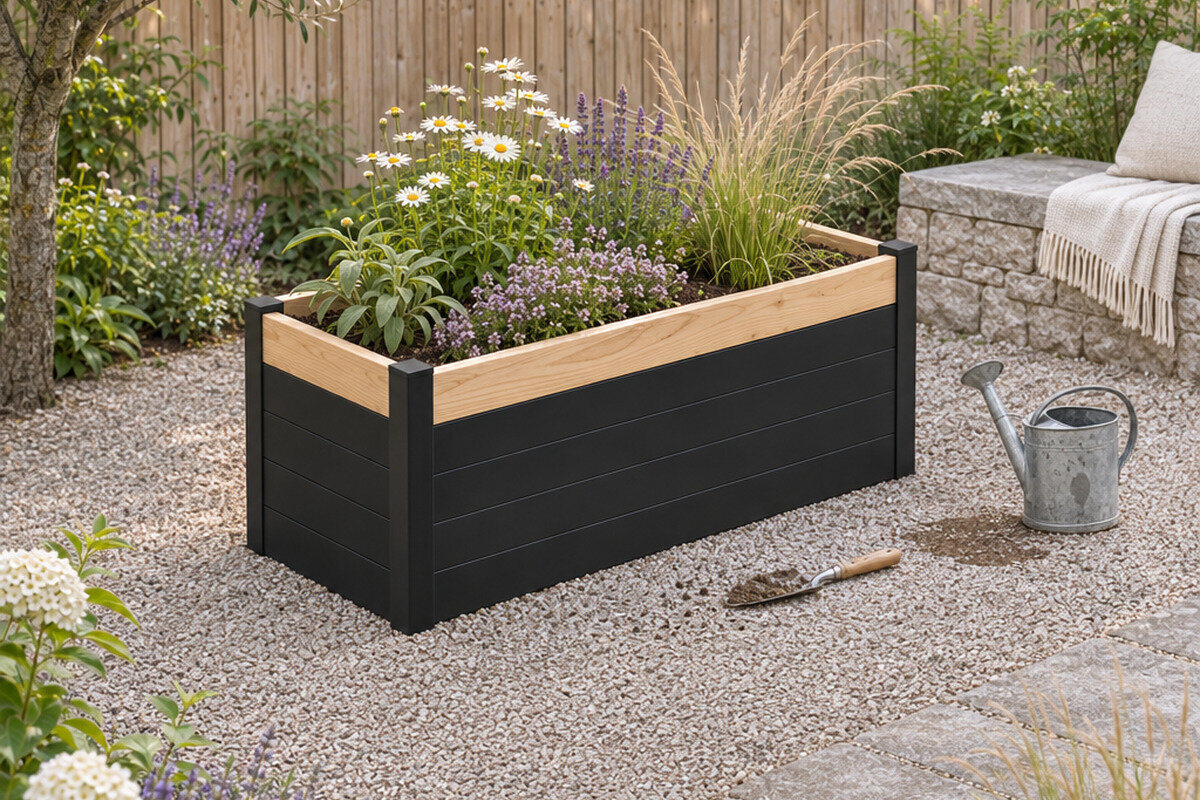
On a patio, the DIY pallet garden box would have a different job: it would need to hold soil above a hard surface and let water drain to a suitable place. That calls for a supported floor and an outlet path, neither of which this sketch provides. The illustrated Bloomcabin raised-bed frames use aluminum wall panels, with Accoya upper boards on certain versions. They are separate products, not pallet collars or examples of a supported planter floor.

06
6. Inspect the frame in its final position
Move the DIY pallet garden box empty, with help if it is awkward to carry. Recheck the joints after setting it down; moving a frame can reveal a loose connection that was not obvious on the work surface. Work from the outside and make sure you can still reach all four corners for inspection or repairs. This is the easiest time to shift the frame away from a fence or other obstruction.
Look along the long walls from both ends. A slat that is already bowed out or a post that moves under light hand pressure needs attention before filling. These checks catch workmanship problems; they are not a load test. Do not sit or stand on the DIY pallet garden box to see whether it holds. Once the empty frame passes inspection, measure the true inside dimensions and mark a fill line on the inside of a wall.
- Fit: compare the diagonals and inspect the corners for gaps, new splits, or board ends that have pulled away from the posts.
- Hardware: check that every screw reaches its intended backing and that no points, sharp heads, or metal fragments are exposed.
- Site: press lightly at each corner of the empty frame to check for rocking. Correct the contact surface instead of relying on fill to hold the frame in place.

07
7. Calculate the fill and add it in stages
Estimate fill for the DIY pallet garden box from the inside, not from the footprint. Continuing the hypothetical example, use a 6-inch fill depth, which leaves 1 inch below the rim on level ground. Convert the 34.5-inch inside length and 16.5-inch inside width to feet and multiply to get about 3.95 square feet before allowing for the supports.
The four 3.5-by-3.5-inch posts and two 1.5-by-3.5-inch cleats together occupy about 0.41 square feet. That leaves about 3.54 square feet. Multiply by the half-foot fill depth for about 1.77 cubic feet of soil. Use your measured dimensions and fill line if they differ. That estimate is for the space inside the frame, not for leveling the site or amending the soil below.
For a DIY pallet garden box with an open base, the fill depth is not necessarily the total rooting depth. Check what lies underneath and use local soil-testing guidance and seed-packet directions to decide what you can grow there. Ask the soil supplier what is in the material before buying. Add it in stages and check that the walls and joints stay in position; if a joint opens or a board bows noticeably, stop filling and relieve the pressure before making repairs.

Questions readers ask
How many pallets do I need for a DIY pallet garden box?
Count usable boards, not pallets. This plan needs four clean, sound lengths that finish at 36 inches and four that finish at 16.5 inches, all at the assumed thickness and course height. One pallet might supply some or all of them, but nail damage, splits, and mismatched widths can reduce the usable stock.
Can I build this DIY pallet garden box with thinner slats?
Not by changing the end-board length alone. Thinner slats also change how the screws seat and how the walls behave between supports. Check the connection for the actual stock before cutting. If you cannot make a suitable joint with the material you have, use different boards rather than adding screws to a weak end.
Can I put this DIY pallet garden box on concrete?
Not as drawn. The plan has neither a soil-retaining floor nor a drain outlet. For concrete, use a planter design that contains the soil, gives runoff a clear exit, and has support appropriate for the filled container and the specific site.
Keep the sketch with your measurements
Keep the actual board sizes, fastener details, and fill line for your DIY pallet garden box. If a slat later needs replacing, you can cut it to fit the frame you built rather than relying on the original pallet dimensions.
Find a raised bed for your plan
Compare layouts and check the dimensions on the product page.
