
Elevated Flower Boxes: How to Choose, Set Up, and Plant One

Bloomcabin · Raised-bed guides
Elevated Flower Boxes: How to Choose, Set Up, and Plant One
Choose elevated flower boxes by checking what sits beneath the soil first. An open-bottom frame is for suitable prepared ground; a planter with a floor is a different purchase. Once you know which type you need, compare the width you can reach, the wall height you want, and the space your flowers will need at maturity.
Check the base first
Open-bottom elevated flower boxes belong over suitable prepared ground. Choose a purpose-built container if you need a floor.
Try the layout
Mark the footprint and test your reach from the side where you’ll actually work.
Calculate fill by bay
Measure inside each bay and use your planned fill depth, not the listed wall height.
Plan for mature plants
Choose flowers for local conditions and leave room for their mature spread and for routine care.
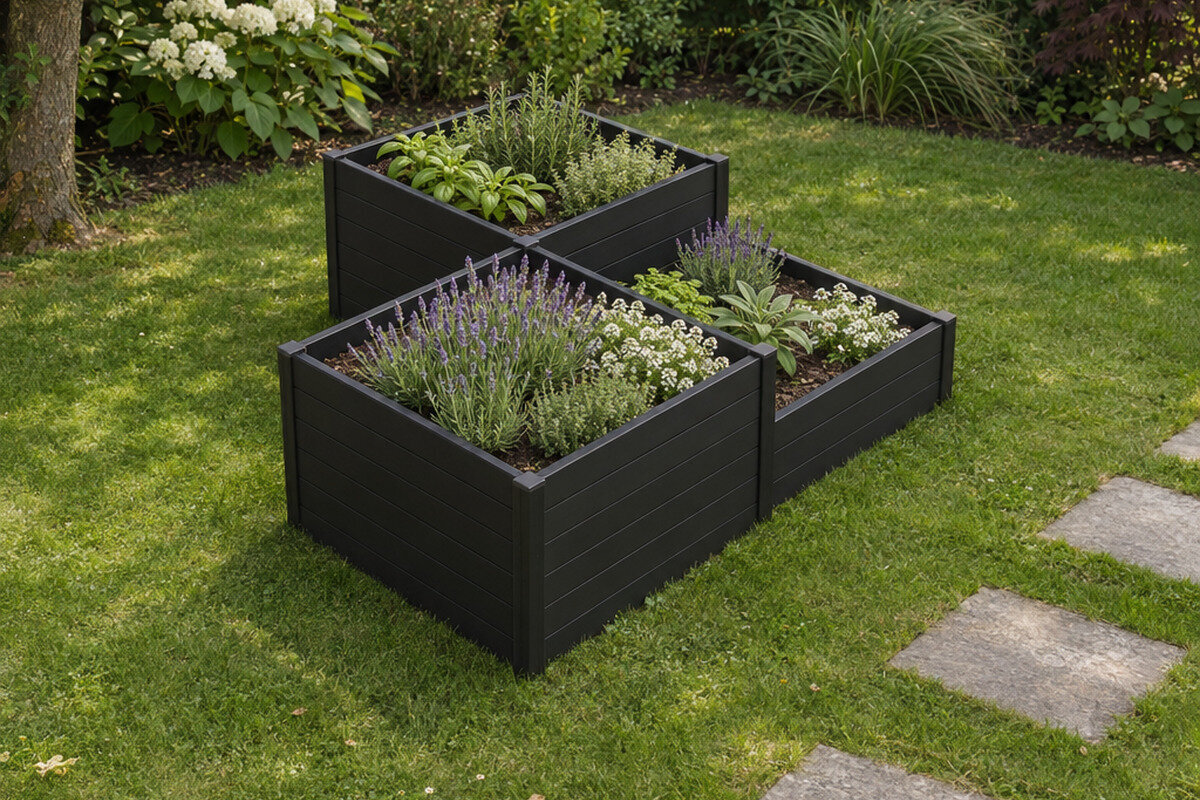
The Bloomcabin examples in this guide are open-bottom elevated flower boxes, not planters on legs. They suit a gardener who wants a defined flower strip or a set of planting bays on the ground. They don’t give you clearance underneath or solve problems with the soil beneath the frame.
A useful way to compare elevated flower boxes is to pick a viewing side and a working side before you shop. Those may be the same path. If they are, the box needs to look good from that path while leaving enough room to reach the back row, water the planting, and remove spent blooms.
01
Choose between an open-bottom frame and a planter on legs
The word “elevated” can describe two different things: a frame that raises the soil surface above garden grade, or a container whose entire planting tray is lifted above the ground. The Bloomcabin elevated flower boxes discussed here are the first type. The walls enclose the fill, but there are no legs or floor panels. That makes them an option for defining a flower strip or grouping flowers in separate bays over prepared ground.
If you need knee clearance for seated gardening, a planter that contains its growing medium on paving, or a box that can be moved seasonally, look for a container explicitly designed for that job. A tall open-bottom frame doesn’t create clearance beneath the planting area. Even if the rim feels comfortable, check whether you can reach the soil and the back of the planting from your working position.
The ground beneath open-bottom elevated flower boxes is part of the growing site. Don’t buy a frame as a workaround for questionable soil or a spot that regularly holds water. Resolve those conditions first. When the ground is suitable, the decision is simpler: choose a frame that puts the flowers where you want to see them without making them difficult to tend.

02
Compare the footprints from your working side
Compare elevated flower boxes from the side you’ll use to water, weed, and deadhead. Mark the nominal footprint with string or tape, then stand where you’d actually work. Test your reach to the far edge for a one-sided layout or to the middle if you have access from opposite sides. Try it at roughly the intended soil height rather than just reaching over a line on the ground. Leave space to turn with a watering can without stepping into the planting area.
Two elevated flower boxes can have the same nominal planting area and offer different access. The Square Aluminum Raised Garden Bed 39.37×39.37×15.75 in has one bay and a nominal planting area of 10.76 square feet. The Narrow Aluminum Raised Garden Bed 78.74×19.69×23.62 in also has one bay and 10.76 nominal square feet. The square works best with access from opposite sides; the narrow model puts that same nominal area into a strip you can assess for one-sided reach.
For elevated flower boxes with several bays, mark walkways as well as walls. The U-Shaped Aluminum Raised Garden Bed 118.11×78.74×11.81 in has five compartments and a nominal 39.37 × 39.37-inch access notch. That notch is working space, not planting area. Check that you can enter, turn, and work there with the tools you use, and allow for any stems that may lean into it.

03
Match wall height and construction to the flower display
Separate three measurements when comparing elevated flower boxes: wall height is the listed height of the frame, fill depth is the thickness of the growing material you add, and total rooting depth depends on what roots can use below that fill. Over suitable ground, roots can extend below an open frame. A tall wall does not tell you whether the soil beneath it is suitable, and the soil surface need not be level with the rim.
For a flower display beside a path, consider the wall and mature plants together. A taller wall can bring low blooms into view, but it can also raise tall plants into a sightline you wanted to keep open. Mock up the rim height, then use plant labels to picture the height above the planned soil surface. Check that the rear flowers will be visible and that you can still reach them to remove spent blooms.
Read the materials specification rather than judging elevated flower boxes by their top edge. The Narrow Accoya Raised Garden Bed 39.37×19.69×23.62 in has aluminum corner posts and lower wall panels; the top 3.94 inches of each wall are Accoya boards. It isn’t an all-wood box. If you’re choosing between that finish and aluminum walls, verify the current model details and assembly instructions before deciding.

04
Check light, water, and ground before assembly
Before installing elevated flower boxes, observe the marked site at different times of day. A fence or building can put one end of a long strip in shade while the other end gets direct light. Compare what you see with the plant labels before buying a whole row of the same flower. Walk the route from the water source, too: a spot that requires dragging a hose across the planting every time will be harder to care for.
Clear the footprint and inspect the ground before building over it. If water repeatedly collects there, investigate the drainage or choose a different location. If you have reason to suspect contamination, seek local testing guidance before proceeding. Adding new fill inside an open frame does not separate it from the ground underneath.
Before assembling elevated flower boxes, confirm the footprint, base type, and current instructions for the model you’re buying. The Bloomcabin frames shown are supplied unassembled. Prepare the site as directed, check the parts against the instructions, and assemble the frame without improvising supports or a floor. Before filling, make sure the assembled bed sits as directed and that gates, paths, and working gaps are still clear. It’s much easier to correct the position now than after you’ve brought in the soil.

05
Measure what you’ll actually fill
Use actual inside dimensions when estimating fill for elevated flower boxes. The outside footprint helps you decide where the frame fits; it doesn’t tell you how much material the frame holds. If internal measurements aren’t available, measure after assembly. Decide where you want the soil surface, accounting for any space you plan to leave below the rim, and measure the fill depth to that level.
For a rectangular bay, multiply internal length by internal width by planned fill depth. If all three measurements are in inches, divide the result by 1,728 to get cubic feet. For divided or U-shaped elevated flower boxes, calculate each rectangular planting bay separately and add the results. Don’t include the access notch, walls, or walking space in the estimate. Use the total to compare bulk and bagged quantities without assuming the nominal planting area is your measured area.
Choose fill for the site and the flowers rather than starting with a fixed recipe. When buying topsoil, ask where it came from and what’s already in it. Use testing and local guidance to decide whether amendments are needed, especially if the supplier describes the material as an amended mix. If you plan to mulch, account for that space separately so you don’t order growing medium to occupy it.

06
Plant for the view without blocking access for care
Sketch elevated flower boxes from the viewing side before sowing or transplanting. For a strip viewed from a path, try lower flowers along the front and taller ones behind, but place plants that need frequent deadheading within easy reach. Where flowers will spill outward, check their mature spread against the walking space you need to keep clear. Use the spacing on seed packets or plant labels when marking positions; gaps at planting time can be room the flowers will need later.
Match flowers sharing a bay by light and moisture needs as well as color and height. If shade reaches one end of the box, plan that end separately rather than treating the entire strip as one uniform site. Use local extension guidance and packet or label directions for sowing and transplanting dates. A planting calendar from a different part of the United States may not fit your location.
Check moisture in elevated flower boxes rather than watering on a fixed schedule. Pay particular attention while seedlings and transplants establish, and direct water toward the roots. Where mulch suits the flowers, it can help limit drying and weeds. As plants fill out, check whether you can still reach behind the front row. If you have to push through stems to water or remove spent blooms, note which plants should move toward the working edge next season.

07
Worked example: fit a flower strip along a fence
Hypothetical worked example: A gardener has a prepared-ground strip along a fence, with 8 feet of length and 54 inches from the fence to the outer edge of the available space. After trying the route with a watering can, they want at least 30 inches clear on the path side. The square and long narrow elevated flower boxes compared above offer equal nominal planting area, but the square needs 39.37 inches across that space, leaving just 14.63 inches before any other gaps.
The long narrow frame is 19.69 inches across, leaving 34.31 inches if measured from the fence line before any setback. The gardener marks the footprint at the position the instructions allow and checks that any required gap and mature plant spread won’t reduce the clear path below their 30-inch goal. They also test whether they can reach the back row from the path. The narrow frame is the better candidate only if those checks hold.
For a fill estimate, suppose the assembled bay measures 77 inches long by 18 inches wide inside and the gardener plans to fill it 20 inches deep. Those are hypothetical measurements, not listed product specifications. The volume is 77 × 18 × 20 ÷ 1,728, or about 16.0 cubic feet. The example shows why the listed wall height and nominal area aren’t enough to order soil for elevated flower boxes. With the fit and fill worked out, the gardener chooses flowers for the observed light and keeps plants that need frequent attention near the path.

Questions readers ask
Can these elevated flower boxes go on a patio or deck?
The Bloomcabin models discussed are intended for prepared ground and have no floor to contain the growing medium. For a patio or deck, start with a planter designed for that surface. Verify where runoff will go and confirm that the surface can support the filled planter; do not assume a load rating.
Does a taller wall give flowers more rooting room?
Not necessarily. In open-bottom elevated flower boxes, rooting room depends on both the actual fill depth and the condition of the ground below. If you’re comparing two wall heights for a particular flower, check its growing requirements and inspect the site before treating the taller frame as the better option.
Can I grow different flowers together in elevated flower boxes?
Yes. For a shared bay, start with flowers whose light and moisture needs are compatible, then compare mature heights and widths. If you want plants that need different care, separate bays can make the planting easier to organize, but an open-bottom divider should not be assumed to isolate water or roots.
Make the final check before you order
Before ordering elevated flower boxes, mark the footprint, test your reach, and verify the model’s base, dimensions, and assembly instructions. Once the frame is assembled, measure for fill and use local growing guidance to choose flowers you can care for from the space you’ve left.
Find a raised bed for your plan
Compare layouts and check the dimensions on the product page.
