
Fungus Gnats in a Greenhouse: Causes, Prevention and Treatment
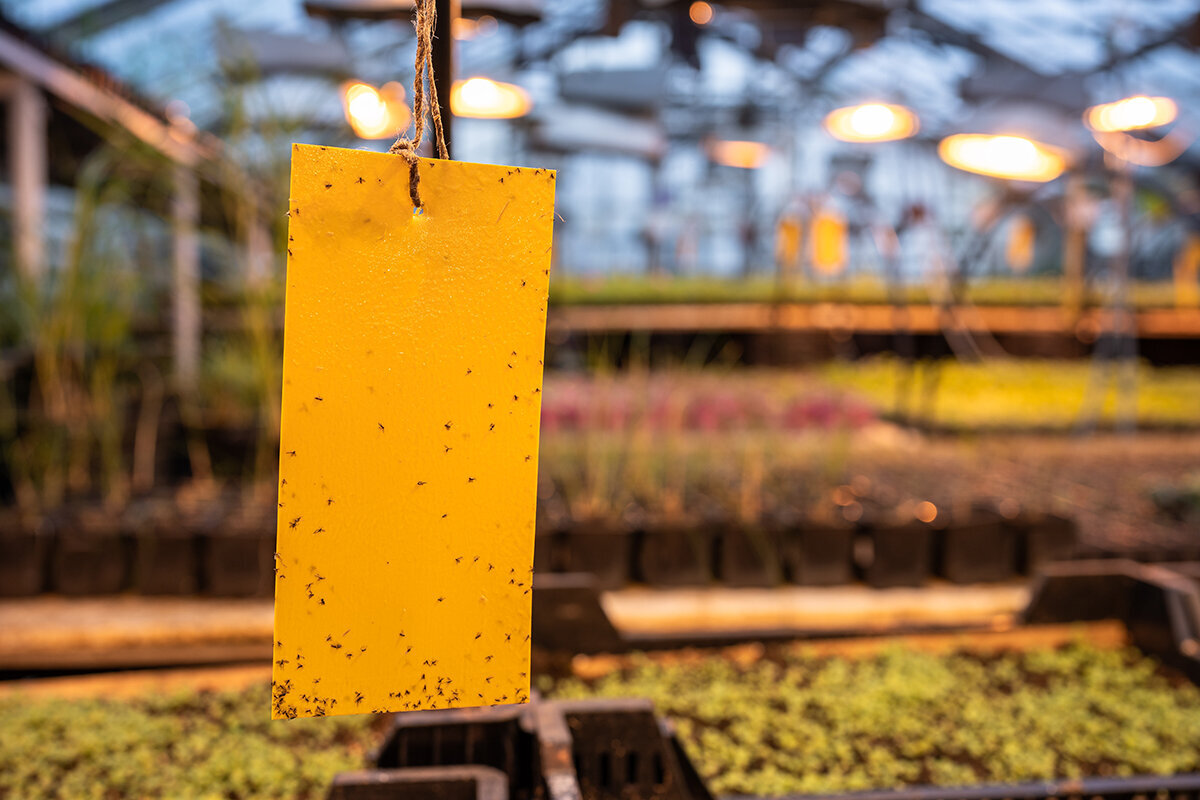
Greenhouse pest register · adults above / larvae below
Fungus Gnats in a Greenhouse: Causes, Prevention and Treatment
A yellow card can make the problem conspicuous. It cannot make the root zone healthy. In most greenhouse outbreaks, trapped adults are the visible record of a wetter biological system developing in the upper growing media.
That distinction changes the response. Catching flying adults is useful monitoring and may reduce nuisance pressure, but fungus gnat management is won or lost around moist surfaces, algae, decaying residues, vulnerable propagation material, and larvae close to the roots. The aim is not to force every pot bone-dry. It is to restore a crop-appropriate wet interval: enough water for the plant, less uninterrupted habitat for the gnat.
Read the card as evidence. If weekly catches rise, trace the moisture, sanitation and propagation conditions beneath the crop instead of treating the card as the complete solution.
First 48 hours
Protect the tender work first.
Fungus gnats are especially inconvenient in the places a serious home gardener has the most invested attention: seed trays, rooted cuttings, newly potted plants and slow-starting transplants. Established, vigorous plants often tolerate a light population; fine roots and uncallused cuttings have less margin. Start by separating the vulnerable bench from the general collection, not by spraying the entire greenhouse.
01
Pause automatic assumptions.
Check whether timers continued through cool, cloudy days or after plants slowed down. A schedule that was sensible last week can be excessive this week.
Check whether timers continued through cool, cloudy days or after plants slowed down. A schedule that was sensible last week can be excessive this week.
02
Remove standing water and algae.
Empty saucers and catch trays, clean puddles beneath benches, and deal with green films on floors, pots and irrigation areas.
Empty saucers and catch trays, clean puddles beneath benches, and deal with green films on floors, pots and irrigation areas.
03
Quarantine incoming material.
Keep new plugs, houseplants and damp bagged media away from propagation until you have inspected them and placed a monitoring card nearby.
Keep new plugs, houseplants and damp bagged media away from propagation until you have inspected them and placed a monitoring card nearby.
Identification before intervention
Not every small dark fly is a fungus gnat.
Adult fungus gnats are delicate, dark, long-legged flies, usually around 1⁄16 to 1⁄8 inch long. They are weak flyers, often hover or zigzag near pots, and may run across the media surface. On a well-positioned sticky card, long legs and antennae are clues; the characteristic Y-shaped wing vein is more reliable when visible with a hand lens.
The larva is the decisive underground clue: slender, translucent to whitish, legless, and equipped with a distinct shiny black head capsule. Look in the moist upper layer of media, not deep in the container. Larvae may be easiest to find around the wettest propagation cells or beneath decaying leaves resting on the surface.
Likely fungus gnatDelicate · long-legged
Shore flyStouter · spotted wing
Beneficial cautionCheck for a wasp waist
Working ruleConfirm habitat and pest
Likely fungus gnat
Look for weak, erratic flight, long threadlike antennae and clear wings. Fungus gnat larvae have a visible dark head and can feed on fungi, organic matter and, when pressure is high, tender roots or root hairs.
Common lookalike: shore fly
Shore flies are associated with algae and excess wetness too, but their stockier adults have pale wing spots. Their larvae lack the fungus gnat’s obvious black head and primarily feed on algae.
Do not harm beneficials
Small parasitoid wasps and predatory midges can also appear on cards. If the insect has a narrow wasp waist or you cannot identify it, inspect several specimens before assuming every tiny winged insect is a pest.
What the distinction changes
Algae control matters for both flies. Root-zone protection and larval controls matter far more when fungus gnats are confirmed. A card count alone cannot make that distinction.
The two-storey cycle
One pest, two different working levels.
Fungus gnats complete their development through egg, larval, pupal and adult stages. Timing varies with temperature, moisture and food, so avoid treating a calendar as a guarantee. The practical fact is simpler: adults are intercepted in the air, while eggs, larvae and pupae are associated with the moist growing-media surface. Break both levels of the route.
Above the crop
monitoring plane
monitoring plane
Adults→
Egg laying→
Cards record→
Adults emerge
In and near
upper media
upper media
Eggs→
Larvae→
Pupae→
Root risk
Above the crop: what cards can show
Weak-flying adults congregate around containers, lower foliage and damp media. Females select moist organic conditions near a food source for larvae. Yellow cards reveal adult activity and changes in pressure over time; they do not reveal how many larvae are in each pot. Emerging adults leave pupal sites and restart this visible phase.
In the upper media: where intervention matters
Tiny eggs are laid at or near the damp media surface. Young larvae feed where fungi, algae and decaying matter are available, then pupate in media or accumulated organic debris. High larval pressure is most consequential around seedlings, cuttings and stressed roots.
Why outbreaks start
Moisture is not the enemy. Persistently wet opportunity is.
Warm protected air + wet upper media + organic residue + repeated irrigation without a dry-back window = favorable fungus gnat habitat.
Peat-based and other organic growing media can be excellent for plants. The problem arises when the surface remains wet day after day, oxygen is limited, algae establish, leaf debris accumulates or containers sit in runoff. Fungus gnats are not proof that a greenhouse is unclean or that every plant has root damage. They are, however, a useful signal to inspect the biological conditions your irrigation routine has created.
Drainage
Water must leave.
Blocked pot holes, compacted media, saucers holding water and poorly graded floors keep the lower bench environment wet long after the crop has taken what it needs.
Algae
Green film is a clue.
Algae points to recurring surface wetness and excess nutrients. It supports shore flies particularly well and often accompanies the same overwatered conditions that favor fungus gnats.
Organic debris
Remove the soft fuel.
Dead leaves, spent plugs, old media and plant fragments can hold moisture and fungal growth. Clean them out before they become part of the next generation’s habitat.
Read symptoms carefully
Larvae can stress roots, but diagnosis still needs restraint.
Fungus gnat larvae commonly feed on fungi and decaying organic material. In high numbers, they may feed on root hairs or tunnel into tender roots. Seedlings and cuttings are the greatest concern because a modest amount of feeding can have an outsized effect on establishment. Wounds may also make already stressed roots more vulnerable to root-rot organisms.
Yet yellowing, stalled growth, wilting and poor rooting are not exclusive fungus gnat symptoms. Low light, cold media, salts, root disease, underwatering after an overcorrection, or poor transplanting can look similar. Inspect roots and moisture before assigning blame. For an overall routine that begins with daily observations, see Bloomcabin’s greenhouse gardening guide for beginners.
Healthy zoneFine pale roots; crop-appropriate moisture.
Food zoneAlgae, debris and old plug material.
Risk zoneConstantly wet top layer; confirmed larvae.
Do not assumeAdult sightings do not prove root feeding.
Useful threshold: treat any confirmed larvae around propagation as a prompt to improve the environment immediately. Waiting for dramatic wilt makes the work harder and narrows the range of gentle options.
Irrigation is the main lever
Design a dry-back cadence, not a drought ritual.
Advice to let soil dry out is only useful when it respects the crop, root volume, weather and growth stage. Basil in a small cell tray, a rooted cutting, a mature citrus container and a dormant succulent do not require the same interval. The aim is partial surface drying between irrigations where the crop permits it, while the active root zone remains appropriately hydrated.
Water when neededPartial surface dry-backRewater before drought
1. Check below the skin.
Press a finger into the top inch, lift a container, or use a moisture probe where it is meaningful for the pot size. A pale surface can conceal a saturated lower root zone; a dark surface may still be acceptable for a moisture-sensitive crop.
2. Change volume before frequency.
If a bench is repeatedly wet, review emitter output, runoff and drainage. Water deeply enough to reach roots, but do not keep topping up small amounts simply because a timer is scheduled to run.
3. Reset for weather.
Reduce irrigation after gray, cool spells and when ventilation is limited. In hot, bright conditions, crops may need more water without becoming gnat-prone if the medium drains and the upper surface gets an appropriate break.
Tomatoes are a useful reminder that crop needs come first: their irrigation changes sharply as plants size up, light rises and fruit load increases. For crop-specific context, consult Bloomcabin’s guide to growing tomatoes in a greenhouse, then apply the same principle to every container: water the plant’s root zone, not the gnat habitat by habit.
A four-station diagnosis
Triangulate the problem before escalating treatment.
A single monitoring tool sees only one part of the system. Use cards, media checks, root checks and a simple written record together. That turns an annoying cloud of flies into usable information: where pressure is highest, whether larvae are present, and whether the cultural correction is working.
Yellow cards
Adult activityLarval check
Near-surface larvaeRoot inspection
Crop vulnerabilityWatering record
Habitat patternYellow cards
Place cards just above the canopy or near media level in vulnerable areas. Date them, use the same placement each week, and compare trends rather than obsessing over one isolated catch. They reveal adult activity, not the number of larvae in every pot.
Larval check
Inspect wet upper media, or use a small raw potato slice or wedge as a short-term sampling aid, then check it after the interval recommended by your extension source. This reveals active larvae near the surface, not the entire root-health picture.
Root inspection
Choose a representative struggling seedling or plug. Look for healthy fine roots, decay, excess wetness and confirmed larvae before deciding whether gnats are a primary driver. It reveals crop vulnerability, not adult flight pressure elsewhere.
Watering record
Write down irrigation, cloudy spells, leaks, algae and card counts. A short weekly note often makes the source obvious when memory does not. The record reveals a habitat pattern, but cannot identify the insect species by itself.
Prioritized treatment pathway
Start wide with habitat correction, then narrow to larval control.
The most dependable program layers compatible measures. Begin with the conditions that are feeding the population. Add biological tools where larvae are confirmed or pressure is persistent. Use products only where the current label permits their use on your crop and site, and never assume a product suitable for ornamentals is suitable for edible crops.
1
Drainage, dry storage and sanitation
Clear saucers and puddles, remove algae and decaying plant matter, discard badly infested old media when sensible, and keep unopened growing media dry and protected from tears. Correct blocked drain holes and review irrigation uniformity. This is the work that prevents a fresh wave after other controls are applied.
Best for:
Every outbreak, every crop, every season.
Every outbreak, every crop, every season.
2
Physical management and crop handling
Use yellow cards for detection and to lower adult nuisance, but do not substitute mass trapping for larval management. Remove senescent leaves from media surfaces, give plants room for air movement, and avoid keeping propagation cells wet simply because neighboring mature plants need water.
Best for:
Low to moderate pressure and early intervention.
Low to moderate pressure and early intervention.
3
Biological controls for larvae
Depending on availability, crop, temperature and your growing method, options may include Bacillus thuringiensis subspecies israelensis (Bti), beneficial nematodes such as Steinernema feltiae, and soil-dwelling predatory mites such as Stratiolaelaps scimitus. These are living or biologically active tools, not decorative additions: follow supplier instructions on storage, mixing, water quality, timing, temperature and compatibility with other pesticides.
Best for:
Confirmed larvae, propagation areas and preventive programs.
Confirmed larvae, propagation areas and preventive programs.
4
Locally permitted products, used with precision
When cultural and biological measures are insufficient, choose only products currently labeled for the exact use site, crop and pest in your state. Read restrictions, re-entry requirements, pollinator statements and compatibility guidance. Broad-spectrum sprays can disrupt natural enemies and often leave the wet root-zone cause untouched.
Best for:
Persistent situations after accurate identification.
Persistent situations after accurate identification.
Compatibility check: beneficial nematodes and predatory mites need suitable moisture but do not tolerate every tank mix, sanitation product or residual insecticide. Plan the biological release and product program as one system; consult the live product supplier and the pesticide label before combining interventions.
Propagation-area reset
Make the next tray less hospitable from day one.
After a crop cycle, remove spent plant material and loose media from benches, floors and drainage channels. Wash trays and tools, clean algae from splash zones, and check that bench surfaces drain instead of holding a thin film of water. Start new propagation with clean containers, fresh media stored dry, labeled trays and a few dated monitoring cards already in place.
Then give each crop its own water logic. A misted cutting bench has different constraints from a tomato transplant bench, and neither should dictate the watering of the other. Separate zones whenever possible; it is both more precise horticulture and a quieter way to manage greenhouse pests.
The clean bench sequence
EmptyRemove debris and old media.
WashClean trays, tools and surfaces.
DryRepair leaks; clear standing water.
MonitorDate cards before planting.
For a greenhouse designed as a long-term garden room as well as a productive workspace, use layout and ventilation choices to make that routine enjoyable. Explore the durable, configurable Bloomcabin Classic Aluminum Greenhouse and plan bench access, roof ventilation and a dedicated propagation corner around the work you actually do.
Frequently asked questions
Practical answers from the potting bench.
The right response is usually calm observation plus a coordinated reset, rather than a single dramatic product or an indiscriminate drying spell.
Will yellow sticky cards get rid of fungus gnats?
They can capture adults and are excellent for monitoring where activity is concentrated, but they do not directly control the larvae in growing media. Keep cards in the program, then correct wet conditions and target larvae where necessary.
How dry should I let greenhouse pots become?
Only as dry as the crop can safely tolerate. Encourage partial drying of the upper media surface where appropriate, but do not let young cuttings, seedlings or moisture-sensitive plants suffer whole-root-ball drought. Use pot weight, media feel and crop appearance instead of a universal number of days.
Can fungus gnats damage mature plants?
They are often principally a nuisance around mature plants, but high larval populations can feed on fine roots. Damage is more consequential in seedlings, cuttings and stressed plants. Examine roots and confirm larvae before attributing every decline to gnats.
Are shore flies treated the same way?
Both pests benefit from cleaner, drier surfaces and algae control, but shore flies are more closely tied to algae and do not usually feed directly on roots. Their stout body and pale wing spots help distinguish them from delicate long-legged fungus gnats.
Should I use Bti, nematodes or predatory mites?
Choose according to crop, infestation level, temperature, availability and the rest of your IPM program. All work against larval stages in different ways and require careful storage, timing and label or supplier directions. They perform best when drainage, sanitation and irrigation are already being corrected.
Sources & further reading
Extension-led references for identification and integrated management.
Product availability and legal use directions change. For any pesticide or biological-control purchase, consult the current product label, supplier guidance and your state extension resources in addition to the references below.
- University of Connecticut IPM — Managing Fungus Gnats in the Greenhouse
- Virginia Tech — Fungus Gnats
- UC Statewide IPM Program — Fungus Gnats
- University of New Hampshire Extension — Fungus Gnats Fact Sheet
- University of Wisconsin–Madison Extension — Fungus Gnats and Shore Flies in Greenhouses
- Penn State Extension — Common Insects Found on Sticky Cards in High Tunnels
A repeatable weekly ritual
Reset the wet interval.
A greenhouse free of fungus gnat pressure is rarely the result of one perfect trap or one forceful treatment. It is a small, disciplined inspection repeated before wet media becomes a permanent habitat.
Inspect moistureCheck the upper media and the lower root zone before the next scheduled watering.
Empty standing waterWalk saucers, trays, benches and floor edges; remove the lingering wet places.
Read the cardsDate catches and compare with the previous week rather than guessing from memory.
Examine vulnerable rootsInspect a representative cutting, plug or seedling when numbers rise or growth stalls.
