
Galvanized Raised Planters: What to Check Before You Buy

Bloomcabin · Raised-bed guides
Galvanized Raised Planters: What to Check Before You Buy
Galvanized raised planters can be a good fit if the supplier documents the steel and coating for your intended use and the planter is designed for your site. On prepared ground, an open-bottom frame may work. On a patio, look for a container that holds its own growing mix, has suitable support, and drains where you need it to.
Verify the material
Ask what steel and coating the exact model uses, not just whether the listing says “galvanized.”
Look underneath
Galvanized raised planters can be open frames or soil-retaining containers. Check for a floor before buying for pavement.
Check the usable space
Measure usable fill depth separately from wall height, and leave working space around the planter.
Get suitability in writing
For vegetables, look for a model-specific statement covering the intended growing use.
Two galvanized raised planters can look alike from above and work very differently once filled. One may be a set of walls intended to sit on soil. Another may have a floor and outlets so it can stand on paving. If you are growing food, the word “galvanized” alone also does not tell you what the supplier has documented about the surfaces that touch the growing mix.
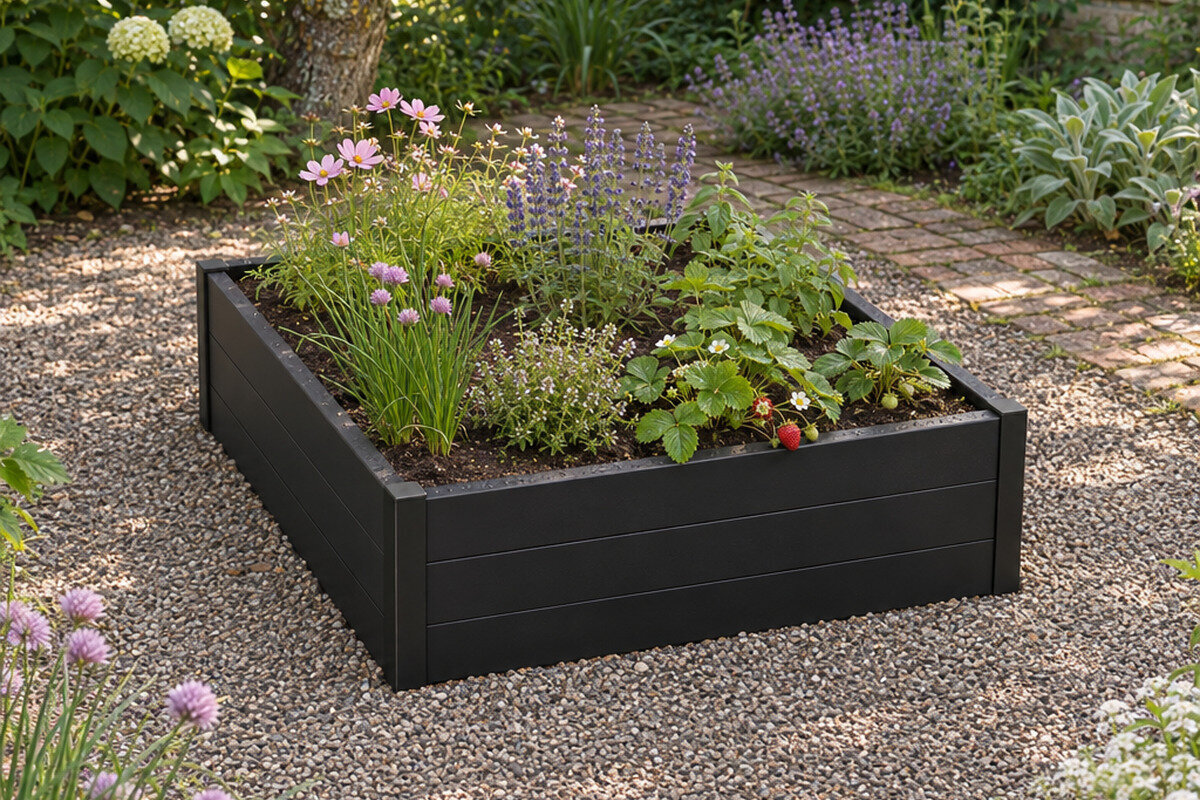
Use this guide to check a listing and its instructions before you order. Start with the material and intended use, then measure the site and follow the water from the growing mix to wherever it will drain. The Bloomcabin beds shown alongside this guide are documented aluminum or aluminum-and-Accoya alternatives, not galvanized steel examples.
01
Read past the word “galvanized”
In galvanized raised planters, galvanizing refers to the zinc coating that protects the steel underneath. That tells you the basic type of finish, not the coating specification, the panel thickness, or whether an additional finish is applied to the soil-facing side. A silver surface or a corrugated panel tells you even less: neither establishes what the metal or coating is.
Compare the structure as a whole. When two galvanized raised planters list similar panel thicknesses, the panel profile, length between supports, and way the sides join are also worth checking. A thickness figure alone does not tell you how much growing mix the assembled planter is designed to hold. If the configuration uses a floor, also ask how that floor is supported and what filling limits apply. A photograph that shows the outside walls may not show those parts at all.
- Request the base metal and grade, the protective coating or treatment on each face, and the base-metal thickness. If the listing gives a gauge or a coated thickness, ask the supplier to clarify what it measures.
- Confirm fastener materials, required bracing, and what protects exposed top edges. Ask whether those parts are included in the configuration you are buying.
- Save the specification sheet and installation instructions for the same model and size. A document for another planter in the same range does not confirm the construction of yours.

02
Check what the documentation says about edible crops
If you are shopping for galvanized raised planters for lettuce, herbs, or other edibles, look for a supplier statement that covers growing edible crops in that exact planter. Ask whether the statement applies to every surface the growing mix touches, including any floor, coating, liner, or finish supplied for the inside. If a seller cites a standard or test, ask what was evaluated and whether the result applies to the finished planter or only to one component.
An intended-use statement and an independent test are not the same thing. A statement can tell you how the supplier intends the product to be used; it does not establish a certification or guarantee that the supplier has not documented. Likewise, descriptions such as “outdoor” or “weather resistant” answer a different question. They do not tell you whether the seller recommends the planter for herbs and vegetables.
Be especially careful with secondhand galvanized raised planters or repurposed metal containers. A clean appearance does not identify a previous coating, repair, or use. If you cannot confirm the history and composition, choose a documented product for an edible planting instead of assuming that a coat of paint or a liner resolves the uncertainty. Before ordering new, put the exact model number in your inquiry so you can compare the reply with the listing and instructions.

03
Decide whether you need a floor
Some galvanized raised planters are frames that sit on prepared ground; others have a floor that retains the growing mix. An open-bottom frame depends on the site underneath it. Look at how the ground drains and whether the existing soil is appropriate for the crop. If water collects in the proposed location or you have reason to question the soil, don't count on the walls to solve the problem.
On pavement, look for a planter designed to retain soil and drain on that surface. Find the outlets in the instructions and work out where the water will go once the planter is in place. A drain near the lowest point is of little use if placement blocks it, and a container that drains across a walking route may be a poor fit even when its dimensions work. Confirm the intended support and, where surface loading is a concern, verify that the site can carry the filled setup before buying.
Don't assume the store photos show patio containers. The listed Bloomcabin models, including the Narrow Aluminum Raised Garden Bed 39.37×19.69×3.94 in, have open bases for prepared ground. That narrow model is an example of a ground-level frame, not one of the galvanized raised planters discussed here. It is worth comparing only if you can use an open base and aluminum meets your material requirements.

04
Measure the growing space, not just the outside
Take two sets of measurements when comparing galvanized raised planters. First, note the nominal outside dimensions and ask whether rims, supports, or other projections extend farther. Mark the footprint on the site and check that you can still use doors, reach the back of the planter, and get to the drains. If the planter will sit against a wall, test your reach from the side you can actually stand on.
Next, check the interior dimensions at the depth where the roots will grow. A listed planting area may be nominal, and taper, dividers, or a wide rim may change the usable space. For a planter with a floor, look for the depth between the base of the growing space and the recommended fill line. The advertised wall height may include space above that line. With an open frame, total rooting depth may extend below the walls if the underlying soil is suitable and roots can enter it.
Use seed packets and local Extension guidance to determine what your plants need rather than shopping by a fixed height for all vegetables. Then compare the fill requirements of galvanized raised planters that meet those needs. A simple rectangular interior can be estimated from its usable length, width, and fill depth. Use the supplier's fill-volume guidance for tapered or divided designs instead of multiplying the overall outside dimensions.

05
Check the build and drainage before filling
Before ordering galvanized raised planters, request the assembly instructions for the size you intend to buy. Check what tools and parts are needed, how the floor or frame is supported, and when the sides, braces, and fasteners go in. If the instructions depend on access from both sides during assembly, make sure your proposed location allows it, even if you'll only garden from one side afterward.
When the parts arrive, lay them out against the parts list and follow the manufacturer's sequence. Don't substitute fasteners because they look similar, leave out a brace to make room for a pot, or drill a hole to move an outlet without checking with the supplier. The connections and drainage details on another planter are not instructions for yours.
Before filling galvanized raised planters, make one final check of the location and drainage route. Filling should come after the structural and site checks, not before: if a support is missing or an outlet is blocked, it is easier to address while the planter is still empty.
- For a floor-bearing planter, confirm the specified supports are in place and the outlets are accessible after placement.
- For an open frame, check that the base sits on the prepared ground as directed and that the planting area is reachable from the planned working sides.
- If a panel arrives with a damaged finish, a sharp edge, or a joint that will not seat as shown, contact the supplier before filling.

06
Keep the finish, hardware, and outlets in view
When comparing galvanized raised planters, ask for care instructions that cover both the finish and the hardware. Find out what the supplier recommends for cleaning, what to do if the coating is damaged, and whether you can order a replacement fastener or panel. Those answers are more useful than assuming a planter is maintenance-free because it is made of metal.
During the growing season, look for blocked outlets, loose joints, shifting supports, or visible damage to the finish. You can do that when clearing debris or changing crops rather than following an arbitrary inspection calendar. If you notice a damaged coating on the soil-facing surface, ask the manufacturer what repair, if any, it recommends for that model and intended use. Do not apply an unspecified treatment inside a planter you use for food crops.
Plant care is a separate task. If a container seems slow to drain, check the outlet and the moisture in the mix before adding more water. If you are deciding when to irrigate galvanized raised planters, check the growing mix and the stage of the crop instead of treating the metal finish as a guide to watering frequency. Newly sown crops and established plants may call for different attention.

07
Worked example: Choose between two patio candidates
Hypothetical example: Taylor is comparing two galvanized raised planters for lettuce and parsley on a paved patio. The crops suit the local season, and Taylor has reserved a 48-by-26-inch spot after leaving room for a walkway. Assume the local growing guidance for these crops is consistent with the usable fill depth in the first candidate.
The first candidate has a floor designed to retain growing mix and a nominal outside footprint of 42 by 22 inches. Its instructions confirm a rectangular interior that is 36 by 18 inches with 12 inches of usable fill depth. Converting those interior dimensions gives 3 feet × 1.5 feet × 1 foot, or 4.5 cubic feet of growing mix to the fill line. That is a volume estimate, not a filled-weight estimate. Taylor still needs to confirm that the outside dimensions include any projections and that the patio can support the filled planter.
The second candidate has a similar outside footprint but is an open-bottom frame for prepared ground. Taylor rules it out for the patio, even if its steel and coating are fully documented. The first candidate stays on the list only if the supplier confirms the finish and intended edible use, and the drain can be positioned away from the walkway. The comparison shows why galvanized raised planters that look similar from above can be unsuitable for entirely different reasons.

Questions readers ask
Are the Bloomcabin beds shown here galvanized raised planters?
The supplied specifications identify the Classic wall panels and corner posts as aluminum. The Accoya fusion example combines aluminum with Accoya boards at the top of the walls. Neither is documented as a galvanized steel planter. The listed beds are open at the base, so they are not substitutes for a patio container that needs to retain its own soil.
Do galvanized raised planters need a liner?
Do not assume one is required or that adding one makes an undocumented planter suitable for vegetables. Follow the instructions for the exact model. If the supplier calls for a liner, confirm what type to use, how it fits, and how water is meant to reach the outlets.
Can I reuse a galvanized metal container as a vegetable planter?
For edible crops, choose a container whose composition, finish, and previous use you can verify. An unknown coating or uncertain history remains a reason to choose a better-documented option. Also check whether the container is intended to hold growing mix and drain without improvised modifications.
Buy for the site as well as the material
Put the material specification, intended-use statement, and installation instructions side by side before choosing among galvanized raised planters. If any one of them leaves a question that could change the purchase, such as whether the floor is included or whether the finish is intended for edible growing, get the answer for that exact model before you order.
Find a raised bed for your plan
Compare layouts and check the dimensions on the product page.
