
How to Grow Orchids in a Greenhouse
Bloomcabin USA / greenhouse growing notes
How to Grow Orchids in a Greenhouse
An orchid greenhouse is not a tropical fantasy. It is a measured pavilion for filtered light, moving air, clean water and roots that become wet—then airy again.
The epiphyte premise
The most successful greenhouse orchid collection is arranged around what happens between the roots—not around the color of the flowers.
Most popular greenhouse orchids are epiphytes: plants that anchor themselves in trees or on rock rather than living in ordinary garden soil. Their roots are adapted to intercept water, hold briefly to a surface and breathe freely between rain events. A glazed house gives you the rare opportunity to orchestrate those conditions: bright but moderated light, humidity without stagnation, and temperatures that change gently from day to night.
It also intensifies every mistake. A small greenhouse can overheat quickly, a dense collection can remain damp after watering, and a single new plant can introduce pests into an ideal breeding ground. The objective is not to imitate a jungle at every moment. It is to make a stable, observable environment in which compatible orchids experience their own rhythm of wetness, drying, growth and rest.
Start with labels. Genus, hybrid name and source culture notes are more useful than a generic instruction such as “water weekly.” Light level, bench position, pot size, medium, season, active growth and local weather all change the drying rate. A collection becomes easier as it becomes more legible: orchids with similar needs are grouped together, and their roots can be inspected without moving half the bench.
For a first dedicated orchid room, choose adaptable hybrids before building around difficult species. A thoughtful greenhouse layout—such as the staging and circulation principles in Bloomcabin’s greenhouse setup guide—will serve plants better than a large but undifferentiated assortment.
A useful distinctionEpiphyte describes where a plant grows, not a parasite. It uses a branch or mount for support. Terrestrial orchids grow in ground-like media and commonly need a different moisture pattern. Always follow the requirements of the particular orchid or hybrid in front of you.
01 / Choose an achievable climate
Select orchids by habitat, habit and experience.
Temperature categories are planning tools, not guarantees. Within any genus, species and hybrids may differ substantially. Use the plant tag and a reputable specialist’s culture guidance as the final authority.
Warm
Protected winter warmthIntermediate
Moderate day and night rhythmCool
Summer heat reliefWarm-growing choices
Warm growers suit a greenhouse where winter nights can remain reliably mild and cold glass is not allowed to chill foliage. Many Phalaenopsis, vandaceous orchids and warm-growing dendrobiums fit this direction, although their light requirements differ. A warm house still needs ventilation: heat and humidity without fresh air are not a tropical climate, but a disease risk.
Intermediate-growing choices
This is often the most practical starting point for a mixed American home collection. Many hybrid cattleyas, oncidium-alliance orchids, Brassia and selected dendrobiums respond well to a broad middle climate with moderate nights and the ability to vent heat. It is a useful category because it leaves room to create brighter and shadier bench positions.
Cool-growing choices
Cloud-forest orchids can be extraordinary, but they are demanding because summer cooling is the crucial test. Some masdevallias, coelogynes and former odontoglossum types require bright, humid, continuously fresh air alongside genuinely lower temperatures. Do not buy a cool grower simply because its flowers are beautiful if the greenhouse remains hot at bench height in July.
A practical U.S. greenhouse rule: build a dependable intermediate or warm zone first, then add cool growers only after recording summer maximums at plant level. A thermometer at the roof tells a very different story from one beside the leaves.
02 / Light is a position, not a setting
Turn glazing, bench height and shade into a light pavilion.
Greenhouse sectionSeasonal sun
HighFiltered bright light
BenchModerated exposure
LowerProtected shade
Air routeLow intake to roof vent
A seasonal shading essay
Measure first. Shade second. Adjust again.
In much of the United States, the same greenhouse can be dim in January and punishing in July. Begin with a light meter if possible, but use plant response as well. Leaf warmth, bleaching, unsuitable red stress pigmentation, weak growth and absent flowering can all provide clues. Bright green leaves are commonly a good sign for many orchids, although foliage color is never a complete diagnosis.
The upper zone is the brightest and hottest part of the house, making it suitable for carefully acclimated high-light orchids. Mid-bench positions often become the working heart of an intermediate collection. Lower and more protected positions can be helpful for shade-tolerant orchids, but no plant should be placed in a dead corner where humid air sits still.
Exterior shade cloth or an adjustable shade system held away from the roof intercepts solar energy before it enters the interior. Interior fabric can still be useful, but it does not prevent the same degree of heat gain. Seasonal, adjustable shading is more refined than holding the greenhouse in heavy shade all year. Bloomcabin’s overview of greenhouse finishes, shading and accessories is a useful reminder that shade, staging and ventilation operate as one system.
Acclimate every new orchid gradually. A plant raised under lights or in a shaded nursery should not be placed under the roof on its first bright spring weekend. Move it in increments, watch it for several days, and remember that clear cold weather can also create surprisingly high leaf temperatures against glazing.
03 / The root laboratory
Water thoroughly. Then let oxygen return.
For most epiphytic orchids, the decisive skill is learning each plant’s drying curve—not enforcing a calendar.
Read the wet–dry cycle.
Healthy exposed roots are often silver-green or pale when dry and turn greener after they take up water; the velamen layer changes appearance as it wets. That visual cue is useful, but it is not universal. Roots inside opaque pots, roots covered by old medium, terrestrial orchids and different genera will not all read the same way. Combine root observation with pot weight, media texture, weather and the plant’s growth stage.
Velamen cycle
Dry
Water
Absorb
Drain
Re-aerate
Water in the morning whenever practical. This gives foliage, crowns and greenhouse surfaces time to dry before the coolest part of the night. Run water through the medium rather than offering a superficial sip, and avoid leaving water in the crown of plants vulnerable to crown rot. In hot, bright weather, a small mounted orchid may need water frequently; a large plant in a water-retentive pot may not. Both can be correct.
Water quality and humidity are separate conversations.
Rainwater is prized by many orchid growers because it is typically low in dissolved salts, but it should be collected and stored cleanly. If you use municipal or well water, learn what it contains. Hardness, alkalinity and dissolved salts can accumulate in bark and on roots. Periodic flushing with lower-mineral water, careful fertilizer concentration and observation of leaf tips can prevent a small chemistry problem from becoming chronic stress.
Humidity supports a plant, but it cannot replace water at the roots. Many orchids do well in a moderately humid greenhouse, and some collections run more humid than a typical room. The essential condition is balance: humidity without air movement can favor disease, while excessive fan force can dehydrate plants. Gentle fans should barely move leaves, disrupting damp pockets without creating a drying wind or cold draft.
Roof vents, side vents and circulation fans are a coordinated answer to heat, moisture and disease pressure. For a structure that can be adapted around this equipment, explore Bloomcabin’s greenhouses and conservatories collection alongside the site’s guidance on automatic window openers.
04 / Media is architecture
Choose the vessel that fits the roots and your greenhouse.
A potting medium is not soil. It is a temporary architecture of moisture, air space, anchoring and access to the root zone.
Pot
Basket
Mount
Pot
A pot offers stability and a measured reservoir of moisture. Clear pots can help with root observation, while slotted pots increase gas exchange. Match bark grade and water retention to root thickness, climate and watering habits rather than choosing a container purely for appearance.
Basket
A basket provides rapid drainage and room for roots to travel. It can be useful for vigorous hanging orchids, but it asks for dependable humidity and a grower who can water with appropriate frequency. A basket is not automatically better; it simply produces a faster drying rhythm.
Mount
A mount on cork or wood creates an airy, natural presentation. Mounted orchids can be both beautiful and healthy, yet their roots dry quickly. Reserve them for a greenhouse environment and daily routine that support their faster watering requirement.
Coarser media is frequently appropriate in a humid greenhouse because frequent watering and elevated ambient moisture slow drying. Fine mixes and large quantities of sphagnum can remain wet too long in the wrong circumstances. Conversely, small-rooted plants and plants in hot, low-humidity conditions may need more moisture retention. There is no prestige in the coarsest mix; the right mix drains freely while maintaining a suitable interval before the next watering.
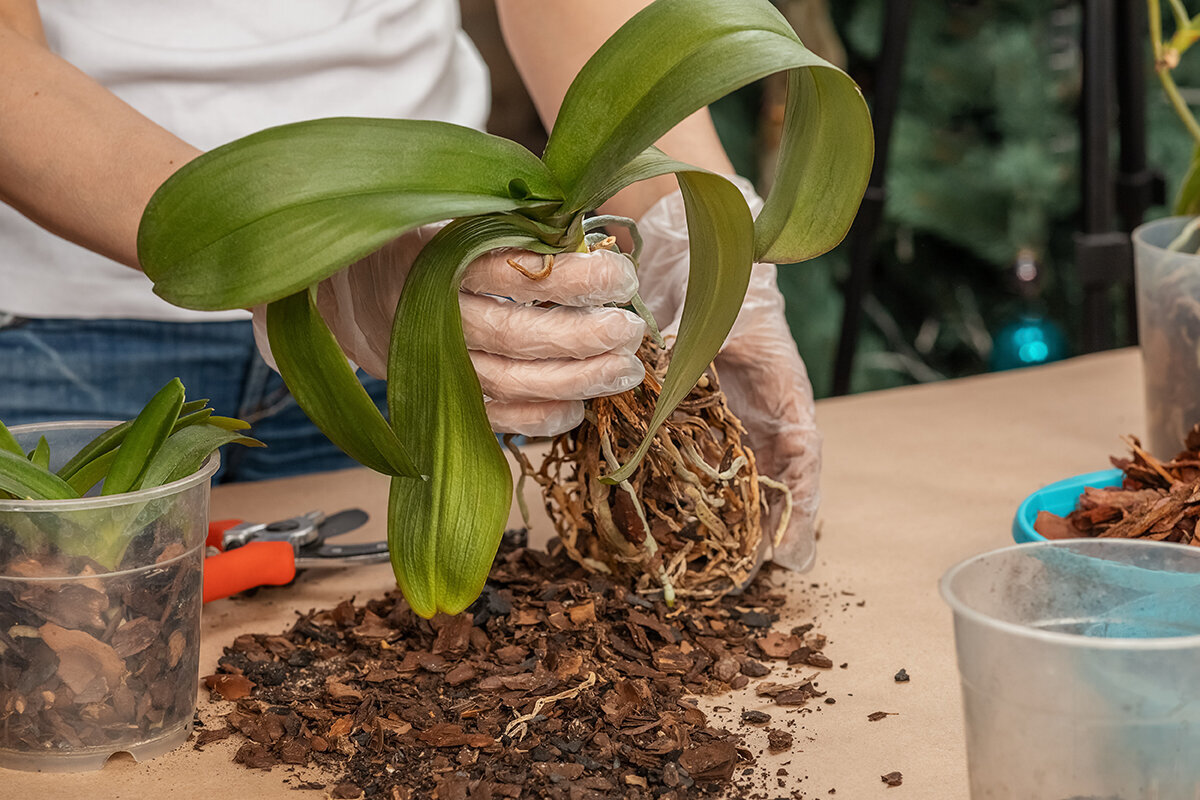
Repot when the medium breaks down, drainage declines, salts accumulate, new roots need room, or the plant has outgrown the container. For many sympodial orchids, repotting just as new root growth begins improves establishment. Use clean tools, remove only clearly dead or rotten roots, secure the plant so it cannot wobble, and avoid disturbing a plant in full stress or active flowering unless there is an urgent health reason.
05 / Growth makes the calendar
Feed and repot in response to active growth.
Plants use water and nutrients differently when extending roots, making a new leaf, swelling a pseudobulb, resting, or preparing to flower.
Roots
Leaves
Pseudobulbs
Spikes
Rest
Fresh root tips indicate a period when a plant can establish well after repotting and use nutrients actively.
Monopodial orchids grow from a continuing crown. Keep standing water from lingering in that crown.
Many sympodial orchids store water and energy in thickened stems. Old bulbs may still feed new growth.
Flower spikes emerge from different places depending on the plant: nodes, new growth, canes or the crown.
Some orchids expect a drier, cooler or lower-feed interval. A pause is not automatically a deficiency.
Fertilizer: modest, consistent, flushed.
Use a complete fertilizer formulated for orchids or a balanced product appropriate for your water and medium, always following the label. Apply more readily when a compatible orchid is actively growing, then reduce or pause when its species-specific rest period calls for it. Low concentrations delivered consistently are often easier to manage than occasional strong doses. Flush periodically with plain water to reduce fertilizer-salt accumulation, especially where water quality is challenging.
Reblooming: solve the environment first.
When an otherwise healthy orchid does not bloom, begin with identification and light. Then review the day–night temperature difference, seasonal rest, root condition, maturity and fertilizer habits. A mature cattleya hybrid may need substantially brighter conditions than a phalaenopsis; some dendrobiums require a particular seasonal change. Do not cut, chill or starve a plant into flowering based on advice meant for another orchid.
06 / Basalt quarantine chamber
A beautiful collection deserves a disciplined threshold.
Warm, wet greenhouse conditions can accelerate pests and disease. Make every new orchid earn its place on the main bench.
New-plant intake
- Keep the newcomer apart from the collection, ideally in a separate growing space or clearly isolated area.
- Inspect leaf undersides, sheaths, roots, pot rim and flowers for scale, mealybugs, mites, thrips, snails and suspicious spotting.
- Remove dead debris, sanitize benches and tools, and do not let drainage from a new plant run toward established orchids.
- Monitor through a meaningful interval, especially after warmer days reveal activity. Record what you see rather than relying on memory.
Symptom triage
- Soft, dark roots or sour medium: review drainage, medium breakdown and watering frequency; isolate if rot is advancing.
- Sunken or spreading lesions: improve sanitation and airflow, isolate the plant, and seek a diagnosis before treating indiscriminately.
- Sticky residue or cottony clusters: inspect neighboring plants for sap-feeding insects and act promptly.
- Wrinkled leaves: do not assume thirst. Root loss, heat, salt damage or failing medium can prevent water uptake.
Avoid routine chemical treatment “just in case.” Correct identification, label-compliant products, physical removal where appropriate and cultural correction are safer than spraying an enclosed greenhouse without a plan. If a problem is persistent or unusual, consult a local extension resource, orchid society or qualified horticultural professional.
07 / Build a collection with composure
Group by climate—not by flower color.
A bench becomes easier to water, shade and monitor when nearby orchids share an environmental rhythm.
Put thirstier, lower-light orchids where you naturally inspect them and where air is still moving. Give brighter, quicker-drying plants the upper or more exposed positions they genuinely need. Keep mounts together so their faster watering requirement does not dictate the routine for every potted orchid. Reserve a small clear area for new arrivals, recovery plants and work in progress.
Think vertically. Hanging plants use the warm, bright upper volume; lower benches can offer moderation. But protect access: every plant should be reachable, labels readable and roots visible. Good spacing is not wasted space—it is the ability to notice a problem before it moves through the room.
A Classic Aluminum Greenhouse can be planned as a filtered-light orchid zone rather than a general-purpose shed: leave a clear central aisle, establish a warm or intermediate bench first, and add shade, airflow and staging as the collection reveals what it needs. For a considered architectural starting point, Bloomcabin’s greenhouse design overview offers useful perspective on choosing scale and format for an American yard.
High lightHanging growers
Mid benchCore hybrids
Lower zoneProtected shade
ThresholdQuarantine
Use this as a starting composition, not a fixed prescription. The greenhouse’s real light, airflow and drying pattern should determine where each group finally lives.
Frequently asked questions
The details growers ask after the first season.
What temperature should a greenhouse be for orchids?
There is no single orchid temperature. As a broad planning reference, warm growers commonly need winter nights around 59°F (15°C) or above, intermediate growers tolerate cooler nights, and cool growers need real summer relief. The exact cultivar or species label overrides any broad category. Measure temperatures at plant level, day and night, before expanding the collection.
Do orchids need high humidity in a greenhouse?
Many orchids perform well with more humidity than a typical home, while some greenhouse collections operate higher still. The essential condition is balance: humidity without air movement can encourage disease, whereas excessive fan force can dehydrate plants. Aim for gentle circulation, foliage that dries appropriately, and roots that receive suitable water.
How often should greenhouse orchids be watered?
Water when the medium has reached the dryness appropriate to that particular orchid, before the plant becomes stressed. Pot size, bark grade, root mass, light, heat, humidity and season all matter. Orchids with pseudobulbs often tolerate a more complete dry-down than many phalaenopsis or paphiopedilums, but individual care instructions remain essential.
Can I use tap water for orchids?
Often yes, but water chemistry matters. Very hard or alkaline water, or water with substantial dissolved salts, can make fertilizer management more difficult and leave deposits in the medium. If possible, obtain a local water report or test your water. Rainwater or treated low-mineral water can be valuable when collection and storage are sanitary.
Why are my orchid leaves wrinkled when the pot is wet?
Wrinkling is a water-balance signal, not automatically a request for more water. Roots damaged by rot, old compacted medium, salt injury, excessive heat or pests may not absorb moisture even from a wet pot. Inspect the roots, medium and greenhouse temperature before increasing irrigation.
Can cool-growing orchids live in a typical backyard greenhouse?
Only if the greenhouse can hold their preferred conditions through the hottest season. In many U.S. locations, summer heat is the limiting factor, not winter cold. A fan alone may not make a hot glasshouse suitable for cloud-forest orchids; shading, ventilation, evaporative cooling and a favorable climate may all be necessary.
Research folio
Sources &
further reading
Culture guidance varies by genus, species and hybrid. These authoritative references informed the general greenhouse principles in this article; consult current specialist, society or extension guidance for the specific orchid you own.
- American Orchid Society — Caring for Orchids in the Greenhouse
- American Orchid Society — Greenhouse Orchid Care
- American Orchid Society — General Orchid Care Basics
- American Orchid Society — Watering
- Iowa State University Extension — How to Repot an Orchid
- University of Connecticut — Orchid Care and Repotting
