
Hydroponic Greenhouse Beginner’s Guide
Bloomcabin field guide / United States
Hydroponic
Greenhouse
Beginner’s Guide
Start at the waterline: a simple crop above it, a stable root environment below it, and a routine that lets you notice small changes before they become expensive problems.
Chapter 01 / the simple definition
Hydroponics is plant growing without soil, not plant growing without care.
The useful correction
In hydroponics, roots receive water and dissolved mineral nutrients through a deliberately managed solution. They still need oxygen, an appropriate temperature, support, light, airflow, cleanliness, and a grower willing to inspect the system.
That is why a greenhouse is such a compelling setting. It gives you shelter, access, and a place to organize water and plant care—but it does not erase heat, humidity, or equipment management. Begin with an uncluttered layout inside a greenhouse rather than trying to fill every square foot at once. Explore the full Bloomcabin greenhouse collection with circulation and servicing in mind.
ReservoirThe covered vessel that holds the nutrient solution.
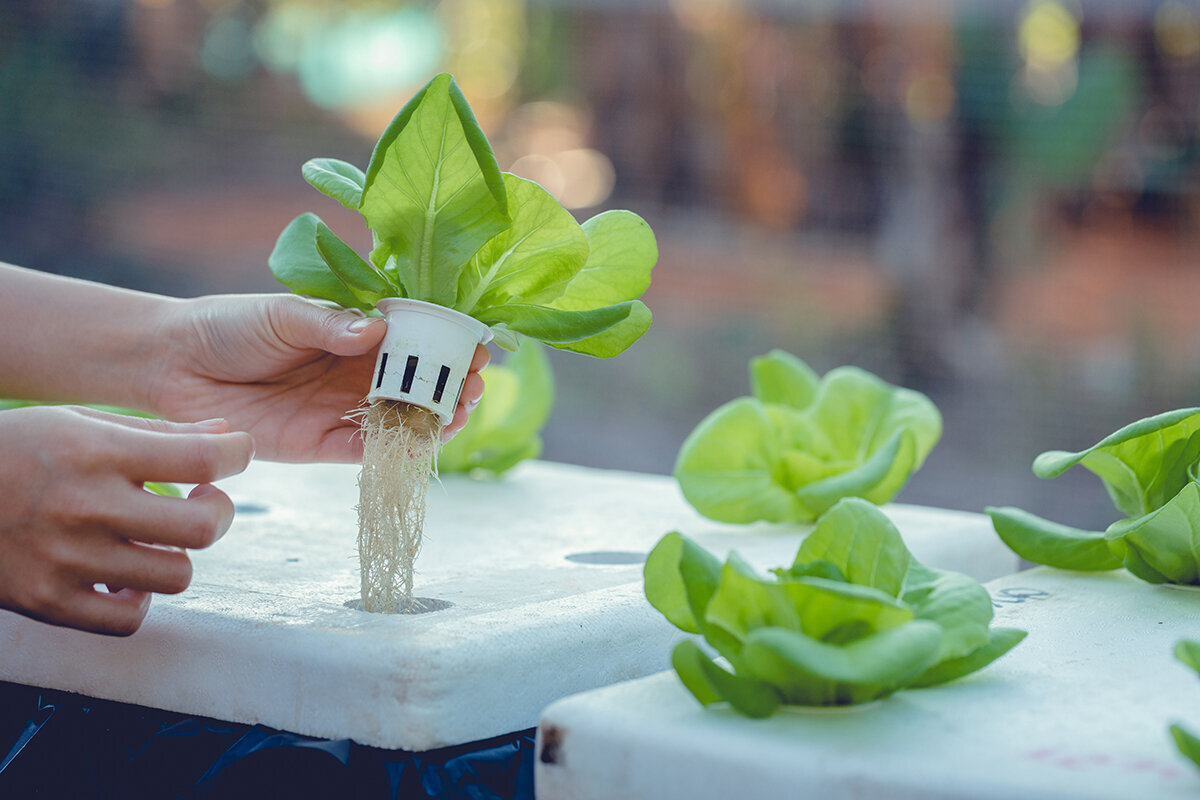
Net potA perforated pot that supports the plant while allowing roots to reach air and solution.
ECElectrical conductivity: a practical reading of dissolved salts, used as a nutrient-strength guide.
Root zoneThe whole working environment around the roots: solution, air, temperature, support, and sanitation.
Chapter 02 / choose success first
Grow a crop that teaches you the system.
Best first crop: loose-leaf lettuce is quick, compact, and visually responsive. Basil is equally satisfying once its roots are established. Both let you practice solution checks and harvesting without the long timeline, trellising, and high demand of fruiting crops.
For a first greenhouse reservoir, choose one crop and one variety. Leafy greens and herbs make their needs visible: pale new growth, slow roots, a falling water line, or a pump that sounds different are all easier to spot before a plant has become a dense canopy.
Tomatoes, cucumbers, peppers, and strawberries can all be grown hydroponically, but they deserve a second chapter. They ask more of the greenhouse: larger reservoirs, stronger support, higher light, more precise feeding, pruning, pollination, and more active heat management. A first crop should build your eye, not test your endurance.
Buy healthy plugs or start seeds in a clean propagation medium suited to hydroponics. Keep the first crop modest—six to twelve leafy plants in a 5- to 10-gallon reservoir is a far more informative beginning than a crowded experimental wall.
Chapter 03 / follow the water
Four system families, one question: where do roots find air?
There is no universally best hydroponic system. The appropriate first choice is the one whose water path, failure points, and cleaning needs you can confidently inspect. This canal is a compact flow map; the practical distinctions are explained below it.
Still water / aerated
Deep-water culture
Reservoir + air stoneThin moving film
NFT
Pump + sloped channelMeasured delivery
Drip
Emitter + growing mediumFlood, then drain
Ebb-and-flow
Tray + timed returnDeep-water culture, or DWC: plants sit over a reservoir while roots reach into nutrient solution. An air pump and air stone supply oxygen. For leafy greens, it is often the clearest entry point because there are few fittings, the roots are visible, and the reservoir can be serviced without dismantling a network of channels.
Nutrient-film technique, or NFT: a pump sends a shallow stream along a gently sloped channel. Roots touch that stream while also occupying air space inside the channel. It can be elegant and efficient for greens, but channels must remain clean, the slope must be correct, and a blockage or pump failure can affect plants quickly.
Drip systems: emitters deliver solution to plants rooted in a soilless medium, then excess solution either drains away or returns to the reservoir. The medium gives a useful buffer between irrigations, making drip adaptable for larger crops, but each emitter, drain path, and line needs a regular inspection.
Ebb-and-flow systems: a tray floods periodically, then drains back to the reservoir. As it drains, fresh air enters the medium around roots. It is flexible for plugs and potted crops, although timing, level surfaces, and careful sanitation all matter. For most home growers, a small aerated DWC reservoir remains the most legible first lesson.
The central habit is the same in every family: observe first, then make a measured correction. Choose a system that leaves you enough time and access to do that well.
A first DWC setup
Four visible essentials
01Opaque reservoir
02Net pots and plugs
03Air pump and stone
04Nutrients and meters
Light exclusion is as important as reservoir capacity: a covered, opaque vessel limits algae pressure. Net pots and clean plugs support the crown without burying it. The pump, tubing, and air stone make oxygen part of the root-zone design. A pH meter, EC meter, and calibration solutions replace guesswork with a repeatable record.
Chapter 04 / purchase with restraint
Essential first. Automation later.
EssentialAn opaque food-safe reservoir, lid, net pots, air pump and stone, nutrient formulated for hydroponics, pH and EC meters, calibration solutions, and a measuring container dedicated to the system.
Useful soonA spare air stone, spare tubing, a thermometer, a marked top-up jug, plant labels, a notebook, and a shallow tray beneath connections that could drip.
Not necessary for crop oneDosing computers, remote alerts, large recirculating systems, complex vertical towers, and automatic top-off hardware. Buy complexity only when a simple routine has proved where your time actually goes.
A greenhouse provides the long-term room to expand carefully. The Classic Aluminum Greenhouse gives a refined, durable setting for a compact reservoir beside a potting bench and a clear working aisle—not a reason to turn the first crop into a laboratory.
Chapter 05 / before the first plant
Build dry. Fill slowly. Test without plants.
Commissioning is not glamorous, but it is the kindest thing you can do for a first crop. Assemble the system on a level, washable surface. Keep outlets, plugs, and power strips higher than potential leaks and use appropriately protected electrical connections. In a greenhouse, give every reservoir a service side you can reach without stepping over plants.
01Place
Set the reservoir out of direct sun, with access to a nearby drain or a safe emptying route.
Set the reservoir out of direct sun, with access to a nearby drain or a safe emptying route.
02Fill
Run plain water through the assembled system and inspect every join, lid, tube, and tray.
Run plain water through the assembled system and inspect every join, lid, tube, and tray.
03Listen
Confirm the pump is steady and that bubbles reach the reservoir evenly before any roots arrive.
Confirm the pump is steady and that bubbles reach the reservoir evenly before any roots arrive.
04Mark
Make a normal fill-line mark. A visible waterline makes topping up and detecting a leak much easier.
Make a normal fill-line mark. A visible waterline makes topping up and detecting a leak much easier.
For broader planning—benches, access routes, and the calm separation of growing and working areas—see Bloomcabin’s greenhouse setup guide. Good hydroponic design puts cleaning and inspection within reach.
Chapter 06 / below the waterline
Water is the carrier. The recipe is a living record.
A nutrient solution is not simply fertilizer stirred into water. Its behavior depends on your source water, the crop, growth stage, reservoir volume, temperature, uptake rate, and the products you use. Test your water before assuming it is neutral or empty; municipal water and private wells can arrive with very different alkalinity and dissolved-mineral profiles.
EC indicates the solution’s overall dissolved-salt level. It is useful for tracking whether a crop is drawing down the reservoir or whether repeated additions are concentrating it, but it does not identify every nutrient. pH influences nutrient availability. Follow your crop and nutrient manufacturer guidance rather than applying one number to every plant.
5.5–6.5Common leafy-crop pH zone
68–75°FUseful temperature reference
EC ≠ recipeRead by crop and stage
These figures are operating references, not a universal prescription. Start with the nutrient label’s crop-specific directions, establish a baseline reading, and record the date, reservoir level, EC, pH, water temperature, and any adjustment.
Chapter 07 / healthy roots are pale, active, and supplied with air
Manage the root room and the greenhouse room together.
Roots need water, but they also need oxygen. Deep-water culture works because aeration keeps the solution moving at the root surface. NFT works because only a thin film passes the roots, leaving substantial air space in the channel. Media-based systems depend on drainage and the air-filled pores left after irrigation.
Clear, aerated roots
- Opaque reservoir
- Cool solution
- Consistent air or flow
- Pale branching roots
Warm, stagnant roots
- Light leaks
- Solar heat gain
- Weak circulation
- Dark or sour roots
The greenhouse climate
Hydroponics does not make greenhouse weather irrelevant. A bright structure can heat quickly, and warm air frequently means a warm reservoir unless the reservoir is insulated, shaded, or placed where it avoids direct sun. Ventilation should move heat and humidity away from foliage without turning young plants into a constant draft.
- LightPut the first crop where it receives bright, even light. Avoid shading the reservoir with plants while allowing sunlight onto the solution.
- HeatUse roof vents, doors, shade, and airflow early in the day. Protect solution from solar gain rather than waiting for roots to react.
- HumiditySpace plants so leaves dry after irrigation and so you can inspect undersides, crowns, and root access points.
- Air movementA small circulating fan helps reduce stagnant pockets, but it cannot replace properly managed venting in hot weather.
Chapter 08 / the routine that keeps a system simple
Let the greenhouse tell you something every day.
MonObserve
TueListen
WedMeasure
ThuScout
FriTop up
SatHarvest
SunReview
- Monday: check leaves, roots, waterline, and bubbles.
- Tuesday: confirm the pump and lines are quiet, clear, and dry outside.
- Wednesday: measure and log pH, EC, and solution temperature.
- Thursday: scout for algae, pests, and early leaf stress.
- Friday: top up as needed, then recheck after mixing.
- Saturday: harvest outer leaves, remove debris, and clean splashes.
- Sunday: review notes and make one considered correction only when evidence supports it.
The exact rhythm will vary with crop size, weather, and reservoir volume. During a hot American summer week, water use can change quickly; during a cool, low-light period, growth and uptake can slow. The habit is not daily tinkering. It is daily noticing.
Chapter 09 / diagnose the environment, not just the leaf
Most beginner problems are signals, not mysteries.
When the system is clear but plants falter
Pale growth or slow development can come from unsuitable nutrient strength, pH drift, insufficient light, cool conditions, or a crop that has outgrown the reservoir plan. Measure the solution, compare conditions with the crop’s needs, and look at new growth before making a correction.
Sudden wilt deserves an immediate plumbing check. In NFT or drip systems, look for a failed pump, blocked line, uneven flow, or an empty reservoir. In DWC, confirm that aeration is running and that the roots are not sitting in overheated solution.
Leaf edge damage is not an automatic cue to add fertilizer. Check EC, temperature, airflow, and water availability first. Too much dissolved salt can injure roots and compound stress.
When the root room turns warm or dirty
Algae needs light, moisture, and time. Cover reservoirs, block light leaks around net pots, remove debris, and clean surfaces between crops. Treat the light path before reaching for a chemical response.
Brown, slimy, or sour-smelling roots point to a root-zone problem: high solution temperature, low oxygen, stagnant water, poor sanitation, or disease pressure. Isolate severely affected plants, correct circulation and temperature, and clean thoroughly before restarting.
Recurring leaks usually indicate a layout problem. Re-route tubing so it is visible, provide drip trays beneath vulnerable fittings, and avoid placing the reservoir where a small spill reaches electrical connections or the greenhouse doorway.
The common mistake: changing pH, nutrient concentration, water level, and lighting all on the same day. Change one informed variable, then give the plants time to answer.
Chapter 10 / harvest, reset, then expand
Scale the understanding before you scale the plumbing.
Harvest leafy crops gradually, taking outer leaves while preserving the center, or cut whole heads when they reach the size you enjoy. At the end of the crop, do not rush to refill. Empty the system, clean it, look at the roots, and review your notes. The most valuable result of crop one is a baseline for crop two.
Keep one reservoir
Add one variable
Protect the aisle
Grow the same crop again with a cleaner, more confident rhythm before adding another system.
Try a second variety, a larger reservoir, or a different season—not all three at once.
Expansion succeeds only if every plant, drain point, wire, and surface remains reachable for cleaning.
For a structure designed around durable materials, ventilation options, and a composed garden presence, read more about Bloomcabin aluminum greenhouses and conservatories. The best greenhouse hydroponic garden has enough elegance to invite you in and enough order to make maintenance straightforward.
United States / practical questions
Hydroponic greenhouse FAQ
Can I use tap water for a hydroponic greenhouse system?
Often, yes—but test it first. Water is not a blank starting point: its EC, pH, alkalinity, sodium, and other dissolved minerals affect how nutrients behave. Municipal water quality can vary, and private wells especially deserve a laboratory water analysis before you commit to a nutrient program. If your water has high alkalinity or salinity, seek crop-specific advice before compensating with more nutrients or repeated pH adjustment.
What is the easiest hydroponic system for a beginner in a greenhouse?
For leafy greens and herbs, a small, opaque, aerated deep-water culture system is usually the clearest starting point. Its components are visible, roots are easy to inspect, and there are fewer lines to clog than in a larger NFT or drip system. Keep the reservoir shaded and cool, and arrange power safely away from possible spills.
Do I need a greenhouse heater to grow hydroponically year-round?
Not necessarily, but year-round production depends on your local climate, crop, glazing, insulation, available daylight, and how much temperature control you provide. A greenhouse extends the season; it does not guarantee summer conditions in a northern winter or prevent overheating in a southern summer. Start with the seasons your structure handles comfortably, then decide whether heating, supplemental light, or shade is justified.
How often should I replace the nutrient solution?
There is no single interval that suits every reservoir. Crop uptake, reservoir size, source-water quality, heat, and your ability to maintain the balance all matter. Replace it between crop cycles as a minimum, and refresh earlier when readings become difficult to stabilize, solution appears contaminated, or the crop shows persistent issues after the environment has been checked. Keep records so replacement decisions become specific to your setup.
Is hydroponic produce automatically organic or pesticide-free?
No. Hydroponics describes how plants receive water and nutrients; it does not by itself determine organic status or pest-management practice. A clean, well-observed greenhouse system can reduce some soil-related issues, but growers still need thoughtful sanitation, pest scouting, and crop-appropriate management.
Sources and further reading
Continue with university guidance.
- https://extension.umn.edu/gardening-minnesota/small-scale-hydroponics
- https://extension.okstate.edu/fact-sheets/electrical-conductivity-and-ph-guide-for-hydroponics
- https://extension.okstate.edu/fact-sheets/algae-control-for-greenhouse-production
- https://extension.psu.edu/downloadable/download/sample/sample_id/117888/
- https://cea.cals.cornell.edu/files/2019/06/Cornell-CEA-Lettuce-Handbook-.pdf
- https://extension.okstate.edu/fact-sheets/understanding-your-irrigation-water-test-report
Your first hydroponic greenhouse season
Fill the first reservoir, not the whole greenhouse.
Choose one crop. Choose one simple system. Reserve one safe service aisle. Those three commitments create a hydroponic garden you can understand, enjoy, and thoughtfully grow.
One crop
Learn its leaves, roots, and rhythm.
Learn its leaves, roots, and rhythm.
One system
Make the water path visible and serviceable.
Make the water path visible and serviceable.
One aisle
Keep access clear for testing, cleaning, and harvest.
Keep access clear for testing, cleaning, and harvest.
