
Large Vegetable Planters: How to Read Dimensions, Depth, and Capacity

Bloomcabin · Raised-bed guides
Large Vegetable Planters: How to Read Dimensions, Depth, and Capacity
Choose large vegetable planters by checking three things separately: the assembled footprint with paths, the clear planting space your crops need, and the volume at your planned fill line. Use listed dimensions for a first comparison; verify the usable interior before ordering soil.
Size the whole site
Use the nominal footprint for an initial fit check, then add paths and confirm any tight clearances.
Check the growing space
For large vegetable planters, compare clear planting width as well as total planting area.
Measure two depths
Use the planned fill line for soil volume and check the base separately for rooting depth.
Count only planted bays
Measure and calculate each usable bay separately. Leave dividers and access notches out of the total.
A long frame can provide the same planting area as a square one, and a tall wall doesn’t tell you how deep roots can grow. When you compare large vegetable planters, start with the constraint you can’t change: a narrow site, access from only one side, or the clear width needed for your vegetable rows.
The Bloomcabin listings below provide nominal dimensions for comparing real beds. A separate hypothetical example shows how actual inside measurements, a chosen fill line, and working clearances turn a size label into a soil estimate and a fit decision.
01
Read the size label before comparing models
Size labels for large vegetable planters can give you three numbers without answering three different questions: Will it fit? How much can I plant? How much soil do I need? In the Bloomcabin examples here, the named dimensions are given as length × width × wall height, in inches. Length and width describe the nominal footprint; the third number describes the wall, not the soil column.
The Narrow Aluminum Raised Garden Bed 39.37×19.69×3.94 in, for instance, has a nominal footprint of 39.37 by 19.69 inches, 3.94-inch walls, and a listed nominal planting area of 5.38 square feet. The area is consistent with the nominal dimensions: (39.37 × 19.69) ÷ 144 ≈ 5.38 square feet. That checks the scale of the listing, but it does not establish the clear inside dimensions.
If you’re comparing large vegetable planters with a space you measured in feet, divide each inch measurement by 12. A nominal length of 39.37 inches is about 3.28 feet, not 3 feet 28 inches. Keep the original inch measurements for a tight fit so rounding doesn’t hide a shortfall. When large vegetable planters must fit between fixed obstacles, confirm the maximum assembled outside dimensions rather than treating a nominal label as a clearance guarantee.
- For site fit: record the assembled outside length and width, plus your planned clearances.
- For crop layout: record clear inside length and width for each uninterrupted planting bay.
- For a soil order: record usable inside dimensions and fill depth for each bay.

02
Compare planting width, not just square footage
Two large vegetable planters can list the same area and still fit very different vegetable layouts. The Square Aluminum Raised Garden Bed 39.37×39.37×15.75 in and the Narrow Aluminum Raised Garden Bed 78.74×19.69×23.62 in both list 10.76 square feet of nominal planting area. The square spreads it across equal sides; the narrow model puts it in one long strip. If only one long side is accessible, the narrow strip is shallower to reach across. If you want several short rows, compare the clear width of the square with the row spacing you need.
To compare large vegetable planters for a specific crop, sketch the rows within each clear bay, not over the outside outline. Use the seed packet or local crop guidance to check plant and row spacing for the variety you’re growing. Leave room for the mature plants, especially where a taller crop could shade a shorter one. If the required rows don’t fit the clear width, extra length or wall height won’t fix that.
A divider changes that sketch. The Double Aluminum Raised Garden Bed 78.74×39.37×11.81 in lists 21.53 square feet of nominal planting area, split into two nominal 39.37-by-39.37-inch bays. Plan two separate blocks of vegetables rather than one uninterrupted row across the full 78.74-inch length. If you also want a close-fitting cover, check the cover’s mounting requirements against the actual assembled frame, including the divider, instead of matching by square footage.

03
Measure fill depth and rooting depth separately
The third number on large vegetable planters is easy to overread. A 15.75-inch wall does not mean there will be 15.75 inches of soil. Measure the planned soil column from the base level of the fill to the intended soil surface. On level ground flush with the bottom of the frame, leaving space below the rim makes that column shallower than the wall. If the grade inside the frame varies, check the depth in more than one place before estimating volume.
Fill depth is also different from total rooting depth. The Bloomcabin beds shown here are open to prepared ground and have no floor panel. If the ground below is suitable for roots, it can contribute growing depth without adding to the amount of new soil needed above grade. Do not simply count the ground below as usable, though: check what’s there and whether drainage or soil conditions limit it.
For large vegetable planters with a floor, measure the soil depth above the actual interior base rather than taking the outside height. A floor can separate the rooting zone from the ground underneath; an open frame cannot hold growing medium on paving the way a purpose-built container does. If your site is paved and you need a contained soil column, verify that the model has a base and a drainage arrangement suited to that site before comparing capacities.

04
Turn usable measurements into a soil order
For straight-sided large vegetable planters with level, rectangular bays, multiply usable inside length × usable inside width × planned fill depth. Put all three measurements in feet to get cubic feet. If your tape readings are in inches, multiply them in inches and divide by 1,728, because one cubic foot is 12 × 12 × 12 cubic inches. To express the result in cubic yards, divide cubic feet by 27.
Measure between the inside faces that actually bound the soil. If the walls taper so that the bottom is narrower than the top, multiplying the top area by the full depth overstates the volume. Don’t use that shortcut for an irregular cavity: get a documented usable capacity at the relevant fill line or allow for the changing cross-section in your estimate. Keep any verified capacity separate from a calculation based on your own measurements.
When ordering soil for large vegetable planters, total the geometric fill volumes before rounding to the units the supplier sells. For bags sold by cubic feet, divide the total cubic feet by the labeled volume per bag and round up to a whole bag. For a bulk quote in cubic yards, convert once after adding all the bays. The calculation estimates the space to fill; it doesn’t supply a universal allowance for settling, uneven grade, or future top-ups.

05
Worked example: one bed, three different answers
Hypothetical worked example—not a Bloomcabin product specification: You’re comparing large vegetable planters and measuring a straight-sided rectangular bed on level, prepared ground. Its outside dimensions are 80 inches long by 34 inches wide, with 16-inch walls. The measured clear interior is 78 inches by 32 inches. With the soil surface 2 inches below the rim and the ground flush with the bottom edge, the intended fill depth is 14 inches.
Convert the inside dimensions: 78 inches is 6.5 feet, 32 inches is 2⅔ feet, and 14 inches is 1⅙ feet. The planting surface is 6.5 feet × 2⅔ feet = about 17.33 square feet. Multiply by the 1⅙-foot fill depth to get about 20.22 cubic feet. Independently, 78 × 32 × 14 = 34,944 cubic inches, and 34,944 ÷ 1,728 ≈ 20.22 cubic feet. Divide by 27 for about 0.749 cubic yard.
For large vegetable planters, a small change to the fill line can move the order noticeably. In this example, each extra inch adds about 17.33 square feet × (1 ÷ 12) foot = 1.44 cubic feet, assuming the sides stay straight. Using the full wall height in place of the planned fill would add about 2.89 cubic feet to the estimate.
Keep three figures on your comparison sheet for large vegetable planters: in this example, 80 by 34 inches for site fit, 78 by 32 inches for crop layout, and 20.22 cubic feet for the estimated fill. None can stand in for the other two.

06
Leave notches out and calculate split bays one at a time
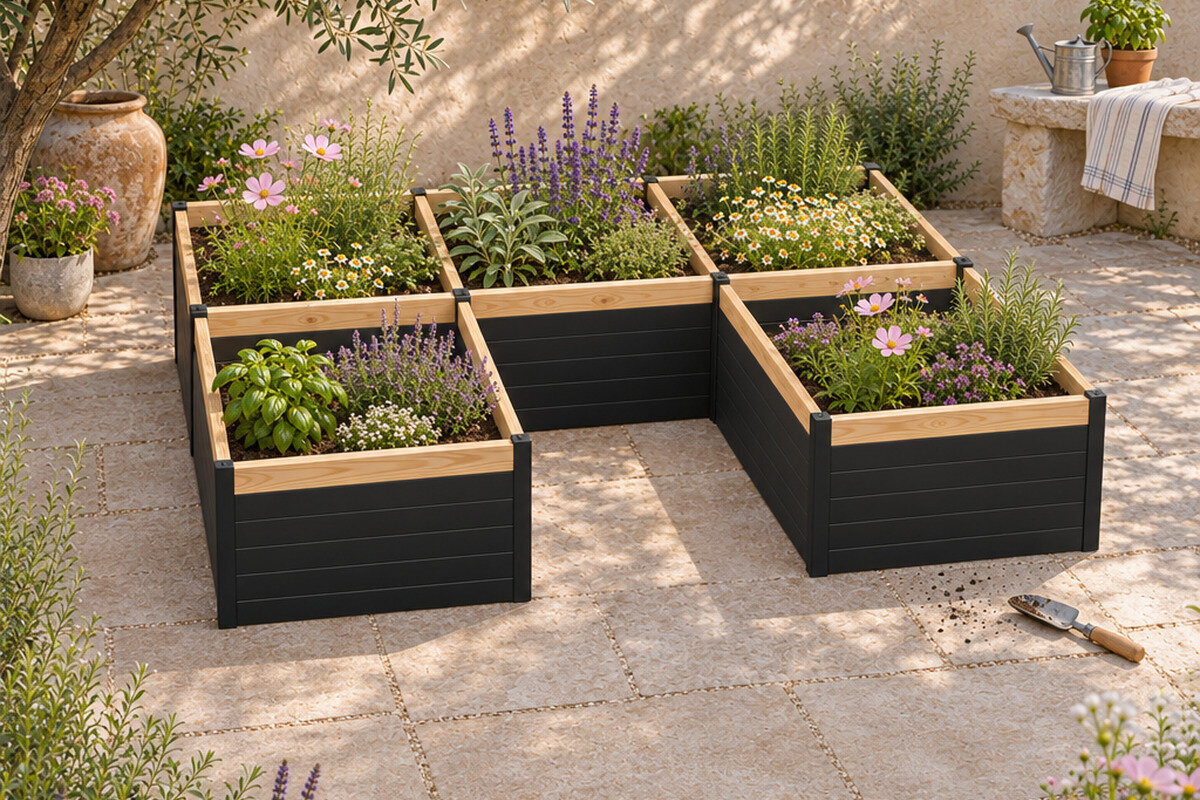
For U-shaped large vegetable planters, the overall rectangle helps you mark out the site, but it includes the access notch. The U-Shaped Aluminum Raised Garden Bed 118.11×78.74×11.81 in has five nominal 39.37-by-39.37-inch planting bays and a nominal notch of the same dimensions. The listed nominal planting area is 53.82 square feet, not the roughly 64.58 square feet enclosed by the overall dimensions.
You can check the planting area from the bays: 5 × (39.37 × 39.37) ÷ 144 ≈ 53.82 square feet. Round after multiplying, not before. For an access check, confirm the actual clear opening and test whether you can move and turn there with whatever you use for tending or harvesting. The nominal notch dimensions are a starting point, not a measured path or turning clearance.
Split-height large vegetable planters need another distinction: neither the tallest wall nor an average wall height tells you the depth you’ll actually fill in each bay. The Split Double Aluminum Raised Garden Bed has two nominal 39.37-by-39.37-inch compartments with 11.81-inch walls on the left and 31.5-inch walls on the right. Record a planned fill depth for each compartment.
Before ordering soil for large vegetable planters with arms, dividers, or mixed heights, get the clear interior measurements for each bay. Calculate the volume of each bay at its own fill depth and add the results. The nominal area check above verifies the listed layout arithmetic; it does not establish soil capacity.

07
Prove the bed fits with paths and reach included
Tape out large vegetable planters using outside dimensions first, then mark the paths. Return to the hypothetical 80-by-34-inch bed. If the site is 120 inches long by 108 inches wide and you choose 30-inch paths on both long sides, the width needed is 34 + 30 + 30 = 94 inches, leaving 14 inches across the site. But if you also want 24 inches at each end, the length needed is 80 + 24 + 24 = 128 inches. The layout falls 8 inches short even though the frame itself fits. A shorter bed or a different location preserves the intended clearances.
Next, check reach without stepping into the soil. Suppose your comfortable reach from the outside edge is 22 inches at the planned wall height. In the hypothetical bed, assume the 32-inch interior is centered within the 34-inch exterior, leaving a 1-inch inset at either side. Reaching the center from either long side takes 1 + 16 = 17 inches. Reaching the far planting edge from one side takes 1 + 32 = 33 inches. If only one side will be accessible, that same bed no longer passes the reach check.
Before choosing between large vegetable planters that fit on paper, test the one you prefer with the actual obstructions marked out. A gate swing can take away part of a path, and a trellis can block a side you meant to work from. Check the footprint again against the assembly instructions and mark the sides you can realistically use for planting and harvest.

Questions readers ask
Can I compare large vegetable planters by wall height alone?
Only if you’re comparing the height of the walls. For soil capacity, compare usable interior area and planned fill depth. For rooting depth, also check the bottom: a solid floor limits the depth to the usable soil above it, while an open frame may give roots access to suitable ground below.
Can I order soil for large vegetable planters before assembly?
Yes, if you have confirmed usable inside measurements and decided where the fill line will be. If all you have is a nominal footprint and a wall height, use them to compare models, not to place a precise order. For a bed with several compartments, keep a separate measurement and fill depth for each bay.
What if two large vegetable planters list the same square footage?
Compare the shape and individual bay dimensions. A long, narrow strip and a square can offer the same nominal area but suit different row layouts and require different access. A divider can also interrupt a row even when the total nominal area looks generous.
Keep a dimension sheet before you buy
When comparing large vegetable planters, write down the outside footprint with clearances, the usable dimensions of each planting bay, and the fill depth. Check rooting conditions separately for any open-bottom frame. If a listing leaves out a measurement that determines fit or soil quantity, confirm it before committing to the layout or placing the order.
Find a raised bed for your plan
Compare layouts and check the dimensions on the product page.
