
Outdoor Vegetable Planters: How to Choose, Set Up, and Use a Raised Bed

Bloomcabin · Raised-bed guides
Outdoor Vegetable Planters: How to Choose, Set Up, and Use a Raised Bed
Choose outdoor vegetable planters by starting with the surface. If you have suitable ground, an open-bottom raised bed can give your vegetables a defined growing area. If you have only paving, choose a soil-holding container designed for that surface instead.
Start with the surface
Choose outdoor vegetable planters by where they’ll sit. The open-bottom frames shown here go on prepared ground.
Test the layout
Mark the footprint and working space before ordering. Test your reach from the sides you’ll actually use.
Measure before filling
Use clear inside dimensions and planned fill depth to estimate soil, not the outside footprint or wall height.
Plant for your site
Pick crops you’ll eat, then use their spacing instructions and local planting guidance to make a plan.
The Bloomcabin outdoor vegetable planters in this guide are open-bottom raised beds for prepared ground. They make sense if you want a narrow strip by a garden edge, a square bed you can work from both sides, or separate bays for different crops. They won’t turn a wet patch into a well-drained site or hold soil on a patio like a floored container.
Before ordering, pick a likely crop and mark the spot where the bed would go. Those two decisions tell you what to check next: whether the site gets the right light, how far you’ll need to reach, how much soil the bed will take, and whether you can get water to it easily.
01
Choose a frame for soil or a container for paving
Outdoor vegetable planters include both containers that hold their own soil and frames that hold soil in place over the ground. The Bloomcabin beds shown here are the second kind. Their walls contain the added soil at the sides, but there’s no floor panel. These beds are supplied unassembled and aren’t planters on legs. Even a tall frame rests over the ground rather than suspending a planting box above it.
Open-bottom outdoor vegetable planters suit gardeners who want to turn a suitable patch of yard into a defined growing area. A short, narrow frame can turn an edge into a salad strip; a divided frame can keep two crop groups separate. Neither is a complete growing system. You still have to supply the growing soil and water, and the ground beneath the frame still matters.
If you’re comparing outdoor vegetable planters for a yard and a paved patio, make that choice before comparing sizes. Don’t buy a ground frame and assume you can make it into a container by adding a liner. For hard-surface use, look for a design intended to hold soil and drain there, and verify any applicable site restrictions.
- Choose an open-bottom frame if you have suitable ground and want a defined space for vegetables.
- Choose a container designed for hard surfaces if the only available spot is paved.
- If standing-height access is essential, verify the working height and base design instead of relying on the word “raised.”

02
Walk the site before you buy
Before marking a spot for outdoor vegetable planters, watch where shadows fall across it during the day. A bright corner when you leave in the morning might be shaded later by a fence or building. Compare what you observe with the light needs of the vegetables on your list. If two spots could work, lay out the hose route to both. A location that demands dragging a hose across the yard every time is worth reconsidering before the bed is full.
Check the ground where the frame will sit, not just the strip of lawn next to it. Look for places where water collects after rain. If you suspect contamination or aren’t sure whether the soil is suitable for food crops, ask your local Extension office what to check before proceeding. Adding outdoor vegetable planters does not, by itself, fix poor drainage or isolate roots from the underlying soil.
Mark the proposed footprint with string or objects you can move easily. Then walk the real route from the house or shed, open any gate beside the bed, and try approaching the corners with the tools you’ll use. Outdoor vegetable planters along a fence can save space, but the fence can also take away a working side. If the layout depends on access you don’t actually have, move the frame or choose a narrower one.

03
Read the measurements in the order they matter
When comparing outdoor vegetable planters, use the nominal footprint to mark where the frame goes and the nominal planting area to compare models. Neither tells you the exact clear space inside the walls. If you want to fit a row, support, or accessory right up to the edges, confirm the relevant inside measurements on the current U.S. listing or with Bloomcabin before ordering.
Shape matters even when planting area is the same. The Square Aluminum Raised Garden Bed has a nominal 39.37-by-39.37-inch footprint, 15.75-inch walls, and 10.76 square feet of nominal planting area. The long Narrow Aluminum Raised Garden Bed lists the same nominal planting area, but its footprint is 78.74 by 19.69 inches, with 23.62-inch walls. Plan to approach the square bed from at least two opposite sides. The long, narrow model trades a longer run along the edge for a shorter reach across the bed.
Wall height isn’t fill depth, and neither number tells you the whole rooting depth. With open-bottom outdoor vegetable planters, roots may grow into suitable soil under the frame. Compare wall construction separately: the narrow Accoya fusion model has 23.62-inch walls, with aluminum below and Accoya boards forming the upper 3.94 inches of all four walls. It’s not an all-wood bed.
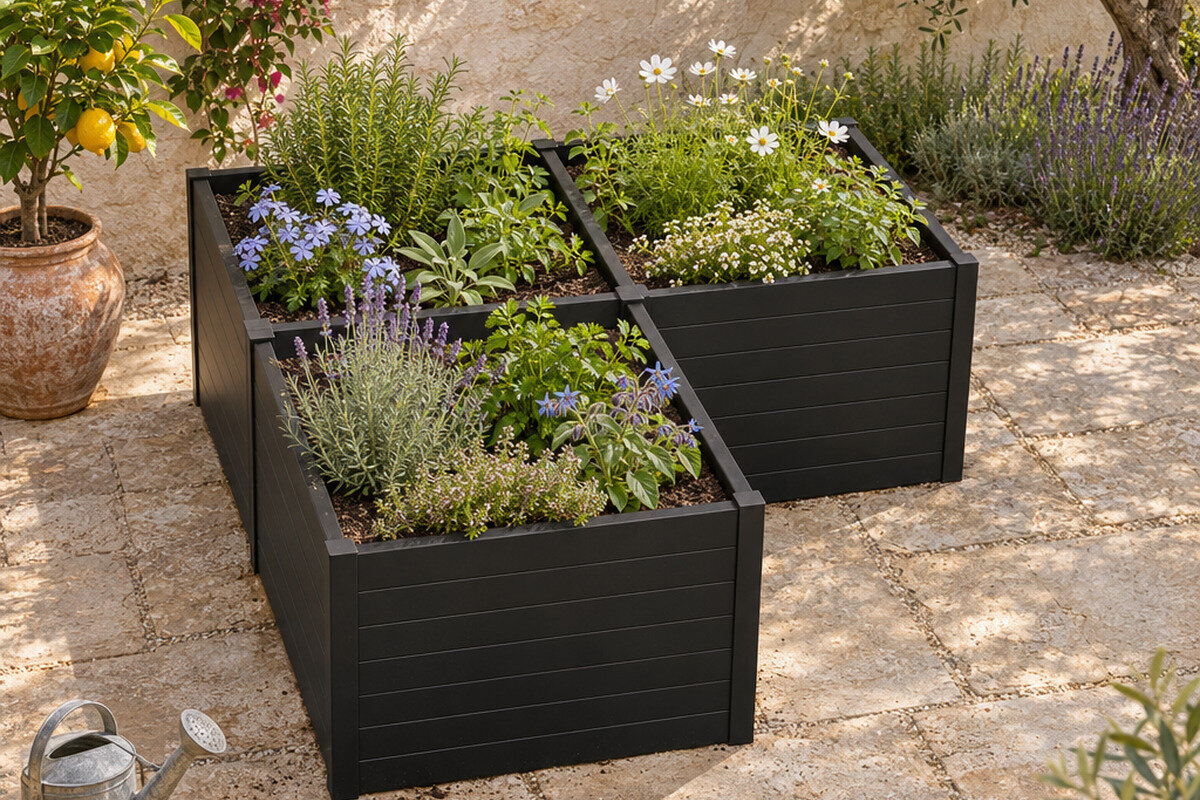
For divided or U-shaped outdoor vegetable planters, check each bay and the space needed to approach it. The five-bay U-shaped aluminum kit has a nominal 39.37-by-39.37-inch access notch. That opening is not growing area, and the kit’s outside rectangle is not a basis for estimating soil.

04
Prepare the ground, assemble the frame, then measure for fill
Set up outdoor vegetable planters before the fill arrives if you can, so you can measure the assembled bays rather than order from the shipping dimensions or a photo. Review the instructions for the exact model first. Clear the marked area and prepare the ground as directed so the walls can sit in their intended position. Check that the supplied parts match the parts list, especially when the kit includes dividers or more than one wall height.
Follow the manufacturer’s assembly sequence rather than borrowing steps from another raised bed. Before adding any soil, confirm that the bed sits as the instructions require and that the planned work areas are still clear. Try bringing a bag or cart up to the frame. If a gate won’t open fully or a corner is awkward to reach, now is the time to adjust the layout.
For outdoor vegetable planters with rectangular bays, measure the clear inside length and width, then choose a fill depth consistent with the product instructions and the crop plan. Multiply those three measurements in feet to estimate cubic feet. With measurements in inches, divide the product by 1,728 instead. For a divided frame, work bay by bay; two bays with different fill depths need separate calculations.
Choose the fill for growing vegetables in an open-bottom bed, not simply for the lowest price per bag. If you’re unsure what to use, describe the bed, the existing soil, and the crops to your local Extension office. For large outdoor vegetable planters, decide where any bulk soil will go and how you’ll move it to each bay without blocking the approach you just planned.

05
Worked example: fit a salad bed into an 8-by-6-foot patch
Hypothetical setup example: A gardener has an 8-by-6-foot patch of suitable ground and wants lettuce and radishes. They’re comparing two outdoor vegetable planters: the short Narrow Aluminum Raised Garden Bed with a nominal footprint of 39.37 by 19.69 inches and 3.94-inch walls, and the 39.37-inch square aluminum bed with 15.75-inch walls. The short frame is worth considering for a planting strip over suitable soil, but this gardener wants room to spread out sowings and can use both sides of the square.
The gardener wants 24 inches of working space on each of two opposite sides. That’s a personal clearance target for this example, not a universal path width. Across the 8-foot direction, the bed and those two spaces add up to 39.37 + 24 + 24 = 87.37 inches. That fits within 96 inches, leaving 8.63 inches to spare in that direction. Across the 6-foot direction, the nominal bed width leaves 32.63 inches total. The gardener marks both approaches before ordering to see whether they’re easy to enter and turn out of.
For the fill estimate only, suppose the assembled bay measures 38 by 38 inches inside and the gardener plans a 12-inch fill depth after checking the instructions and crop needs. The calculation is 38 × 38 × 12 ÷ 1,728, or about 10 cubic feet. Those inside dimensions are assumptions, not Bloomcabin specifications. Anyone using the same method for outdoor vegetable planters should measure their own bay before buying soil. Here, the square wins because the gardener can reach it from both sides and wants more room for successive sowings, not simply because it has taller walls.

06
Turn the usable space into a crop plan
Plant outdoor vegetable planters for the kitchen you actually use. Two crops that you’re happy to eat repeatedly are a better starting point than a row of everything you saw at the garden center. Write down whether each crop is direct-sown or transplanted, the spacing it needs at maturity, and when to plant it locally. Use seed packets, plant labels, and your local Extension guidance rather than a national planting date.
Sketch the crops inside the clear planting area. Put a crop you’ll pick frequently along an edge you can comfortably reach. If you’re mixing tall and short plants, consider where the tall ones will cast shade. In the hypothetical salad bed, the gardener could mark separate bands for lettuce and radishes and leave some space for a later sowing if the local season allows. Use the instructions for the actual varieties to decide how many rows fit, rather than assuming every lettuce or radish needs the same spacing.
In outdoor vegetable planters with more than one bay, divide crops only if it makes care easier. You might use one bay for repeated sowings and leave the other undisturbed for crops already established. Label each batch with its variety and sowing date so you know what you’re waiting for. Acclimate tender indoor-grown transplants before moving them outside.

07
Watch how the bed performs through the first harvest
Care for outdoor vegetable planters by checking the soil, not by assigning every bed the same watering days. Raised beds can dry sooner than nearby ground. Check where you sowed and around new transplants as well as near established plants; don’t assume that one damp corner represents the whole bed. When watering is needed, aim near the roots. If the far end of a long bed is consistently drier, check whether you’re reaching it with the hose before changing how you water the whole bed.
Mulch can help limit moisture loss and weeds where it suits the crop. Look at the plants while you water or harvest rather than waiting for a separate garden chore. If one patch looks unhealthy, note which plants are affected and what changed before treating it. For fertilizer decisions, use soil-test results and recommendations for what you’re growing.
After the first round of harvests, review how well your outdoor vegetable planters fit the work. Did you use both sides as planned? Was the hose easy to bring over? Did a crop crowd the row next to it, or did a strip sit empty because it was hard to reach? Adjust one thing for the next planting, such as moving the frequently picked crop to the near edge or sowing fewer seeds at once. That’s a better reason to change the layout than assuming you need a bigger bed.

Questions readers ask
Can outdoor vegetable planters go on concrete?
Only if the planter is designed to retain soil and drain on that surface. The Bloomcabin frames in this guide have no floor and are specified for prepared ground. If you are shopping for concrete placement, check the container’s intended use and decide where its runoff can go before you buy.
How much soil should I order for outdoor vegetable planters?
For a rectangular bay, multiply the clear inside length by the clear inside width and the planned fill depth. With all three measurements in inches, divide the result by 1,728 for cubic feet. Calculate divided or differently sized bays separately and add them together. Compare that total with the volume printed on the bag or quoted by the supplier.
Can I grow root vegetables in a low-walled bed?
Check the variety’s guidance and the soil below the frame. A low wall contains only a shallow layer of added soil, but an open base can give roots access to suitable ground beneath. If the underlying soil is not usable for that crop, choose a different site, bed, or variety rather than counting on depth you don’t have.
Make the first decision before you shop
The easiest outdoor vegetable planters to live with are the ones you can reach and water without rearranging the yard. Once you’ve found suitable ground, compare the Bloomcabin configurations that fit, confirm the measurements and assembly requirements, and start with crops you know you’ll use.
Find a raised bed for your plan
Compare layouts and check the dimensions on the product page.
