
Small Greenhouse Guide: Sizes, Layout, Placement & What to Grow | Bloomcabin USA
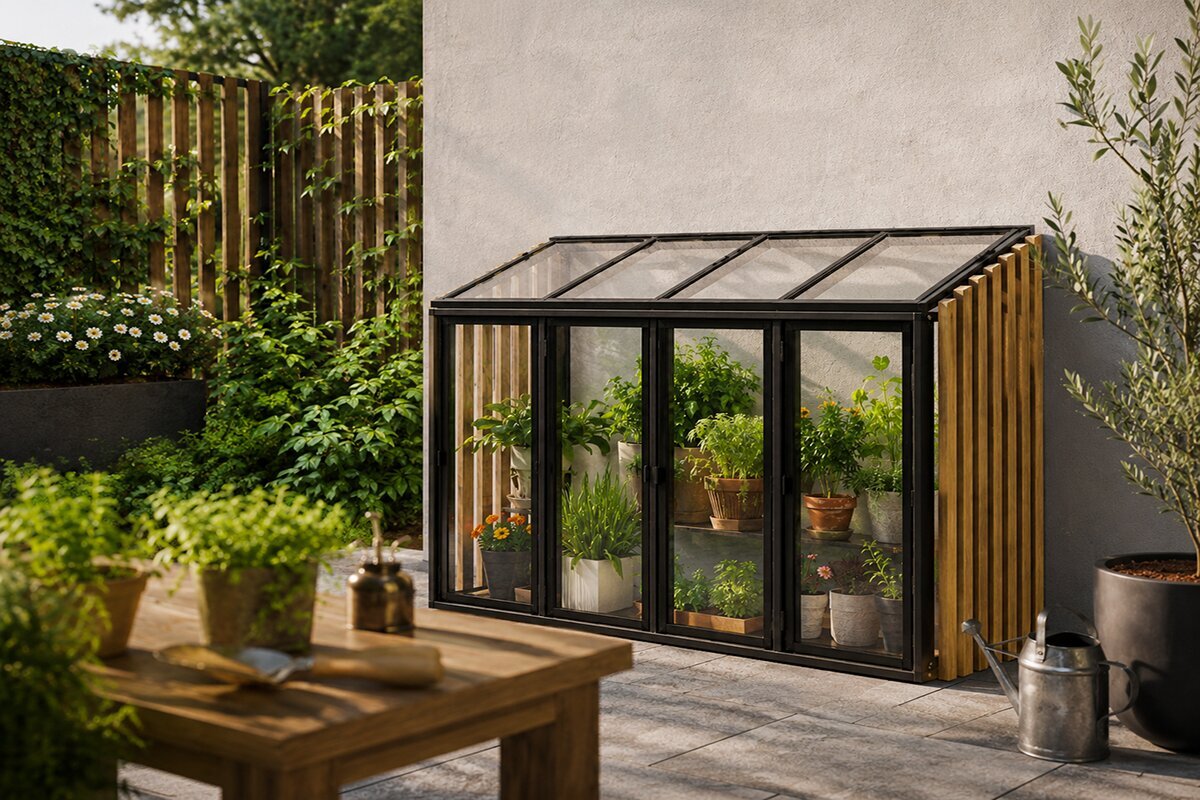
The small-greenhouse advantage
The best small greenhouse is the one that uses a difficult part of your property intelligently.
A narrow side yard, a sunny wall beside the garage, a small urban backyard or an unused patio edge can all become productive greenhouse space. The goal is not to force the largest structure onto the lot. It is to choose the greenhouse geometry that creates the most useful interior for the space you actually have.
That is why “small greenhouse” can describe several very different ideas. A true mini wall greenhouse may occupy only a few square feet. A compact lean-to greenhouse uses a house or garden wall as one side. A small freestanding glass greenhouse needs more clearance around it but offers access from every direction and can become a strong garden focal point.
Bloomcabin's U.S. range illustrates this spectrum. The Aluminum Mini Wall Greenhouse is offered in compact sizes from about 8 to 15 sq ft, while the Aluminum Lean-To Greenhouse begins around 40 sq ft and extends into much larger wall-mounted formats. The Classic Aluminum Greenhouse provides a freestanding option when you have a little more footprint available.
Before choosing by square footage alone, decide what you want the greenhouse to do: raise seedlings, grow herbs, maintain a collection of tomatoes and cucumbers, protect plants during shoulder seasons, or create a compact glass garden room that is enjoyable to step into every day.
Three compact greenhouse types
Mini wall, lean-to or freestanding? Start with the shape of the space, not the product name.
01 / Smallest footprint
Mini wall greenhouse
Best where ground space is extremely limited: patio edge, side yard, wall beside the house or another compact sunny location.
The vertical wall gives structure to the layout and makes shelves especially valuable because growing space can be stacked rather than spread across the floor.
02 / Compact walk-in space
Lean-To greenhouse
A strong choice when you want a real walk-in greenhouse but need to use the edge of a building rather than the center of the backyard.
The wall-mounted geometry can make circulation simple: growing benches along one side, taller crops on another and a clear central path.
03 / Garden centerpiece
Small freestanding greenhouse
Best where you can walk around the structure and want light to reach it from several directions.
It generally requires more surrounding clearance, but it offers the classic greenhouse experience and can be positioned independently of the house.
How small is “small”?
Think in usable growing zones, not just total square feet.
Two greenhouses with similar floor area can feel completely different. Door placement, wall height, roof shape, shelving depth and whether a central aisle is required may change how much of the space can actually hold plants.
In a mini greenhouse, vertical space is often more valuable than floor area. Shelves can hold seed trays, herbs and compact vegetables at several levels. Tall plants can use the lower floor while smaller pots occupy shelves above areas that would otherwise be empty.
Once the structure becomes large enough to walk into, circulation becomes the first subtraction from nominal square footage. A path that is too narrow becomes frustrating; one that is unnecessarily wide reduces the productive growing zone.
This is why the best small greenhouse is not automatically the one with the smallest outside dimensions. A slightly larger footprint with a cleaner interior path can sometimes deliver much more usable growing area.
For the smallest Bloomcabin option, the Mini Wall Greenhouse collection is designed around extremely limited ground space. For buyers who want to step inside and work at standing height, a compact Lean-To or freestanding greenhouse is the more natural category.
A useful planning exercise is to draw the footprint at full scale with painter's tape or string. Mark the door swing or sliding-door line, benches, shelves, tall-crop zone and the space your body needs when watering or carrying a tray.
Then test the route. Can you enter while holding a seedling tray? Can you reach the back corner? Can the door open without hitting a planter? Can a tomato plant grow without blocking the only path?
These questions are more practical than an abstract definition of “small.” The right size is the smallest structure that still lets your intended gardening routine work naturally.
Placement
On a small property, the greenhouse location may matter more than the greenhouse size.
A compact greenhouse can fit in places where a larger model cannot, but “it fits” is only the beginning. The site must also support light, access, drainage, ventilation and the normal work of gardening.
Start with sunlight. Observe the proposed location across the day rather than judging it once at noon. Trees, fences and neighboring buildings can create long periods of shade that are easy to miss during a quick site visit. Seasonal sun angles matter too: the pattern in March or October can be very different from July.
Then look at convenience. A greenhouse used every day should not require an obstacle course. The easier it is to carry water, tools, seedlings and harvested vegetables between the house and greenhouse, the more often the space tends to be used well.
Drainage matters because compact structures are often placed against existing paving or walls. Roof water and surrounding surface water should move away from the greenhouse and away from the building foundation. Do not position the greenhouse in the low point where the entire patio naturally drains.
For a wall-mounted greenhouse, inspect the wall itself: doors, windows, hose bibs, downspouts, exterior lights, electrical outlets and utility access. The greenhouse should improve the area rather than block something the house already needs.
Finally, consider future access around the outside. Glass needs cleaning, gutters and vents need inspection, and nearby plants grow. A greenhouse that fits with zero working clearance can become difficult to maintain a few seasons later.
Small-space layout
A compact greenhouse should be designed from the inside out.
The outside dimensions tell you whether the greenhouse fits. The inside layout determines whether you will enjoy using it.
In very small structures, every bench and shelf should have a reason. Empty circulation zones, inaccessible corners and oversized furniture consume disproportionate amounts of the available area.
Layout rule 01Keep the main path obviousA direct route reduces wasted corners and makes carrying trays easier.
Layout rule 02Use vertical space deliberatelyShelves, hanging supports and tall crops can share the same footprint at different heights.
Layout rule 03Reserve one flexible zoneA movable shelf or open corner lets the greenhouse adapt from spring seedlings to tall summer crops.
Layout rule 04Do not block ventilationPlants and shelving need to leave vents and openings free to move air.
What to grow
Choose crops by height, duration and value per square foot — not by how impressive the seed packet looks.
A compact greenhouse rewards selective gardening. When space is limited, plants that remain productive for a long period, grow vertically or allow repeated harvests often make especially good use of the protected environment.
Tomatoes are a classic greenhouse crop because they can be trained vertically. In a small walk-in greenhouse, a few well-spaced plants can use height rather than occupying a wide floor area. The key is not to overcrowd them; dense foliage can restrict airflow and make maintenance difficult.
Cucumbers can also use vertical support effectively. Their leaves become large, so position them where they will not shade every smaller crop in the greenhouse. A trellis along a wall or rear zone can make better use of height.
Herbs are excellent for mini wall greenhouses and shelves. Basil, parsley, cilantro and other culinary herbs occupy relatively small containers and are easy to harvest frequently. They also make sense close to the kitchen because regular harvesting becomes convenient.
Lettuce and leafy greens work well during cooler periods and can make productive use of shelves before tall warm-season plants reach full size.
Peppers and eggplants can be good candidates for sunnier compact greenhouses where warm conditions can be maintained during their active season. Their footprint needs to be planned around the mature plant, not the small transplant you bring in during spring.
Seedlings may be the highest-value use of a very small greenhouse. A few shelves can hold many seed trays in spring, and after those plants move into the garden the same space can be converted to herbs or summer containers.
The smartest crop plan changes through the year. A greenhouse does not need to contain the same plants for twelve months. Seasonal rotation lets the same shelf, bed or container zone perform several different jobs.
Ventilation
Small greenhouses can heat up quickly because there is less air volume inside.
A compact greenhouse often responds faster to sunshine than a large structure. That can be useful in cool weather, but it also means temperature and humidity can change quickly when the sun appears.
Do not sacrifice ventilation just to maximize shelving. Roof vents, doors and any designed air openings need clear space around them. Tall tomato leaves pressed against a vent may reduce the very airflow the crop needs.
On warm days, opening the door can become part of the ventilation strategy, especially in a walk-in greenhouse. In a wall greenhouse, the relationship between vents and the heated wall behind the structure also affects the local microclimate.
Automatic ventilation accessories can reduce the need for constant manual adjustment, but any accessory should suit the particular greenhouse and be installed according to its instructions.
The goal is not to keep the greenhouse permanently warm. It is to create appropriate conditions for the plants you are growing at that stage of the season.
Glass or polycarbonate?
In a small greenhouse, glazing changes not only plant conditions but how the whole garden feels.
Clear glass gives a very direct visual connection between the greenhouse and the surrounding landscape. That can be especially attractive when the structure sits close to a patio, kitchen window or main garden path where its appearance is visible every day.
Polycarbonate offers different performance and visual characteristics. The choice should consider the greenhouse model, desired light behavior, local weather, budget and how important transparency is to the finished garden design.
For a tiny greenhouse beside a living area, aesthetics may carry more weight than they would for a structure hidden at the back of a large property. Conversely, a greenhouse used primarily for propagation or practical food growing may prioritize function differently.
Do not treat glazing as an isolated specification. It works together with ventilation, shading, orientation, frame design and the plants inside. The most appropriate greenhouse is a complete system, not merely a choice of panel material.
Small greenhouse by property type
A townhouse patio, suburban backyard and rural garden should not all receive the same compact greenhouse.
Urban patio or tiny yardA mini wall greenhouse can turn vertical wall area into growing space without consuming the central patio.
Narrow side yardA wall-oriented compact greenhouse may fit where a traditional freestanding model would leave no usable route around it.
Suburban backyardA small walk-in Lean-To or Classic greenhouse can balance productive growing space with lawn and entertaining areas.
Architectural gardenA compact glass greenhouse can act as a design feature rather than being hidden as purely functional equipment.
Cold-climate gardenPrioritize foundation, drainage, wind exposure and seasonal maintenance as much as the compact footprint.
Hot-summer regionShade planning, ventilation and the ability to move air become essential because a small volume can warm rapidly.
Foundation & floor
A compact greenhouse still needs a serious base.
Small does not mean temporary. A precisely glazed aluminum greenhouse depends on a base that is level, stable and appropriate for the site. Local wind, frost conditions, soil and drainage should influence the foundation decision.
Existing patio pavers may look strong but are not automatically the structural support required for a greenhouse. A deck also needs its underlying framing considered rather than relying only on surface boards.
Wall-mounted structures introduce another relationship: the greenhouse base, the building wall and the surrounding patio need to work together without sending rainwater toward the house.
Think about the inside floor at the same time. A hard, cleanable surface can make a tiny greenhouse easier to maintain, while planting beds may maximize direct growing area. Containers provide flexibility because the layout can change from season to season.
Whatever floor you choose, keep drainage paths visible. Watering in a compact greenhouse can quickly create wet corners if there is nowhere for excess water to go.
Shelving without overcrowding
Vertical growing is powerful — until shelves begin stealing light and airflow from one another.
The temptation in a small greenhouse is to install shelving everywhere. That may increase nominal pot capacity, but it can also create dark lower levels, inaccessible corners and stagnant air.
Instead, vary shelf depth. A narrow upper shelf can hold small pots without casting the same shadow as a deep bench. A removable shelf can serve seed trays in March and disappear when tomatoes need the full height in June.
Keep the floor beneath at least part of the shelving usable. Tall containers can sometimes sit below a higher shelf early in the season, while the shelf itself holds propagation trays.
Avoid placing solid storage boxes directly against ventilation openings. In such a small air volume, a single blocked vent may materially reduce circulation.
The objective is flexibility: the greenhouse interior should be able to change as the plants grow. Permanent furniture is valuable only if it continues to serve the space across several seasons.
Watering
Small greenhouses make watering easier to reach — but easier to overdo.
Because every pot is close, hand watering can work extremely well in a compact greenhouse. The gardener can check soil condition plant by plant rather than watering the entire space automatically.
Containers on high shelves may dry faster than large pots on the floor. Sunny areas beside clear glazing may also behave differently from shaded lower shelves. A single watering schedule for every plant is rarely ideal.
If you add drip irrigation, keep the system tidy and accessible. In a small greenhouse, a hose or irrigation line crossing the main path becomes a constant annoyance and potential trip point.
Good greenhouse watering is less about volume than observation. The compact scale is an advantage because you can notice a wilting plant, blocked emitter or waterlogged pot quickly.
Five common mistakes
Most small-greenhouse problems begin with trying to fit too much into too little space.
1. Buying only by outside size
The interior path and growing zones matter more than the footprint number alone.
2. Ignoring mature plant size
A small tomato transplant can become a large plant that blocks ventilation and circulation.
3. Shelving every wall
Too much fixed shelving can steal light, airflow and flexibility.
4. Choosing a convenient but shady corner
A greenhouse that is easy to fit but receives poor light may never perform the way you expect.
5. Treating the base as an afterthought
Compact glazing still depends on a stable, level foundation and sensible drainage.
When should you size up?
A small greenhouse stops being the right choice when circulation or crop height becomes the compromise.
If your plan includes several full-size tomatoes, cucumbers, propagation shelves, a potting bench and space to sit, the smallest greenhouse may create constant conflicts. Each individual idea fits on paper, but not necessarily at the same time.
Likewise, if two people regularly garden together, aisle width becomes more important. A greenhouse sized for one person to turn around comfortably may feel crowded when two gardeners, trays and watering equipment are inside.
If the greenhouse will become part growing space and part relaxation space, size up earlier. A chair needs more room than it appears to need because a real person also needs to walk around it.
Bloomcabin's broader Greenhouses & Conservatories collection includes compact wall-mounted models as well as larger freestanding structures, so you can compare the smallest footprint against layouts that offer more circulation.
The goal is not to buy a bigger greenhouse for its own sake. It is to avoid buying twice because the first greenhouse was optimized for the property boundary rather than the gardening routine.
Design & color
A small greenhouse is often more visible from the house than a large greenhouse at the back of a property.
Because compact greenhouses frequently sit beside patios, exterior walls or kitchen windows, their appearance can become part of the daily architecture of the home.
Frame color, glazing, wall relationship and foundation finish should therefore be chosen with the house and landscape in mind. A small structure can look intentional and architectural when its lines relate to windows, paving and garden edges.
Bloomcabin also offers a Limited Edition Mini Wall Greenhouse for buyers who want a more distinctive visual treatment, while the broader greenhouse design options show how aluminum structures can be coordinated with different garden styles.
Do not hide a well-designed compact greenhouse automatically. In a small backyard, it can be one of the elements that gives the garden structure and purpose.
Wall-mounted alternatives
If the mini greenhouse is too small, the next step does not have to be a freestanding greenhouse in the middle of the yard.
A Lean-To greenhouse is often the natural upgrade because it preserves the idea of building along an edge while creating a true walk-in interior.
Wall-mounted geometry can be especially efficient beside a house, garage or substantial garden wall. The garden's central space remains open while the greenhouse uses an area that might otherwise be only a narrow border or paved strip.
For buyers seeking more vertical space and a larger wall-oriented greenhouse, the Aluminum Greenhouse on Wall is another model family to compare with compact Lean-To solutions.
This progression — mini wall greenhouse, walk-in Lean-To, larger wall greenhouse — is useful because it lets you increase gardening capacity without abandoning the space-saving logic that made you consider a small greenhouse in the first place.
Quick decision framework
Choose the greenhouse by the constraint you cannot change.
Almost no ground space?Start with a mini wall greenhouse and maximize shelves.
A sunny building wall is available?Compare Lean-To and wall greenhouse models.
You want access from all sides?A small freestanding greenhouse is the more natural layout.
You mainly raise seedlings and herbs?Vertical shelves may be more valuable than walk-in floor area.
You want tomatoes, cucumbers and a potting bench?Size up enough to preserve a real aisle and mature crop space.
The greenhouse will sit beside the patio?Treat appearance, glazing and color as part of the landscape design.
Bloomcabin USA / Compare small-space options
Start with the smallest structure that supports the way you actually want to garden.
Smallest footprintMini Wall Greenhouse →
Wall-mountedLean-To Greenhouse →
FreestandingClassic Aluminum Greenhouse →
Larger wall formatGreenhouse on Wall →
All modelsGreenhouses & Conservatories →
QuestionsAluminum Greenhouse FAQ →
FAQ
Small greenhouse questions
What is a good size for a small greenhouse?
There is no single best size. The right size is the smallest footprint that still provides the growing zones, access and ventilation needed for your intended crops.
Is a mini greenhouse worth it?
It can be very useful for seedlings, herbs, compact vegetables and protected container growing when the available yard or patio space is extremely limited.
What can I grow in a small greenhouse?
Herbs, leafy greens, seedlings, peppers and carefully planned vertical crops such as tomatoes or cucumbers can all work, depending on season, climate and available height.
Is a Lean-To greenhouse good for a small backyard?
Yes, especially when a sunny wall is available and you want a walk-in greenhouse without occupying the center of the yard.
Does a small greenhouse get too hot?
It can warm quickly in direct sun because the interior air volume is small, so ventilation and seasonal shading deserve careful planning.
Should I put shelves in a small greenhouse?
Yes, but do not fill every wall permanently. Use shelves to increase vertical growing area while keeping light, ventilation and tall-crop space available.
Where should a compact greenhouse be placed?
Choose a location with useful sunlight, convenient daily access, sensible drainage and enough clearance for maintenance. Local climate and site exposure also matter.
When should I choose a bigger greenhouse?
Size up when your crop plan, required aisle, potting bench or relaxation area cannot coexist comfortably within the compact layout.
Small footprint / serious greenhouse
A small greenhouse works best when every square foot has a purpose and every moving part remains easy to reach.
Choose the site first, decide how you want to garden second, and select the greenhouse size third. That order leads to a compact greenhouse that feels intentional rather than constrained.
View Mini Wall Greenhouse Explore All GreenhousesUSA planning note: Greenhouse foundation, anchoring, wind, snow, setback, zoning, permitting and utility requirements vary by location and model. Use this guide for general planning and confirm the requirements that apply to your property and selected Bloomcabin greenhouse.
