
Timber Garden Bed: How to Tell If the Wood Fits Your Plans

Bloomcabin · Raised-bed guides
Timber Garden Bed: How to Tell If the Wood Fits Your Plans
A timber garden bed can be a good choice when the wood and any treatment are documented for the intended use, the frame is designed for the planned fill, and the site lets excess water drain. If you can’t verify a key detail, especially the treatment history for an edible bed, choose a better-documented option before you buy or fill it.
Verify the wood
Identify the wood species or product grade and confirm whether it is untreated, treated, coated, or modified.
Check the intended use
For a timber garden bed used to grow food, look for written guidance covering the exact materials and finish.
Check the whole frame
Judge actual thickness, wall span, supports, and fasteners together. One measurement cannot establish what a frame can hold.
Plan the drainage path
Decide where water can go before buying an open-bottom frame, especially if the site is paved.
Shopping for a timber garden bed usually means making two decisions at once: whether you want wood as the main wall material, and whether the particular boards and hardware will work where you plan to put them. A listing can answer the first question with a photo and still leave you without the information you need for the second.
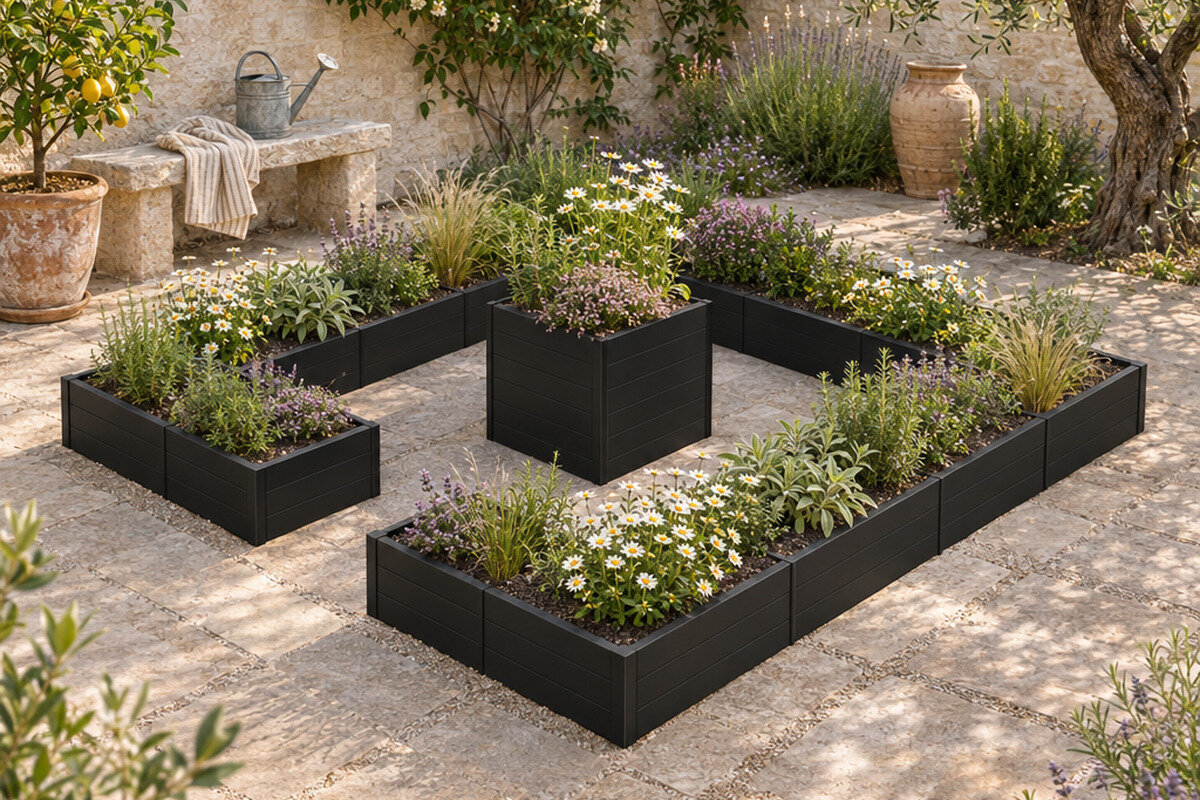
Use this guide to check a kit or a set of boards before committing. Start with the material and its intended use, then work through the frame, site, and upkeep. The Bloomcabin designs shown here are useful for comparison: they are aluminum or aluminum with an Accoya upper course, not all-wood frames.
01
Find out what the walls are made of
“Timber” tells you that wood is part of the design, not what kind of wood it is or where it goes. For a timber garden bed sold as all wood, ask whether that means all four soil-retaining walls or only the visible trim. Request a parts drawing if the listing is unclear. A cap board, an upper course, and a full-height wooden wall are different purchases, even if the photos show wood along every edge.
Ask for the exact species or named wood product and the grade where applicable. Then check whether the boards are sold untreated, treated, modified, or coated. A grade can help identify the stock without telling you what has been applied to it. Likewise, a listing that says “unfinished” doesn’t necessarily tell you whether the wood was treated before it was cut or milled. Look for documentation tied to the exact product rather than a general description of the species.
Put the materials in writing, including any coating on the face that will touch soil. If the timber garden bed is made from salvaged boards, ask about their previous use and finish as well as their species. A clean-looking surface doesn’t settle an unknown material history. If the seller can’t say what the wood is or how it was treated, record that as unknown rather than filling in the blank with a guess.

02
Separate outdoor use from edible-growing suitability
Tell the supplier where the timber garden bed will sit and what you intend to grow. For vegetables or herbs, ask whether its identified wood, treatment or coating, and any specified liner are intended for a raised bed that holds soil for edible crops. Give the model or board designation so the reply addresses the material you will actually buy. If there are conditions on that use, read them before deciding if the build is practical.
Keep three questions separate: Is the material identified? Is it intended for the expected soil and moisture contact? Does the written guidance cover the kind of planting you have in mind? A description of outdoor use may answer part of the second question but not the third. If a liner is required for the stated use, check what the instructions specify and how the liner affects drainage. Don’t assume adding an improvised liner resolves an unknown treatment history.
You can decide against a timber garden bed without declaring it unsafe. If the written guidance doesn’t address your use, the useful conclusion is that you can’t verify the fit. The same reasoning applies to finishes sold separately: check the instructions for the frame and the finish before adding one. Save the specification and any written answer so you have something to consult later if a board needs replacing.

03
Read board thickness and hardware as a system
Compare actual board thickness, not the nominal size alone. Then look at how far each wall runs between supports and how high you intend to fill it. Soil pushes outward against the walls, so a longer unsupported run presents a different design question from a short wall made with the same stock. There is no useful thickness verdict without the rest of the geometry. For a timber garden bed kit, look for a configuration that supports the planned wall height and span in the assembly drawing. If you’re buying loose boards, check them against the requirements of a suitable bed plan.
Confirm the fastener type, length, and material or finish specified for the wood and its treatment. Check whether corners and any intermediate supports are included and whether the instructions require pilot holes. Don’t substitute hardware simply because it fits through a hole: the connection needs to match the design and the materials it joins.
Before filling a timber garden bed, inspect the assembled joints. Check that the boards meet their supports as shown, that the corners are square, and that the frame sits evenly where the instructions require it. A board already split at a fastener or a corner that won’t seat is easier to address before it is holding soil. Ask the supplier about a replacement or an approved correction rather than assuming the fill will hold everything in place.

04
Measure the site and follow the water
Mark the outside footprint of the timber garden bed at the proposed site, then mark the space you’ll stand in to plant and harvest. Try reaching the center from the sides you can actually use. If a fence blocks one side, test your reach from the open side instead of assuming you’ll have access all the way around. Allow room to carry soil in and to inspect the frame later. Check that the spot gets enough light for your crops and that water is within practical reach.
Inside the timber garden bed, distinguish the clear planting dimensions from the outside footprint. Thick walls take up part of the overall width, and posts can reduce clear space locally. Wall height is a separate measurement from fill depth: determine where the finished soil surface will sit, then consider what is under it. Roots may reach prepared soil below an open base. A hard surface changes both rooting depth and drainage.
Inspect the site after rain before committing to a timber garden bed. If water already collects there, the open base isn’t a guarantee that it will drain. If the ground’s history raises a contamination concern, seek local guidance before counting it as part of the growing area. For paving, check that the design is intended for that placement, retains the soil, and provides a route for excess water to leave. Don’t assume a frame sold for prepared ground can serve as a freestanding container.

05
Assemble and inspect before adding soil
Before ordering a timber garden bed, read the assembly instructions alongside the parts list. Check which parts arrive unassembled, what tools you need, and how much room you’ll have to work. A narrow strip beside a fence might be fine for tending plants from one side but too cramped to reach a connection during assembly. Resolve that before placing the frame, and avoid moving it once it contains soil.
Inventory the timber garden bed parts before you start. Match the boards, hardware, and supports to the drawing and follow the documented order. Check whether the instructions call for a particular board orientation or give directions for cut ends. If a part is missing or doesn’t fit, get an answer before drilling new holes or cutting a replacement. A modification can change how much wood remains around a fastener or which surfaces contact soil.
Before adding soil, confirm that the base still matches the drainage plan. Remove anything left from assembly that would block the intended path for water. As you add fill, watch the long sides and corners rather than waiting until the bed is full to inspect them again. If a side starts to bow noticeably or a joint starts to open, stop filling and check the assembly and supplier guidance before proceeding.

06
Check how you would maintain or replace a board
Choose a timber garden bed you can inspect and maintain in the space available. Look at the corners, the bottom edges, and the spots around fasteners when you’re already working nearby. A change in color alone doesn’t tell you whether the wall still holds soil as intended. A widening joint, a soft area near a connection, or a wall that moves out of line deserves closer attention. Compare what you see with the supplier’s care instructions before deciding whether the issue calls for repair or replacement.
Ask how you would replace a board if it failed. Can you reach the fasteners from outside, and can you get a matching board with the original thickness and finish? Even if the wall comes apart easily when empty, you may need to remove soil before you can safely release a board that holds it back. That access and effort are part of the maintenance comparison, alongside any finish the supplier says to renew.
Don’t plan to reseal a timber garden bed just because it’s made of wood. Find out whether a finish is recommended and, if it is, whether the instructions cover where and how to apply it around the planting area. Keep the original material and hardware details for later repairs. Compare alternatives by the upkeep you can verify and carry out, not by assuming one material always lasts longer.

07
Work through a choice for a narrow planting strip
Hypothetical example: A gardener wants an all-wood timber garden bed for herbs and salad greens beside a path. The frame will sit on prepared ground, and she can reach the entire planting strip from the path. Assume one candidate’s supplier identifies the wood and finish, provides edible-growing guidance for that setup, and specifies hardware for the chosen wall span. A second all-wood candidate fits the path equally well but is made of reclaimed boards with no treatment history. She keeps the first candidate on the list and sets the second aside: the fit is known for both, but the material history isn’t.
Suppose the documented timber garden bed will have a clear, rectangular interior 4 feet long by 2 feet wide, with no interior offsets, and she plans to add 9 inches of soil. The planting area is 8 square feet. Since 9 inches is three-quarters of a foot, the initial fill estimate is 6 cubic feet. That’s the volume of the soil layer she plans to add, not the volume inside the outside dimensions or the total rooting space available below the open base.
If all-wood walls turn out to be a preference rather than a requirement, she can compare the Narrow Accoya Raised Garden Bed 39.37×19.69×23.62 in. Its nominal footprint is 39.37 by 19.69 inches. It is open to prepared ground, with aluminum corner posts and aluminum below the top 3.94 inches of each wall; the upper course is 0.79-inch-thick Accoya. It’s a mixed-material alternative, not an all-wood timber garden bed. She would ask for clear interior measurements and intended-use guidance for that model rather than borrowing the fill estimate or suitability decision from the first candidate.

Questions readers ask
Can I use leftover boards for a timber garden bed?
Consider them if you can identify the wood, establish its treatment and finish history, and confirm that the boards fit a design suitable for the site and crops. For an edible bed, leave out boards with an unknown history rather than judging them by color or sanding them and assuming the uncertainty is gone.
Do the Bloomcabin beds shown here have all-wood walls?
No. The listed designs are aluminum or aluminum with an Accoya upper course. In the Narrow Accoya Raised Garden Bed, aluminum forms the lower 19.69 inches of each wall and Accoya forms the upper 3.94 inches. The corner posts are aluminum.
Does a taller timber garden bed always give roots more room?
Not necessarily. Compare the actual fill depth and what lies beneath it. Roots in an open-bottom frame may grow into suitable prepared soil below, whereas paving prevents that connection. A taller wall is not, by itself, a measurement of usable soil depth.
Buy the construction, not the label
Before buying a timber garden bed, make sure you can identify what touches the soil, what holds the walls together, and where excess water will go. If those answers match your intended crops, site, and maintenance plans, you have a sound basis for choosing the bed.
Find a raised bed for your plan
Compare layouts and check the dimensions on the product page.
