
Greenhouse aphids: spot, prevent and control colonies early
Greenhouse file / T39
Aphids in the greenhouse Spot, prevent and control colonies before they spread.
The first clue is rarely the insect itself. It may be shine on a leaf, a crease in a young shoot tip, or a pale skin along the midrib. Reading these signs in sequence turns aphids into a manageable problem rather than a burden for the whole growing season.
Good greenhouse management starts with access: young growth can be checked, leaf undersides remain visible, and new plants can be kept apart. The considered, well-ventilated design of a Classic aluminium greenhouse creates a clear working space for exactly this routine.
Chapter 01 / The signs
Read the plant first. Then decide on action.
One symptom does not prove an aphid infestation. Cold, heat, drought stress, root damage and unbalanced nutrition can also distort plant tissue. A reliable diagnosis comes from a chain of evidence: inspect the plant closely, find live insects or fresh cast skins, and connect those clues with typical sap-feeding damage.
Live colony
Cast skins
Honeydew
Sooty mould
Distortion
Live colony
Look on tender shoot tips, stems, buds and leaf undersides for small, soft-bodied insects. Adults, young aphids and occasional winged forms may occur together.
Cast skins
White to silvery, papery cases are shed skins. They are neither active whiteflies nor a coating of powdery mildew.
Honeydew
Aphids excrete surplus sugar as sticky honeydew. It leaves a glossy film on foliage, pots, benches, fruit and leaves below the feeding site.
Sooty mould
Dark sooty mould can grow on honeydew. It is a secondary effect; first find the honeydew-producing insects.
Distortion
Young leaves may curl, twist, roll up or stop growing. This matters especially on seedlings, herbs, capsicums, cucumbers and flowering ornamentals.
Ants are an additional clue, not proof. They use honeydew and can disrupt natural enemies. Their trails should prompt a careful check of plants above and beside them.
Chapter 02 / Identification
How to recognise aphids up close.
View through a hand lens
- Pear-shaped body
- Long legs and antennae
- Cornicles
- Winged or wingless
Pear-shaped body. Most aphids are delicate, soft-bodied insects rather than hard-shelled pests, and are only a few millimetres long. A hand lens makes their outline easier to see, especially where many insects crowd a midrib or shoot tip.
Long antennae, legs and cornicles. Many aphids have noticeable antennae and two short tube-like projections at the rear, called cornicles. These features help distinguish them from flatter, largely immobile scale insects often found on stems and branches.
Winged and wingless forms. Both forms are aphids. A winged insect spreads the colony and is not necessarily another pest. Its presence means neighbouring plants, doors, vents and new stock should be checked immediately.
Consider the feeding site. Aphids gather where plant sap is easy to reach: young leaves, flower stems, buds and soft shoots. An appropriately shaped insect in such a place tells you more than colour alone.
Comparison / Do not confuse these signs
Whiteflies
Thrips
Scale insects
Helpful larvae
Whiteflies
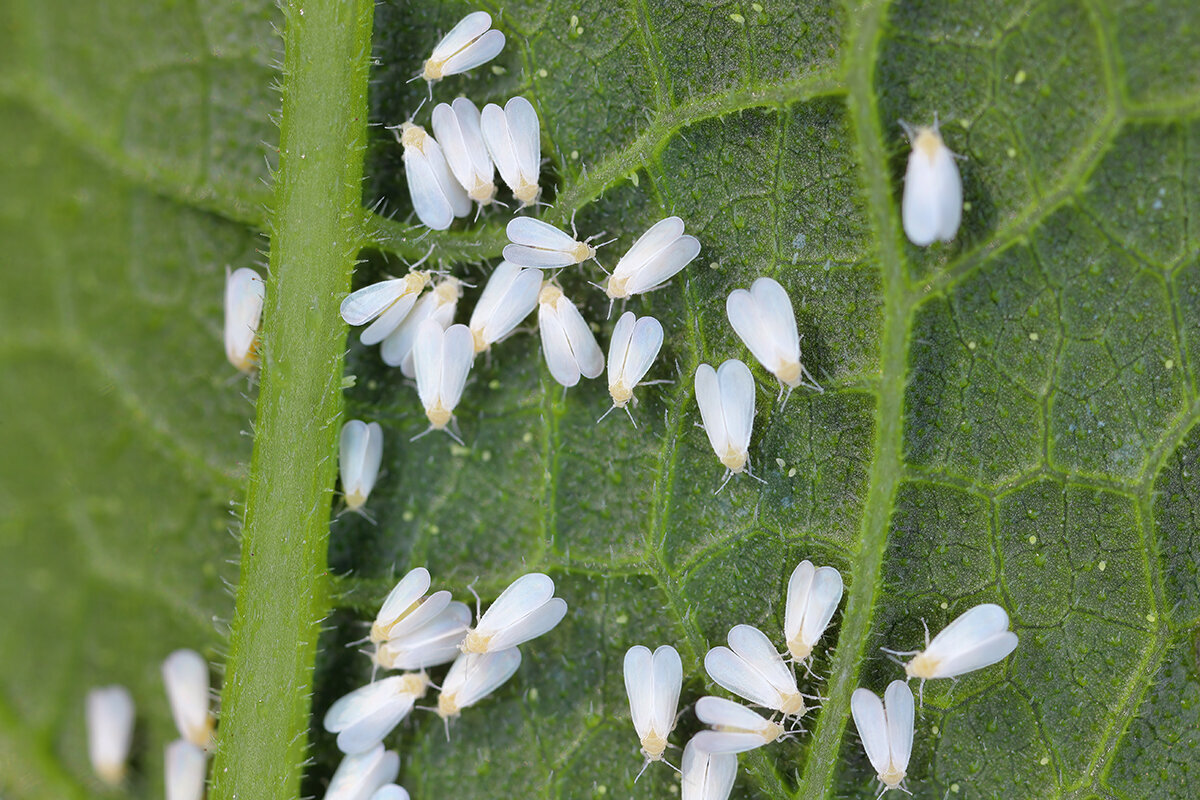
Small white winged insects flutter up when leaves are moved. Their immature stages sit like scales beneath leaves and differ from a mobile aphid colony.
Thrips
Thrips are slender and move quickly. Their feeding often leaves silvery scars and dark droppings rather than sticky honeydew.
Scale insects
Scale insects can also produce honeydew. Adults appear as raised, fixed bumps, not mobile pear-shaped groups on young growth.
Helpful larvae
Ladybird and lacewing larvae hunt aphids. Do not quickly remove an unfamiliar insect among a colony: it may already be working for you.
Chapter 03 / Acceleration
A small colony does not stay small simply because it looks that way today.
Warm, protected conditions and a steady supply of tender plant tissue can speed colony growth. Many common species produce live young without prior mating during much of the growing season. Development speed depends on temperature, light, host plant, species and plant quality. There is no responsible universal calendar, but there are good reasons to act early.
01Arrival
02Feeding colony
03Honeydew
04Spread
Aphids first establish on an accessible plant. Wingless insects feed and reproduce among sheltered leaves and buds. As numbers rise, cast skins and honeydew become easier to see. Crowding, declining plant quality or other changes can produce winged forms that colonise new host plants. Timing depends on conditions. That is why a weekly inspection route is more useful than a fixed date; after a finding, shorten the interval markedly.
Winged aphids may also arrive through open doors and vents or with new plant material. An infested basil pot, young capsicum or flowering ornamental should trigger a check of the entire greenhouse. Heavily distorted or otherwise suspicious plants should be assessed separately rather than propagated, shared or carried through the collection.
Chapter 04 / Inspection map
These greenhouse locations are particularly easy to miss.
Follow the same route every time. Starting at the door and ending with the newest plants lets you read even a small greenhouse systematically: changes stand out rather than only already-obvious damage.
- 1
Newest growth
Check folded leaves, shoot tips and soft stems first. Aphids favour vigorous, unfolding tissue. - 2
Leaf undersides and midribs
Turn leaves over, particularly dense or low foliage that is easily missed during a quick look or treatment. - 3
New plants
Fresh herbs, seedlings, cuttings and overwintered container plants are common entry routes. - 4
Weeds, hanging plants and edges
Weeds and hanging plants can hide colonies outside normal eye level or behind other crops. - 5
Doors and vents
These areas can be entry corridors for winged aphids, so include them in visual inspections.
Yellow sticky cards can indicate winged aphids near doors and vents. They are monitoring tools only, not a way to control a settled colony, and do not replace plant checks. For a workspace with accessible paths and growing zones, explore the Classic aluminium greenhouse.
Chapter 05 / Prevention
Prevent new colonies through exclusion, quarantine and balanced growth.
Insect mesh Fine mesh, unrestricted ventilation.
Quarantine Keep arrivals separate.
Hygiene Remove weeds and plant debris.
Growth Avoid overly soft growth.
Records Note crop, date and finding.
Quarantine need not be complicated. A separate bench, a bright sheltered area or a defined space is enough if a plant can be watched there closely for several days. Check leaf undersides, stems, pot rims and tight young growth. A week without a finding can be encouraging; longer observation is sensible for suspicious symptoms or sensitive crops. If fresh activity remains visible, do not return the plant to the main collection.
Close entry routes without turning the greenhouse into still, overheated space. Fine mesh can reduce incoming winged insects, but it must still allow adequate airflow and dependable temperature management. Roof ventilation, shading and orderly plant spacing create this balance. The guide to aluminium greenhouses is a useful starting point for considering ventilation, glazing and accessories as one growing system.
Weeds matter because they can host aphids unnoticed. Remove them beneath benches, around the base and along the path to the door. Also check decorative and overwintered container plants. Geraniums, citrus or other frost-tender plants moved from sheltered winter positions in spring can carry aphids to vegetable seedlings.
Avoid trying to force every crop with heavy fertiliser applications. Very soft, lush nitrogen-rich growth attracts aphids. Feed according to crop, container size and growth stage, water consistently, and leave enough space to inspect new shoots without breakage or contact with neighbouring leaves.
Chapter 06 / Action sequence
Start with the gentlest action that reliably reaches the colony.
Aphid management is not a contest for the strongest product. Coverage, crop safety and follow-up matter. Escalate only when the previous step does not suit infestation level, plant or practically reachable feeding sites.
01
Isolate and label the source.
Move a portable plant aside if insects will not be brushed onto other plants. Label the crop and date. Do not take cuttings, divide pots or carry the plant through the greenhouse until repeated checks find no live colony.
02
Remove densest infestation centres.
Use clean tools to cut away tightly curled tips, heavily populated buds and inaccessible foliage, then bag the material. Do not leave visibly infested parts exposed on compost beside the greenhouse. On robust plants, a targeted gentle water jet can dislodge exposed aphids. Support leaves and allow the plant to dry with good airflow.
03
Choose beneficials with a plan.
When several plants are affected, beneficial organisms may be more elegant than repeated broad spraying. They must suit the aphid, crop, temperature, day length and infestation level. Consider residues from products used previously.
04
Use approved contact products only on reachable colonies.
Contact soaps or oil products can help only when they actually hit exposed aphids. Colonies inside curled leaves or deep bud folds are easily spared. Use only products approved in New Zealand for the target pest, specific crop, greenhouse use and user category. Read the full label and do not treat heat- or drought-stressed plants.
Practice note / Biological control
Beneficial enemies need suitable conditions, not merely good intentions.
Ladybirds, lacewings, aphid midges and parasitoid wasps can help suppress aphids. The dependable greenhouse choice depends on crop and aphid species, infestation size and age, and the temperature, light and other environmental conditions you can actually maintain.
Predators eat aphids; parasitoids develop in or on them and often leave rounded, discoloured aphid mummies. Do not automatically remove every unusual-looking insect. A papery mummy can show that a released parasitoid wasp is already active.
Chapter 07 / Direct treatment
For soaps, oils and conventional products, the label sets the boundary.
Contact soaps and oils
These products may be a next step in a home greenhouse if their current New Zealand approval covers the crop, greenhouse use and user category. Their key limitation is that they must reach the insect directly. Turn leaves and gently open foliage only as the directions allow. Visible aphids after treatment do not necessarily mean a new arrival; sheltered insects or missed colony sections may have remained out of reach.
Plant tolerance is crop-specific
Even a product intended for aphids can damage sensitive varieties or stressed plants. Heat, strong sun, drought stress and delicate seedlings can affect tolerance. Follow every label direction, including any test-application advice, withholding periods and mixing restrictions. Never combine products on your own simply because each is familiar.
Systemic and conventional products
Some products move through plant tissue or have longer activity. That can matter in certain professionally managed situations, but has consequences for edible crops, flowers, pollinators, beneficials, harvest and re-entry. Approval for outdoor ornamentals does not automatically cover tomatoes, capsicums, herbs or leafy vegetables in a greenhouse.
Current New Zealand controls govern use
Check current EPA controls, MPI agricultural-compound requirements and the complete product label, not only the sales description. Confirm the product, crop or crop group, greenhouse use, target pest, application method, withholding periods, protective measures, maximum rates and user category. If a crop or use is absent, do not assume it is permitted.
Do not spray to a calendar. No universal concentration, product or spray interval is safe for every greenhouse crop and aphid species. Follow the directions for the selected approved product exactly. Observe requirements on repeat applications, withholding periods, beneficial protection and resistance management. If building biological control, ask the beneficial supplier or a plant-protection adviser about compatibility before every treatment.
Chapter 08 / Recovery
Reach is only half the work. Reinspection closes the case.
Contact products, water jets and pruning reduce insects reachable on that day. They do not prove every leaf fold and neighbouring plant is clear. Make the return inspection a fixed part of the action. This checking rhythm complements binding label directions and crop-specific advice; it does not replace either.
| Timing | Area | Record | Decision |
|---|---|---|---|
| Day 0 | Source and neighbours | Live aphids | Isolate |
| Day 2–3 | Young growth | New activity | Reach gaps |
| Day 7 | Neighbouring crop | Development | Reassess |
| Weekly | Hotspots | Recurring source | Note |
Day 0
Check the infestation source, immediate neighbours, doors, benches and areas beneath them. Record live aphids, skins, honeydew, winged forms, pruning and actions used. Clean tools after contact with the infested plant.
Day 2–3
Return to the newest growth and hidden leaf undersides. Distinguish live moving aphids from old skins, and note whether a water jet, pruning or treatment missed folded tissue.
Day 7
Check the original plant and the next row or bench zone. Look for fresh honeydew, distortion, winged insects on monitoring traps and, under biological control, aphid mummies.
Following weeks
Continue the weekly route through known hotspots and new arrivals. Rising numbers often point to missed weeds, an inaccessible crop area or a newly introduced host plant.
Remove honeydew only after checking the colony.
Wipe benches, pots, greenhouse surfaces near crops and other hard surfaces with a mild method suited to the material, then rinse with clean water where appropriate. Gentle washing can remove sticky residue from sturdy leaves and improve light entry. Do not rub tender foliage sore. Sooty mould can recede once new honeydew stops. The aim is functioning leaves and clearly inspectable surfaces, not cosmetic perfection overnight.
Support damaged plants with steady care rather than corrective overfeeding. Remove only dead, badly distorted or uncontrollable tissue. Appropriate watering, good airflow and sensible spacing let new growth show whether the plant is recovering normally.
New Zealand FAQ
Important questions after finding the first aphid colony.
Can I use soap products on greenhouse vegetables?
Only when the specific product is approved in New Zealand for the target pest, your edible crop, greenhouse use and user category. Check the crop list, directions, withholding period and every precaution. Approval only for ornamental plants is not enough.
Will aphids die if I spray them with water?
A targeted gentle water jet can remove many exposed aphids from robust plants and can suit small colonies. Insects in tightly rolled leaves, buds or dense foliage are not reached reliably. Check the plant again soon afterwards.
Do ants cause aphid infestations?
No. Ants are attracted to honeydew and can protect honeydew-producing insects, making control harder. Treat the aphid colony and limit ant access where possible rather than treating ants as the sole cause.
Why are aphids present again after treatment?
Sheltered insects may have been missed, a neighbouring host plant may have remained untreated, or aphids may have returned with a new plant, via weeds or through an opening. Check the surroundings and trace the likely route before automatically choosing a stronger product.
Can ladybirds solve a severe aphid infestation alone?
They can contribute, but a large infestation can exceed the effect of one release. Correct identification, mechanical reduction of dense centres, expert supplier advice, suitable climate conditions and compatibility with earlier plant-protection products determine whether biological control works.
Must an infested plant be discarded?
Not always. A small colony on a valuable, accessible plant can often be isolated and controlled. Disposal may be sensible if the plant is heavily infested, substantially distorted or difficult to treat without spreading aphids. Suspected virus problems also need a separate assessment.
Sources and further guidance
Keep reliable New Zealand guidance and clearly attributed overseas references close at hand.
More from Bloomcabin: Setting up a greenhouse · Protecting greenhouses from weather and pests · Greenhouses and conservatories
- Environmental Protection Authority,Gardening safely.
- German Environment Agency,Gardening with beneficial organisms.
- Germany’s North Rhine-Westphalia Chamber of Agriculture,Biological control of aphids.
- Germany’s North Rhine-Westphalia Chamber of Agriculture,Aphids on ornamental and indoor plants.
- Julius Kühn Institute,Beneficial-organism information – general principles.
- German Federal Office of Consumer Protection and Food Safety,Online database of authorised plant-protection products.
- German Federal Office of Consumer Protection and Food Safety,Plant-protection products for home and allotment gardens.
Final finding
Close the case before the colony writes its next chapter.
Aphids need attention, not reflexively maximum force. Find live insects, remove or isolate the simplest source, keep gentler options open, and make follow-up checks a regular greenhouse ritual.
Three decisive steps
- Check the newest growth.
- Isolate the source.
- Put follow-up checks in the growing calendar.
Build this routine around a greenhouse that supports calm access, effective ventilation and long-term cultivation.
Classic aluminium greenhouse